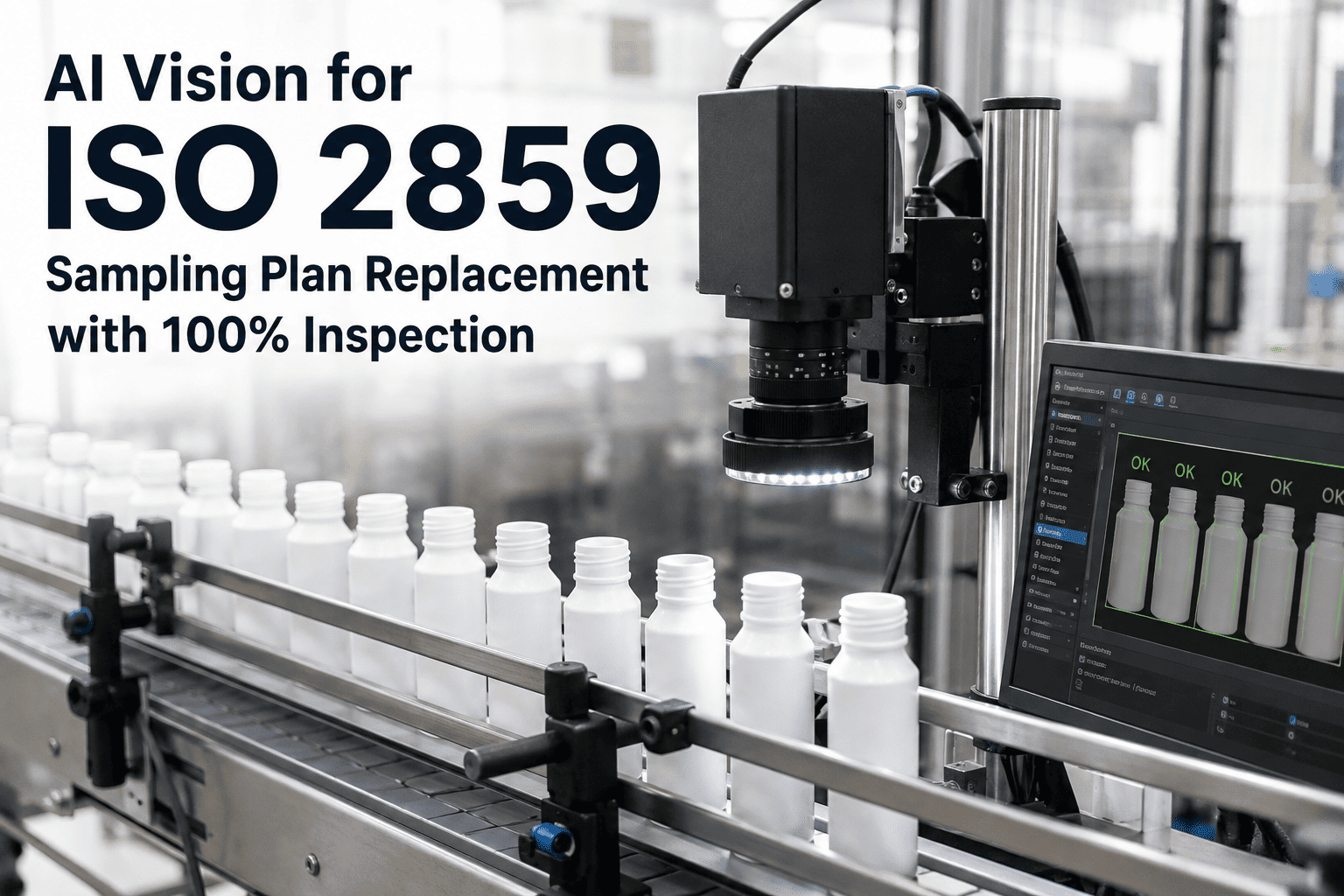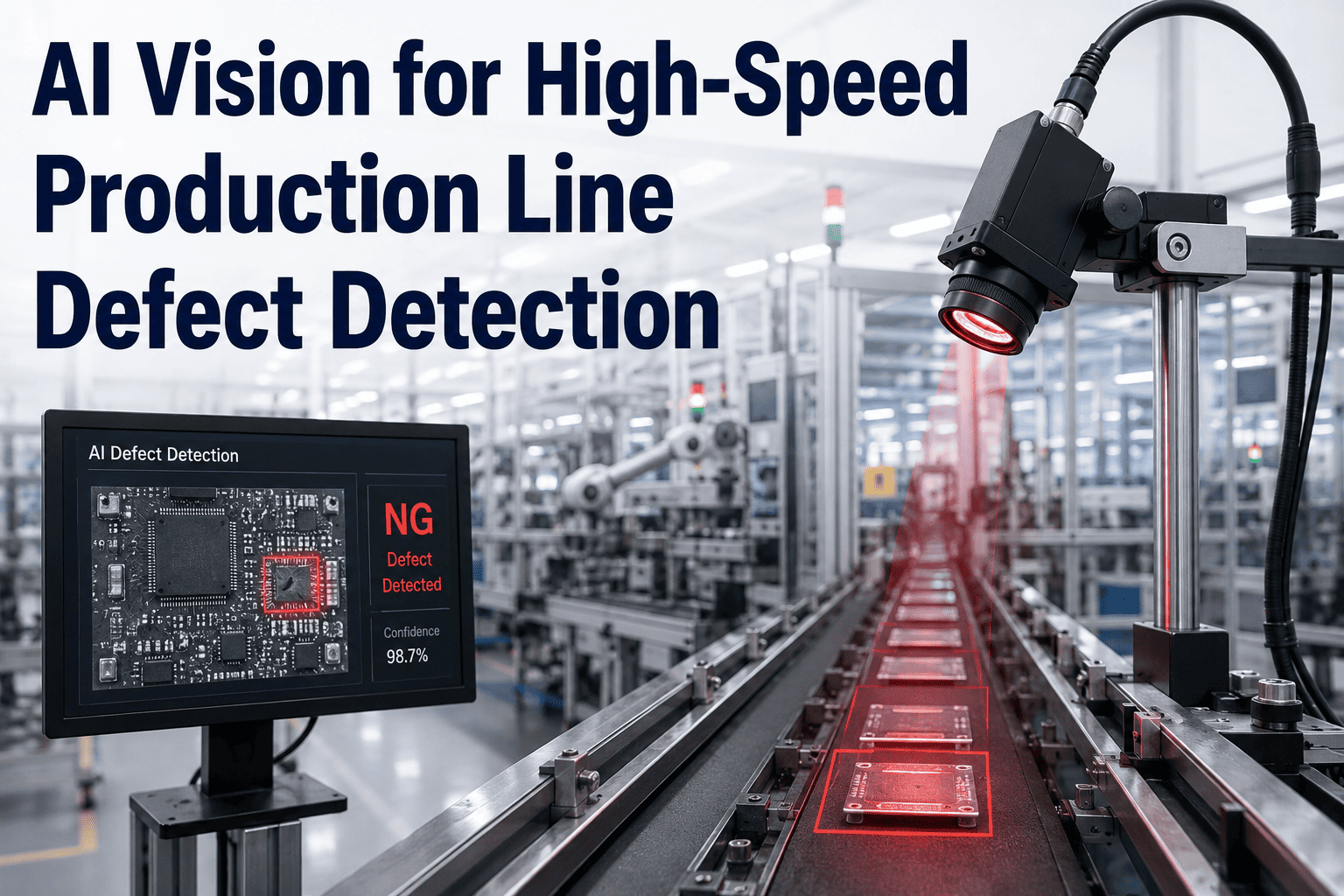
A batch of 10,000 units ships after passing AQL 2.5 sampling inspection, and three weeks later a customer complaint traces back to a defect that never showed up in the sample — because the sample was never designed to catch every defect, only to make a statistically reasonable call about the lot as a whole. That gap between "the sample passed" and "the lot is defect-free" is the central limitation of statistical sampling, and it's exactly the gap 100% inline inspection is built to close. The tradeoff is that automated 100% inspection at production speed requires a fundamentally different tool than a manual spot-check, one that can evaluate every part without slowing the line to a human inspector's pace. Manufacturers weighing this tradeoff for a specific line can book a 30-minute demo to see inline AI inspection running at full production throughput.
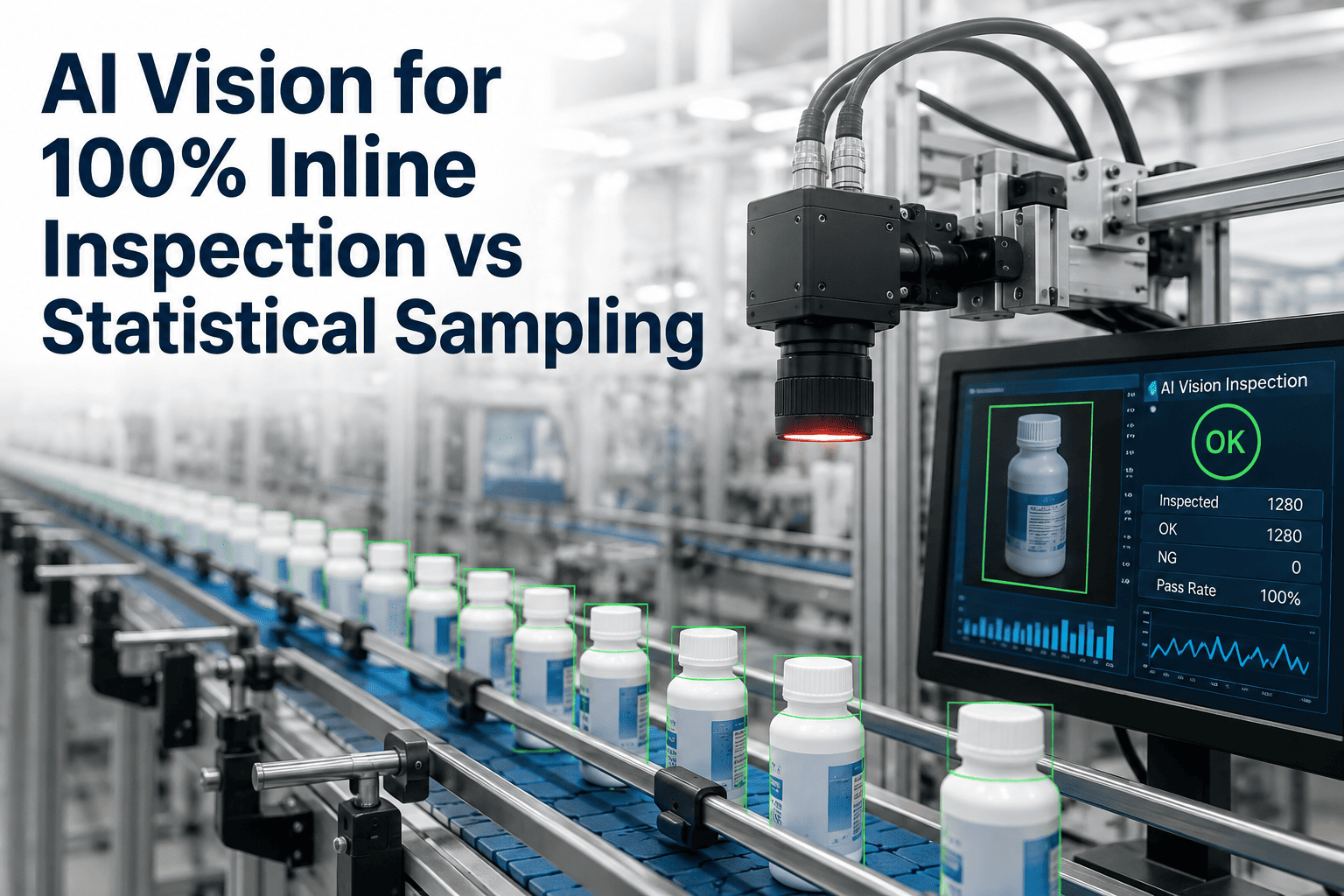
AI Vision for 100% Inline Inspection vs Statistical Sampling
Statistical sampling misses defects between samples by design. AI inspects every single part at production speed, moving quality assurance from AQL-based sampling to genuine 100% inline coverage.
What AQL Sampling Actually Guarantees — and What It Doesn't
Acceptable Quality Level sampling is a statistical framework: inspectors check a representative sample sized according to a standard sampling table, count the defects found, and use that count to decide whether the entire lot passes or fails. Common thresholds run from roughly 0% for critical defects up to 2.5% for major defects and 4.0% for minor defects, depending on the product and its risk profile. The framework is efficient by design — inspecting 80 to 315 units out of a 10,000-unit lot is far cheaper and faster than checking every unit — but that efficiency comes from accepting a defined, non-zero probability that defective units outside the sample ship anyway.
Typical AQL threshold range for critical to major defects across common consumer goods sampling plans.
Typical sample size range inspected out of a lot, rather than checking every unit in it.
Reported real-world catch rate for sustained manual visual inspection, meaning roughly one in five defects can still escape even a full manual check.
The AQL framework is explicit about this limitation: a shipment can pass AQL 2.5 inspection and still contain defects, because only a sample was checked, and the confidence level improves with a larger sample but never reaches full certainty. AQL sampling also does not catch a systemic process problem well — if a process is consistently producing at a 3% defect rate, a single sampling pass might still pass on a day the sample happened to include fewer defective units than the true rate would suggest.
Why Manual 100% Inspection Is Usually the Wrong Answer, Too
The intuitive fix for sampling's blind spots is to just check every unit manually. In practice, this is frequently the most expensive and least reliable option available, not the safest one. Manual full inspection suffers from the same fatigue, monotony, and expectation bias that affects any repetitive visual task — inspectors checking every unit, hour after hour, still miss defects at a meaningful rate, while the line slows to the pace of human visual checking and labor cost rises sharply.
Fast and cost-efficient for stable, in-control processes with non-catastrophic defect cost, but statistically accepts that some defective units in the unsampled portion of the lot will ship.
Checks every unit but is slow, labor-intensive, and still misses a meaningful share of defects due to fatigue and monotony — often the most expensive option with the least reliability gain.
Checks every unit at production line speed without the fatigue-driven miss rate of manual full inspection, making genuine full coverage practical rather than a theoretical ideal.
The Real Decision Isn't Sampling vs 100% — It's Matching the Method to the Risk
Framing this as a single universal choice misses the point. AQL sampling remains a legitimate, cost-effective choice for stable, high-volume processes where an individual defect's cost is low and non-catastrophic. Automated 100% inspection earns its cost where a defect's consequence is high — safety-critical components, regulated products, or high-value items where a single escaped defect carries outsized downstream cost. Manual 100% inspection is rarely the right long-term answer in either case; when it feels necessary, it's often a signal that the underlying process needs fixing, not that inspection needs to work harder.
| Scenario | Recommended Approach |
|---|---|
| Stable process, low-cost non-critical defects, high volume | AQL sampling remains appropriate and cost-effective |
| Safety-critical or regulated components | 100% inspection, automated wherever line speed makes manual checking impractical |
| Unstable or drifting process | Fix the process first — sampling assumes a homogeneous lot, which an out-of-control process violates |
| High-value or brand-sensitive product | 100% inspection justified by the cost of a single defect reaching a customer |
| New product introduction or process change | Temporary 100% coverage while the process stabilizes, stepping down to sampling once stable |
How Automated Inline Inspection Achieves 100% Coverage Without Slowing the Line
The core constraint that has historically made 100% inspection impractical is speed — a human inspector simply cannot evaluate every unit on a line running at production tact time without becoming the bottleneck. AI vision systems built for inline deployment are designed around that constraint from the start: image capture, defect scoring, and pass/fail routing happen within the existing cycle time rather than requiring the line to slow down for inspection.
Every unit is imaged in-line as it passes the inspection point — no diversion, no manual handling, no sampling selection step.
The model scores each unit against trained defect criteria within the available cycle time budget.
Pass, fail, and rework routing decisions are made automatically and fed to the line controller in real time.
Every result — not just the sampled subset — is logged, giving full lot traceability instead of a sample-based estimate.
The Data Advantage: What Full-Coverage Inspection Adds Beyond Pass/Fail
Sampling produces a pass/fail decision on a lot and, at best, an estimate of the defect rate within it. Full inline inspection produces a defect record on every single unit, which opens up a level of process visibility sampling structurally cannot provide — trends by shift, by machine, by raw material lot, or by time of day become visible instead of inferred from a small sample.
What AQL sampling can tell you: whether a lot as a whole meets an acceptable defect threshold, based on a sample.
What 100% inline inspection can tell you: the specific defect status of every single unit, traceable back to its exact production conditions.
What full-coverage data enables that sampling can't: real-time detection of a defect rate creeping upward before it crosses any sampling threshold at all.
Migrating From Sampling to Inline Without Disrupting Production
Plants moving from an AQL-based program to inline inspection rarely do it in a single cutover, since replacing an established quality gate carries its own risk if the new system isn't validated first. A staged approach lets the plant build confidence in the automated system's accuracy before it becomes the sole basis for shipping decisions.
Inline inspection runs alongside the existing AQL sampling program, with results compared but not yet acted upon, to validate model accuracy against known outcomes.
Inline inspection catches and flags defects between sampling checks, giving the quality team an early signal before AQL sampling would have caught a drifting process.
Inline inspection becomes the primary shipping gate once accuracy is validated, with sampling retained only as an audit check rather than the sole quality decision.
Where Sampling Still Belongs Even With Inline Inspection in Place
Moving to inline inspection doesn't necessarily eliminate every use for sampling. Incoming raw material checks, supplier audits, and destructive testing that can't be performed on every unit still rely on statistical sampling logic, because some checks are inherently incompatible with 100% coverage. The distinction worth holding onto is that sampling remains the right tool where full coverage is either impossible — as with destructive tests — or genuinely unnecessary because the defect cost profile doesn't justify full automated coverage.
The right inspection strategy matches coverage level to defect consequence, not habit.
Sampling, manual full inspection, and automated inline inspection each solve a different part of the quality problem. iFactory's inline AI layer is built to make full-coverage inspection practical at production speed, so that decision is based on risk and economics rather than what a manual check can physically keep up with.
Defect Severity Categories: Why Not All Misses Carry Equal Weight
AQL frameworks and inline inspection systems alike typically separate defects into severity tiers, because a cosmetic blemish and a structural flaw don't warrant the same response even if both are technically "defects." Getting this categorization right matters as much for an inline AI system's rule set as it does for a manual sampling plan — a system tuned to flag every minor variation at the same priority as a critical defect will generate so many false alarms that operators start ignoring its output entirely.
A defect that could cause harm or safety risk to the end user — typically held to a 0% acceptance threshold regardless of inspection method.
A defect affecting product usability or function, commonly held to a low acceptance threshold such as 1.0–2.5% under AQL frameworks.
A cosmetic or low-impact defect with a comparatively higher acceptance threshold, often 2.5–4.0% under common consumer goods sampling plans.
Average Outgoing Quality: The Number Sampling Plans Are Actually Optimizing
Average Outgoing Quality Level (AOQL) describes the worst-case average defect rate a sampling plan will let through across many lots, accounting for the fact that lots failing inspection typically get rectified or fully sorted while passing lots ship with only the sample checked. This is a more honest measure of a sampling plan's real-world performance than the pass/fail decision on any single lot, because it captures what happens systematically over time rather than treating each lot in isolation. A sampling plan's AOQL tends to peak at a specific incoming defect rate and decline on either side of that peak — meaning a sampling plan can actually perform worst not at the highest defect rates, where more lots get caught and fully sorted, but at a middling defect rate where enough defective lots slip through as "passing" to drag the average down.
This is a subtle point worth internalizing: a sampling plan isn't uniformly worse as incoming quality gets worse — its weak point is a specific defect rate range where just enough bad units hide in the accepted lots. Full inline inspection sidesteps this dynamic entirely, since there's no "accepted lot with an unchecked remainder" — every unit gets its own pass/fail determination regardless of what the surrounding lot's defect rate happens to be.
Frequently Asked Questions
Does moving to 100% inline inspection mean AQL sampling becomes irrelevant?
Not entirely — AQL sampling still has a role for checks that are inherently incompatible with full coverage, such as destructive testing or certain incoming material audits, and it remains a reasonable choice for low-risk, stable processes where the cost of a defect is genuinely low. What changes with inline inspection in place is that sampling is no longer the only line of defense against defects reaching a customer; it becomes one tool among several rather than the primary quality gate for the whole process. Book a demo to discuss where sampling still fits alongside an inline inspection program.
Can AI-based inline inspection actually keep up with high-speed production lines?
Whether a specific inspection setup can keep pace depends on the line's cycle time, part complexity, and the processing hardware behind the vision system, so this is a question worth testing against a real line rather than assuming from a general capability claim. The core design goal of an inline system is evaluating every unit within the existing cycle time budget rather than requiring the line to slow down, and that goal is achievable on a wide range of production speeds when the camera, lighting, and processing pipeline are properly specified for the application. Contact iFactory Support to review throughput requirements for a specific line.
Is 100% inspection always better than sampling from a pure quality standpoint?
From a pure defect-detection standpoint, checking every unit will always catch more defects than checking a sample of the same units, assuming equal detection accuracy per unit — that part is mathematically straightforward. The real question is whether the marginal defects caught justify the marginal cost of full coverage, which depends heavily on defect consequence and current process stability. For a stable process making low-risk products, the marginal benefit of full coverage may not justify the cost; for safety-critical or regulated products, it usually does.
What happens to the AQL-based contracts or customer agreements already in place?
Moving to inline inspection internally doesn't automatically change contractual AQL commitments made to customers, and many manufacturers continue reporting against agreed AQL terms even while gaining the additional visibility of full-coverage internal inspection data. Renegotiating quality terms with a customer based on improved internal inspection capability is a commercial conversation separate from the technical inspection upgrade itself, and typically follows once the new system has a track record.
How long does it typically take to validate an inline system before trusting it as the primary quality gate?
There's no universal timeline, since it depends on production volume, defect rate, and how many distinct defect types the system needs to demonstrate reliable coverage against — a low-volume line with rare defects naturally needs a longer parallel-run period to accumulate enough validation data than a high-volume line does. Most plants define a specific agreement threshold with existing inspection methods and a minimum sample of validated cycles before shifting decision authority, rather than picking an arbitrary calendar date. Book a demo to discuss a validation plan suited to a specific line's volume and defect profile.
See full-coverage inspection running at your line's actual production speed.
A 30-minute session walks through inline defect detection, unit-level traceability, and how a staged rollout from sampling to full coverage typically works.