ISO 2859 was never designed to catch every defect. It was designed to make catching every defect statistically unnecessary, back when inspecting every unit meant paying a person to look at every unit, one at a time, for hours. An AQL of 1.0 percent, one of the most common levels in the standard, means the sampling plan is built to accept lots where up to 1 in 100 units is defective, and it will still pass most of those lots even if the true defect rate runs somewhat higher, because sampling only ever sees a fraction of the lot. That math made sense when 100 percent inspection was the expensive option. AI vision has quietly flipped which option is actually expensive, and iFactory built the inspection layer for the side of that trade that now wins.
Your Sampling Plan Was Built To Accept Defects. That Was The Whole Point.
ISO 2859 sampling was a statistical compromise for an era when inspecting every unit was too expensive. AI vision inspection now costs less than the risk sampling was built to accept, which means the compromise itself is now optional.
What An AQL Actually Promises You, In Plain Terms
An Acceptance Quality Limit is not a target, it's a tolerance. ISO 2859-1 defines it as the worst quality level that's still considered acceptable as a process average over a continuing series of lots. Set an AQL of 1.0 percent and the sampling plan isn't aiming for zero defects, it's calibrated to routinely pass lots sitting right around that 1 percent defect rate, and to still pass a meaningful share of lots running somewhat worse than that, because a sample is a sample, not a census.
Lot Size Sets The Sample
ISO 2859 Table A maps lot size and inspection level to a code letter, which determines how many units actually get inspected out of the full lot.
Sample Sets The Threshold
Table B takes that code letter and returns the sample size along with the accept and reject numbers, the actual count of defects that triggers a lot rejection.
Threshold Sets The Risk
Everything outside the sample never gets looked at, meaning any defect in the uninspected majority of the lot ships by default, not by exception.
None of this is a flaw in the standard, it's the standard working exactly as designed. ISO 2859 exists to let a producer and a buyer agree on a defensible, repeatable statistical process instead of relying on ad hoc spot checks, which the standard itself explicitly discourages because ad hoc sampling creates unknown risk with no formal basis for accepting or rejecting a lot. The problem isn't the statistics, it's that the statistics were built to solve a cost problem that AI vision inspection has since made mostly moot.
Sampling Was A Trade-Off Between Two Costs, Not A Quality Preference
Every sampling plan is really a bet on which is cheaper: inspecting everything, or accepting the statistical risk of shipping some fraction of defects. For most of manufacturing's history, that bet was easy. A human inspector checking every unit on a high-volume line was slow, expensive, and prone to fatigue-driven misses even when fully staffed, so accepting a small, quantified defect risk was the economically rational choice, and ISO 2859 gave that choice a rigorous statistical foundation instead of leaving it to guesswork.
The Old Trade-Off
100% manual inspection was slow and costly enough that sampling a fraction of the lot and accepting a defined statistical risk was the economically rational choice, even knowing some defective units would ship.
The Trade-Off Now
AI vision inspects every unit at production line speed for a cost that can sit below what the sampling plan's accepted defect risk costs once those defects reach a customer.
The Question Isn't Whether Sampling Is Statistically Sound. It's Whether It's Still The Cheaper Option.
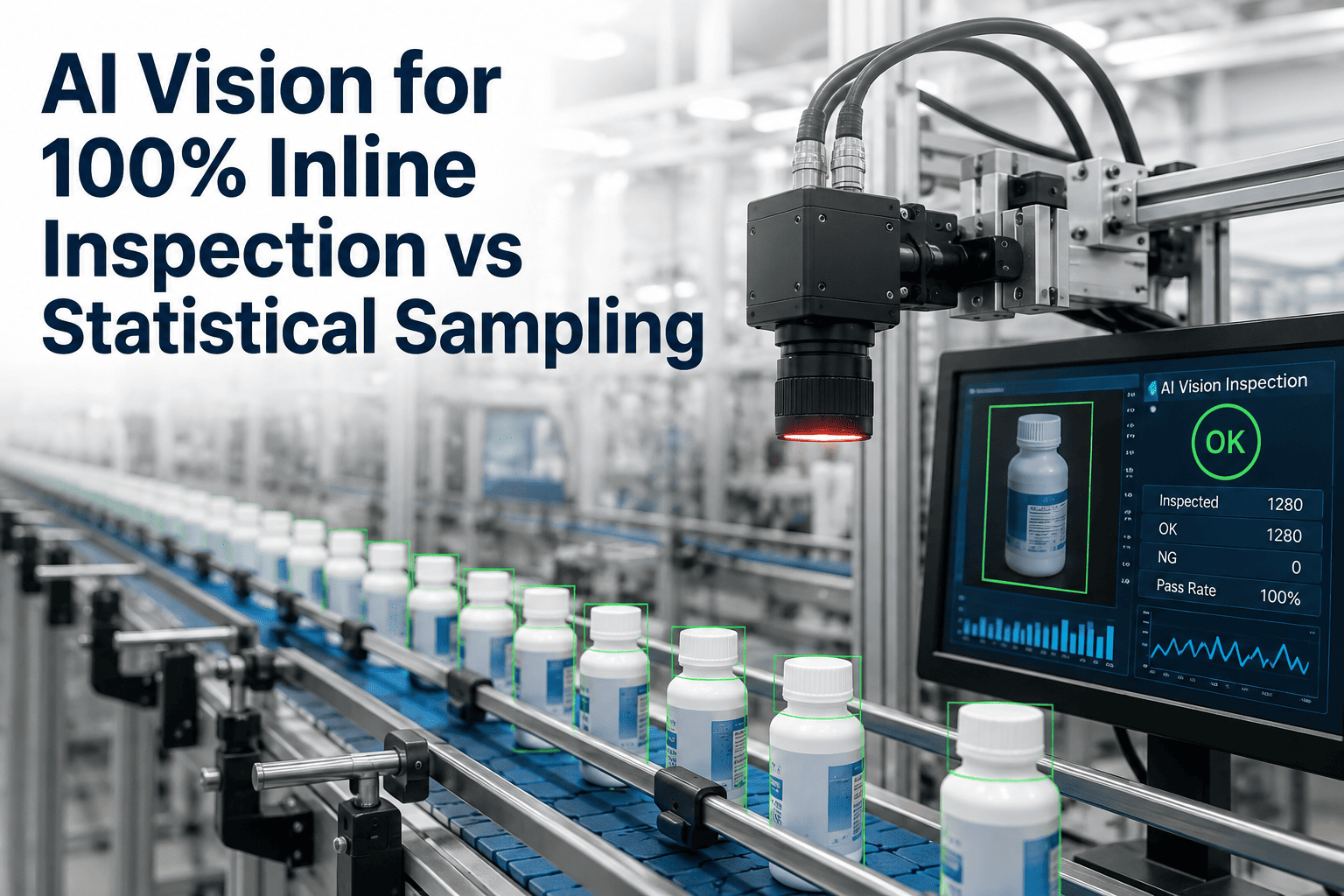
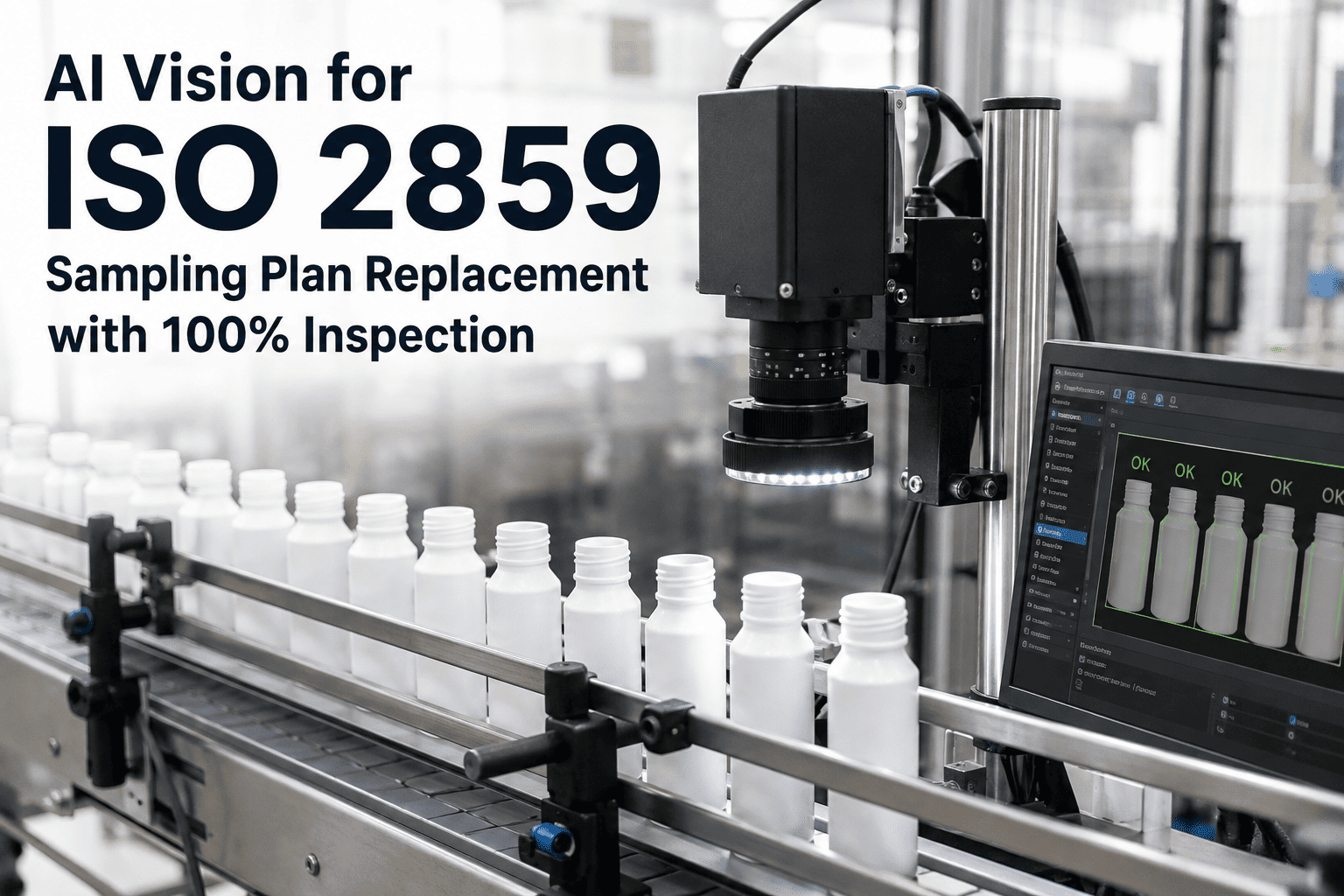
iFactory's AI vision cameras inspect 100 percent of production at line speed, replacing the accepted-risk math of AQL sampling with an actual, continuous count of every defect in every unit.
A Defect Never Gets Cheaper To Fix, It Only Gets More Expensive The Later It's Found
The 1-10-100 rule is one of the oldest principles in quality management, and it's the exact reason sampling risk deserves fresh scrutiny now. A defect caught at the point of production costs roughly one unit to resolve. The same defect caught later inside your own process, during assembly or a downstream station, costs roughly ten times that. Let it escape all the way to the customer, and the cost climbs to roughly a hundred times the original, once you count returns, warranty claims, corrective action investigations, and the reputational cost that never shows up on an invoice. In regulated industries like aerospace and pharmaceuticals, that final multiplier can run into the thousands once regulatory penalties and recall logistics are included.
Sampling inspection sits at exactly the wrong end of this curve for the units it doesn't check. Every defect outside the sample skips the 1x and 10x stages entirely and heads straight toward the 100x outcome by default, because nobody looked at it before it shipped. That's not a criticism of the people running the sampling program, it's simply what a sample is: a bet that the uninspected majority of the lot looks statistically like the inspected fraction, which is true on average and false for any specific defective unit that happens to fall outside the sample.
Same Production Line, Two Very Different Coverage Guarantees
| Dimension | ISO 2859 Sampling Inspection | AI Vision 100% Inspection |
|---|---|---|
| Units Actually Checked | A statistically determined fraction of each lot | Every unit, every time, at line speed |
| Defect In Unsampled Portion | Ships by default, never inspected | Detected regardless of position in the lot |
| Inspector Fatigue Effect | Accuracy degrades over long shifts | Consistent detection threshold, shift after shift |
| Cost Basis | Labor cost per unit sampled, scales with headcount | Fixed camera and compute cost, scales with throughput |
| Defect Data Produced | A pass or fail decision on the sampled lot | A defect record for every unit, sampled or not |
Not Every Line Needs To Move Off Sampling On The Same Day
Moving away from AQL sampling isn't an all-or-nothing decision, and it isn't purely a technology question either, it's a cost comparison specific to your product, your defect rate, and what a quality escape actually costs you downstream. The crossover point, where 100 percent AI inspection costs less than the statistical risk your current AQL is built to accept, arrives faster on some lines than others.
High Consequence Per Escape
Products where a single defective unit reaching a customer triggers a disproportionate cost, safety-critical components, regulated goods, or high-value assemblies, cross the economic threshold fastest.
High Volume, Repetitive Geometry
Lines producing large volumes of visually consistent parts are the easiest and fastest to model for AI vision, since the defect patterns being trained for repeat predictably.
Tightening Customer AQLs
When a buyer moves you to a lower AQL to reduce their own accepted risk, your required sample size grows, often making 100% inspection cost-competitive well before it would on a looser AQL.
Recurring Escape History
A line with a track record of defects that slipped through sampling and reached a customer has already paid the 100x cost once, which is usually the fastest way to justify the switch.
From Sampling Plan To Full Coverage Without Stopping The Line
Current AQL And Defect History Are Reviewed
Your existing sampling plan, AQL level, and historical escape data establish the baseline the AI system needs to beat, not a generic industry benchmark.
Cameras Are Installed Alongside Existing Sampling
AI vision runs in parallel with the current sampling process first, so results are validated against real production before sampling is reduced or removed.
Defect Detection Accuracy Is Confirmed Against The Line
The model's detection rate is validated against known defect types from your own product, not a generic training set, before it takes on inspection responsibility.
Coverage Shifts From Sample To Full Lot
Once validated, inspection coverage moves from the statistical sample to every unit, with the AQL-based sampling plan retired or kept only as a fallback audit layer.
Every Unit's Result Is Logged Continuously
Instead of a lot-level accept or reject decision, every individual unit now has its own defect record, giving far more granular data than a sampling plan ever produced.
Manufacturing Is Moving Past Sampling Wherever The Economics Allow It
Quality assurance and inspection is already the single largest application segment inside the broader machine vision market, and the shift underway isn't really about adopting new technology for its own sake, it's about a cost curve that has quietly inverted. Sampling inspection made economic sense as long as full coverage was the expensive option. AI vision systems now inspect at production line speed for a cost per unit that, on many lines, sits below the statistical risk a sampling plan is explicitly built to accept, which changes the calculation from a quality preference into a straightforward cost comparison.
This doesn't make ISO 2859 obsolete as a standard, sampling still has a place wherever inspection genuinely is destructive, prohibitively slow, or simply not automatable for a given product. What's changed is that sampling is no longer the automatic default it once was for high-volume, visually inspectable production, and more manufacturers are running the actual math per line rather than assuming the historical trade-off still holds.
It's also worth being precise about what "replacing" sampling actually means in practice, since the goal isn't to argue statistics away. ISO 2859 remains a sound method for the situations it was built for, small-lot or destructive-testing scenarios where full inspection genuinely isn't feasible. The argument here is narrower and more practical: for high-volume, visually inspectable production, the assumption that sampling is automatically the economical choice deserves to be checked against current inspection costs rather than carried forward unexamined from an era when full coverage wasn't realistic at any price.
Common Questions From Quality Managers Weighing The Switch
Stop Betting On The Fraction Of The Lot You Didn't Inspect
iFactory's AI vision cameras replace AQL sampling risk with 100 percent inspection coverage at production line speed. Book a demo and see the actual cost comparison run against your own line.