Most AI vision inspection RFPs get answered by every vendor on the shortlist, and every response looks impressive. That's the problem. A generic manufacturing RFP written around feature checklists — resolution, frame rate, defect classes — flatters a legacy rule-based system the same way it flatters a genuine deep-learning platform, and it lets a software-only vendor duck the lighting-and-optics questions that actually determine whether the system will hold accuracy on a real line. The result is a six-month evaluation cycle that ends in a pilot no one is confident in, and a deployment that misses on the exact defects the buyer thought they were procuring against. A properly weighted scoring matrix, built specifically for AI vision, is what separates responses that talk from responses that hold up on the floor — and it's exactly what the AI vision inspection platform team at iFactory helps buyers build before a single vendor gets contacted.
AI Vision · Procurement · Vendor Evaluation
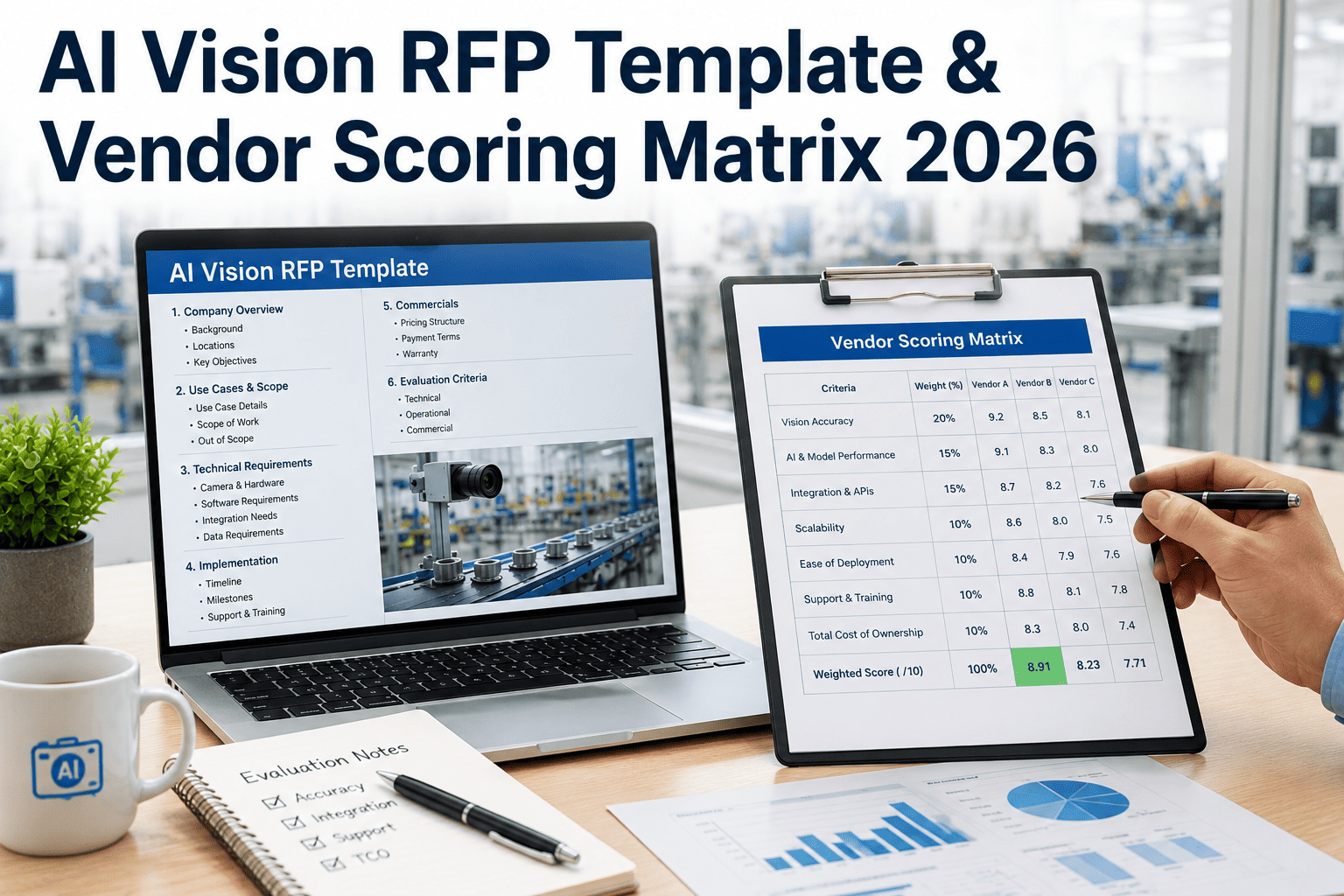
AI Vision RFP Template & Vendor Scoring Matrix 2026
Generic equipment RFPs don't stress-test AI vision the way they need to. This page walks through the eight sections an AI vision RFP has to contain, a weighted scoring matrix with the criteria that actually predict production success, a sample vendor scorecard you can adapt, and the pilot acceptance clauses that keep a shortlist honest — everything you need to run an evaluation that lands on the right partner instead of the loudest one.
8 Sections
Mandatory RFP structure for AI vision
7 Criteria
Weighted scoring matrix ready to adapt
Pilot-Ready
Written acceptance clauses included
Why This Page Exists
Why a Generic Manufacturing RFP Fails for AI Vision
Feature checklists reward the wrong vendors
Resolution, frame rate, and defect-class counts are easy for a legacy rule-based system to match on paper. Whether the model actually generalizes across lighting, SKU changeovers, and rare defects is a different question the checklist never asks.
Demos are always cherry-picked
Every vendor will show you a demo where their system catches every defect on a curated sample video. Without a pilot bound by written acceptance criteria on your own messy parts, the demo tells you nothing about production behavior.
Total cost of ownership hides in the wrong column
Software-only pricing looks cheaper until you add the cameras, lighting, edge compute, integration labor, and ongoing labeling costs the buyer ends up owning. TCO belongs on the scorecard with real weight, not as a footnote.
Rare-defect timelines get glossed over
If a defect occurs fewer than ten times per ten thousand cycles, waiting for real data before training is not a viable plan. Sample-efficient learning and synthetic defect generation are non-negotiable criteria — not optional features.
The Structure
The 8 Sections Every AI Vision RFP Needs
01
Executive Summary & Project Background
Business objective in one paragraph, current inspection state, target line and product mix, and the specific decision this procurement will support. Vendors read this first to decide how seriously to respond.
02
Detailed Scope & Deliverables
Number of lines, parts per minute, defect classes with sample counts, environment (lighting, dust, temperature), and what "done" looks like at each phase — pilot, hand-off, and steady-state operations.
03
Technical Requirements
Cameras and lighting architecture, edge or on-prem compute, model architecture (deep-learning segmentation vs rule-based), explainability (Grad-CAM or equivalent), PLC/SCADA/MES protocols supported, and drift-monitoring approach.
04
Data Requirements & Rare-Defect Strategy
Minimum image volume per defect class, labeling responsibility, synthetic data generation capability, cold-start plan for defects with fewer than ten historical samples, and ownership of the labeled dataset once training completes.
05
Commercial Terms & Line-Item Pricing
Hardware, software licenses, integration labor, training, first-year support, retraining/labeling costs, and out-year renewals — each broken out separately. Bundled all-in numbers hide the levers that actually shift TCO.
06
SLA, Support & Uptime Commitments
Response times by severity, spare-parts guarantees, remote monitoring scope, retraining cadence, and what happens when a new SKU launches and the model needs updating within the production schedule.
07
Implementation Plan & Timeline
Week-by-week plan from PO to go-live with named milestones, dependencies on the buyer's side, and a pilot phase with written acceptance criteria before full deployment moves forward.
08
Vendor Qualifications & Evaluation Criteria
Minimum three production references in the same industry, the weighted scoring matrix you'll actually use, the submission format, and the timeline for the entire evaluation from RFP release through award.
The Centerpiece
Weighted Scoring Matrix — What to Ask and What Each Answer Is Worth
| Criterion | Weight | What to Ask | Red Flag Answer |
| Technical Fit & Accuracy |
30% |
Demonstrated accuracy on our sample set, including rare defects and borderline parts |
Only lab benchmarks or clean sample videos, no willingness to test our parts |
| Total Cost of Ownership |
20% |
Line-item pricing across hardware, software, integration, retraining, and Year 2–3 renewals |
Single blended number with integration and labeling costs bundled out of view |
| Integration & Deployment |
15% |
Supported PLC/SCADA/MES protocols, custom-code vs no-code integration, time to first inspection |
Proprietary middleware only, undefined integration labor, vague go-live date |
| Explainability & Operator Trust |
10% |
Saliency heatmap per decision, operator override capture, audit trail retrievable by part ID |
Confidence score only, no visual evidence, no override-to-retraining pipeline |
| SLA & Support |
10% |
Response times by severity, remote monitoring, retraining cadence, new-SKU turnaround |
Best-effort language, no defined severity tiers, retraining priced separately every time |
| References & Deployment Depth |
10% |
Minimum three production deployments in our industry we can call directly |
Marketing case studies only, no direct references, or references from pilots that never went live |
| Innovation & Roadmap |
5% |
Published product roadmap, retraining automation, model-drift detection built in |
No shared roadmap, manual retraining only, no drift-monitoring story |
Weights are a starting point — a high-mix line running dozens of SKUs may want to lift Integration to 20% and drop References to 5%. What matters is that the weights are published in the RFP itself so vendors can address what actually decides the award.
Adapt This Matrix to Your Line
Get a 30-Minute Working Session on Your AI Vision RFP
Bring your current RFP draft or evaluation criteria. We'll walk through the weighted matrix live, flag the sections that read too generic for AI vision, and hand you a version tuned to your part mix and defect profile.
What a Filled-In Scorecard Looks Like
Sample Vendor Scorecard — Three Shortlisted Vision Vendors
| Criterion (Weight) | Vendor A | Vendor B | Vendor C |
| Technical Fit (30%) |
4 / 5 |
5 / 5 |
3 / 5 |
| TCO (20%) |
3 / 5 |
4 / 5 |
5 / 5 |
| Integration (15%) |
4 / 5 |
5 / 5 |
2 / 5 |
| Explainability (10%) |
2 / 5 |
5 / 5 |
2 / 5 |
| SLA (10%) |
4 / 5 |
4 / 5 |
3 / 5 |
| References (10%) |
3 / 5 |
5 / 5 |
4 / 5 |
| Innovation (5%) |
3 / 5 |
4 / 5 |
3 / 5 |
| Weighted Total |
3.45 |
4.70 |
3.30 |
Notice Vendor C had the lowest sticker price and the highest TCO score, but the missing explainability and weak integration story dragged the weighted total below Vendor A. The scorecard exposes exactly this pattern — where a single low-weight strength doesn't rescue a high-weight gap.
Who You're Actually Talking To
The Three Vendor Tiers Behind an AI Vision RFP Response
Tier 1
Full-Stack AI Vision Vendors
Built cameras, lighting, edge compute, training pipeline, and MES connectors around a single AI architecture. Highest performance and lowest TCO on high-mix, high-volume lines. This is the tier iFactory sits in.
Best signal: unified stack, single accountability, pilot with written acceptance criteria offered upfront.
Tier 2
Legacy Machine-Vision Retrofits
Established rule-based vision platforms with a deep-learning module added on. Broad global service networks, strong industrial pedigree. AI capability varies widely — some invested in real deep learning R&D, some layered a classifier on top of a rule-based core.
Ask directly: is defect detection segmentation-based deep learning, or a neural classifier over rule-based ROIs?
Tier 3
Software-Only AI Platforms
Model training and inference tools that run on customer-supplied cameras and compute. Flexible, often lower software price. Image-quality control — the single biggest driver of false-reject rate — becomes the buyer's problem.
Watch for: lighting architecture responsibility pushed to the buyer, integration priced separately by a third-party SI.
The Clause That Protects the Buyer
Pilot Acceptance Criteria — What Must Be Written Before the Pilot Starts
1
Duration and sample size
Two to four weeks on a single line, with a minimum number of parts inspected and a minimum number of each defect class present in the sample. Written into the pilot agreement, not agreed verbally after the fact.
2
Accuracy targets by defect class
Recall and false-reject targets set per class, not a single blended number. A system that hits 99% average by nailing common defects and missing the rare critical ones has failed the actual quality mission.
3
Latency and cycle-time budget
Maximum inference time in milliseconds tied to the part-per-minute rate of the line. A model that misses cycle time is a model the line won't run, no matter how accurate it is offline.
4
Named reviewers on both sides
Buyer-side quality lead and vendor-side technical lead named in writing, plus a stop-clause the buyer can invoke without penalty if agreed criteria aren't met by the pilot end date.
5
Decision package and next-step price lock
A written decision document at pilot end covering pass/fail against every criterion, plus a locked price for full deployment so a passing pilot doesn't trigger a renegotiation on commercial terms.
Signals Worth Walking Away Over
Red Flags in AI Vision RFP Responses
Guaranteed ROI before any baseline inspection
No vendor can promise ROI without seeing your part flow, defect profile, and current reject rates. A guarantee up front is a sales tactic, not a technical commitment.
A single fixed model with no representative evaluation
Recommending a specific model or architecture before testing on your parts means the vendor is selling what they built, not what your line needs.
Refusal to commit to written pilot acceptance criteria
A vendor unwilling to have pass/fail criteria in writing before the pilot begins is one signal worth taking very seriously — that vendor plans to renegotiate the definition of success once the data comes in.
Pricing that excludes integration and labeling
If the quote covers cameras and software but silently pushes integration labor, cabling, and ongoing labeling onto the buyer, the real TCO is often two to three times the quoted number.
Vague data reuse and ownership language
Contracts should be explicit about whether the vendor can reuse your labeled images to train models for other customers. Silence usually means yes.
No failure or rollback design
A production-ready vendor answers what happens when the model drifts, a camera fails, or a new SKU breaks the classifier. Absence of a rollback story means the buyer will own that risk.
Realistic Cadence
A 12-Week RFP-to-Award Timeline
Wk 1–2
Scope & Long-List
Lock the RFP content, publish weights, build a long list of five to eight vendors across the three tiers above.
Wk 3–4
Release RFP
Send the RFP, hold one clarification call for all vendors together to keep answers consistent, publish Q&A.
Wk 5–6
Response & Score
Vendors submit, evaluation team scores independently against the matrix, then reconciles and produces a shortlist of two or three.
Wk 7–10
Pilot
Two to four-week pilot on your parts with the written acceptance criteria from the pilot section above running against the shortlist.
Wk 11–12
Award & PO
Decision package signed off, commercial terms locked, PO issued with the pilot results referenced as the technical baseline.
Common Questions
AI Vision RFP & Vendor Scoring — FAQ
How is an AI vision RFP different from a standard machine vision RFP?
A standard machine vision RFP is essentially a hardware spec — cameras, lenses, lighting, controller — and vendors compete on component-level features. An AI vision RFP has to cover model architecture, data strategy for rare defects, retraining cadence, explainability, and drift monitoring, on top of the hardware layer. Skipping those sections leaves you comparing responses that look similar on paper but behave very differently in production. Contact
our team if you want a version of the template pre-annotated with the AI-specific sections your current draft is likely missing.
Are the weights in the scoring matrix universal, or do they change by industry?
The starting weights on this page reflect a common high-mix manufacturing profile, but they should absolutely shift by industry. Regulated industries like pharma and medical devices typically lift Explainability to 15% or 20% because they need audit-defensible evidence per part. High-mix, high-changeover lines lift Integration because a new SKU that takes weeks to onboard costs real production hours. Commodity lines with stable products often lift TCO. What matters is that whatever weights you choose get published in the RFP so vendors respond to what actually decides the award.
How many vendors should we invite to respond?
A long list of five to eight is a healthy target — enough to cover the three vendor tiers described above, small enough that the evaluation team can actually score every response against the matrix. Fewer than three risks missing the full price and capability spread; more than eight tends to collapse into cursory scoring that defeats the point of the matrix. Once responses are in, most teams shortlist two or three for the paid pilot phase, which is where the real evaluation happens.
Should we run a paid pilot, and should the losing pilot vendors be paid too?
Yes on both counts, and this is worth being explicit about. A paid pilot buys the vendor's real integration effort rather than a stripped-down proof of concept, and paying the pilot regardless of the eventual award keeps the vendor invested in a real test instead of pushing to close ambiguity in their favor. The pilot fee is small next to the cost of picking wrong, and vendors who insist on unpaid pilots are usually the ones least confident their system will hold up on your parts.
Book a demo if you want to walk through what a fair paid-pilot structure looks like for your line.
What if we've already released an RFP and the responses feel generic?
That happens often, and the fix is usually a targeted addendum rather than a full restart. Publish the weighted scoring matrix as an amendment, ask a small set of pointed follow-up questions on the sections that came back thin — data strategy, explainability, integration protocols, rollback design — and re-score responses against the revised criteria. Vendors who can't or won't answer the sharper questions self-select out, which is exactly the filter the original RFP was meant to be. That's usually enough to salvage the cycle without losing another quarter.
Run the Evaluation Your Line Deserves
Build an AI Vision RFP That Lands on the Right Partner, Not the Loudest One
iFactory ships a full-stack AI vision inspection platform — pre-configured hardware, sample-efficient models, explainable heatmap evidence, and turnkey integration — and we help buyers structure the RFP and scoring matrix that surfaces which vendor can actually deliver.