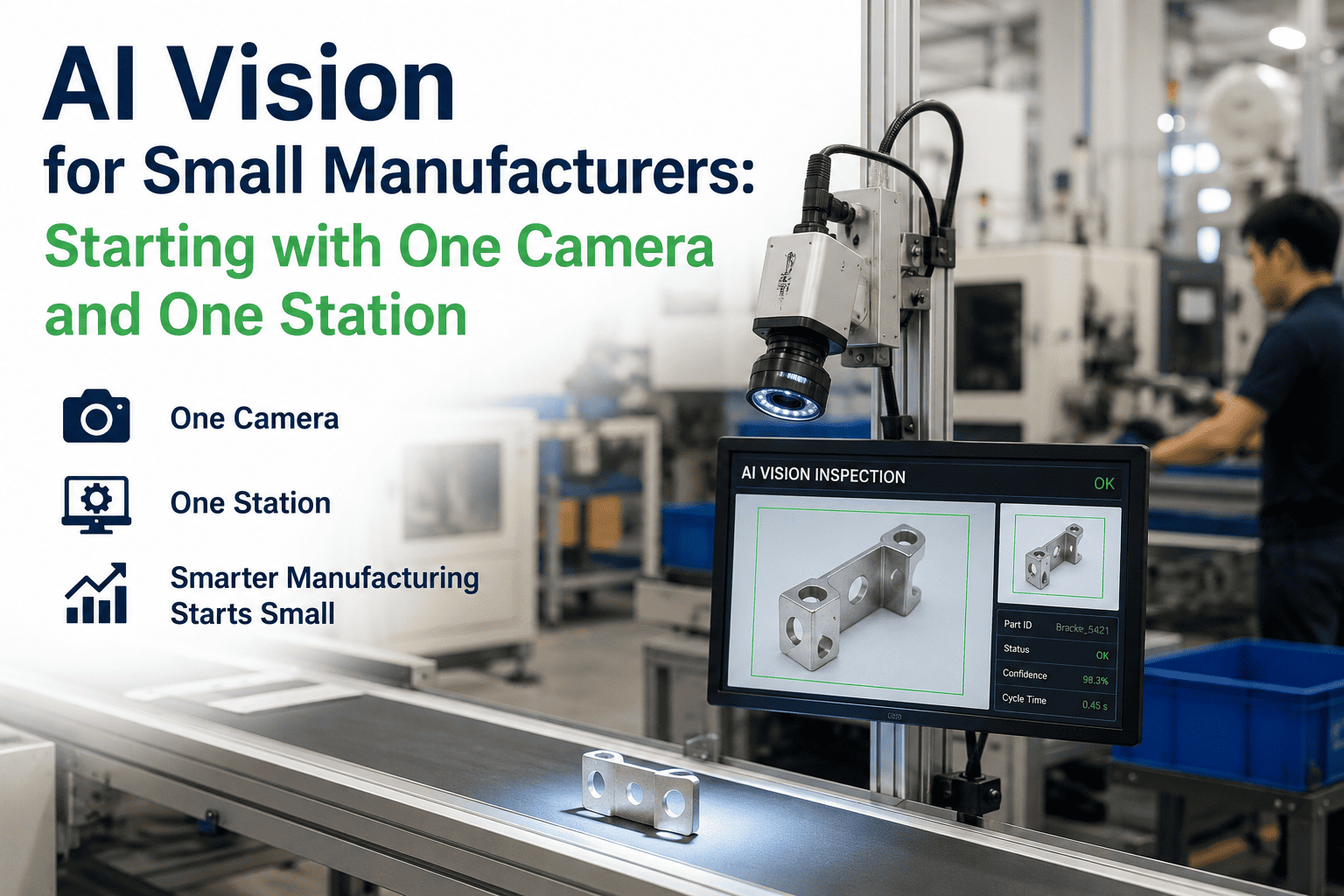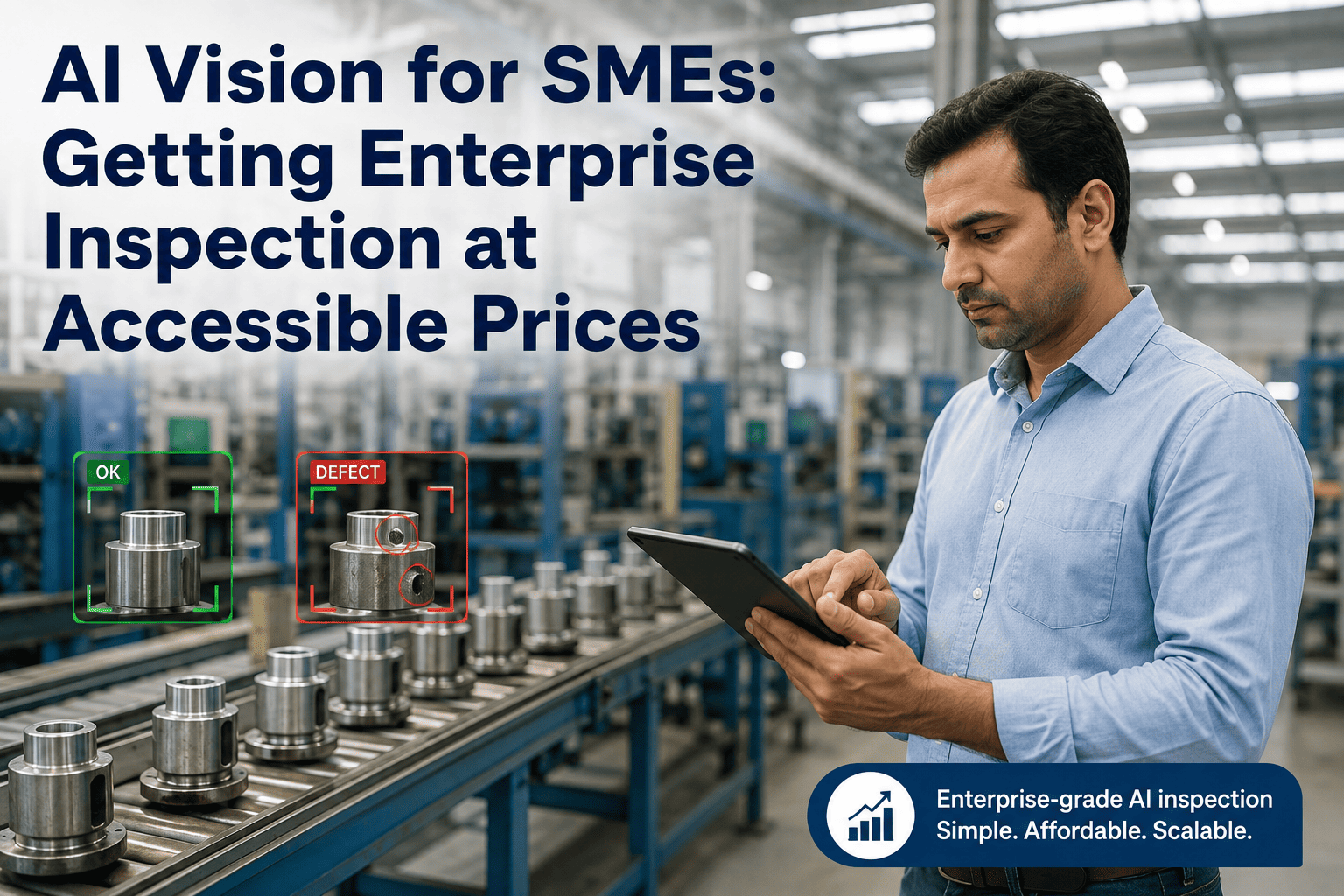
Most small manufacturers rule out AI vision inspection before they ever get a quote, because everything they've read about it — six-figure line integrations, dedicated automation engineering teams, multi-year rollouts — describes a system built for a company twenty times their size. That picture is outdated. A single working inspection station, with edge hardware included, now starts around $50,000 total — not $50,000 as a down payment on something bigger. See how iFactory deploys enterprise-grade AI vision inspection at a single-station price built for SME budgets, with no enterprise contract required to get started.
AI Vision for SMEs: Getting Enterprise Inspection at Accessible Prices
One camera, one station, one clear number: roughly $50K total investment including the NVIDIA edge hardware. Prove the ROI on your highest-risk quality gate, then scale station by station — no enterprise contract, no six-figure commitment on day one.
"AI Vision Is an Enterprise Technology" Was True — Five Years Ago
Industry pricing research puts full-scope AI vision deployments for large manufacturers anywhere from $120,000 to $500,000-plus, and those numbers get repeated so often that smaller operations assume the technology simply isn't built for them. What that figure actually describes is a multi-line, multi-station rollout with custom integration engineering across an entire facility — not what a 40-person job shop or a single-plant food processor actually needs to solve their most expensive quality problem.
The technology underneath has also changed. Edge AI processors that used to require a dedicated server rack now run on a compact NVIDIA edge unit that sits next to the line. Deep learning models that used to need months of custom data science work now train on a few hundred labeled images from your own product. The cost curve moved down faster than the market narrative did — SMEs are still pricing 2021 technology against a 2026 budget line.
The market data backs this up. The AI-based machine vision and quality inspection market was valued at roughly $7.9 billion in 2024 and is projected to nearly quadruple by 2031, and that growth isn't being driven by a handful of automotive giants buying bigger systems — it's being driven by adoption spreading downward into exactly the size of manufacturer that assumed this technology wasn't for them. Vendors have followed that demand with smaller, single-station offerings priced accordingly, which is the deployment model this guide describes.
The Single-Station Starter Deployment, Broken Down
Station by Station, Not All at Once
Deploy at the single point where defects are most expensive — final packaging, end-of-line assembly, or the step that currently causes the most rework. Prove the ROI here before spending another dollar.
Once Station 1's numbers are real — not projected — expand to the next highest-cost inspection points. Each addition uses the network and edge infrastructure already in place, so incremental stations cost less than the first.
By the time you're covering a full line or facility, you're scaling a system with a proven track record on your own product — not making a first-time bet on unproven technology at enterprise scale.
One Station, One Number, One Decision
No facility-wide commitment, no multi-year contract. Deploy AI vision at your highest-risk quality gate and let the results decide what comes next.
Why Enterprise Pricing Doesn't Fit Enterprise Value at SME Scale
| Decision Point | Traditional Enterprise Rollout | Single-Station SME Model |
|---|---|---|
| Initial commitment | Facility-wide contract, often $120K+ | One station, roughly $50K total |
| Deployment timeline | Months of custom integration engineering | Weeks from order to live station |
| Model training data | Large historical image archive assumed | Trained on a few hundred images from your own line |
| Team required | Dedicated automation engineering staff | Existing quality or line staff, with training included |
| Expansion approach | Planned and budgeted as one large project | Added station by station, funded by proven ROI |
| Risk if it underperforms | Large sunk cost across the full facility | Contained to a single station's investment |
What a Single Station Needs to Catch to Pay for Itself
A single escaped defect that reaches a customer — a returned shipment, a warranty claim, a lost contract over a quality complaint — routinely costs more than a month of AI vision operating costs at a single station. Manual inspectors also fatigue, miss shift changes, and can't run at full line speed during peak throughput.
Industry data on deployed AI vision systems shows detection rates above 99% at production speed, catching defects as small as a fraction of a millimeter that inconsistent human attention would miss on a long shift. That gap between manual and AI detection is where the payback lives.
For SME manufacturers with a clearly defined high-cost defect — scrap, rework, or a recurring customer complaint — a single station commonly pays back its total cost within the first year of operation, based on scrap reduction and labor reallocation alone.
Once a station has paid for itself, every additional month of operation is direct margin recovery — and the data it has generated becomes the business case for funding the next station without another round of budget justification.
The math is deliberately simple to build because that's the whole point of starting with a single station: you don't need a facility-wide financial model to make the first decision. Take your current monthly cost of the specific defect you're targeting — scrap material, rework labor hours, and any customer-facing cost if it has escaped before — multiply by twelve, and compare it against the roughly $50K total investment. For most SMEs targeting a genuinely high-cost defect, that comparison alone answers the question before a formal ROI spreadsheet is ever built.
No Line-Item Surprises After the Quote
Pricing research across the machine vision market consistently flags the same problem: entry-level systems look affordable on the sticker price, then calibration, staff training, ongoing maintenance, and software licensing show up later as separate charges that quietly erode the number a manufacturer budgeted for. Annual maintenance and calibration alone can run several thousand dollars a year on a poorly scoped system, on top of hardware that already looked expensive at purchase. A single-station deployment built for SME budgets is priced as one total figure specifically to avoid that pattern — hardware, model training, installation, operator training, and first-year support are all inside the number, not staged as future line items.
There is also no cloud-dependency cost creep. Because inference runs on the edge unit at the station itself rather than routing every frame to a cloud service, there are no per-inspection charges that scale unpredictably with your production volume — a cost structure that matters more to an SME running variable shifts than to a large facility with predictable throughput. Edge processing also means the station keeps working if your internet connection drops, which matters on a shop floor where network uptime isn't always guaranteed.
Software licensing is the other place costs commonly creep in on comparable systems, with AI modules and analytics features frequently sold as add-ons stacked on top of a base hardware license. The single-station model folds the software layer needed to run and retrain the model into the same total figure, so a manufacturer isn't faced with a second negotiation six months in just to unlock the features the sales conversation implied were already included.
The SME Profile Where a Single Station Makes Immediate Sense
You already know which defect is costing you money — a recurring cosmetic flaw, a dimensional out-of-spec rate, a missing component that keeps slipping past final check. A single station is built to solve exactly one clearly defined problem first.
The product passes a consistent location on the line — end of packaging, post-assembly, final visual check — where a camera can be mounted once rather than needing to track a moving or highly variable process.
You have inspectors today, and they're good, but they're human — fatigue late in a shift, inconsistency between different inspectors, and the physical limit of catching sub-millimeter flaws at line speed are the exact gap AI vision closes.
You don't have — and don't want to hire — a dedicated vision systems engineer. The single-station model is priced and supported specifically for teams whose quality function is run by generalists, not automation specialists.
Three Ways Manufacturers Misjudge the Investment Before They Ask for a Quote
The first mistake is pricing the wrong scope. Manufacturers researching AI vision costs typically land on figures describing a full facility rollout — every line, every station, custom integration across the plant — and assume that number is the entry price rather than the ceiling. A single station is a fundamentally different purchase, and comparing its price against a facility-wide figure produces a decision based on the wrong comparison entirely.
The second mistake is underestimating what manual inspection is actually costing today. Most SMEs can state their scrap rate but haven't calculated the fully loaded cost of inspector hours, rework labor, and the downstream cost of defects that escape to a customer — a number that, once assembled, usually makes the AI vision investment look considerably smaller by comparison than it did as an isolated line item on its own.
The third mistake is assuming the sticker price is the total price. As pricing research across the vision systems market consistently shows, calibration, staff training, ongoing maintenance, and software licensing frequently arrive as separate charges after the initial quote — which is precisely why a single total figure that includes those elements up front matters more to an SME evaluating a first deployment than it does to an enterprise buyer accustomed to itemized procurement.
Frequently Asked Questions
Start With One Camera. Let the Results Justify the Next One.
iFactory deploys full AI vision inspection at a single station for roughly $50K total, with no enterprise contract and no facility-wide commitment required to get started.