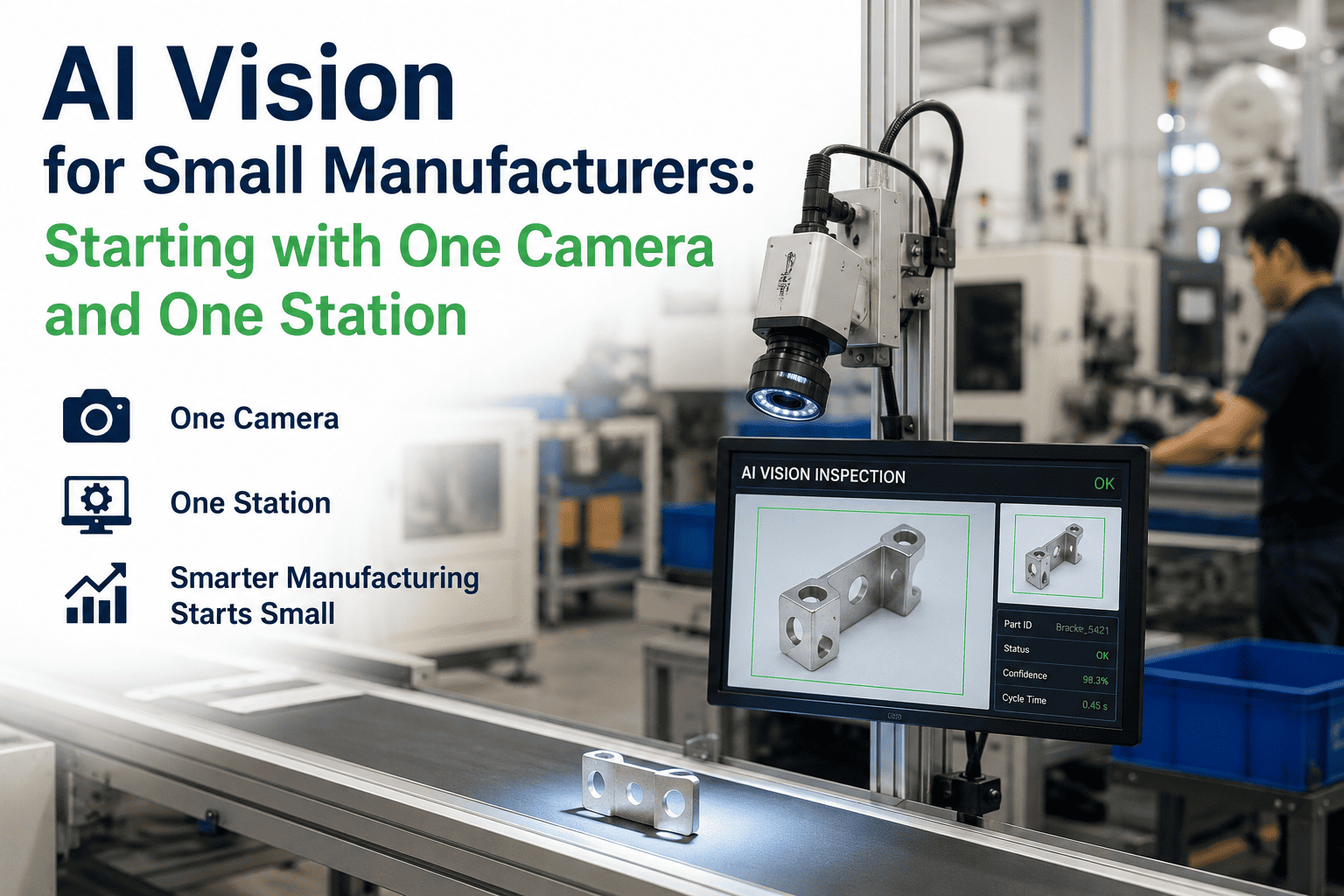
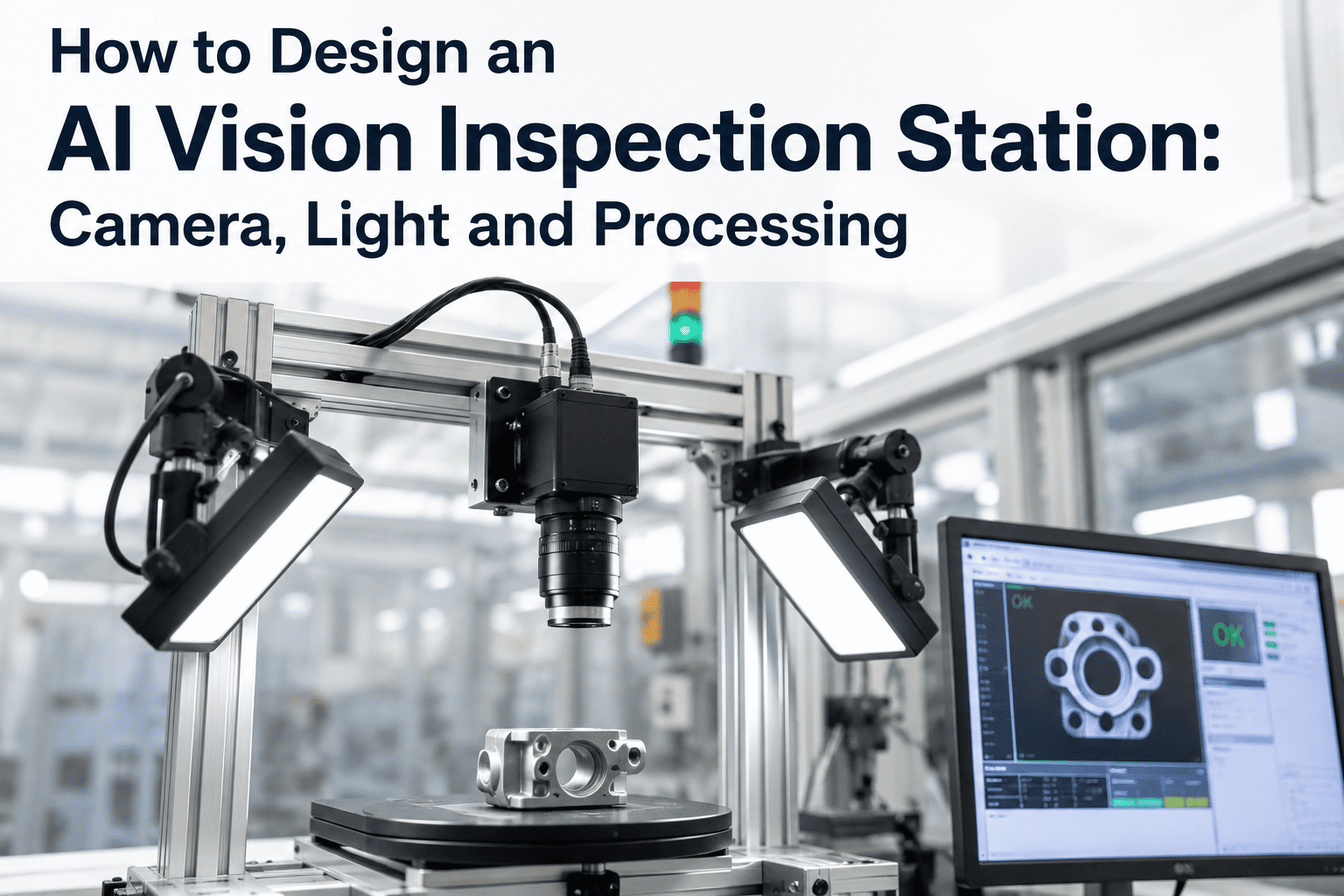
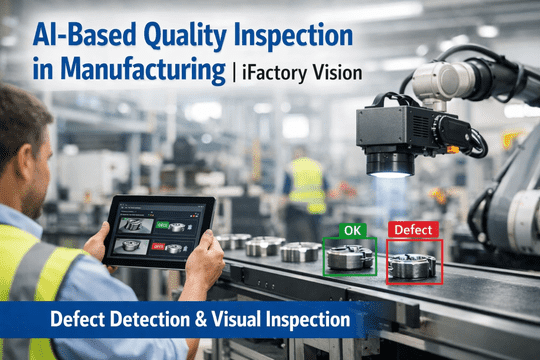
Ninety-one percent of SMEs using AI report a revenue lift, yet fifteen percent of pilots ever reach production. The failure mode is almost never the technology — it is the shape of the pilot itself. Ambitious multi-line rollouts starve for attention, miss deadlines, and quietly die. One camera at one station, chosen carefully, avoids every trap and delivers a defensible ROI number inside a single budget cycle. You can book a demo that scopes this kind of pilot against your own line.
SMALL & MID-SIZE MANUFACTURERS · BUYER GUIDE · 2025
Start With One Camera, One Station, and One Question — Does It Pay Back Before the Next Budget Cycle?
The iFactory vision layer runs on the IP cameras you already own, installs in thirty minutes, and can be scoped down to a single inspection point. Prove the ROI at station one, then scale to the rest of the line on the numbers — not on a vendor slide deck.
1
Camera at one station — the entire scope of a first-week pilot
30 min
Typical install time using an existing IP camera and RTSP stream
8–18
Months typical payback for an SME AI-vision inspection deployment
91%
Of SMEs using AI report a measurable revenue lift within the first year
IS THIS YOU · QUICK QUALIFIER
You Do Not Need a Data Science Team, a New CapEx Cycle, or Ideal Data — You Need One Station That Hurts
Most small manufacturers overestimate what an AI vision pilot demands. The five questions below are the practical qualifiers we use in scoping calls. If two or more sound like your line, a single-camera pilot is a good fit; you do not need to solve every other item first.
?
You already have IP cameras somewhere on the floor — even if they were installed for security or general oversight, not for inspection.
?
There is at least one inspection step today done by a person looking, checking, or counting — and you would like a second pair of eyes on it.
?
You can point at one recent customer complaint, chargeback, or scrap event that a station-level check would have caught before shipment.
?
Your line runs the same product family long enough at a time that a model does not need to relearn the world every hour.
?
Someone on the plant leadership team can spend two hours a week for a month reviewing pilot outputs — no need for a full-time project manager.
PICK YOUR FIRST STATION · RANKED BY ROI IMPACT
The Four Stations Where a Single-Camera Pilot Almost Always Pays Back Fastest
Choosing the right first station matters more than choosing the right vendor. The list below is ranked by how quickly a well-scoped pilot produces a defensible number, based on the pilot deployments we most commonly see in SME manufacturing environments.
01
HIGHEST IMPACT · FASTEST PAYBACK
Packaging Line End
Last defensible check before the truck. A missed defect here is a customer chargeback, a return, or a recall — every one avoided is a hard dollar saved. The vision layer catches missing labels, damaged cartons, and count discrepancies at line speed.
02
HIGH IMPACT · CLEAR ROI
Final Assembly Check
The station where a person checks that all components are present and correctly oriented. Vision layer flags missing screws, wrong-orientation parts, and misaligned sub-assemblies before the unit moves to boxing — the highest-frequency source of rework in most SME lines.
03
STRONG IMPACT · SURFACE QUALITY
Post-Machining Surface Inspection
The check after milling, turning, or grinding where surface defects are subtle and human fatigue drives inspection miss-rates. Vision layer holds a consistent detection threshold shift after shift — no more good-morning versus end-of-Friday variance.
04
SOLID IMPACT · INCOMING QC
Incoming Materials Verification
The dock check that confirms what the vendor shipped matches what the PO ordered. Vision layer verifies pallet contents, count, and packaging integrity as it comes off the truck — catching supplier issues before they consume line time.
INSTALL DAY · THIRTY MINUTES, START TO FIRST DETECTION
What Actually Happens on Install Day — A Thirty-Minute Walkthrough, Not a Three-Month IT Project
The install runs shorter than most people expect the first time they see it. The vision layer taps into an existing IP camera's RTSP stream and applies detection on the edge. No new cabling, no PLC integration on day one, no cloud dependency. The steps below are the actual sequence for a single-station pilot.
0:00 – 0:05
Confirm the Camera
Walk to the station, confirm the existing camera's field of view covers the inspection area, and copy the RTSP URL from the camera admin page. If the angle is wrong, a small reposition takes another five minutes.
0:05 – 0:10
Rack the Edge Appliance
The pre-configured edge box lands on the shop-floor network. Plug power and Ethernet, and the appliance discovers itself. No workstation build, no server room clearance, no long-lead procurement.
0:10 – 0:20
Point the Model at the Feed
In the config console, add the camera stream, select the detection template that matches the station (packaging, assembly, surface), and set the initial detection thresholds to shadow mode so no alert fires yet.
0:20 – 0:25
Walk a Golden Sample
Run three good units and two known-bad units through the station while an engineer watches the detection output. The confidence scores tell you whether the out-of-the-box thresholds are close enough or need a small tune.
0:25 – 0:30
Hand Off to Shadow Mode
Leave the pilot running in shadow mode for two weeks. Alerts are logged with evidence clips but no supervisor notification fires, so the operators keep working normally while the model tunes against real production data.
Send Us One RTSP Stream and We Will Run a Live Detection Session on Your Own Camera
Bring a camera URL from your highest-value station to a working session. In under an hour we will show you what a pilot would detect against your actual line — not a demo reel.
WHAT YOU PAY · PILOT VS FULL DEPLOYMENT
The Two Line Items That Matter — Pilot Scope, Then Full-Line Scope Once the Pilot Has Earned It
The SME cost conversation is not about a five-year enterprise licence — it is about a small first commitment that can grow. The comparison below sets the pilot scope alongside a full first-line deployment, so the CFO sees both numbers on the same page.
STAGE 01
Single-Station Pilot
Two to four weeks in shadow mode + two weeks live
- One existing IP camera reused
- One edge appliance shipped racked
- One detection template configured
- Shadow-run tuning against real production data
- Weekly evidence review with operations lead
- Pilot report with defect-catch and false-positive numbers
STAGE 02
Full First-Line Deployment
Roll-out only after pilot ROI is documented
- Additional cameras across the line
- PLC or CMMS integration where useful
- Custom model tuning per station type
- Operator dashboard and reporting
- Quarterly model refresh included
- Named support contact and SLA
The commitment at Stage 01 is deliberately small. Stage 02 is only triggered when the pilot report shows a payback path — no long-term contract signed in the dark.
THE ROI MATH · ONE FORMULA, THREE INPUTS
The Only ROI Calculation You Need for a Single-Station Vision Pilot
Most vision-vendor ROI models are more complicated than they need to be. For a single-station pilot, three numbers already on your P&L do most of the work. Fill them in, and the payback window is right in front of you.
WHEN TO SCALE · FOUR CHECKPOINTS BEFORE STATION TWO
Do Not Scale Until the Pilot Answers These Four Questions With Real Data
The most common cause of a stalled AI vision roll-out is scaling before the pilot has produced defensible answers. The four checkpoints below are the milestones we tell every SME to hit before authorising a second station.
Checkpoint 01
Detection Accuracy
Confirmed catch rate is inside the agreed tolerance against a labelled sample of at least fifty units — good and bad, mixed. Not a lab number; a shop-floor number.
Checkpoint 02
False-Positive Rate
Nuisance alerts per shift are below the level operators consider tolerable — usually one or two, not ten. Above that, alert fatigue kills adoption before ROI arrives.
Checkpoint 03
Operator Adoption
Operators are acting on alerts and reporting false positives. If the pilot is running silently without floor engagement, ROI is theoretical, not real. Adoption is a leading indicator.
Checkpoint 04
Documented Financial Impact
A written pilot report with the actual weekly saving in dollars — signed by operations and by finance. This is what the second-station business case is built on, and it is what protects the programme when priorities change.
FREQUENTLY ASKED QUESTIONS
What Small-Manufacturer Operations and Quality Leaders Ask Before a First Camera Pilot
Do we really need dedicated inspection cameras, or will our existing IP cameras work?
In most cases the existing IP cameras are more than adequate for a first pilot. What matters is field of view covering the inspection zone, reasonable lighting, and a stable RTSP stream. The vision layer handles analytics on the edge appliance — it does not care whether the camera was installed for security or inspection. If repositioning is needed, that is a ten-minute fix on install day, not a procurement cycle. You can
book a demo and share a still from your feed so we can confirm before you commit.
We do not have thousands of labelled defect images — can we still train a model?
A common misconception. Modern vision templates come pre-trained on the visual patterns typical of packaging, assembly, and surface inspection — you are tuning against your specific line, not training from zero. In practice a shop-floor tune-up needs a few dozen labelled examples across the good/bad distribution, not thousands. The shadow-run phase generates the labelled data as it goes.
Contact support to walk through what a realistic data-preparation task looks like for your product family.
What happens when we switch product families or add a new SKU?
This separates a lab demo from a shop-floor system. The vision layer supports multiple detection templates per camera, switchable by production-run signal or an operator toggle. New SKUs typically need a short retune — the same shadow-run process the original pilot used — rather than a full retrain. Change management is baked into the platform, not left as an exercise for the customer. You can
book a demo to see template switching in the console.
How do we bring the operators along without them fearing surveillance?
The single most important step is to frame the pilot as a second pair of eyes on the product, not on the person. Show operators the evidence clips, invite them to flag false positives, and let them see how the model learns from their corrections. The vision layer is scoped to product inspection, not person tracking — being explicit about that boundary in the briefing removes the anxiety.
Contact support for the operator briefing template we use in SME deployments.
What is a realistic timeline from first conversation to first ROI number?
Two weeks of scoping and camera assessment, a thirty-minute install, and two to four weeks of shadow-run tuning — call it six to eight weeks from first call to a pilot report with real numbers on it. That is deliberately shorter than the twelve-to-eighteen-month enterprise vision projects that dominate industry write-ups, because the scope is deliberately smaller. A first-station pilot is designed to close fast, not to be a strategic transformation.
Book a demo that walks through the six-week timeline against your calendar.
ONE CAMERA · ONE STATION · SIX WEEKS TO ROI DATA
Point One Camera at One Station. Get a Real Pilot Report in Six Weeks. Then Decide.
The pilot is small on purpose. If the numbers work, the second station gets funded on evidence, not on a vendor promise. If they do not, you have lost weeks, not quarters.