Substation and transmission infrastructure represents the most capital-intensive and operationally critical segment of power grid assets — and historically one of the least continuously monitored. Insulators, busbars, disconnect switches, power transformers, surge arresters, and current transformers operate at high voltage under environmental stress that degrades their condition progressively in ways that are invisible until the degradation event — a flashover, a busbar fault, a transformer bushing failure — occurs with immediate and widespread consequence. A single insulator string failure on a 400 kV transmission line can initiate a cascading outage affecting hundreds of thousands of customers and generating repair, restoration, and liability costs that dwarf the cost of any monitoring system that could have detected the pre-failure condition. Traditional inspection programs for substation equipment rely on periodic visual surveys by qualified electrical engineers, thermal imaging during live patrol walks, and scheduled outage inspections that may occur annually or less frequently — intervals that leave extended windows during which defect development goes undetected. iFactory's AI vision camera platform with integrated thermal monitoring provides continuous, automated inspection coverage across substation equipment and transmission insulator strings — detecting surface cracks, contamination accumulations, flashover precursors, corona activity, and thermal hotspots in real time, without requiring outage access or qualified personnel in the high-voltage zone. Power transmission and substation engineers evaluating their current inspection program gaps regularly choose to Book a Demo with iFactory's engineering team to understand how AI vision thermal monitoring maps to their specific asset portfolio and inspection regime.
Why Substation Inspection Cannot Rely on Periodic Surveys Alone
The inspection interval problem in substation and transmission asset management is structurally different from most industrial maintenance environments because of the access constraints that high-voltage equipment imposes. Maintenance personnel cannot approach live substation equipment at working distances that allow close-range visual or contact inspection — they must work from exclusion zone boundaries or wait for planned outage access that may be scheduled months in advance. This constraint means that visual and thermal inspection surveys are conducted infrequently, under operational pressure to minimise the time spent in the substation yard, and with equipment viewed from distances where early-stage defect signatures are below reliable human detection thresholds. The result is an inspection regime that consistently identifies defects at an advanced stage — when intervention is more expensive, more disruptive, and in some cases no longer an option before a forced outage event. Insulator contamination that reaches flashover threshold, busbar connection resistance increases that generate sustained thermal anomalies, and transformer bushing surface tracking that precedes dielectric breakdown are each detectable weeks or months before the failure event using continuous AI vision and thermal monitoring — but only if the monitoring system is in place and generating alerts before the defect reaches the crisis threshold. iFactory's AI vision camera platform resolves the access constraint entirely by deploying fixed cameras and thermal imaging systems at safe standoff distances within the substation yard — providing the continuous monitoring coverage that periodic survey inspection cannot deliver without compromising personnel safety or operational continuity.
Defect Classes Detected Across Substation and Transmission Equipment
| Equipment Type | Defect Classes Detected | Detection Method | Consequence if Undetected |
|---|---|---|---|
| Suspension & Strain Insulators | Surface cracks, contamination deposits, cap-and-pin corrosion, zero-value discs | Visual anomaly classification and UV corona detection | Flashover, insulator string collapse, transmission line outage |
| Post Insulators & Bushings | Surface tracking, glaze damage, moisture ingress, bushing oil level anomaly | Surface texture anomaly detection and thermal imaging | Bushing explosion, transformer loss, extended outage |
| Busbars & Connections | Thermal hotspots at joints, loose clamp connections, oxidation | Thermal imaging with delta-T threshold alerting | Busbar fault, substation fire, unplanned outage |
| Disconnect Switches | Contact overheating, blade misalignment, incomplete engagement | Thermal anomaly detection and visual alignment monitoring | Contact welding, fault during switching operation |
| Surge Arresters | Leakage current heating, housing surface cracks, pollution accumulation | Thermal imaging and surface anomaly classification | Arrester explosion, flashover propagation, equipment damage |
| Power Transformers | Tank hotspots, cooling radiator anomalies, conservator level, bushing heating | Thermal monitoring with zone-specific threshold configuration | Transformer failure, catastrophic oil fire, extended substation outage |
| Current & Voltage Transformers | External thermal anomalies, top terminal heating, oil expansion anomalies | Thermal imaging and surface anomaly detection | Internal dielectric failure, metering errors, protection system faults |
How AI Vision Thermal Monitoring Works in the Substation Environment
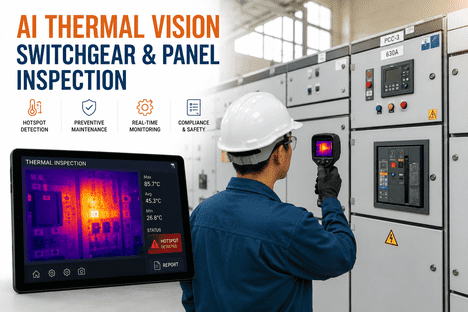
iFactory's substation inspection platform integrates two complementary detection mechanisms — visual anomaly detection and calibrated thermal imaging — into a single monitoring system that operates continuously across all monitored equipment from safe standoff positions. The visual AI models are trained on substation equipment imagery across a range of environmental conditions: clear weather and rain, day and night lighting, seasonal contamination patterns from salt, dust, and biological fouling — enabling reliable anomaly detection against the normal equipment appearance baseline regardless of environmental variation. The thermal imaging layer captures continuous temperature maps across all monitored equipment zones, with zone-specific alert thresholds configured for each equipment class based on the temperature differential values that indicate developing faults: a 10°C differential at a busbar joint is a monitoring trigger; a 30°C differential is an urgent maintenance alert. When either the visual or thermal detection model identifies an anomaly signature above the configured threshold, the platform generates a structured alert — containing the equipment ID, anomaly classification, severity score, annotated visual and thermal images, and recommended maintenance action — routed simultaneously to the substation control room operator display and the maintenance planning system for work order generation. This detection-to-alert cycle completes within seconds of the anomaly appearing in the camera's field of view, compared to the weeks or months between periodic survey inspections that the same condition would otherwise remain undetected. Teams responsible for substation asset management who want to understand the specific detection performance specifications for their voltage class and equipment configuration are encouraged to Book a Demo with iFactory's power grid engineering specialists.
Insulator Inspection: Contamination, Flashover Risk, and Corona Detection
Insulator contamination and flashover is the leading cause of transmission and substation equipment outages in coastal, industrial, and high-pollution environments worldwide. Contamination from salt spray, industrial particulates, cement dust, and biological fouling accumulates on insulator surfaces over months and years, reducing the insulator's surface leakage distance and making the string susceptible to flashover under wet or fog conditions — even though the insulator may show no visible defect. The contamination level on individual insulator discs and strings cannot be reliably assessed by visual inspection from patrol walking distances — the early stages of contamination accumulation and the critical distinction between dry and wet contamination performance require close-range inspection or continuous monitoring to evaluate reliably. iFactory's AI vision models trained on insulator imagery across contamination severity levels provide a continuous contamination assessment for each monitored insulator string — tracking the rate of contamination accumulation between washing cycles and alerting the maintenance team when strings in specific yard zones reach the contamination severity level that requires accelerated washing before the next forecasted fog event. Corona discharge on insulator surfaces — a pre-flashover condition that occurs when electric field concentration on contaminated or damaged insulator surfaces generates UV radiation — is detectable by UV-sensitive camera systems that iFactory integrates alongside visible-spectrum cameras at critical insulator positions. Corona detection provides the earliest available warning of flashover risk conditions, identifying the specific insulator strings or hardware components generating corona activity before the surface degradation event that causes a forced outage. The combination of visual contamination monitoring, thermal anomaly detection, and UV corona imaging at critical insulator positions gives the transmission maintenance team a complete, continuously updated picture of insulator health across the substation yard — replacing the incomplete, infrequent snapshot that periodic survey programs provide. Book a Demo to review iFactory's insulator monitoring configuration for your specific voltage class, pollution severity zone, and insulator type portfolio.
Drone-Assisted and Fixed Camera Deployment Configurations
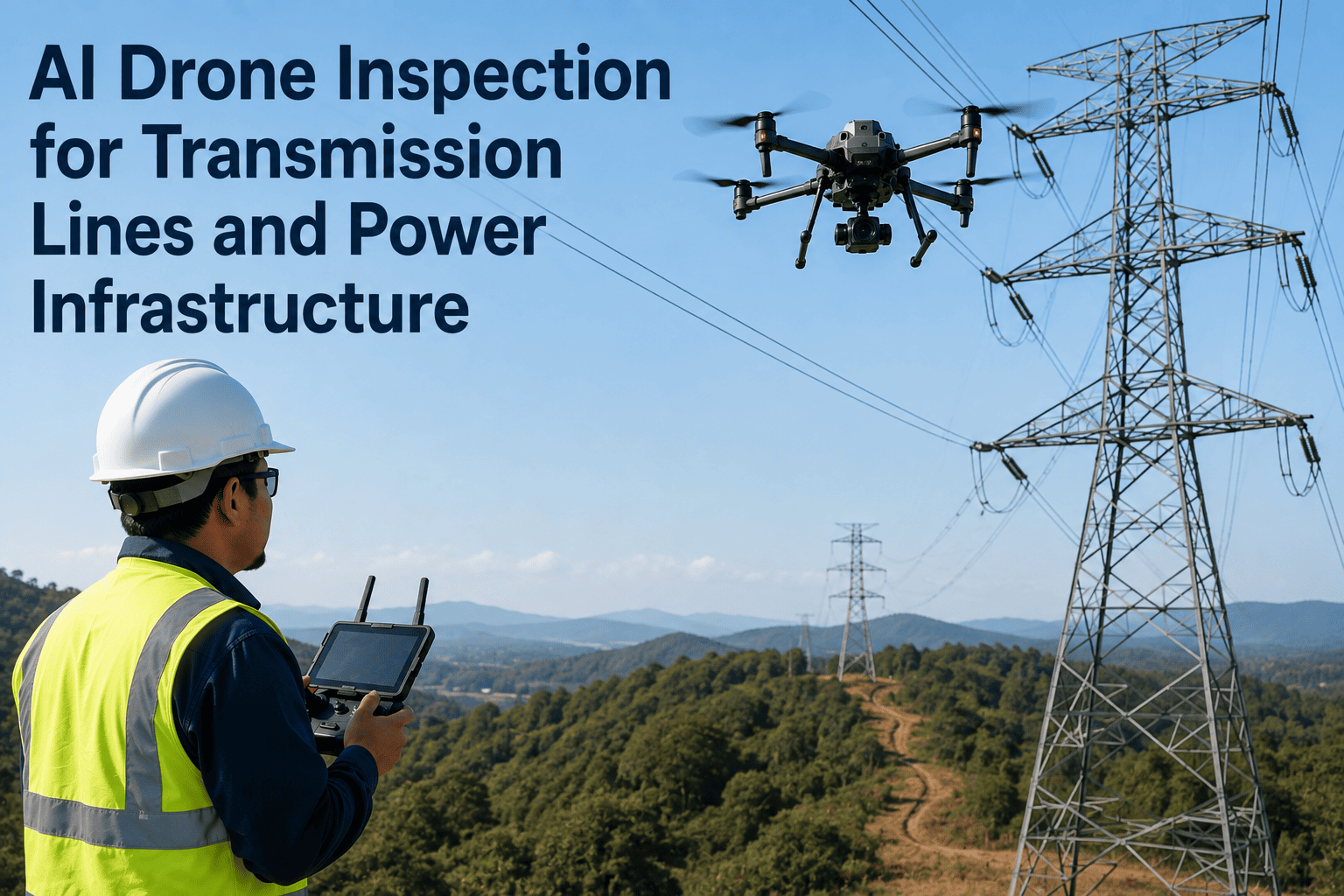
Substation and transmission line inspection deployments use two complementary coverage architectures that each address different aspects of the inspection requirement. Fixed camera systems installed within the substation yard provide continuous 24/7 monitoring of critical equipment positions — transformer banks, busbar sections, insulator strings at key entry and exit positions, and disconnect switch arrays — where the equipment location is static and continuous monitoring between outages is the primary requirement. Drone-assisted inspection extends coverage to transmission line insulator strings, tower hardware, and overhead conductor connections along line sections where fixed camera installation is impractical and periodic high-resolution close-range inspection is the objective. iFactory's platform supports both deployment modes within the same detection, alert, and work order architecture — with drone inspection imagery processed through the same AI anomaly detection models that analyse fixed camera feeds, and generating the same structured maintenance alert and work order output regardless of the image source. Drone inspection data captured on periodic line surveys is ingested to the platform as a timestamped condition record for each tower and insulator string position, building a longitudinal asset health history that tracks defect development across successive inspection cycles and enables condition-based maintenance scheduling for transmission line components. For substations with both fixed monitoring requirements and periodic transmission line inspection needs, iFactory's unified platform architecture eliminates the separate data management overhead of running independent inspection systems for each coverage mode.