Parts almost never arrive at an inspection station lined up neatly the way they did in the vendor demo. They tumble off a conveyor, sit at a 40-degree tilt in a tote, or land upside down after a robot handoff — and a fixed-rule vision system trained on one pose sees a stranger, not the same part it was built to check. AI-based inspection is built around a different premise: learn what an acceptable part looks like across the full range of angles, rotations, and partial occlusions it will actually appear in on the line, not one staged position. That shift matters even more on mixed-SKU lines, where the camera has to recognize which product is even in frame before it can judge whether that product is good. Plants juggling several SKUs on one inspection cell can book a 30-minute demo to see orientation-invariant detection running against their own part mix.
AI Vision for Variable Product Orientation and Mixed SKU Inspection
Products arrive at inspection stations in random orientations, mixed with other SKUs, on lines that were never built for one fixed pose. AI adapts to any angle, any position, and any rotation to deliver consistent defect detection without fixturing.
Why Fixed-Rule Vision Breaks the Moment a Part Rotates
Traditional rule-based machine vision is set up around known geometry, known lighting, and known part positioning defined once during commissioning. That works well when a part is fixtured into the exact same pose every cycle. The moment a part is loaded loose — from a bin, a random-feed hopper, or a fast-moving belt — that fixed geometry assumption collapses, and the system either rejects good parts it no longer recognizes or, worse, waves through orientations it was never taught to check.
Rules are tuned around a known part pose, lighting setup, and camera geometry established at commissioning; anything outside that window requires re-tuning by an integrator.
Learns how acceptable parts appear across a range of real production conditions — including surface finish, lighting, and orientation variation — without hand-coding a rule for every angle.
What "Any Orientation" Actually Means on the Floor
Orientation invariance is not one feature — it is a stack of separate capabilities that each solve a different way a part can present itself at the inspection point. A system that only solves rotation but not occlusion will still fail on a part half-hidden behind another item on the belt.
Rotational Variation
The part is the same, but its rotation around the camera axis changes cycle to cycle — a label, seam, or feature the model must find regardless of which way it is facing.
Tilt and Pose
Parts loaded loose in totes or on a random-feed hopper rarely lie flat — tilt changes the apparent shape and shadow pattern the model has to interpret.
Partial Occlusion
One part overlapping another, or a gripper partially blocking the view, means the model has to make a defect call from a partial silhouette.
Scale and Distance
Parts closer to or further from the lens on a variable-depth line appear at different apparent sizes; the model has to normalize for that before comparing features.
Mixed SKU Lines Add a Second Layer of Difficulty
Orientation is only half the problem on a mixed-SKU cell. Before the system can even judge quality, it has to correctly identify which of several product variants is in frame — a task that gets harder as SKU count grows and as SKUs start to resemble each other in size, color, or shape.
| Line Configuration | Identification Task | Typical Failure Mode Without AI |
|---|---|---|
| Single SKU, fixtured | Not required — part identity is known | Rarely fails; classic rule-based vision suffices |
| Single SKU, loose-loaded | Pose estimation only | Missed or false rejects as orientation drifts from the trained pose |
| 2–5 SKUs, shared conveyor | SKU classification + pose estimation | Cross-SKU misclassification triggers wrong inspection rule set |
| 6+ SKUs, high changeover frequency | Continuous classification, pose, and defect scoring | Manual recalibration between changeovers eats line uptime |
How the Model Learns to Generalize Instead of Memorize
An AI vision model built for variable-orientation inspection is trained on a representative spread of real production images rather than a single staged pose, so it learns the underlying appearance of acceptable parts instead of memorizing one camera angle. Systems designed this way can interpret variation in surface finish, lighting, and orientation that would otherwise demand constant manual rule tuning, and this AI layer typically runs alongside — not instead of — traditional measurement and edge-detection tools for the geometric checks that don't need to vary.
Camera captures the part in whatever pose it happens to arrive in — no fixturing step, no forced re-orientation.
The model identifies the SKU and estimates pose before any defect scoring begins.
Defect detection runs against the correct rule set for that specific SKU and orientation.
Results and confidence scores route to the line controller and the plant's quality dashboard in the same pass.
Where This Still Needs Engineering, Not Just Software
AI orientation invariance reduces re-tuning, but it does not remove the need for sound imaging fundamentals. Lighting still has to be consistent enough that the same defect looks like the same defect regardless of pose, and camera placement still has to give the model a usable view of the feature that matters most — a scratch on the far side of a rotated part is still a scratch the lens has to actually see.
A production QC line usually needs both fixed rules and adaptive AI, not one or the other.
Dimensional checks, code reads, and clearly defined geometric tolerances are often still faster and simpler to solve with traditional rule-based tools. AI earns its place specifically on the variation rule-based tools cannot cover — orientation, pose, surface texture, and mixed-SKU identification. iFactory combines both in one inspection pipeline so a plant isn't forced to choose.
Building the Training Set: What "Representative" Actually Requires
The single biggest driver of how well an orientation-invariant model performs is the quality and range of the images it was trained on, not the sophistication of the underlying algorithm. A dataset that only shows a part right-side-up under even lighting will produce a model that only works right-side-up under even lighting, no matter how advanced the architecture behind it is. Building a genuinely representative dataset means deliberately capturing the part across its full realistic range of poses, tilts, and partial views — including the awkward, ugly, half-obscured frames that a human data collector might be tempted to throw out because they don't look like a "clean" training example.
Images collected in a short window, often during a quiet shift or a staged capture session, that miss the pose and lighting variation the line produces over a full week of production.
Images collected across shifts, lighting conditions, and the full range of poses a part naturally takes on the actual line, including edge cases that look messy but occur regularly in production.
A practical rule of thumb: if a defect inspector on the floor has never seen a part in a certain orientation, the training set probably hasn't captured it either, and it is worth walking the line for a shift specifically looking for those rare poses before finalizing a dataset. This is also where a phased rollout earns its keep — running the model in a shadow mode alongside existing inspection for a few weeks surfaces the pose and lighting gaps that a one-time data collection pass will always miss.
Rollout Sequencing: Where Plants Actually Start
Plants rarely flip an entire mixed-SKU line over to AI-based inspection in one changeover. A staged rollout reduces risk and gives the quality team a chance to validate model behavior against known-good and known-bad parts before it carries production weight.
Start with the single highest-volume SKU and the widest realistic pose range, running the model in parallel with the existing process without acting on its calls yet.
Compare model calls against inspector calls on the same parts for a defined trial period, and use disagreements to identify dataset gaps rather than assuming the model is simply wrong.
Add the next SKUs one at a time, prioritizing SKUs that most closely resemble ones already in the model since those tend to expose classification confusion first.
Move to production authority — allowing the model's call to actually route or reject parts — only once agreement rates are stable across shifts and lighting conditions.
Cost Drivers Worth Modeling Before Committing to a Rollout
The economics of a variable-orientation, mixed-SKU inspection project depend on a handful of specific variables, and skipping any one of them tends to produce an ROI estimate that looks better on paper than it performs on the floor.
| Cost or Benefit Driver | What It Depends On |
|---|---|
| Dataset collection effort | Number of SKUs, pose range per SKU, and how often new SKUs are introduced |
| Camera and lighting hardware | Line speed, part size range, and whether existing fixturing can be reused or removed |
| Changeover time saved | Current manual recalibration time between SKU changes on the existing line |
| Escaped-defect cost avoided | Downstream cost of a missed defect reaching the next process step or the customer |
| Retraining cadence | How frequently new SKUs, packaging changes, or supplier material changes occur |
Plants that skip modeling changeover time savings specifically tend to underestimate the case for AI-based inspection on mixed-SKU lines, since the labor and downtime cost of manual re-tuning between SKU runs is often larger than the inspection accuracy improvement alone would justify.
Common Mistakes Plants Make When Evaluating This Technology
A handful of avoidable mistakes account for most of the disappointing pilots reported across the industry, and nearly all of them trace back to skipping a step rather than the technology itself falling short.
Testing on Staged Parts
Validating a vendor's demo on hand-picked, well-lit sample parts instead of the actual messy pose range the line produces gives a falsely optimistic first impression.
Ignoring Lighting Drift
Ambient light changing across a shift, or a burned-out fixture light, can shift model performance even when part orientation range hasn't changed at all.
Treating All SKUs as Equal Effort
Visually similar SKUs need more training data and tighter validation than SKUs that look nothing alike, but budgets are often set as if every SKU costs the same to onboard.
Skipping the Shadow-Mode Period
Giving a model production authority before comparing its calls against a known-good baseline removes the safety net that catches dataset gaps before they cost real product.
Single-Camera vs Multi-Camera Coverage for Loose-Loaded Parts
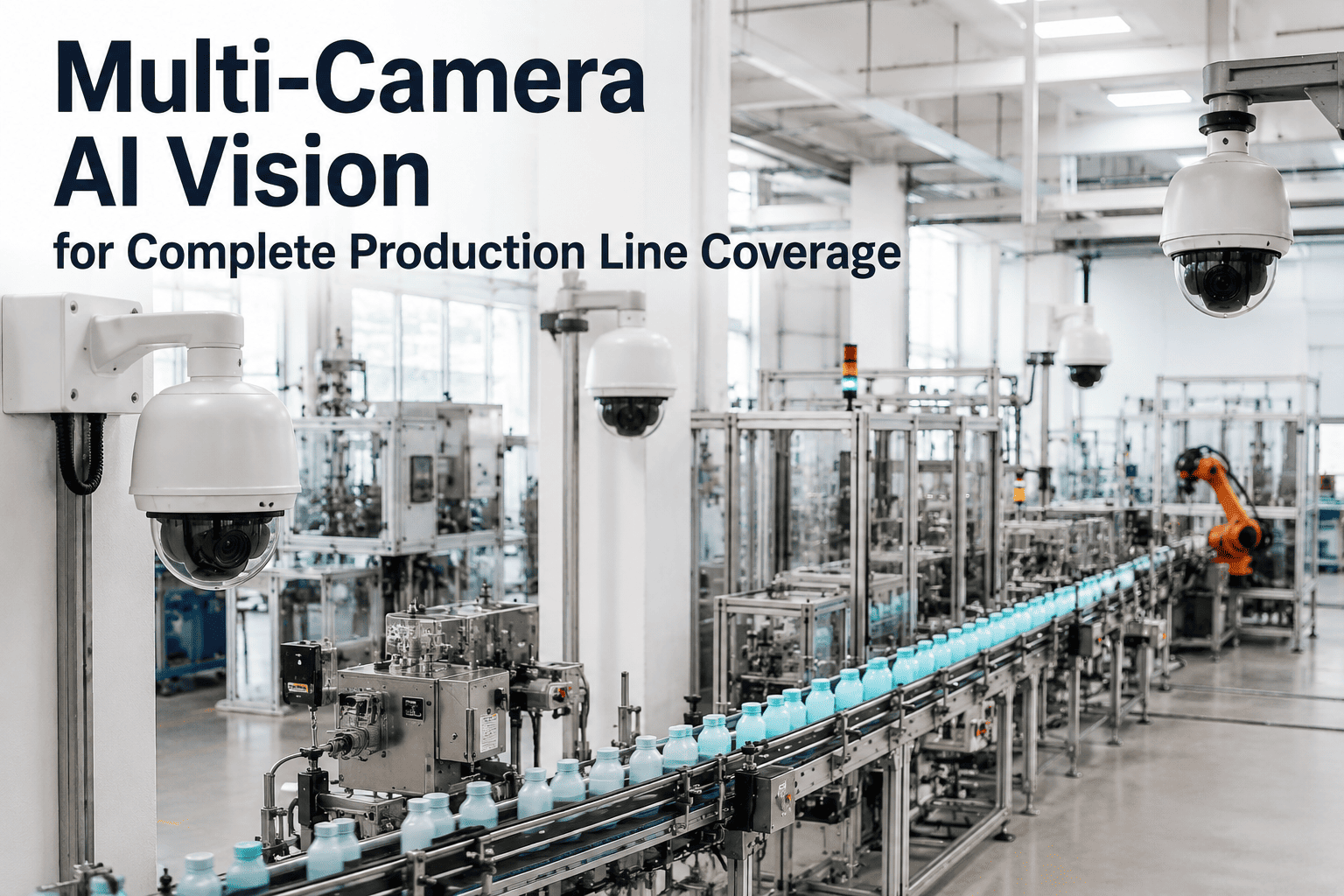
A part that can land in any orientation on a belt or in a tote often can't be fully evaluated from one viewpoint — a defect on the underside or far face simply isn't visible to a single overhead camera no matter how good the model behind it is. This is a hardware and geometry decision that sits upstream of the AI model itself, and getting it wrong caps the system's achievable accuracy regardless of how well the model is trained.
Simpler and cheaper to deploy, but only sees the part face currently oriented toward the lens — defects on hidden faces are structurally invisible no matter how well the model performs.
Captures multiple angles or full spatial geometry in one cycle, closing the blind-spot problem at the cost of more integration complexity and processing load per part.
The right choice depends on the part geometry and where defects typically occur — a part with a dominant "face" that carries most of the risk may do fine with a well-placed single camera, while a part with defect risk distributed across its whole surface usually needs multi-angle coverage to avoid systematically missing one side.
Where This Connects to Robotic Bin-Picking and Sortation
Orientation and pose estimation aren't unique to inspection — the same underlying capability powers robotic bin-picking, where a robot arm needs to know a part's exact position and rotation before it can grip it correctly out of a random-feed hopper or tote. Plants already running or considering robotic sortation upstream of inspection can often share the same pose-estimation layer across both tasks rather than building it twice, since the core problem — recognizing a part's orientation regardless of how it landed — is identical whether the next step is a robot gripper or a defect check.
Depth and spatial information matter more in this context than in flat 2D inspection alone. A 2D system evaluates contours, color, and position within a flat image, which is often sufficient for orientation-invariant defect inspection on a conveyor. A 3D system additionally captures height, depth, and true spatial orientation, which becomes necessary when parts are picked from a bin rather than moved across a flat belt, or when tilt itself — not just rotation — needs to be resolved precisely enough for a robot to grip the part safely.
Lighting Consistency Across a Full Range of Poses
A model that has correctly learned to generalize across orientation still depends on the physical camera and lighting setup producing a usable image at every one of those orientations. A part that is well-lit face-on but casts a heavy shadow when tilted at 45 degrees can still trip up even a well-trained model, not because the model failed to generalize but because the image itself lost the detail the model needs. Diffuse, multi-angle lighting designed around the full pose range — rather than a single dominant light source aimed at the "expected" orientation — tends to produce far more consistent results across a variable-orientation part stream.
Frequently Asked Questions
Does orientation-invariant AI replace fixturing entirely?
Not always, and not immediately in every application. Some lines still benefit from light physical guides that narrow the range of poses a part can land in, simply because that reduces the imaging burden and speeds up throughput. What changes is the requirement — fixturing becomes an optional throughput optimization rather than a mandatory precondition for the vision system to work at all. Many plants start with AI handling the full pose range and add lightweight guides later only where cycle time benefits from it. For a specific part geometry, book a demo to see whether fixturing still adds value on top of the AI layer.
How many SKUs can one inspection cell realistically handle before accuracy suffers?
There is no fixed ceiling, but accuracy depends heavily on how visually similar the SKUs are to one another, not just the raw count. A cell running five SKUs that look nothing alike can perform better than a cell running three SKUs that differ only by a subtle label or color variant. The practical answer is to test the model against the actual SKU set and required defect sensitivity rather than relying on a generic number from a different plant's part mix. Contact iFactory Support to scope a model against a specific SKU list and defect catalog.
What happens when a brand-new SKU is introduced mid-production?
A new SKU requires the model to learn what an acceptable version of that product looks like, which typically means collecting a representative image set and retraining or fine-tuning before that SKU goes live on the inspection cell. This is faster than reprogramming a rule-based system from scratch, since the underlying pipeline for pose estimation and defect scoring doesn't have to be rebuilt — only the SKU-specific reference data changes. Plants that introduce new SKUs frequently should plan a standard onboarding step for this rather than treating each new product as a one-off integration project.
Does variable orientation reduce inspection speed compared to a fixtured line?
There is typically a small computational overhead for pose estimation compared to a system that assumes one fixed pose, but in practice this is offset by the time saved from eliminating manual fixturing steps and changeover recalibration. Whether the net effect on line speed is positive or neutral depends on the specific camera hardware, processing pipeline, and cycle time target — this is exactly the kind of comparison worth testing against a real line rather than assuming from general principles.
How does this integrate with an existing PLC or MES on the line?
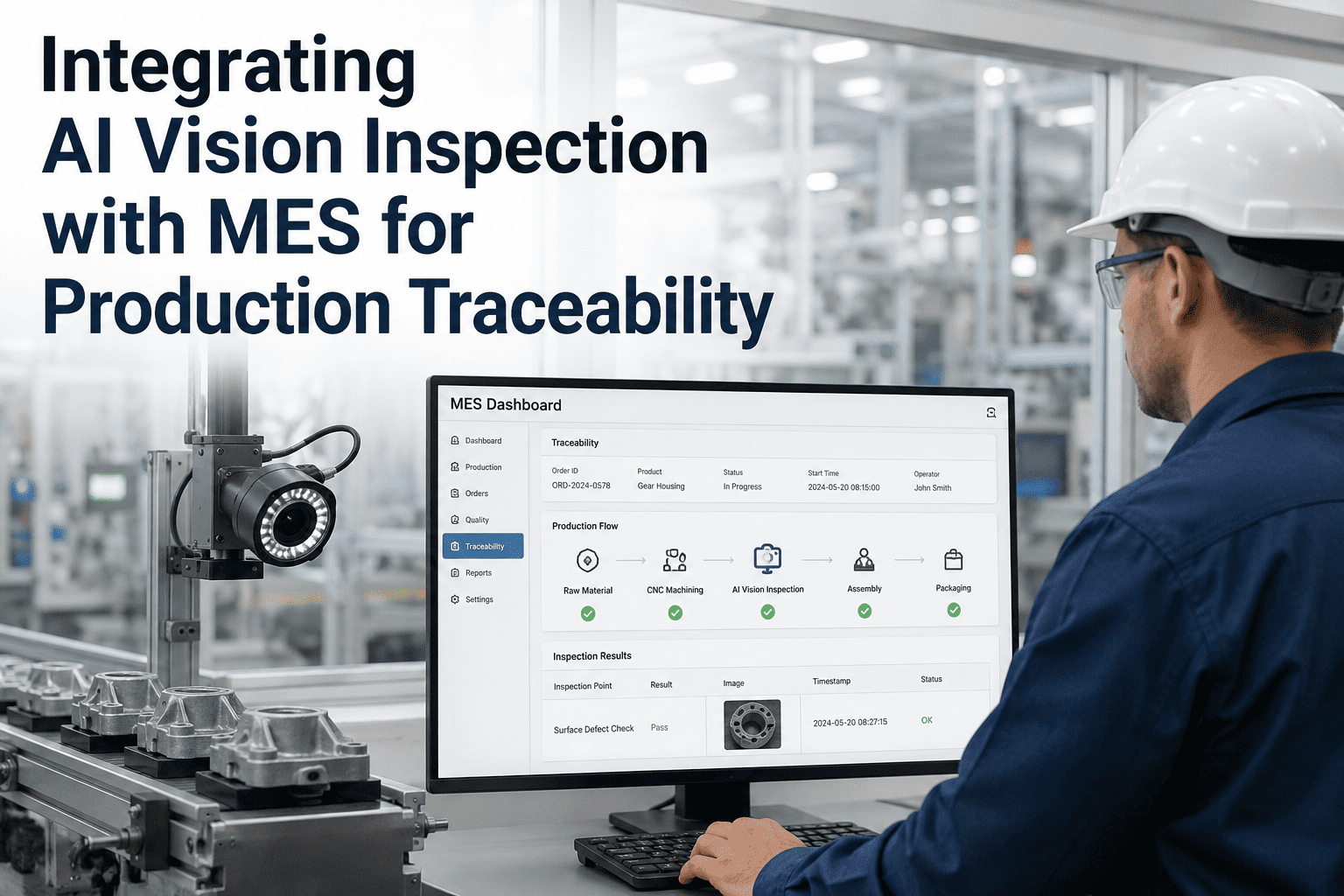
Pose, SKU identity, defect result, and confidence score are typically passed to the line controller through the same industrial protocols already in use for existing vision or PLC communication, so the inspection cell slots into the current control architecture rather than requiring a separate parallel system. Integration specifics depend on the plant's existing automation stack. Contact iFactory Support to review integration requirements for a specific line.
See orientation-invariant, mixed-SKU inspection running against your own parts.
A 30-minute session walks through pose estimation, SKU classification, and defect scoring on real production images from your line — no staged demo poses.