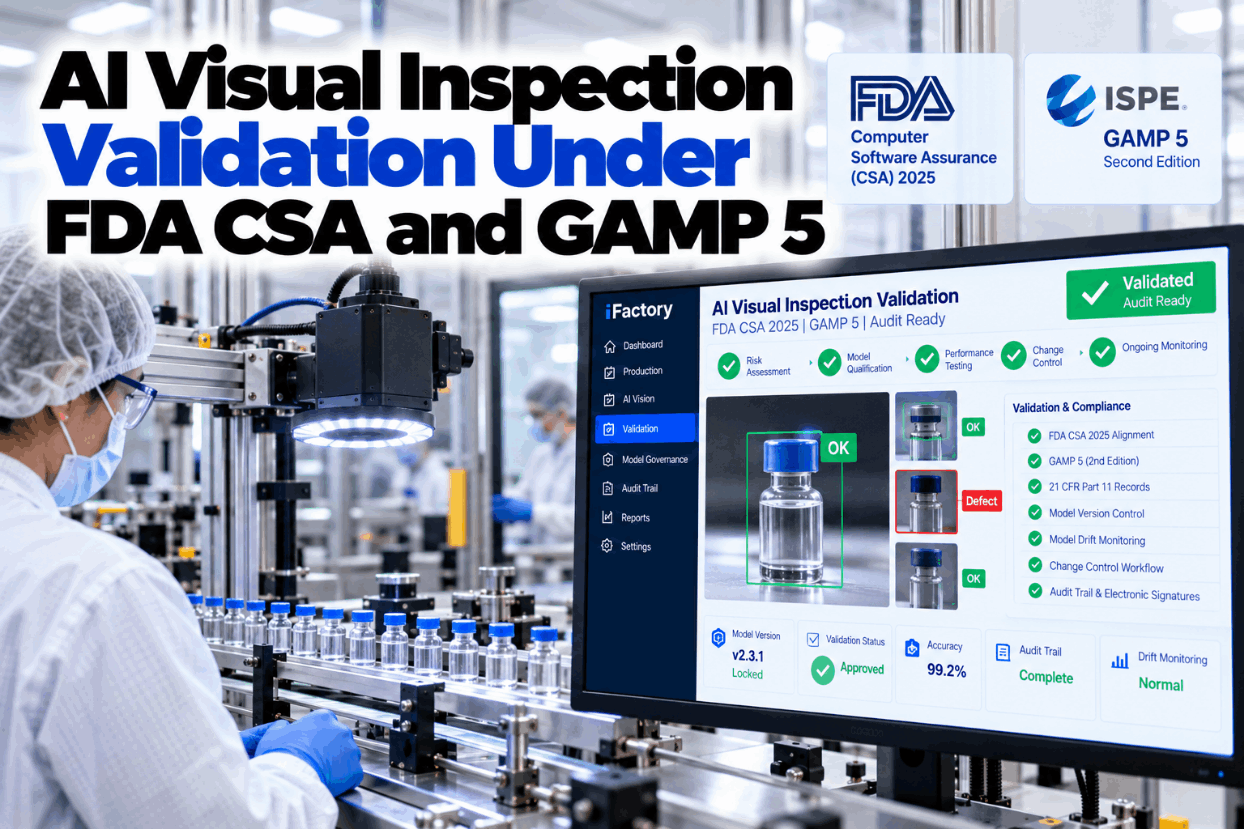
An AI model that inspects vials or syringes makes GMP decisions on every unit, so it has to be validated like any other GMP computerised system. The guidance has moved quickly. FDA finalised its Computer Software Assurance guidance in September 2025, ISPE published a GAMP guide on AI in July 2025, and the EU consulted on a draft Annex 22 for AI the same year. This guide turns that into a practical validation strategy for AI visual inspection, from qualifying the model to locking versions and watching for drift. See the records it produces in a short validation demo.
Validate AI Visual Inspection Once, Then Keep It Validated
iFactory Vision Audit Trail and Model Governance keeps every inspection model version-locked in a registry, routes each change through change control and watches live data for drift. Every result carries a Part 11 audit trail that names the exact model version behind it.
From Paper-Heavy Testing to Risk-Based Assurance
FDA's final guidance, Computer Software Assurance for Production and Quality System Software, was announced in the Federal Register on 24 September 2025. It comes from CDRH and CBER, covers software used in device production and quality systems, and replaces Section 6 of the 2002 General Principles of Software Validation. The final text also makes clear it can apply to AI tools used in those systems. Drug makers are not directly in scope, but the same risk-based logic sits at the heart of GAMP 5 Second Edition. Ask our validation team how it maps to your site.
- Same scripted depth for every function
- Screenshots as proof for each test step
- Documents written mainly for the auditor
- Vendor testing repeated in full on site
- Effort spread evenly, not by patient risk
- Start from intended use and process risk
- Scripted testing where failure could harm safety
- Unscripted, scenario and exploratory testing elsewhere
- System logs and audit trails used as evidence
- Vendor evidence leveraged after assessment
Eight Documents That Shape AI Inspection Validation
No single document covers AI visual inspection from end to end. Device rules, drug GMP, pharmacopeia chapters and industry guides each cover a piece, and two of the most relevant EU texts are still drafts. The matrix shows where each one stands and what it asks of an inspection model. Review it against your product portfolio in a strategy session.
Locked, Adaptive or Generative: Know Which One You Have
Draft Annex 22 draws a clear line. It applies to static models that do not adapt during use and that give identical outputs for identical inputs. It says dynamic models that keep learning, and models with probabilistic outputs, should not be used in critical GMP applications, and it does not apply to generative AI or large language models. A visual inspection model that accepts or rejects units is a critical use. Talk through your model types with our support team.
FDA's December 2024 guidance on Predetermined Change Control Plans covers AI-enabled device software functions in marketed medical devices. It is useful context for planned model changes, but it does not cover production or inspection software inside your plant.
Match the Testing Effort to the Risk of Each Function
CSA treats software as high process risk when its failure could cause a quality problem that foreseeably compromises safety. An AI model that rejects or passes injectables sits at the top of that scale. The dashboards around it do not. Splitting an AVI system by function keeps scripted effort where it matters. The tiers below are a typical split, not a rule. Build yours in a risk workshop.
Change Control That Knows Which Model Is Running
Every model version, training set and approval sits in one registry. When someone proposes a retrained model, the system shows what changed, what must be retested and which version is live until QA signs off.
Six Steps From Intended Use to Release
Draft Annex 22 sets out a sequence that suits any regulated AI inspection model, whichever market you sell into. A process expert describes the intended use, the test data stays separate from training data, and acceptance criteria are fixed before testing starts. The tested model then goes under configuration control. Plan each step with our validation team.
Showing the Model Matches or Beats Manual Inspection
USP <1790> bases the validation of an automated inspection system on comparison with compendial manual inspection. One established way to do this is the Knapp method, first described by Knapp and Kushner in 1980, which compares the probability of rejecting each unit in a characterised test set under manual and automated inspection. FDA's 2021 draft guidance on visible particulates also expects automated systems to meet or surpass human capability. These are the measures worth agreeing up front. Review them in a qualification call.
A Change Record for Every Model Version
Draft Annex 22 asks for any change to the model, the system or the process it runs in to be evaluated for retesting. Annex 11 and Part 11 already expect controlled change and system documentation. A model change record should carry enough to rebuild the decision later. Ask our support team for a blank version.
Catch Drift Before It Reaches a Batch
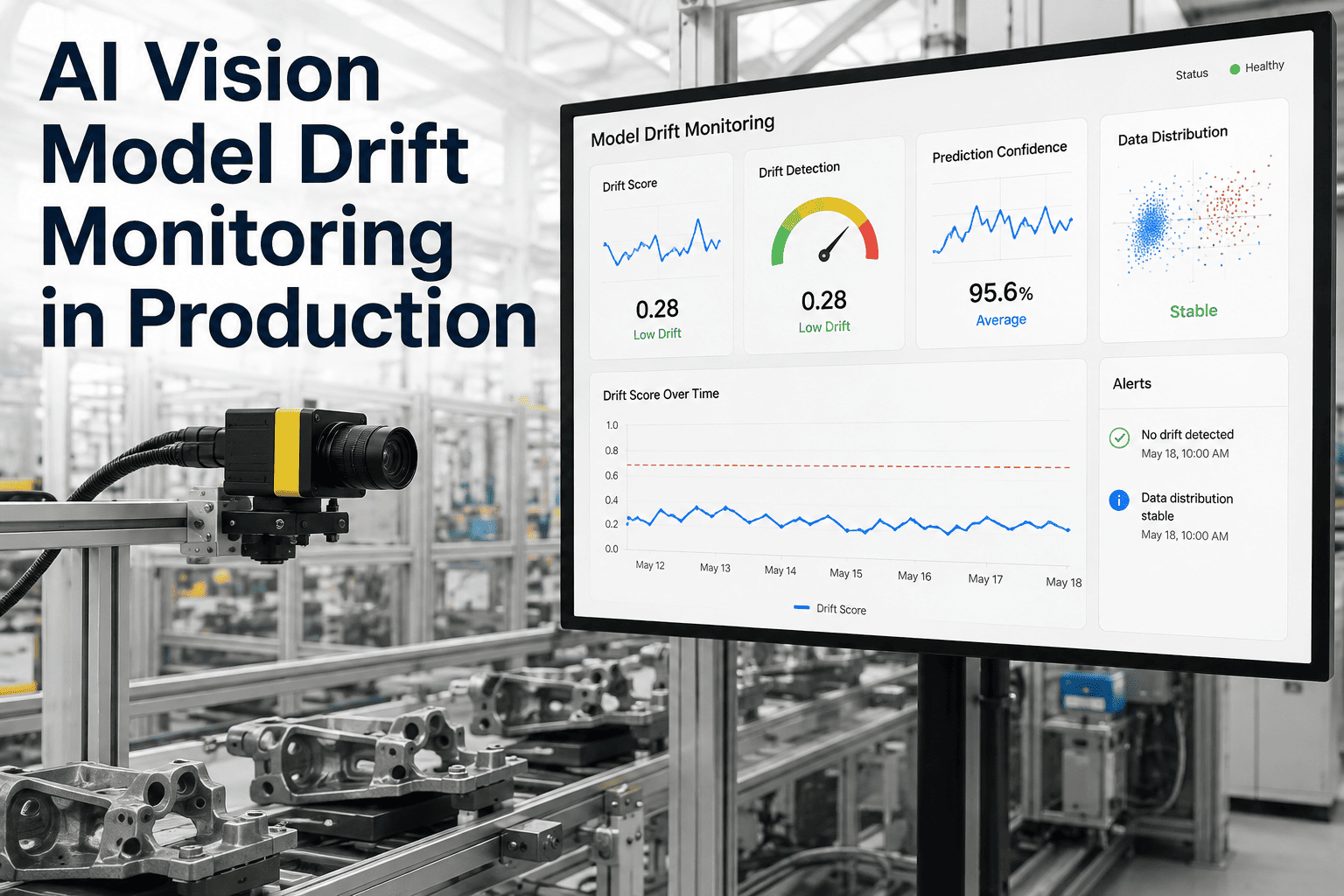
A locked model does not change, but the images it sees do. New glass suppliers, a lamp replaced during maintenance or a camera nudged out of position can push inputs outside the range the model was tested on. Draft Annex 22 asks for defined drift metrics and regular checks that inputs stay within the intended use. The example below is an illustration. See live monitoring in a drift demo.
What Part 11 Means for Each Inspection Result
Under Part 11, an AI accept or reject decision held as an electronic record needs the same controls as any other. FDA's CSA guidance also points to system logs and audit trails as good evidence, rather than screenshots. These are the clauses that matter most for model records. Get a sample audit export from our support team.
Inspection AI and Model Governance in One Package
iFactory delivers AI visual inspection with governance built in. A pre-configured NVIDIA AI server ships racked and ready with the model registry, audit trail and drift monitor pre-loaded, so images and records stay on site. You rack it, plug in power and Ethernet, and the AI is live. Scope it for your line with a turnkey quote.
- Pre-configured NVIDIA AI edge server, racked and ready
- Inspection cameras and lighting for your containers
- Model registry with version locking and hashes
- Change control workflow with QA e-signatures
- Drift, confidence and undecided-rate monitoring
- Part 11 audit trail for every inspection result
- 24×7 remote monitoring of models and hardware
Hardware installed, intended use and requirements written, risk assessment done by function.
Model trained, independent test set built, shadow run compared with manual inspection.
Protocols run, model locked and released under change control, QA team trained.
Regulated AI That Stays in a Validated State
iFactory keeps the evidence that inspectors and QA ask for in the same place the model runs. Our support team can walk you through a pilot plan.
What Validation and QA Teams Ask About AI Inspection
Put Your Inspection AI on a Validated Footing
Lock model versions, control every change, watch for drift and keep Part 11 records for each result. Delivered turnkey and live in 6 to 12 weeks.