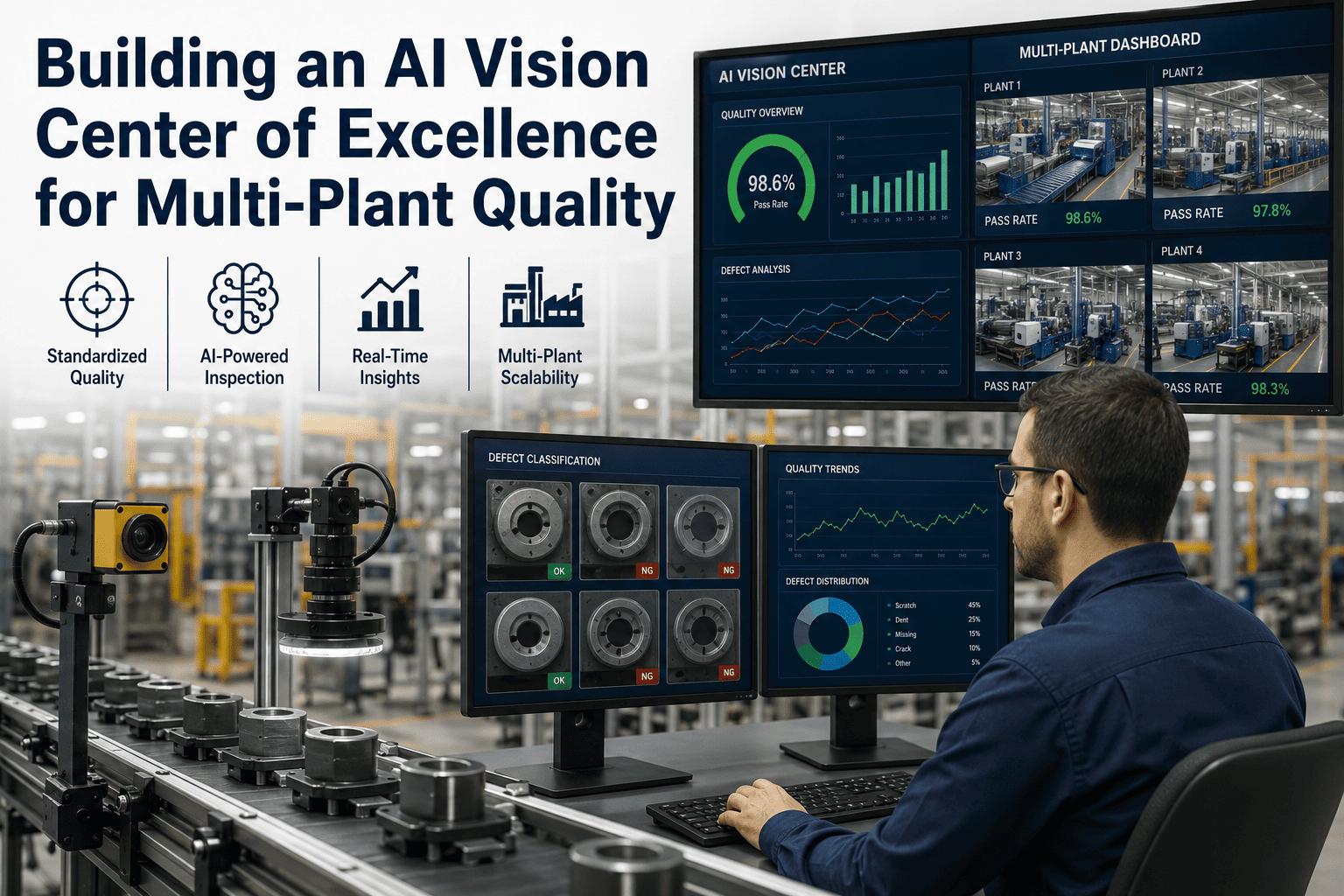
In the era of Industry 4.0, manufacturing enterprises face an escalating challenge: maintaining consistent, world-class product quality across multiple plants, each with its own equipment, workforce, and operational culture. Traditional quality inspection methods, relying on manual visual checks or isolated machine vision systems, are no longer sufficient to meet the demands of high-volume, high-precision production. An AI Vision Center of Excellence (CoE) emerges as the strategic solution, centralizing the development, deployment, and governance of computer vision models for automated defect detection and quality assurance. This comprehensive guide provides a deep-dive, enterprise-grade blueprint for building such a CoE, covering organizational design, technical standardization, data sharing, deployment methodologies, and performance management. Whether you are a Plant Manager, CTO, or Maintenance Director, this guide will equip you with the insights needed to transform your multi-plant quality strategy. Book a Demo to explore how iFactory can accelerate your AI vision journey.
Ready to Transform Your Quality Inspection?
Standardize defect detection across all plants with a centralized AI Vision Center of Excellence. Let our experts guide your strategy.
The Imperative for a Vision Center of Excellence
Manufacturing quality is no longer a local plant responsibility—it is a strategic enterprise imperative. Inconsistent inspection standards, redundant model training, and siloed data across plants lead to higher defect rates, increased rework costs, and diluted brand reputation. An AI Vision CoE addresses these challenges by creating a unified framework for vision model development, camera specification standardization, dataset sharing, and deployment governance. This centralized approach ensures that every plant benefits from the best available models, data, and expertise, while maintaining the agility to adapt to local production nuances. For enterprises operating 5, 10, or 50+ plants, the CoE model is the only scalable path to achieving Six Sigma-level quality consistency.
Centralized Model Development
Eliminate redundant efforts by building and refining vision models in a single, expert-led team. Models are then distributed to all plants, ensuring uniform defect detection capabilities. This reduces development time by up to 60% and accelerates time-to-value.
Standardized Camera Specifications
Define enterprise-wide camera hardware standards—resolution, frame rate, lighting, optics—to ensure consistent image quality across plants. This eliminates variability caused by disparate equipment and simplifies maintenance and upgrades.
Shared Training Datasets
Aggregate defect images from all plants into a centralized, labeled dataset. This rich, diverse dataset dramatically improves model accuracy and robustness, especially for rare defect types that may not appear in a single plant's production.
Consistent Deployment Standards
Establish a common deployment pipeline, including edge device configurations, model versioning, and monitoring dashboards. This ensures every plant runs the same high-quality models with the same performance metrics.
Step-by-Step Methodology for Building Your AI Vision CoE
Assess Current State & Define Vision
Conduct a comprehensive audit of existing vision systems, data quality, and personnel skills across all plants. Engage stakeholders from quality, IT, and operations to define a unified vision for the CoE, including key performance indicators (KPIs) such as defect detection rate, false positive rate, and model deployment time.
Design Organizational Structure
Establish the CoE as a dedicated unit reporting to the VP of Quality or CTO. Include roles such as AI Vision Architect, Data Engineer, Model Trainer, Deployment Specialist, and Plant Liaisons. Define clear governance for model approval, dataset access, and change management.
Standardize Hardware & Software Stack
Select and document enterprise-wide camera models, lenses, lighting solutions, and edge computing platforms. Choose a unified AI framework (e.g., TensorFlow, PyTorch) and MLOps platform (e.g., MLflow, Kubeflow) to manage the model lifecycle.
Build Centralized Data Lake
Create a secure, cloud-based data lake to ingest, store, and label images from all plants. Implement data quality checks, automated labeling pipelines, and version control for datasets. Ensure compliance with data privacy and security policies.
Develop & Train Foundation Models
Train base vision models using the centralized dataset, focusing on common defect types (e.g., scratches, dents, discoloration, misalignment). Use transfer learning to adapt models for plant-specific variations. Continuously retrain with new data to improve accuracy.
Deploy, Monitor & Iterate
Roll out models to plants using a phased approach, starting with a pilot plant. Monitor model performance in real-time using dashboards, collect feedback from quality teams, and establish a feedback loop for continuous improvement. Scale to remaining plants after validation.
Key Components of a Vision CoE
| Component | Description | Enterprise Impact |
|---|---|---|
| Model Registry | Central repository of all approved vision models with versioning, metadata, and performance history. | Ensures traceability and reproducibility; reduces model drift risk. |
| Data Annotation Pipeline | Automated toolchain for labeling images, including active learning to prioritize uncertain samples. | Reduces annotation time by 70%; improves model accuracy. |
| Edge Device Management | System for remote monitoring, updating, and troubleshooting of edge inference devices at each plant. | Minimizes downtime; ensures consistent inference performance. |
| Quality Dashboard | Real-time visualization of defect rates, model alerts, and plant-level quality metrics. | Enables data-driven decision-making; accelerates root cause analysis. |
| Governance & Compliance | Policies for data security, model validation, and audit trails to meet regulatory requirements. | Mitigates risk; builds trust with stakeholders. |
Accelerate Your AI Vision Deployment
Leverage iFactory's expertise to build a world-class Vision Center of Excellence. Our platform integrates seamlessly with your existing infrastructure.
Deep Dive: Data Standardization for Multi-Plant Vision
Data is the lifeblood of any AI vision system, but in a multi-plant environment, data heterogeneity is a major obstacle. Different plants may use different camera models, lighting conditions, and image resolutions, leading to inconsistent model performance. A Vision CoE must enforce strict data standardization protocols. This includes defining minimum image resolution (e.g., 1920x1080), color space (sRGB), file format (PNG or JPEG), and naming conventions. Additionally, every image must be accompanied by metadata such as plant ID, production line, timestamp, and defect label. This metadata enables the CoE to analyze model performance across plants and identify domain shifts. For example, a model trained primarily on images from Plant A may perform poorly on Plant B's images due to different lighting angles. By standardizing data collection and metadata, the CoE can quickly detect and address such issues through targeted retraining or data augmentation.
Another critical aspect is data labeling quality. Inconsistent labeling across plants—e.g., one plant labels a scratch as 'minor defect' while another labels it as 'critical'—can confuse the model. The CoE must establish a centralized labeling guideline with clear definitions, examples, and a review process. Using a tool like Label Studio or Supervisely, the CoE can manage labeling projects, assign tasks to plant experts, and perform quality audits. Active learning techniques can further optimize labeling efforts by automatically selecting the most informative images for human review. This not only reduces labeling cost but also accelerates model improvement. Finally, data versioning is essential to track which dataset was used to train each model version, enabling reproducibility and rollback if needed.
Edge vs. Cloud Inference
Deciding where to run inference—on edge devices at the plant or in the cloud—is a key architectural decision. Edge inference offers low latency (milliseconds) and operates even with intermittent network connectivity, ideal for real-time quality gates. Cloud inference provides virtually unlimited compute for complex models and enables centralized model updates. The CoE should adopt a hybrid approach: deploy lightweight models on edge for real-time decisions, and use cloud for model training, retraining, and handling complex or rare defect cases. This balances performance, cost, and scalability.
Model Monitoring & Drift Detection
Once deployed, vision models can degrade over time due to changes in lighting, camera wear, or new defect types. The CoE must implement automated drift detection by comparing model predictions against ground truth labels from quality audits. Statistical tests (e.g., population stability index) can trigger retraining workflows when performance drops below a threshold. Monitoring dashboards should display per-plant accuracy, false positive rates, and coverage metrics, enabling proactive intervention.
Change Management & Plant Adoption
Technical excellence alone is insufficient; plant teams must embrace the new system. The CoE should establish a plant liaison program, where each plant has a dedicated contact who understands local processes and can champion the CoE. Regular training sessions, clear documentation, and a feedback mechanism (e.g., monthly reviews) foster adoption. Celebrate quick wins—such as a plant reducing defect rates by 20%—to build momentum.
Frequently Asked Questions
How long does it take to set up an AI Vision Center of Excellence?
The timeline depends on the number of plants, existing infrastructure, and data readiness. Typically, a pilot CoE can be established in 3–6 months, including organizational design, hardware standardization, and initial model deployment. Full enterprise rollout may take 12–18 months. Book a Demo to get a personalized timeline for your organization.
What is the ROI of a Vision CoE compared to isolated plant deployments?
Isolated deployments often duplicate efforts and yield inconsistent results. A centralized CoE reduces model development costs by 40–60%, improves defect detection accuracy by 15–25%, and accelerates time-to-value by 30–50%. Additionally, shared datasets and best practices lead to faster continuous improvement. Contact Support for a detailed ROI analysis tailored to your operations.
Do we need to replace existing vision systems to adopt a CoE?
Not necessarily. The CoE can integrate with existing camera systems by standardizing image capture parameters and adding an edge device for inference. Legacy systems can be retrofitted with sensors and software to feed data into the centralized data lake. A phased migration plan minimizes disruption. Book a Demo to discuss integration options.
How do we ensure data security and intellectual property protection?
The CoE should implement role-based access control, data encryption (both at rest and in transit), and anonymization of sensitive images. Use a private cloud or on-premises deployment for highly confidential data. Regular security audits and compliance with standards like ISO 27001 build trust. Contact Support for our security whitepaper.
What skills are needed to staff a Vision CoE?
Key roles include AI/ML engineers with computer vision expertise, data engineers for pipeline management, MLOps engineers for deployment, and domain experts from quality and manufacturing. Soft skills in change management and cross-functional communication are equally vital. iFactory offers training programs to upskill your team. Book a Demo to learn more.
Build Your AI Vision Center of Excellence Today
Partner with iFactory to design, deploy, and scale a world-class vision CoE. Achieve consistent, Six Sigma-level quality across all your plants.