Checklist: AI Vision Camera Deployment Best Practices for Manufacturers

By Austin on May 23, 2026

checklist-ai-vision-camera-deployment-best-practices

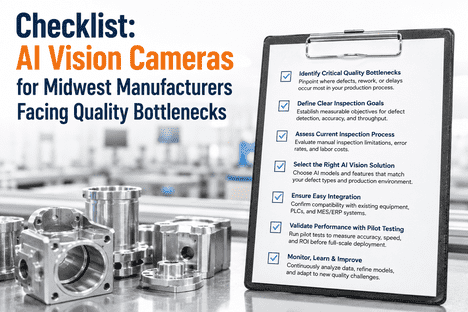
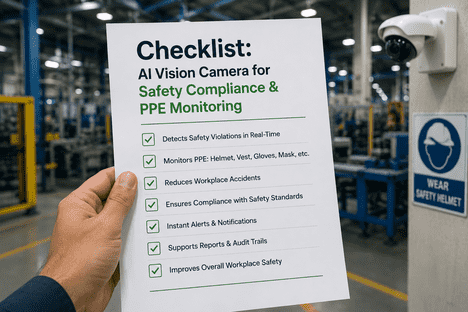
AI vision camera deployment in industrial manufacturing environments demands more than just hardware installation — it requires a structured, validated approach to site readiness, model calibration, integration logic, and operator training. Poorly deployed vision AI systems generate excessive false positives, miss critical defects, and erode trust on the production floor. ifactory's AI Vision Camera platform is purpose-built for food processing and discrete manufacturing, delivering real-time quality inspection, safety compliance monitoring, and process analytics from a single connected interface. Book a Demo to see how ifactory guides your team through every stage of vision AI deployment — from mounting geometry to production-grade model validation.

AI VISION CAMERAS DEPLOYMENT BEST PRACTICES QUALITY INSPECTION

Deploy AI Vision Cameras Across Your Production Floor with Confidence

Follow a structured deployment checklist that covers site preparation, camera calibration, AI model training, and live production integration — fully aligned with your manufacturing quality and compliance requirements.

Why a Structured Deployment Checklist is Critical for Vision AI Success

Poor Installation Geometry is the Root Cause of Most Vision AI Failures

Even a high-accuracy AI model will fail if cameras are mounted at incorrect angles, improper focal distances, or under inconsistent lighting. In high-speed production lines — particularly snack packaging and bottling — even a 5° tilt in camera placement reduces defect detection accuracy by up to 40%. A structured site survey and mounting checklist ensures every camera sees exactly what the model was trained to inspect, eliminating the most common source of deployment failure before it starts.

Undertrained Models Drive False Positives That Halt Production

AI vision models trained on insufficient sample sets generate high false-positive rates that trigger unnecessary line stops and erode operator confidence in the system. In food manufacturing environments, where product variability is high (color, shape, texture), models require exposure to thousands of labeled samples across multiple shifts and lighting conditions. ifactory's deployment framework mandates a minimum validation dataset and accuracy threshold before any model goes live, protecting throughput while maintaining inspection integrity. Book a Demo to see how ifactory validates models before go-live.

1. Site Readiness and Environment Assessment
2. Camera Hardware Selection and Mounting
3. Network Infrastructure and Edge Computing Setup
4. AI Model Training and Dataset Preparation
5. PLC Integration and Rejection Mechanism Validation
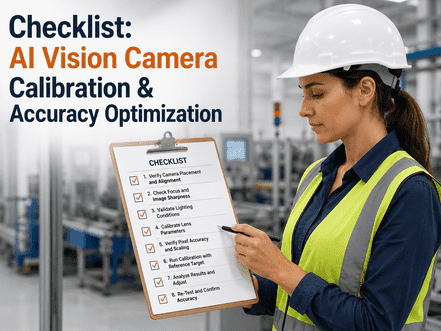
6. Camera Calibration and Image Quality Verification
7. Operator Training and HMI Usability Review
8. Production Validation, Go-Live, and Continuous Improvement
VISION AI DEPLOYMENT REAL-TIME INSPECTION

Ready to Deploy AI Vision Cameras Across Your Production Lines?

Automate defect detection, rejection actuation, quality compliance logging, and continuous model improvement — and eliminate manual inspection bottlenecks with ifactory's AI Vision Camera platform.

Benefits of Following a Structured AI Vision Camera Deployment Checklist

98%+ Defect Detection Accuracy at Full Line Speed

A properly calibrated and validated AI vision system achieves detection accuracy that no manual inspection team can sustain over a full shift — eliminating missed defects due to fatigue, lighting variation, or product position inconsistency across every unit produced.

60% Reduction in Quality Inspection Labor Costs

Automating visual inspection tasks — label verification, fill level checks, seal integrity, and foreign object detection — eliminates the need for dedicated inspection headcount on high-speed lines, reallocating skilled workers to higher-value quality assurance roles.

Zero Line Downtime from Vision System Failures

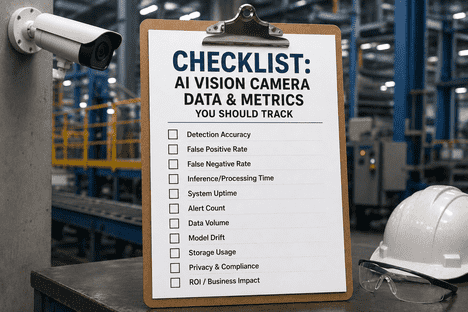
Predictive monitoring of camera health, lighting intensity, and inference latency allows engineering teams to schedule maintenance proactively — preventing the silent failures that cause batches of defective product to pass uninspected through the full production run.

Full SQF, BRC, and FSMA Compliance Documentation

Every inspection event, defect image, rejection record, and model version is logged with a timestamp to an immutable audit trail — providing the objective evidence required for third-party food safety certification audits with zero manual record compilation effort.

Continuous Model Improvement with Active Learning

ifactory's active learning pipeline automatically identifies low-confidence detections, routes them for human verification, and incorporates confirmed samples into the retraining cycle — so the AI becomes more accurate every week without requiring a dedicated data science team on-site.

Multi-Line, Multi-SKU Scalability from a Single Dashboard

Once the deployment framework is established on the first line, ifactory replicates the camera configuration, model, and alert logic across additional lines and SKUs in days rather than months — providing a scalable inspection architecture that grows with the facility's production capacity.
AI Vision Camera Deployment FAQs

1. How long does a typical AI vision camera deployment take from site survey to live production?
A structured deployment following this checklist typically takes 6 to 10 weeks from initial site survey to validated go-live. The longest phase is dataset collection and model training (3–4 weeks), which can be accelerated if the customer has existing quality defect image archives. PLC integration and shadow-mode validation add 1–2 weeks before the system is cleared for live automated rejection.
2. What happens if the AI vision camera loses network connectivity during production?
ifactory deploys edge inference units that continue processing and making reject decisions locally even during a WAN or cloud connectivity outage. All inspection records are buffered on the edge device and synced to the central dashboard once connectivity is restored. A network outage does not pause the inspection system or require a line stop.
3. Can ifactory's AI vision cameras inspect multiple defect types simultaneously on the same line?
Yes. ifactory's multi-class detection models can inspect for up to 15 distinct defect classes in a single inference pass — including label misalignment, underfill, foreign objects, color deviations, and seal integrity — without any reduction in throughput or increase in latency. Each defect class is logged independently for granular quality reporting.
4. How does ifactory handle new product SKU introductions after the initial deployment?
New SKUs require a dedicated dataset collection run (minimum 200 images per defect class) followed by a model fine-tuning cycle that typically takes 48 to 72 hours. ifactory's model management platform allows quality teams to add and activate new SKU profiles directly from the production dashboard without requiring engineering involvement for each change.
5. What is the minimum lighting standard required for ifactory AI vision camera installations?
ifactory recommends a minimum of 2,000 lux at the product surface with a uniformity ratio of 80% or higher across the full field of view. Dedicated coaxial or dome lighting is required for reflective products (e.g., foil packaging). Natural or ambient-only lighting is not sufficient for production-grade AI inspection and will result in significant model drift between shifts.
6. What ROI can manufacturers expect from an AI vision camera deployment?
Most ifactory customers achieve full ROI within 9 to 14 months, driven by the elimination of quality-related product recalls, reduction in inspection labor headcount, and the recovery of yield lost to false rejects on manual inspection lines. Facilities running high-speed packaging lines typically see the fastest payback, as the per-unit inspection cost at 300+ units per minute makes manual inspection economically unsustainable.
GET STARTED DEPLOY TODAY

Digitize Your Quality Inspection with AI Vision Camera Analytics

Join manufacturers who have eliminated manual inspection bottlenecks, achieved 98%+ defect detection accuracy, and built audit-ready quality documentation with ifactory's AI Vision Camera platform.


Share This Story, Choose Your Platform!