AI Vision Camera Deployment Checklist: 50 Points Before Go-Live
By Johnson on July 20, 2026
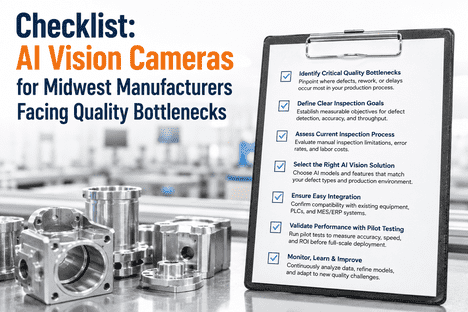
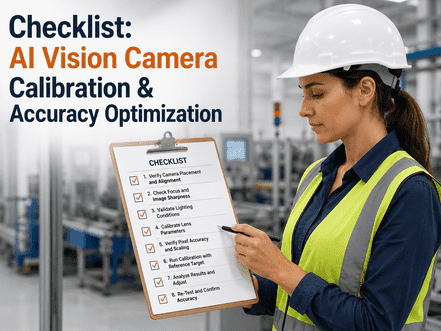
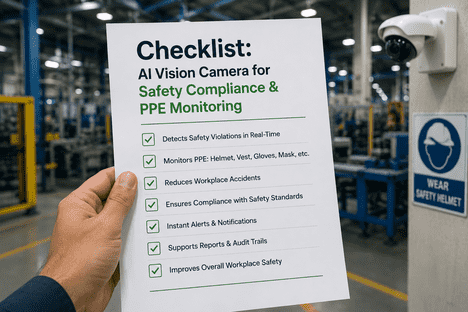
Deploying an AI vision camera on a production line is not plug-and-play. It spans site survey, camera and lighting engineering, edge compute setup, model training, PLC and MES integration, and formal validation. Skip an upstream step and you inherit false positives, missed defects, and stalled ROI for months. This 50-point checklist gives engineers and quality managers a field-tested sequence to follow before go-live, so week one in production looks like your acceptance test — to see how iFactory AI runs every phase with your team, book a demo.
AI Vision Deployment Playbook
50 Points to Verify Before Go-Live on Your First AI Vision Camera
A phase-by-phase checklist covering camera placement, lighting, network setup, model training, PLC/MES integration, operator training, and validation — for engineers rolling out AI vision in real production.
Why AI Vision Projects Struggle Without a Structured Checklist
AI vision projects fail for predictable reasons — almost never because the model is bad. They fail because lighting made defects invisible, the lens blurred at line speed, the edge box could not reach the PLC, or operators never learned to respond to alerts. Structured checklists reach production accuracy in days; skipping them buys 90 days of chasing symptoms.
99.9%
Detection accuracy on commissioned edge vision systems
1–3 days
Go-live window for pre-planned deployments
60%
Defect-escape reduction in scaled rollouts
<100 ms
Inference latency for real-time reject actuation
The 50 checkpoints below map to the AIA commissioning sequence — IQ, OQ, and PQ. Each phase has clear entry and exit criteria: do not proceed until every box is verified, logged, and signed off.
Deployment Phase Map — 50 Checkpoints Across 5 Phases
01
Pre-Deployment Planning
Scope, defects, ROI, ownership
02
Camera & Lighting Setup
Optics, geometry, image quality
03
Network & Edge Compute
Subnets, protocols, edge GPU, security
04
Model Training & Tuning
Images, labels, thresholds, validation
05
Integration & Go-Live
PLC/MES, training, PQ sign-off
Phase 1: Pre-Deployment Planning (10 Checkpoints)
Every failed vision project traces back to a planning gap. Before a camera arrives on site, the team needs consensus on which defects are in scope, what accuracy defines success, and how the vision output feeds downstream systems.
Phase 1 — Scope, Defects & ROI
Field Note
Every hour spent on Phase 1 saves roughly a day of rework after go-live. Teams that treat planning as an artifact-driven phase — written spec, defect gallery, acceptance criteria signed off before hardware arrives — ship faster than teams that figure it out on site. Book a demo to walk through the iFactory planning template.
Phase 2: Camera Placement, Optics & Lighting Setup (10 Checkpoints)
Lighting is the most underestimated variable and the top cause of false positives after go-live. Correct geometry makes defects visible; wrong geometry generates shadows no model can filter. Execute this phase on the physical line at production speed, not on a bench.
Phase 2 — Optics, Lighting & Image Quality
Get the iFactory AI Vision Deployment Kit
Pre-configured cameras, NVIDIA edge GPU, PLC templates, and operator training — kickoff to validated go-live in 6–12 weeks.
A perfectly placed camera cannot deliver value if the edge box cannot reach the PLC or push events to the MES. This phase covers the industrial IT foundation — GigE cabling, OPC-UA endpoints, edge inference hardware, segmentation, and secure remote access.
Phase 3 — Network, Edge & Security
Phase 4: Model Training, Threshold Tuning & Validation (10 Checkpoints)
The model is the most visible part of the deployment and the most likely to be over-trusted. Lab-perfect training degrades within days of production exposure. This phase gates the shift to trusted inference — diverse images, consistent labeling, tuned thresholds, and parallel inspection.
Training Data Reference Ranges — Deep Learning Vision Models
Parameter
Minimum
Recommended
Risk if Below
Good-part images per class
300
1,000+
Model over-flags variations
Defect images per class
100
500+
Rare defects go undetected
Lighting variations captured
2
All shift conditions
Accuracy drops after shift change
Product variants covered
Top 3 by volume
All SKUs on line
False positives on SKU switch
Parallel inspection duration
72 hours
2 full weeks
Edge cases missed pre go-live
Confidence threshold tuning
1 iteration
3+ iterations
Operator alert fatigue
Phase 4 — Data, Model & Threshold
Phase 5: Integration Testing, Operator Training & Go-Live (10 Checkpoints)
The final ten checkpoints turn a prototype into a production system. PLC handshakes get tested end-to-end, reject actuators are timed, operators build muscle memory, and the PQ test locks in a signed record. Skip these and a successful pilot becomes a system operators bypass in two weeks.
Phase 5 — Integration, Training & PQ Sign-Off
Deployment Timeline — A Real 8-Week Rollout
Structured deployments run on a repeatable timeline. The pattern below is a single-station rollout at a mid-volume line — scale each phase for multi-camera projects. Every week has an owner and a filed artifact.
Week 1
Kickoff & Site Survey
Defect gallery review, line audit, environmental measurements, Phase 1 sign-off.
Week 2
Hardware Specification
Camera, lens, lighting, and edge compute selected. Network and PLC integration signed off.
Week 3–4
Install & Image Capture
Mount, cable, edge setup, and image capture at production speed across shifts.
Week 5–6
Model Training & Tuning
Labeling, training iterations, threshold tuning, and hold-out validation.
Expert Perspective — What Vision System Auditors Actually Look For
Field Perspective: AI Vision Deployment Audit
Based on AIA IQ/OQ/PQ Commissioning, DOE Manufacturing Guidelines & Field Deployment Reviews
Auditors returning six months after go-live see the same failures — almost none are model failures. Most common is lighting drift from ambient light leaks or a shield moved during troubleshooting. Second is a broken feedback loop — the model was never retrained on new defect types, so accuracy silently drops from 99% to 92% over a quarter.
Third is orphaned integration — a system producing good decisions never wired to MES or CMMS. Fourth and most preventable is operator drift: training done once, no refresher scheduled, and by month three the second shift silences alerts. A living SOP and quarterly retraining keep the system trusted.
Lighting drift is the top post-go-live failure — enclosure and shielding matter more than the model
Broken feedback loops silently degrade accuracy 5–10 points per quarter
Unwired integration wastes 60–80% of the deployment's business value
Operator retraining every 90 days is non-negotiable for sustained trust
Frequently Asked Questions
How long does a typical AI vision deployment take from kickoff to go-live?
A single-station deployment following a structured checklist typically takes 6–8 weeks from kickoff to validated go-live. Multi-camera or multi-line rollouts scale to 10–14 weeks for full-line coverage across 4–6 stations. The critical path is rarely hardware install; it is image collection across shifts, model training iterations, and the parallel inspection window before cutover. iFactory AI's turnkey approach — pre-configured cameras, NVIDIA edge GPU, and integration templates — targets the 6–8 week window. Book a demo to review a plan for your line.
Why is lighting more important than camera resolution or model accuracy?
Lighting geometry determines what the camera can physically see. A defect producing no contrast under the chosen light is invisible to every downstream stage — no lens, sensor, or model recovers what illumination did not reveal. Poor lighting is also the top cause of false positives, since shadows and reflections create features that mimic defects. Field data shows lighting engineering delivers more accuracy gain than model tuning and camera upgrades combined. This is why Phase 2 requires prototyping with actual parts at production speed before permanent mount.
How many training images do we actually need per defect type?
The practical minimum is 100 defect images and 300 good-part images per class. The recommended target is 500+ defect and 1,000+ good-part images per class for reliable generalization. Diversity matters more than raw count — images across every shift, variant, and material batch. A model trained on 5,000 identical day-shift images will underperform one trained on 800 images spanning realistic variation. The Phase 4 hold-out validation catches under-sampled classes before go-live.
What is the difference between IQ, OQ, and PQ in vision commissioning?
These are the three AIA-recognized phases of system bring-up. Installation Qualification (IQ) verifies hardware is installed to spec — serials, firmware, cable runs, IP ratings documented. Operational Qualification (OQ) verifies every function operates correctly under nominal and boundary conditions — image capture, inference, PLC signals, MES records. Performance Qualification (PQ) is the statistical acceptance test where the system must meet accuracy, false-positive, and latency targets. Skipping OQ before PQ is a documented cause of field failures requiring expensive remediation.
How does iFactory AI support the full 50-point deployment checklist?
iFactory AI is a turnkey vision platform covering every phase — pre-configured cameras with NVIDIA edge GPUs for sub-100ms inference, OPC-UA and Modbus templates for major PLC platforms, a browser-based model console, and a quality dashboard feeding MES, CMMS, and executive reporting. Our team runs the site survey, defect capture, training, and IQ/OQ/PQ sign-off with your engineers — typically completing all 50 checkpoints in a 6–12 week engagement. For scope detail, contact support or book a live demo tailored to your line.
Ready to Run Your First AI Vision Deployment on a Proven Checklist?
iFactory AI's turnkey team runs all 50 checkpoints with your engineers — site survey to PQ sign-off in 6–12 weeks. See it on your product and line speed before you commit.