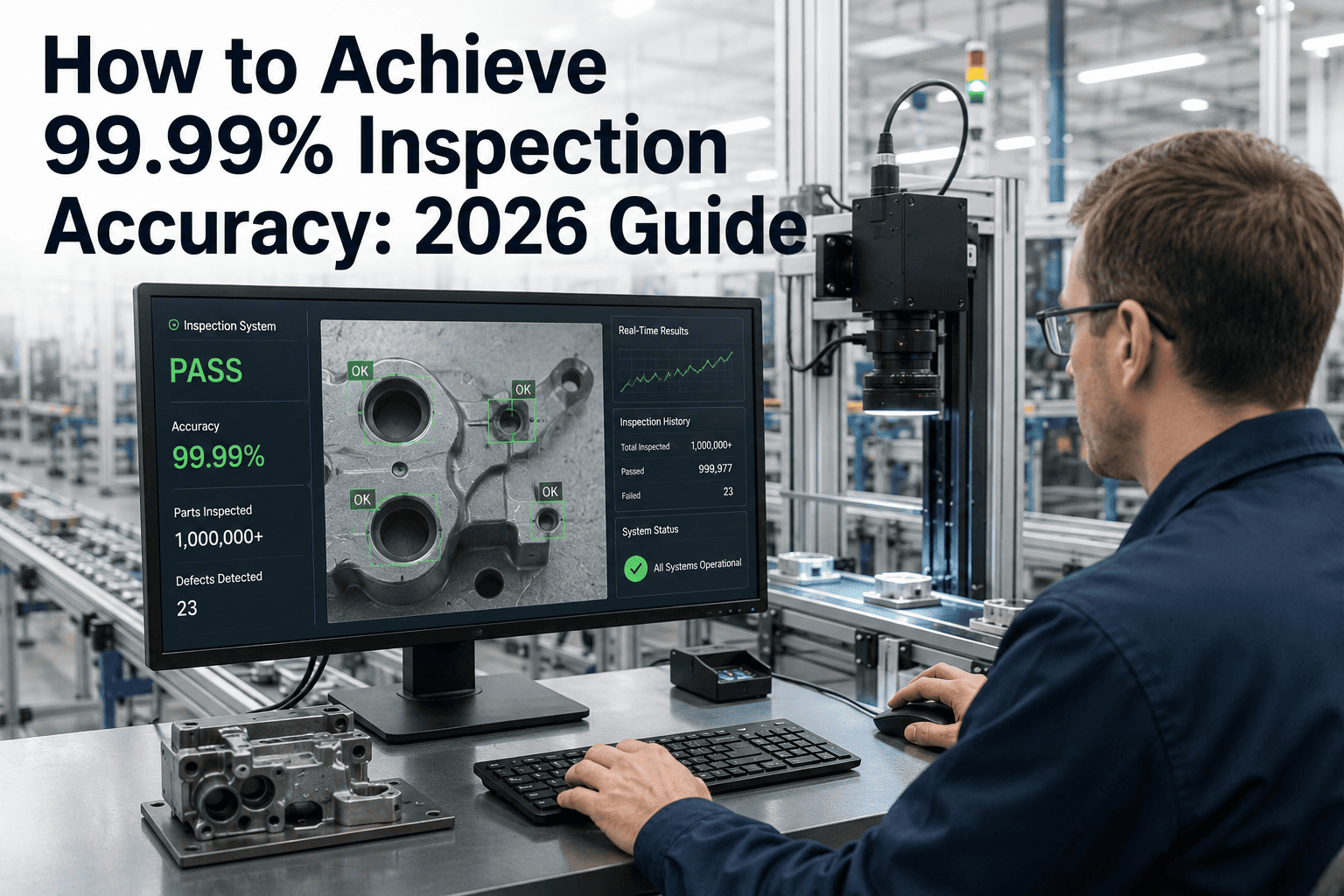
Reaching 99.99% inspection accuracy — the "four nines" that separates a good vision line from a genuinely reliable one — is not a matter of buying a better camera. It is the outcome of five decisions made together: the physical capture stack, the training data pipeline, the model architecture, the runtime governance, and the human review loop. Most manufacturers stall between 97% and 99% because one of those five is under-invested, and that single weak layer sets the ceiling for the entire system. Quality leaders mapping their own path to four-nines detection can start by talking with the iFactory support team about where their current stack is capped.
99.99% Accuracy Isn't a Camera Spec. It's a Five-Layer Discipline.
The gap between 99% and 99.99% is a hundred times fewer escapes — and it lives in the layers most vendors don't talk about. iFactory's AI vision stack is built to close all five: capture, data, model, runtime, and review.
Why "99%" Is the Number Everyone Reaches and Nobody Trusts
Almost every vision vendor can quote a 99% accuracy figure from a lab bench. The reason most plants still ship defects is that the number does not survive the walk from the lab to the line — because five separate failure modes eat away at it, and no single fix closes them all.
Four-nines accuracy is not the peak reading on day one. It is the number the system holds at month twelve, on the busiest shift, on the hardest defect class, without a specialist babysitting the model.
The Five Layers of a Four-Nines Inspection Stack
Every layer below has its own failure mode and its own set of decisions. A weakness in any one of them caps the accuracy of the entire line — no matter how good the other four are.
Capture — Cameras, Optics, and Lighting
If the defect is not clearly resolved in the pixels, no model will find it. Four-nines lines run industrial-grade sensors (typically 8 MP or higher), structured lighting matched to the defect physics (darkfield for scratches, backlight for silhouette, coaxial for reflective surfaces), and enclosures that isolate the camera from ambient light swings.
Training Data — Coverage of the Long Tail
Common defects are easy. Four-nines accuracy is decided on the rare ones — the classes with fewer than a hundred examples in three years of production. A mature library curates images across every known defect type, every product variant, every lighting condition, and deliberately synthesises examples for the rare tail using augmentation.
Model — Architecture Matched to the Defect
A single detection model rarely wins across every defect physics. Modern four-nines stacks combine a fast localiser (YOLO-family or similar) with a segmentation head for pixel-level defects and an anomaly-detection branch for the classes that were never seen during training, then fuse the outputs before a decision is made.
Runtime — Edge Inference and Line Integration
Accuracy on paper is useless if the decision arrives after the reject actuator has closed. Four-nines lines run inference on-edge with a strict per-part latency budget, integrate the pass or fail signal directly into PLC or SCADA logic, and log every decision with a full image trace for later audit and retraining.
Review — Active Learning and Drift Response
The last tenth of a percent is bought with a review loop. Operators triage borderline calls, disagreements between the model and QC are fed straight back into the training queue, and the model is retrained on a defined cadence so that model drift is detected and corrected before it shows up in an escape.
See Where Your Line Is Capped Today
Every inspection line has one layer holding it back — usually not the one the team assumes. Book a 30-minute walkthrough and we will map your current stack against the four-nines model, layer by layer.
The Metrics That Actually Matter (and the Ones That Mislead)
A single "accuracy" number hides too much. Four-nines programs report against a small set of separate, well-defined metrics so that a change in one does not silently degrade another.
| Metric | What It Measures | Four-Nines Target | Why It Matters |
|---|---|---|---|
| Detection Rate (Recall) | Share of true defects the system flags | ≥ 99.99% | Directly controls how many defects escape to the customer |
| False Positive Rate | Good parts incorrectly rejected | ≤ 0.5% | Runs scrap and rework cost up if left uncontrolled |
| Precision | Share of flagged parts that really are defective | ≥ 98% | Tells operators whether they can trust the system's rejects |
| Inference Latency | Time from image capture to pass or fail decision | < 200 ms | Decides whether the system can keep line speed at full production rate |
| Drift Delta | Accuracy change vs. the baseline over 30 days | ≤ 0.2 pt | Early warning that the model needs retraining before escapes happen |
| Coverage | Share of production actually inspected by the system | 100% | Sampling-based inspection cannot mathematically reach four nines |
The 12-Week Roadmap From Baseline to Four-Nines
A realistic four-nines deployment moves through three overlapping phases. The timing below reflects what iFactory sees on typical single-line rollouts; portfolios spanning multiple lines follow the same shape, sequenced across the sites.
Baseline & Capture Build-Out
Cameras, lighting, and mounts installed on the target inspection points. The existing manual or rule-based inspection continues in parallel as the reference. Three years of prior defect images are pulled from records to seed the training library.
Model Training & Shadow Mode
The vision model trains on the curated library and runs in shadow mode against the live line — making calls but not yet actuating rejects. Every disagreement between the model and the reference process is reviewed and used to close gaps in the training data.
Go-Live & Active Learning
The system takes over the reject decision, integrated into PLC or SCADA control. Operator review queues are turned on for borderline calls, KPI dashboards go live for quality leadership, and the retraining cadence is set for the following ninety days.
A Composite Scenario: How One Assembly Line Closed the Gap From 99.1% to 99.99%
A tier-one components manufacturer running a high-volume assembly line was sitting at 99.1% detection accuracy — well above manual inspection, but still allowing roughly one defective part in a hundred to reach customer receipt. Field returns and warranty claims tied to those escapes were costing an estimated $1.4 million a year, and the internal quality team could not identify a single cause because the defects spanned three different classes.
A layer-by-layer audit showed the ceiling was not the model, which was already a modern multi-head architecture. The capture layer was under-resolving a subtle surface class because the original lighting geometry was tuned for a different defect physics, and the review layer had no active learning path back into training, so a slow drift over eight months had gone uncorrected. Fixing both — new structured darkfield lighting on two stations and a daily borderline review queue feeding retraining every sixty days — lifted the line to 99.99% detection over the following quarter.
The same layer-audit approach has since been applied to two adjacent lines using the first deployment as the template — an important lesson: a four-nines program tends to expand line by line, not plant by plant, and the audit framework is what makes each new rollout faster than the last.
Common Reasons Four-Nines Programs Stall
Buying the Camera Before the Defect Physics Are Understood
Sensor and lens choices that look impressive on a spec sheet often fail on defects that need a very specific lighting geometry. The physics of the defect should drive the capture stack, not the other way around.
Chasing Accuracy Without Measuring False Positives
A system tuned only for detection rate quickly starts rejecting good parts, and operators lose trust and start bypassing the reject signal — which collapses the effective accuracy to zero.
Treating the Model as Finished at Go-Live
Product variants change, materials shift, and new defect classes appear. Without a retraining cadence and an active learning queue, a model that hit 99.99% at launch will drift below 99% within a year.
Running Inference in the Cloud on a Fast Line
Round-trip latency to a cloud endpoint is fine for offline analytics, but on a line running hundreds of parts a minute the decision arrives after the actuator has already passed the part. Inference belongs on edge.
Sampling Instead of 100% Inspection
Statistical sampling was born because human 100% inspection was uneconomic. AI vision removes that constraint, and a program that samples cannot mathematically reach four nines — only full-coverage inspection can.
No Owner for Long-Term Model Health
If nobody in the quality organisation owns the retraining cadence, drift dashboards, and label review queue, the system silently degrades. A named owner is as important as any piece of hardware in the stack.
Four-Nines Readiness Check
You know the physics of your top three defect classes
Being able to describe what makes each defect visible — surface, sub-surface, dimensional, contamination — is what tells the capture layer which lighting and sensor combination to use, and it is the single most useful input into a scoping conversation.
You have three years of defect records in some usable form
Images, reject bin samples, QC reports — any form of prior evidence can be curated into the training library that gets the model past 99%. The library only has to be started; it does not have to be perfect on day one.
Your line control can accept a pass or fail signal from a vision system
A PLC or SCADA layer that can take a real-time reject signal from an external system is the integration surface a four-nines line needs. Where that path does not exist yet, the deployment usually starts with a shadow-mode phase while the interface is built.
Leadership is willing to name an owner for model health
The retraining cadence, drift dashboards, and borderline review queue need a name attached to them inside the quality organisation. Without that ownership, even a well-built system will slide backwards inside twelve months.
Frequently Asked Questions
Is 99.99% inspection accuracy actually achievable outside a lab?
Yes, but only when all five layers of the stack — capture, data, model, runtime, and human review — are built to the same standard. Most published 99.99% numbers come from tuned production lines with a mature training library and an active learning loop, not from out-of-the-box installations. The realistic path is to hit 99% within the first quarter of deployment and close the remaining gap over the following two to three quarters through drift monitoring, targeted data collection on the long-tail classes, and periodic retraining. Manufacturers can walk through a layer-by-layer readiness assessment for their own line by reaching out to iFactory support.
How is 99.99% different from the 99% figure vendors typically quote?
In practical terms, 99.99% detection means one escaped defect for every ten thousand parts inspected, while 99% means one for every hundred — a hundredfold difference in field returns, warranty exposure, and customer complaints. The gap is small on paper and large in the accounting. What separates the two is rarely the model itself; it is the combined quality of the capture geometry, the coverage of rare defect classes in the training data, and the discipline of the retraining loop that keeps the model from drifting after go-live.
How long does it take to reach four-nines on a new line?
A typical single-line deployment runs on a twelve-week arc: four weeks to install the capture stack and seed the training library, four weeks to train the model and run it in shadow mode against the existing process, and four weeks to go live and open the active learning loop. Reaching the full 99.99% number usually takes another one to two quarters of continuous refinement as the long-tail defect classes are covered and the model is retrained. Multi-line rollouts follow the same shape per line, sequenced across sites so that lessons from the first line accelerate the ones that follow. Book a demo to see how the twelve-week plan is typically scoped for a line like yours.
Do we need to replace our current AOI or vision system to get to four nines?
Not always. Where the existing capture stack is sound — good sensors, correct lighting, stable mounting — the AI vision layer can often run alongside the current system, using the same cameras and feeding a modern model and runtime pipeline. Where the capture layer itself is the ceiling, only the specific stations that need it get new hardware, and the rest of the plant continues on existing equipment. The scoping conversation almost always starts with an audit of the current stack before any hardware is quoted.
What happens if a defect type appears that the model has never seen?
A mature four-nines stack includes an anomaly-detection branch that flags images the model is not confident about, even when they do not match any known defect class. Those flagged images are routed into the operator review queue, and every confirmed new defect becomes a training example, so the model learns the new class within the next retraining cycle. This is what keeps accuracy from decaying as products, materials, and processes change over time, and it is the mechanism that turns a static model into a system that actually improves with age.
Give Your Line the Layer Every Four-Nines Program Depends On
iFactory's AI vision platform is built layer by layer to hold 99.99% accuracy in production, not just on paper — from capture geometry through active learning. Book a walkthrough to see the stack running on lines that look like yours.