Only 23% of enterprises define success criteria before their AI pilot starts — and that single gap is why industry research puts AI pilot failure rates between 70% and 88%. Most teams don't fail because the vision model is bad. They fail because week one has no camera plan, week two has no labeling discipline, week three skips the shadow-run comparison against manual inspection, and week four has no ROI number to bring to the budget conversation. This guide walks the exact 30-day structure iFactory runs with every new customer — camera install, model training, shadow mode, and the ROI math — so your pilot lands in the 23% that succeeds on the first try. Book a demo to have our team scope your specific 30-day plan.
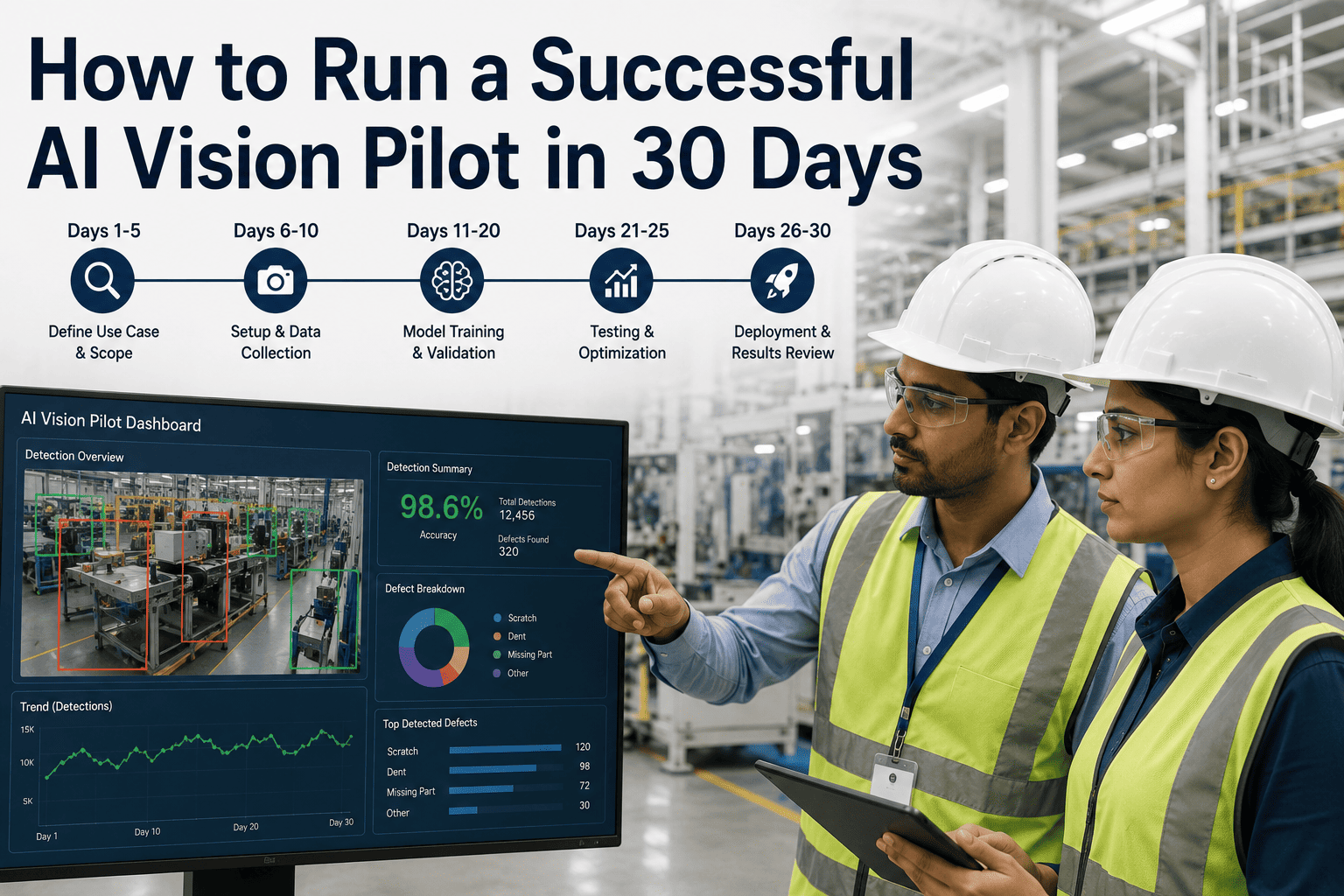
How To Run A Successful AI Vision Pilot In 30 Days
Camera install to ROI number in four weeks — the exact sequence, milestones, and go/no-go checkpoints iFactory uses to get customers from zero to a production decision without the 88% failure rate industry data reports for AI pilots.
Why Most AI Vision Pilots Never Reach Production
The failure numbers on AI pilots are not a technology problem — they are a planning problem. Research across enterprise AI initiatives found that 80.3% of AI projects fail to deliver their intended business value, and separate analysis of AI pilot programs found that only 15% of AI pilots successfully transition to full production deployment. Dig into why, and the same four causes surface again and again: no defined success criteria, artificial test conditions that do not resemble production, no plan for the pilot-to-production handoff, and no internal owner accountable for the outcome.
For AI vision specifically, one more failure mode dominates — the "successful demo trap." A model trained and tested on 500 clean, well-lit sample images looks flawless in a conference room. It falls apart on the factory floor where lighting shifts by shift, product orientation varies, and camera vibration blurs frames the lab data never included. The 30-day structure below is built specifically to force real production conditions into the pilot from week one, not week twelve.
The 30-Day Structure At A Glance
Four weeks, four checkpoints, one production decision. Each week has a single primary objective and a hard go/no-go gate before moving to the next — this is what stops teams from discovering in week four that the camera was never mounted correctly in week one.
Install Camera & Collect Images
Camera and lighting mounted at the exact production station, baseline image collection begins across every shift and product variant the model will eventually see.
Label & Train The Model
Collected images are labeled against your actual defect taxonomy, then used to train and validate the first version of the vision model against a held-out test set.
Shadow Run Beside Manual Inspection
The model runs live on the production line in parallel with your existing manual inspectors — scoring every part but making zero line decisions, so nothing ships on the AI call yet.
Compare Results & Calculate ROI
Shadow-run data is compared against manual inspection outcomes, false positive and false negative rates are quantified, and a projected ROI is built for the production go/no-go decision.
Week 1 — Install Camera & Collect Images
The single biggest week-one mistake is treating camera placement as an afterthought. Proper lighting is arguably more important than the camera itself — ring lights for even shadow-free illumination on flat surfaces, bar lights for directional emphasis on surface features, and backlights for silhouette imaging on edge detection tasks. Get lighting wrong in week one and every week that follows inherits the problem.
Station Selection & Camera Mounting
Pick the exact inspection point on the line, mount the industrial camera with rugged housing rated for vibration and dust, and confirm the interface — GigE Vision or USB3 Vision — matches your existing network infrastructure.
Lighting Calibration
Test ring, bar, dome, and backlight configurations against your actual product surface. Lock exposure and lighting settings so every captured frame is consistent unit-to-unit and shift-to-shift.
Multi-Shift Image Collection Begins
Start continuous capture across day, evening, and night shifts. Different shifts often mean different ambient lighting, different operators, and different product batches — the model needs to see all of it.
Week 1 Gate Review
Confirm 1,000+ images collected covering every product variant, defect type, and shift condition the model will need to recognize. Short on coverage here means restarting collection, not pushing forward.
iFactory's on-site deployment team handles the camera and lighting install directly, so week one doesn't depend on your plant having a machine-vision specialist on staff. Book a demo to see the exact hardware kit used for your line type.
Week 2 — Label & Train The Model
Poor data quality is cited as the root cause behind 85% of failed AI projects — and labeling is where data quality is won or lost. A pass/fail label is not enough for an industrial defect model. Every image needs a defect class, a bounding region, and a severity tag that matches how your quality team already talks about the problem, or the model learns a taxonomy nobody on the floor actually uses.
Defect Taxonomy Definition
Your quality team and iFactory's engineers agree on the exact defect classes the model needs to detect — not a generic "good/bad" split, but the actual categories your inspectors already use on the floor.
Image Labeling Against The Taxonomy
Collected images are labeled with defect class, bounding region, and severity. iFactory's labeling workflow supports dual review, so ambiguous defects get a second opinion before they enter the training set.
Train-Test Split & Model Training
Labeled images are split into training and held-out validation sets. The model trains on iFactory's on-prem AI vision server, with the validation set never touched during training to keep the accuracy number honest.
Adversarial Testing With Edge Cases
Before declaring the model ready, it is deliberately fed messy, incomplete, and edge-case images — the ones that don't look like the clean training set. A model that can't handle imperfection at this scale won't survive production scale.
A model that scores 98% on curated, well-lit sample images and then falls apart on the actual line is the most common pilot failure pattern in AI vision. That gap is exactly why week 2 includes deliberate edge-case testing — and why week 3 puts the model on the real line before anyone calls it finished.
Week 3 — Shadow Run Beside Manual Inspection
This is the week that separates a real pilot from a lab demo. A pilot uses production data, production integrations, and real end users — evaluated on business outcomes, not a slide of technical metrics. During the shadow run, the AI vision model scores every single part live on the line, in parallel with your existing inspectors, but makes zero accept/reject decisions itself. Nothing ships or gets scrapped based on the AI call yet — every prediction is logged against what the human inspector actually decided.
- Scores every part in real time as it passes the camera station
- Logs its own accept/reject call with confidence score
- Tags predicted defect class and location on flagged parts
- Runs continuously across all shifts, not just daytime
- Model-vs-human agreement rate on every part inspected
- False positive rate — good parts the model would have rejected
- False negative rate — defects the model would have missed
- Confidence-score drift across shifts and lighting conditions
Track the agreement rate daily rather than waiting for a week-end summary — a model drifting off track on day 16 is a cheap fix, and the same drift discovered on day 21 has already cost you a week of comparison data. iFactory's dashboard surfaces the agreement trend live so nothing waits for a Friday report.
Week 4 — Compare Results & Calculate ROI
Well-designed pilot success criteria are specific, measurable, time-bound, and outcome-based — not "good adoption," but a defect-detection rate above a stated threshold measured on a stated date. Week 4 is where the shadow-run data finally gets turned into that number, and where the production go/no-go decision actually gets made.
| Evaluation Metric | Manual Inspection Baseline | AI Vision Shadow-Run Result | What It Means For Go/No-Go |
|---|---|---|---|
| Defect Detection Rate | Typically 88–92% on visible defects | Target: match or exceed baseline | Primary threshold for go decision |
| False Positive Rate | Varies by inspector fatigue and shift | Should stay below agreed ceiling | High rate signals retraining need |
| Inspection Speed | Line-rate dependent, fatigue-limited | Consistent at full line speed | Throughput gain quantified here |
| Consistency Across Shifts | Drops on night shift, end of shift | Flat across all shifts logged | Key differentiator vs. manual |
| Documentation Per Part | Manual note, often inconsistent | Auto-logged image + defect tag | Traceability improvement |
This is also the week to plan the handoff, not the week after go-live is approved. The path from pilot to production — network integration, CMMS/MES connection, operator training, and a named owner for the deployed model — needs to be scoped before the pilot ends, not discovered after. Talk to support about what that handoff looks like for your specific line.
See The Exact 30-Day Plan Built For Your Line
30 minutes with our deployment team. We map camera placement, defect taxonomy, and the shadow-run comparison plan against your specific product and inspection station — before you commit a single day of pilot time.
Five Mistakes That Turn A 30-Day Pilot Into A 90-Day Pilot
The pilots that stall almost always hit one of these five patterns. Catching the pattern early is cheaper than discovering it in week four.
No Success Criteria Defined Upfront
Only 23% of enterprises define pilot success criteria before starting. Without a specific, measurable, time-bound target agreed before week one, "success" becomes a subjective argument in week four instead of a data comparison.
Training On Curated, Not Production, Images
A model trained only on clean, well-lit sample images will look excellent in week 2 and fail on the real line in week 3. Week 1 collection must include every shift, lighting condition, and product variant from day one.
Skipping The Shadow-Run Comparison
Teams that go straight from training to live deployment skip the one step that proves the model works under real conditions with real inspectors. Shadow mode is not optional — it is the evidence base for the ROI number.
No Named Owner For The Outcome
77% of AI pilot failures are organizational rather than technical. A pilot with no single person accountable for the go/no-go decision tends to drift indefinitely instead of reaching a decision on day 30.
Planning The Handoff After The Pilot Ends
MES/CMMS integration, network scoping, and operator training take real time. Pilots that wait until day 31 to start planning production handoff routinely lose the momentum and budget approval they earned in week 4.
Treating The POC Result As Pilot-Ready
A small-scale proof of concept on 500 images is not evidence a full pilot will succeed. Confirm the model holds up on volume and shift variation before treating a good POC number as the final answer.
What Happens After Day 30 — The Path To Production
A successful 30-day pilot ends with a documented ROI number and a go decision — not a finished production system. iFactory's turnkey deployment closes that final gap so the pilot's momentum doesn't stall waiting for IT scoping.
Pre-Configured NVIDIA AI Vision Server
Ships racked and ready with your validated pilot model pre-loaded, GPU-accelerated for real-time inference at full line speed, and network-isolated for on-prem processing of production imagery.
Rack It, Plug Power And Ethernet, AI Is Live
No custom infrastructure build. The server that ran your shadow-run validation becomes the production inference engine — same model, same accuracy numbers, now making real accept/reject calls.
MES / SCADA Integration & Operator Training
Cabling, network configuration, PLC and MES integration so accept/reject calls interlock with line control, plus operator training on the review console and alert workflow.
24×7 Remote Monitoring & Model Retraining
iFactory's team monitors production accuracy for drift, schedules retraining as new defect patterns appear, and keeps the model performing at the standard your pilot proved out.
Frequently Asked — Running An AI Vision Pilot
The 30-day timeline holds when the gates are enforced — 1,000+ representative images by end of week 1, a validated model by end of week 2, and a logged agreement rate throughout week 3. Where pilots slip is almost always week 1: incomplete image collection that only covers one shift or one product variant forces a restart in week 2. Teams that treat the week-1 gate seriously consistently land on day 30. For a specific line with unusual complexity, our team can help scope a realistic timeline during the initial call — book a demo to walk through your setup.
1,000 images is the practical floor for a single-station pilot, but the real requirement is coverage, not raw count — every shift, every product variant, and every defect class the model needs to recognize should appear multiple times in the dataset. A defect type that shows up only twice in 1,000 images will not train reliably regardless of total volume. If your defect rate is naturally low, week 1 collection may need to extend slightly to capture enough real examples rather than relying on synthetic augmentation alone.
A lower-than-expected agreement rate in week 3 is a normal, useful finding — not a failed pilot. The daily logging is designed to catch this early, when it can be diagnosed and corrected: often the gap traces to an underrepresented defect class from week 1 or a labeling inconsistency from week 2. iFactory's team reviews disagreement cases with your quality team mid-week and can retrain against the specific gap before week 4 rather than waiting for a final report to surface the problem.
No. iFactory's deployment team handles camera installation, model training, and the technical side of the shadow-run comparison directly. Your team's role is providing production access, defect-taxonomy expertise from your existing quality process, and a named decision owner for the week-4 go/no-go call. The turnkey model exists specifically so plants without in-house AI expertise can run a rigorous pilot on the same 30-day structure.
The ROI figure at day 30 is a projection built from real shadow-run data, not a finished production result — it typically covers missed-defect cost avoided, inspection labor hours reallocated, and consistency gains across shifts, extrapolated to annual volume. The specific number depends heavily on your current defect rate, field-failure cost, and inspection labor structure. Contact support for a worked example close to your industry and line type before the pilot starts.
Start Your 30-Day Pilot With A Plan, Not A Camera And Hope
Book a 30-minute scoping call with iFactory's deployment team. We map your camera station, defect taxonomy, and shadow-run comparison plan before day one — so your pilot lands in the 23% that reaches a real production decision.