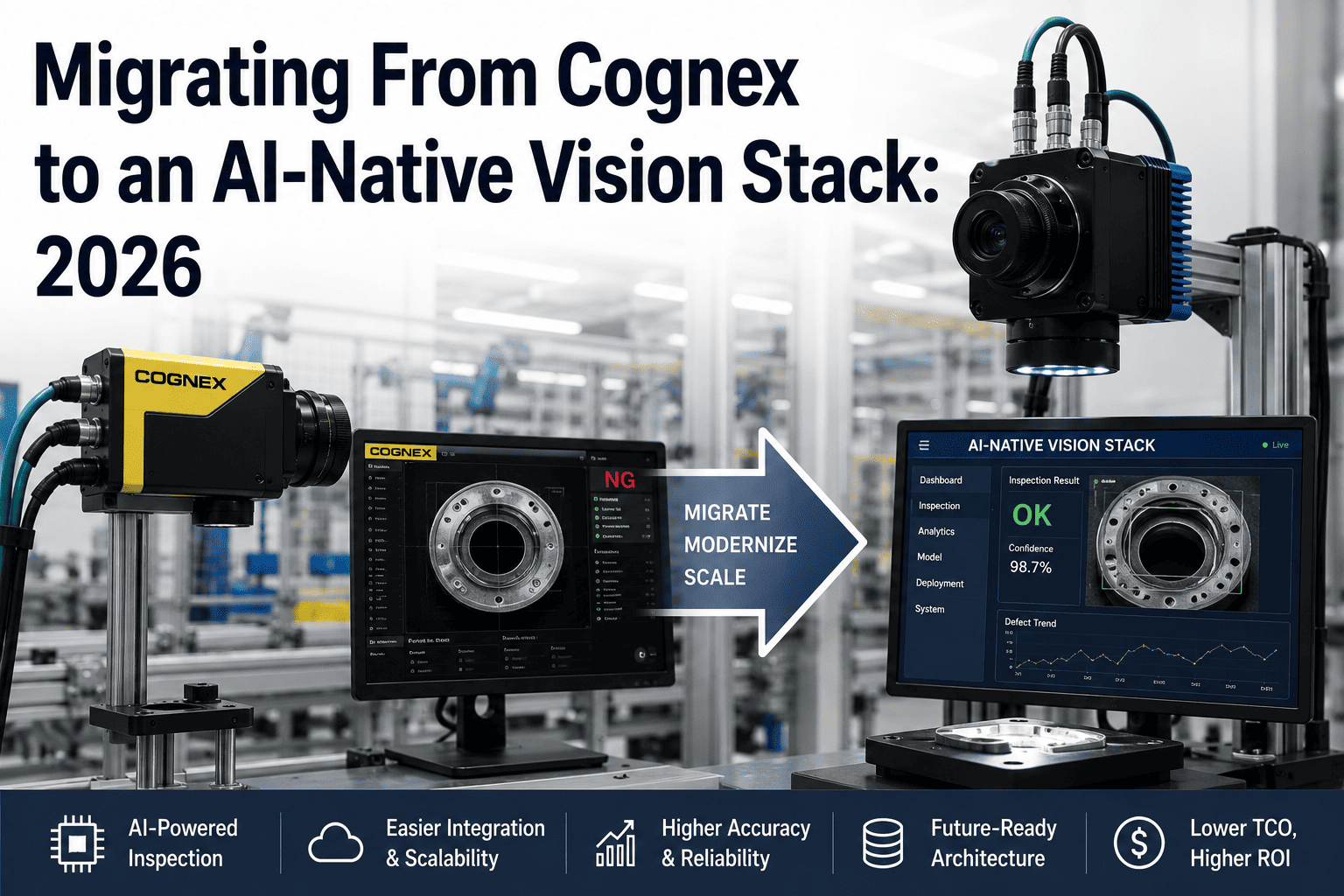
A rule-based vision system does exactly what its rules say, nothing more and nothing less, which is exactly why it starts missing defects the moment a lighting fixture ages, a supplier shifts a tolerance by half a millimeter, or a new cosmetic flaw shows up that nobody wrote a rule for yet. Machine vision teams running Cognex In-Sight cameras and PatMax pattern matching know this cycle well: every new SKU, every surface finish change, every seasonal lighting drift means another trip back to the tooling bench to retune thresholds that were only ever approximate to begin with. An AI-native vision stack learns what a good part looks like from the parts themselves, then keeps learning as production drifts, instead of waiting for someone to notice the false reject rate climbing on a shift report. Book a vision migration assessment to see how an AI-native stack performs against your own part library and existing camera hardware.
Replacing Cognex Rule-Based Inspection With an AI-Native Vision Stack
Fixed-rule pattern matching was built for a factory where parts, lighting, and tolerances never changed. AI-native vision was built for the one you actually run, where cosmetic defects, supplier variation, and changeovers happen every week and the inspection system needs to keep pace without a re-tooling project every time something shifts on the line.
Why Fixed-Rule Vision Systems Hit a Wall on the Line
Cognex In-Sight cameras and PatMax-style pattern matching were a real leap forward over manual inspection, and for parts with tight geometric tolerances and stable lighting they still work well. The trouble starts with everything that isn't geometric. A dent, a scuff, a discoloration, a texture change, a flash line that shifts half a degree between injection molding shots, none of these fit neatly into an edge-detection rule, so engineers end up writing an ever-growing pile of thresholds and exceptions to catch what the original rule set missed. Every one of those thresholds is a manual guess at where good ends and bad begins, and every guess needs revisiting the next time a supplier, a lot, or a light bulb changes.
of vision system escapes trace back to lighting or camera-angle drift the original rule set was never tuned to handle
rule-based vision deployments require a re-tooling project within the first year as SKUs or suppliers change
of manufacturers cite manual threshold tuning as the top reason inspection accuracy drifts between audits
of cosmetic and texture-based defects are missed by geometric pattern matching alone without added rule layers
Four Places Where Rule-Based Inspection Breaks Down
None of these failure points show up in a system integrator's demo, they show up six months into production once the line has seen real supplier variation, real seasonal light changes, and a few SKU changeovers nobody scoped for at commissioning.
Lighting and Reflectivity Drift
Ambient light changes with the seasons, fixtures dim as they age, and reflective surfaces catch glare differently depending on the angle a part lands on the fixture. Rule-based systems tuned to one lighting condition start flagging good parts as defective, or worse, passing bad ones, as that condition slowly shifts.
Orientation and Fixture Variation
A part that lands a few degrees off the trained orientation can throw off a pattern-matching template entirely, even when the part itself is perfectly good. Rigid fixturing helps, but it adds cost and cycle time, and it never fully eliminates the variation that comes from upstream handling.
Cosmetic and Texture Defects
Scratches, discoloration, surface porosity, and texture inconsistencies rarely have a clean geometric signature. Catching them with rules usually means stacking exception after exception onto the original template, and each new exception makes the system more brittle to the next variation that shows up.
SKU Changeover Downtime
Every new part number on a mixed-model line means a new set of templates, thresholds, and calibration runs before inspection can restart. On lines that change over several times a shift, that retooling time adds up to real production hours lost every single week.
The Four-Phase Path From Cognex to AI-Native Vision
A vision migration does not have to mean ripping cameras off the line and starting over. Most of an existing Cognex installation, the cameras, the lighting rigs, the mounting hardware, is reusable. What changes is the inspection logic running behind it, and that change happens in stages so production risk stays low the entire way through.
Assessment and Data Capture
Existing camera feeds are tapped to capture a labeled image set across good parts, known defect types, and edge cases the current rule set already struggles with, establishing a baseline before any model training begins.
Model Training and Validation
A deep learning model is trained on the captured image set and validated offline against historical escapes and false rejects, so accuracy is proven against real production history before it ever touches a live line.
Parallel Run Alongside Cognex
The AI-native model runs shadow-mode alongside the existing rule-based system, scoring the same parts in real time without making the accept or reject call, so its performance is proven on the actual line before it takes over.
Cutover and Continuous Learning
Once parallel-run accuracy clears the agreed threshold, the AI-native model takes the live accept or reject decision, and every new flagged part continues feeding the retraining loop so the model keeps improving with production.
Rule-Based Cognex Inspection vs an AI-Native Vision Stack
The two approaches look similar from the factory floor, a camera watches a part and makes a call, but the logic underneath behaves very differently once real production variation shows up. Here is how the two compare across the decisions that matter most to a quality and vision engineering team.
Swipe left to see the full comparison
See Your Own Parts Run Through an AI-Native Model
iFactory can score a sample of your current escapes and false rejects against a trained model before a single camera on your line changes, so you see the accuracy difference before committing to a migration plan.
Inside an AI-Native Vision Stack
Migrating off a fixed-rule system means gaining a set of capabilities that geometric pattern matching was never architected to provide in the first place. These are the pieces that make an AI-native stack behave less like a camera running a checklist and more like a quality inspector who keeps getting better with every shift.
Deep Learning Defect Classification
Models trained on labeled defect libraries recognize cosmetic, textural, and dimensional defects together, rather than relying on separate rule sets stacked on top of each other for each defect type.
Few-Shot Model Training
New SKUs and part variants are onboarded from a small labeled image set using transfer learning, cutting new-part setup time from days of manual tooling to a matter of hours.
Continuous Retraining Loop
Every part an operator overrides or a quality reviewer reclassifies feeds back into the training set automatically, so model accuracy keeps improving with production instead of degrading between audits.
Edge Inference at the Camera
Inspection decisions run locally at the line for millisecond response times, keeping cycle time intact even on high-speed lines while still syncing results back to a central model repository.
Multi-Camera Fleet Management
Every camera across every line and every plant is managed from one console, with model versions, accuracy trends, and defect libraries kept in sync instead of tuned station by station.
CMMS and MES Work Order Integration
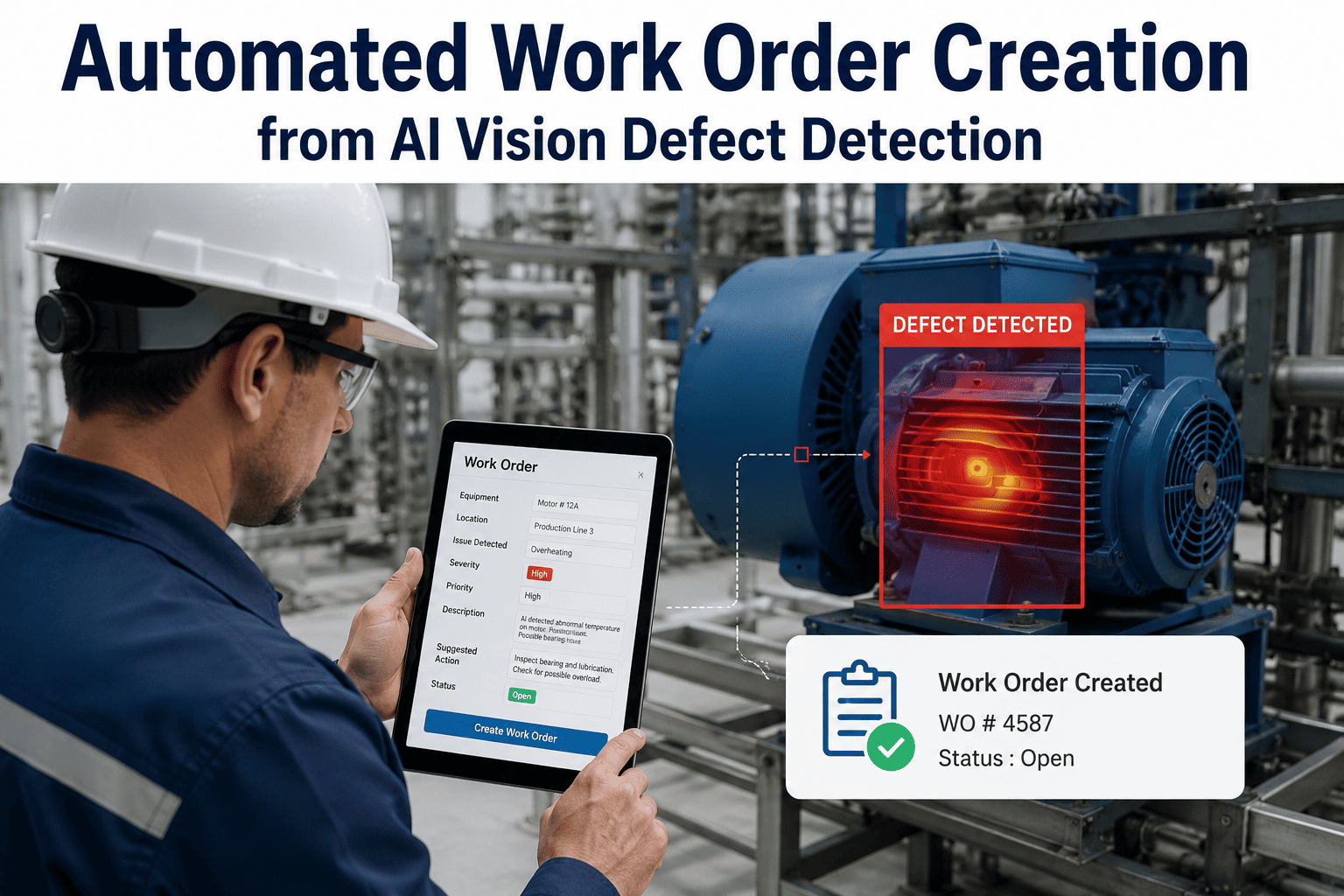
Flagged defects write directly into the quality record with classification and image evidence attached, so root cause investigation starts with data instead of a manual pull from camera logs.
Migration Mistakes That Slow the Payback
Most vision migrations that stall out do so for avoidable reasons, not because AI-native inspection failed to perform. These are the mistakes worth planning around before the project starts.
Ripping Out Hardware Unnecessarily
Most existing Cognex camera and lighting installations are perfectly reusable. Replacing hardware that only needed a software and logic upgrade adds unnecessary cost and downtime to the project.
Skipping the Parallel Run
Cutting over to a new model without a shadow-mode validation period removes the safety net that proves accuracy on real production parts before the model makes a single live accept or reject call.
Training on Too-Clean a Data Set
A model trained only on pristine sample parts underperforms the moment real production variation shows up. Training data needs to include the messy, borderline cases the current system already struggles with.
Leaving Operators Out of the Rollout
Operators who don't understand why the system's calls changed tend to override it or work around it. Involving line operators in reviewing flagged parts during the parallel run builds trust before cutover.
What Changes on the Line After Migration
Facilities that complete a Cognex to AI-native vision migration typically see the shift show up in the quality numbers within the first full production month. Here is the typical before-and-after on a mixed-model line.
Perspective From the Field
We had four Cognex stations on our trim line and every new supplier lot meant a half day of retuning thresholds before we trusted the pass rate again. We kept the same cameras and the same lighting rigs, and swapped the inspection logic underneath during a parallel run over about six weeks. The false reject rate dropped enough that operators stopped manually re-checking parts the camera had already cleared, and new SKU setup went from most of a shift to under two hours.
— Renata Alvarez, Quality Engineering Manager, Automotive Trim Components Plant
length of the parallel run before the AI-native model took over live inspection decisions
cameras or lighting rigs replaced during the migration
typical new SKU setup time after migration, down from most of a production shift
Frequently Asked Questions
Do we have to replace our existing Cognex cameras to migrate to AI-native vision?
In most cases, no. The camera hardware, lighting rigs, and mounting fixtures already installed on your line are usually reusable, since what changes during a migration is the inspection logic running behind the camera feed rather than the camera itself. The image sensor just needs to be compatible with streaming a feed to the AI inference layer, which the majority of existing In-Sight installations already support. Book a migration assessment and bring your current camera model list so we can confirm compatibility before scoping anything.
How much labeled image data do we need before a model is accurate enough to trust?
Modern deep learning vision models use transfer learning, so they start from a foundation already trained on millions of general images and only need a few hundred labeled examples of your specific parts and defect types to reach production-ready accuracy. This is a fraction of what building a model from scratch would require, and it is why new SKU onboarding usually takes hours rather than the days a full rule-tooling project would need.
What happens if the AI-native model makes a wrong call during the parallel run?
During the parallel run the AI-native model operates in shadow mode, scoring every part alongside the existing rule-based system without making the actual accept or reject decision on the line. Any disagreement between the two systems gets logged and reviewed, which both validates model accuracy and feeds directly back into training before the model ever takes over the live production call.
Can one AI-native vision platform manage cameras across multiple lines and plants?
Yes. A central console manages model versions, accuracy trends, and defect libraries across every camera on every line, rather than requiring each station to be tuned and maintained separately the way a rule-based system typically is. This is particularly valuable for facilities running mixed-model lines with frequent changeovers, since a validated model for one SKU can be reused as a starting point for a similar part elsewhere. Talk to a specialist about your specific camera count and line layout.
How long does a typical Cognex to AI-native vision migration take start to finish?
Most migrations move through assessment, model training, and a parallel run within four to eight weeks depending on part complexity and the number of SKUs involved, with cutover happening only once parallel-run accuracy clears an agreed threshold against the existing system. Facilities running a single high-volume part typically move faster, while mixed-model lines with many SKUs take closer to the upper end of that range.
Stop Retuning Thresholds Every Time a Part Changes
Book a 30-minute scoping call and iFactory will map your current camera fleet, part library, and escape history to a migration plan built around your highest-variation lines first.