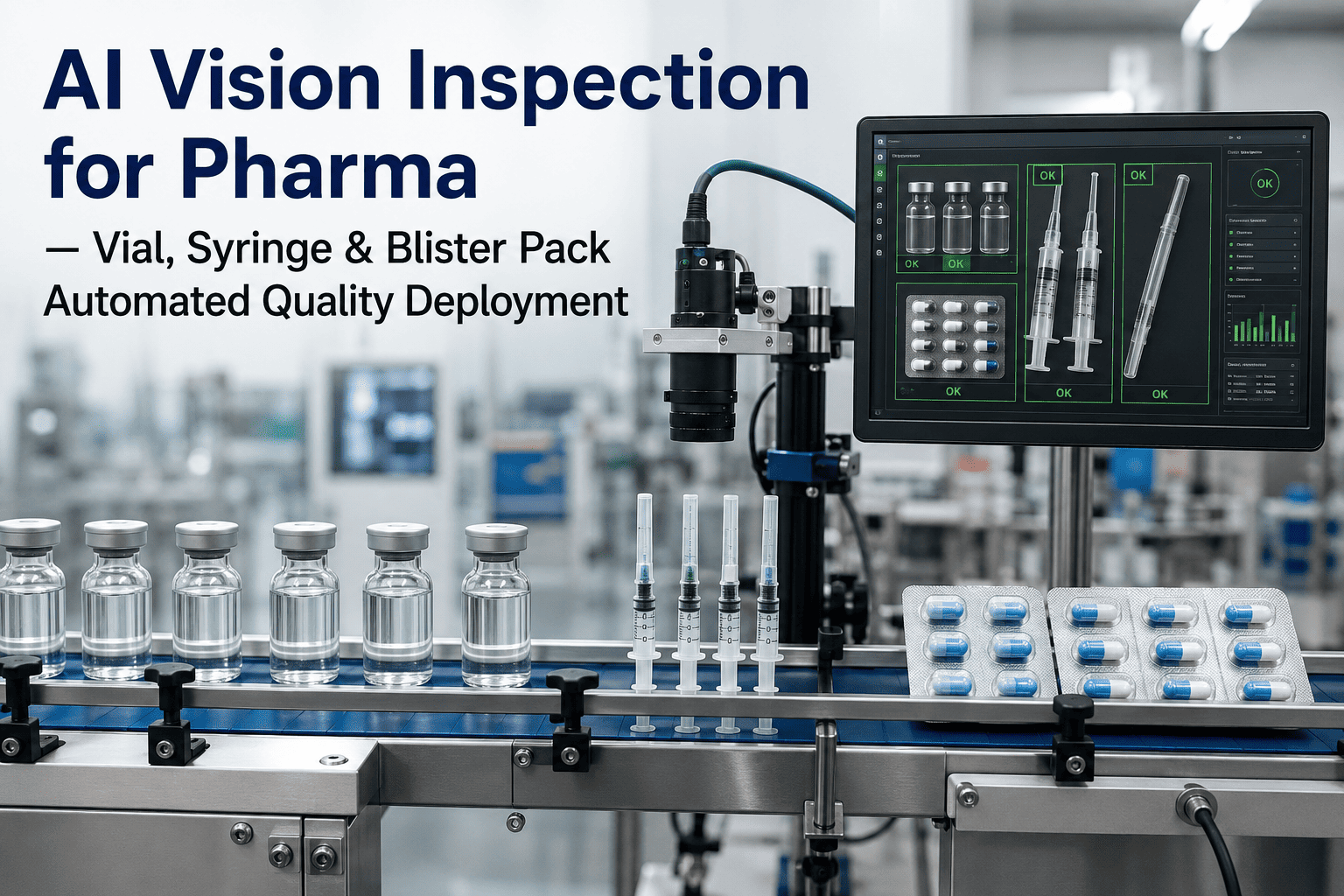
A single missed defect in a vial, syringe, or blister pack is never just a quality miss in pharmaceutical manufacturing — it is a potential 483 observation, a batch quarantine, or a recall that can run into the millions once litigation and lost market share are counted. Manual visual inspection was never built for the speeds modern fill-finish lines now run at, and even the best-trained human inspector cannot reliably hold attention across an eight-hour shift checking hundreds of containers a minute for particulates a few microns wide. AI vision inspection closes that gap by combining high-speed multi-angle imaging with deep-learning defect classification, and the manufacturers who have deployed it are not reporting incremental improvement — they are reporting detection sensitivity that exceeds what manual inspection could ever consistently achieve. This page covers how AI vision inspection actually works across vials, syringes, and blister packs, and how to see it validated against your own product formats.
Why Manual Inspection Cannot Keep Up With Modern Fill-Finish Speeds
Pharmaceutical packaging lines routinely run at speeds that make manual visual inspection a statistical exercise rather than a genuine 100% check. Blister lines now move past 300 packs per minute, vial lines run up to 600 units per minute on high-speed carousels, and syringe lines process comparable volumes — all while every single unit is expected to be checked for particulates, cosmetic defects, fill accuracy, and seal integrity without exception. A human inspector working under magnified light simply cannot sustain the attention needed at that pace across a full shift, which is exactly why regulatory scrutiny on visual inspection processes has intensified. The financial exposure of getting this wrong is severe on its own terms, independent of the human safety consequences that make pharmaceutical quality failures different from almost any other manufacturing defect.
What Actually Goes Wrong Across Vials, Syringes, and Blister Packs
Each container format carries its own set of defect classes, and a vision system built for one does not automatically transfer to another — a blister pocket check has nothing in common with detecting a suspended particulate in a rotating vial. Understanding the specific failure modes for each format is what separates a generic camera setup from a system that actually catches what matters for patient safety and batch release. A vision system that has only ever been trained on tablet blister formats will struggle the first time it sees a lyophilized vial, and one built purely for cosmetic glass inspection will miss the subtler particulate signatures that only emerge once a container is properly agitated and imaged from multiple angles in sequence.
Vials & Ampoules
Visible particulates suspended in solution, glass cracks and chips, stopper misalignment, crimp cap seal failure, incorrect fill volume, and lyophilized cake collapse or fissuring all require detection on every single unit, not a sample set.
Prefilled Syringes
Air bubbles must be reliably distinguished from foreign particles in viscous solutions, plunger and stopper position must be verified, and barrel cosmetic defects need to be caught without the false rejections that waste good product.
Blister Packs
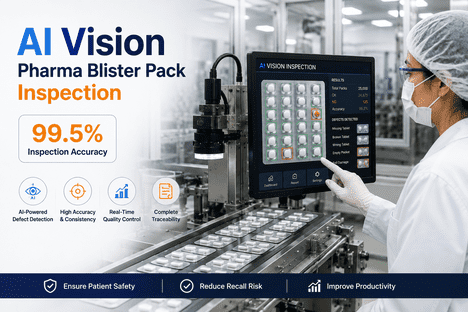
Missing tablets, broken or chipped capsules, empty or partially filled pockets, foil seal defects and pinholes, wrong color or orientation, and double-product errors must all be caught in the same pass as the seal zone check.
Labels & Codes
Lot codes, expiration dates, and 2D serialization codes need OCR-grade verification on curved, reflective, or shrink-wrapped surfaces where standard barcode readers routinely fail to get a clean read.
Inside the Inspection Cycle: Pre-Spin, Multi-Angle Capture, and AI Classification
Many of the defects that matter most are not visible in a static image — a hair clinging to the underside of a stopper or a metal fragment resting motionless at the bottom of a syringe will not show up unless the container is moved in a way that brings the defect into view. This is why AI vision inspection for liquid parenterals is a multi-step process rather than a single camera snapshot, and why the sequence of steps matters as much as the vision model itself.
Pre-Spin & Vortex
Vials and ampoules are rapidly rotated to create a vortex inside the solution, lifting and suspending particulates long enough for cameras to capture a clear image rather than missing a motionless fragment.
Multi-Angle Imaging
Multiple cameras capture each container from different angles and lighting configurations, distinguishing surface reflections and air bubbles from genuine foreign particles or cosmetic defects.
Deep-Learning Classification
A GPU-accelerated inference engine classifies each captured image against trained defect models, distinguishing acceptable variation from genuine rejects across every defect class simultaneously.
OK/NG Signal & Logging
A pass or reject signal is issued to the downstream ejector within milliseconds, while the image, timestamp, and classification code are logged to a full audit trail automatically.
What Changes When Inspection Moves From Sampling to 100% Coverage
The shift from manual or semi-automated inspection to full AI vision coverage is not just a speed improvement — it changes what kind of process pharmaceutical quality assurance actually is, moving it from a statistical sampling exercise to a genuine unit-by-unit check with a defensible record behind every decision.
| Dimension | Manual / Rule-Based Inspection | AI Vision Inspection |
|---|---|---|
| Inspection coverage | Sample-based or fatigue-limited full checks | True 100% inline inspection, every unit |
| Particle vs. bubble distinction | Prone to false rejects on viscous solutions | Up to 70% higher particle detection with 60% fewer false rejects |
| Consistency across shifts | Degrades with inspector fatigue over a shift | Constant sensitivity regardless of shift length |
| Audit trail | Manual logs, inconsistent evidence capture | Automatic per-unit image, timestamp, and classification record |
| Line speed compatibility | Becomes the bottleneck above moderate speeds | Matches line speeds up to 600 units per minute |
| Regulatory defensibility | Vulnerable to 483 observations on process adequacy | 21 CFR Part 11 and EU GMP Annex 1 aligned records by default |
Data Integrity That Holds Up Under FDA and EU GMP Review
A vision system that catches defects but cannot produce a defensible record of every inspection decision does not actually solve the compliance problem pharmaceutical manufacturers face — the record is as important as the detection itself when an auditor or investigator asks how a batch was released. iFactory's platform is built around this requirement from the first unit inspected rather than as an add-on feature.
Full Audit Trail
Every inspection decision, model change, and user action is captured automatically, linked to batch, lot number, and fill timestamp for complete traceability.
USP <790> Alignment
Visible particulate detection in vials, ampoules, and prefilled syringes is designed around current visible particulate inspection standards for injectable products.
21 CFR Part 11 Ready
Electronic records and audit trail structure are built to satisfy data integrity requirements from the point of first deployment, not retrofitted after a finding.
MES / LIMS Integration
Per-container inspection records connect directly into existing manufacturing execution and lab information systems without requiring a separate reporting layer.
How iFactory Deploys AI Vision Inspection on Your Line
A turnkey deployment means your quality and validation teams are not left assembling cameras, lighting rigs, and inference hardware into a system on their own. iFactory's approach starts with a feasibility study on your specific container format, validates the model against your defect library, and moves through a supervised pilot before full production rollout — with every step documented for your validation package.
Feasibility Study
Engineers assess your container format, product characteristics, and existing defect library to define the camera, lighting, and pre-spin configuration your line requires.
Model Validation
The vision model is trained and validated against sample defects specific to your product, confirming detection sensitivity and false-reject rates before line integration.
Supervised Pilot
The system runs alongside existing inspection processes on your line, with performance benchmarked directly against your current escape and false-reject rates.
Full Production Rollout
Once validated, the system moves to full production with MES and LIMS integration live, delivering measurable ROI typically within 12 to 18 months.
What This Looks Like in Practice
A manufacturer running a high-speed syringe inspection line moved from a rule-based system that struggled to distinguish air bubbles from foreign particles in viscous parenteral solutions to a deep-learning approach, and the difference showed up immediately in the numbers: a substantial increase in genuine particle detection alongside a significant drop in false rejections that had previously been scrapping good product unnecessarily. On the blister packaging side, a manufacturer moving from sample-based checking to full inline AI vision coverage converted the change directly into fewer escapes reaching the market, less good product scrapped on false rejects, and an audit-ready record that quality teams no longer had to reconstruct manually before an inspection. The pattern holds across container formats and product types: the value is rarely in catching one dramatic defect that would have caused a recall on its own, it is in the compounding effect of catching thousands of smaller issues consistently, shift after shift, in a way no rotation of human inspectors could sustain without fatigue eventually letting something through.
Quality teams who have gone through this transition also point to a less obvious benefit — the amount of time freed up for genuine investigation work rather than routine checking. When inspectors are no longer needed to stare at every unit passing under magnified light, the same skilled staff can be redirected toward root-cause analysis on the defects the system does flag, trend review across batches, and process improvement work that a vision system cannot do on its own. That reallocation of skilled labor toward higher-value work is frequently cited alongside the recall-avoidance and scrap-reduction numbers as one of the more durable outcomes of the transition.
We used to lose good product to false rejects almost as often as we caught real defects. Once the model was properly validated against our own particle library, both numbers moved in the right direction at the same time — more real detections, far fewer good units scrapped.
Frequently Asked Questions
See Your Own Defect Library Validated Against the Model
iFactory deploys AI vision inspection built around your specific container format, product characteristics, and defect history — moving quality control from statistical sampling to true 100% inline coverage with the audit trail your next inspection will need.