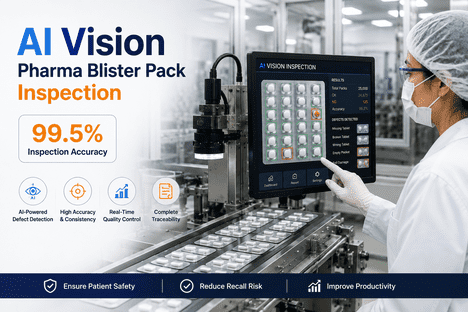
Pharmaceutical blister pack inspection is one of the highest-consequence quality control tasks in drug manufacturing — and one of the most structurally inadequate when performed through manual visual checking or conventional rule-based machine vision. A blister line running at 300 packs per minute produces 18,000 packs per hour, each containing 10 to 30 individual product pockets. Manual inspection of this throughput is physically impossible at any meaningful coverage level. Conventional automated optical inspection detects gross defects — obviously empty pockets, severely misaligned seals — but consistently misses the defect categories that generate FDA Form 483 observations and recall actions: sub-visible foil pinholes that compromise seal integrity over shelf life, partially filled pockets where a broken tablet fragment meets the count criterion but not the dose requirement, print defects where a batch number digit is smeared but partially legible, and colour non-conformances where a wrong-strength tablet entered a pocket during a line changeover event. iFactory's AI vision camera platform closes these detection gaps by deploying deep learning models trained on pharmaceutical-specific blister defect libraries — detecting missing tablets, empty pockets, broken and chipped dosage forms, foil seal anomalies, print defects, and contamination events at 99.5 percent accuracy at 300-plus packs per minute — while automatically generating the time-stamped, per-pack electronic inspection records that FDA 21 CFR Part 11, EU GMP Annex 11, and current Good Manufacturing Practice requirements demand as objective evidence of inspection execution.
Why Blister Pack Inspection Is the Critical Quality Control Point in Solid Dose Packaging
The blister pack is the final barrier between the manufacturing process and the patient. Every defect that escapes blister pack inspection — an empty pocket, a broken tablet, a compromised foil seal, a wrong-strength tablet from a changeover event — reaches the end user without any further quality checkpoint between the packaging line and the dispensing counter. This makes blister inspection the quality control decision with the highest direct patient safety consequence in the solid dose packaging sequence, and the one where detection failure generates the most serious regulatory response. FDA recall data consistently shows that missing tablet, wrong dosage form, and packaging defect failures account for 35 to 40 percent of pharmaceutical recall actions annually — and the majority originate from inspection programmes that provided insufficient coverage or detection sensitivity to intercept the defect category involved. iFactory's AI vision camera platform replaces these structurally inadequate inspection programmes with 100 percent coverage at full line speed, giving quality managers the detection architecture that modern pharmaceutical regulatory expectations actually require.
The Blister Pack Defect Profile: What AI Vision Detects at 99.5% Accuracy
Pharmaceutical blister pack defects span a wide spectrum of consequence — from cosmetic imperfections that affect pack presentation to critical defects that directly compromise patient dose delivery or product safety. iFactory's AI vision inspection models cover the full defect profile across every pocket, seal, and print element of the blister pack, with classification models trained to distinguish defect severity tiers and apply grade-appropriate rejection decisions. The following defect coverage reflects iFactory's standard blister inspection model library, which is fine-tuned to each facility's specific product forms, pack formats, and acceptance criteria during commissioning.
| Defect Category | Specific Defects Detected | Detection Method | GMP Consequence Class |
|---|---|---|---|
| Missing or Empty Pocket | Absent tablet, empty cavity, partial fill, fragment only | Pocket fill analysis, depth profiling | Critical — immediate reject |
| Product Damage | Broken tablet, chipped edge, cracked surface, deformed capsule, capped tablet | Surface morphology AI classification | Critical — dose delivery impaired |
| Product Non-Conformance | Wrong colour, wrong shape, wrong size, wrong imprint, product mix-up from changeover | Multi-channel colour + shape matching | Critical — wrong product risk |
| Foil Seal Defects | Pinhole, wrinkle, incomplete seal, burnt seal, delamination, tear, misalignment | Specular reflectance + AI texture analysis | Major — seal integrity impaired |
| Pocket Integrity | Cavity deformation, underfill, tilt, tablet overlap, double fill, foreign particle | 3D geometry + contamination AI model | Major to Critical depending on type |
| Print and Code Defects | Smeared batch number, missing expiry date, illegible text, barcode grade failure, print offset | OCR verification + print quality scoring | Major — traceability impaired |
AI defect classification operates simultaneously across all defect categories on every pack — no sequential or staged detection pipeline that introduces latency between frame capture and reject decision. Every pocket in every pack receives a per-cavity quality disposition within 20 milliseconds of imaging, enabling reject signal transmission to the line divert mechanism before the defective pack reaches the transfer point. Pharmaceutical quality teams who want to validate iFactory's detection accuracy against their specific tablet or capsule form and pack format can Book a Demo to see classification performance demonstrated on representative product imagery.
How iFactory AI Vision Outperforms Manual and Conventional AOI Blister Inspection
The structural limitations of manual and conventional automated optical inspection on pharmaceutical blister lines are not operator performance failures — they are the predictable consequences of applying detection technologies that are inherently incapable of meeting the coverage, resolution, and consistency requirements that pharmaceutical blister pack inspection demands at production throughput rates.
FDA 21 CFR Part 11 and GMP Compliance: How iFactory Generates Audit-Ready Inspection Records
Regulatory compliance in pharmaceutical blister pack inspection is not achieved by detecting defects — it is achieved by generating objective, verifiable evidence that every pack produced was inspected to a validated standard and that the inspection system's performance was monitored and controlled throughout the production batch. FDA 21 CFR Part 11 requires electronic records used to satisfy GMP obligations to include complete audit trails, access controls, and data integrity protections against unauthorised modification. EU GMP Annex 11 specifies equivalent requirements for computerised systems used in manufacturing quality control. iFactory's AI vision platform is architected to satisfy these requirements as an inherent output of inspection operation — not as a separate compliance documentation exercise added after the inspection is complete.
Every blister pack inspection event is recorded with a time-stamped electronic record that includes the pack identifier, lot number, inspection timestamp, per-cavity quality disposition, defect classification where applicable, and the AI model version and performance qualification status active at the time of inspection. Records are written to an immutable audit log with cryptographic integrity protection against unauthorised modification — satisfying 21 CFR Part 11's requirement for records that accurately reflect the information used to authenticate them. User authentication controls limit access to inspection parameter modification and batch record review to qualified personnel with documented authorisations. Batch inspection certificates are generated automatically at batch completion, summarising total packs inspected, rejection count by defect category, and system suitability confirmation — in a format exportable for direct attachment to the batch manufacturing record without manual transcription. Quality teams who want to see iFactory's 21 CFR Part 11 documentation architecture can Book a Demo for a compliance-focused walkthrough mapped to their current quality system configuration.
Deploying iFactory AI Vision on Pharmaceutical Blister Packaging Lines
Pharmaceutical blister pack inspection deployment must satisfy both production engineering and quality assurance requirements simultaneously — integrating with the packaging line's mechanical and control architecture without disrupting GMP-qualified processes, while generating the inspection records and system suitability evidence that quality release decisions require. iFactory's blister inspection deployment methodology is designed to meet both requirements through a validated commissioning sequence that satisfies GAMP 5 computer system validation principles and FDA computer software assurance guidance. Pharmaceutical quality managers who want to understand how iFactory's deployment approach applies to their specific blister machine type and regulatory framework can Book a Demo with iFactory's pharmaceutical validation team for a facility-specific walkthrough.
Inspection Specification and Acceptance Criteria Definition
Define the defect acceptance criteria for every defect category applicable to each product and pack format — distinguishing critical defects requiring 100% rejection from major and minor defects with AQL-based disposition thresholds. Document the inspection specification as the validated configuration input for AI model calibration. This specification becomes the quality release evidence that demonstrates the inspection programme was designed to detect every defect category with patient safety significance, satisfying the inspection adequacy requirement that FDA investigators assess during pre-approval and routine surveillance inspections.
Camera Installation and IQ/OQ Qualification
Install AI vision cameras at the blister inspection station with illumination configurations optimised for the specific defect detection requirements — structured lighting for cavity fill detection, specular illumination for foil seal defect detection, and high-contrast coaxial illumination for print and code verification. Complete Installation Qualification and Operational Qualification protocols per GAMP 5 and FDA CSA guidance, documenting hardware configuration, software version, user access controls, and audit trail functionality against the validated acceptance criteria. IQ/OQ documentation is provided as part of iFactory's standard validation package, minimising customer-side authoring effort.
Performance Qualification and Detection Sensitivity Validation
Execute Performance Qualification protocols using known defect samples across every critical defect category — empty pockets, broken tablets, foil pinholes, print defects — at the minimum detectable defect size defined in the inspection specification. Document detection rate, false rejection rate, and system suitability test results for each defect category as the PQ evidence that validates the inspection system's capability before release for production use. iFactory's standard PQ protocol is designed to generate the detection capability evidence that satisfies FDA 21 CFR Part 820 and EU GMP Annex 11 validation requirements for automated quality systems.
Live Production Operation and Batch Record Integration
Activate live production inspection with automated batch record generation, reject mechanism integration, and real-time defect trend monitoring. Connect the iFactory inspection database to the facility's LIMS or MES via API to enable per-pack inspection record linkage to the batch manufacturing record — satisfying the audit trail completeness requirement that links every inspection event to its production batch without manual transcription. Configure system suitability checks that execute automatically at the start of each production run, confirming that the inspection system's detection performance meets the validated specification before any product is released from inspection.
Ongoing Performance Monitoring and Periodic Review
Establish ongoing performance monitoring dashboards that track detection rate, false rejection rate, and system suitability test results across production batches — providing the continuous process verification data that demonstrates the inspection system remains in a state of control throughout its operational life. Conduct periodic performance reviews at the frequency defined in the system's quality plan, using iFactory's automated performance report generation to produce the review evidence without manual data assembly. Any modification to inspection parameters or AI model versions is managed under change control with re-qualification scope determined by risk assessment.
Frequently Asked Questions About AI Vision Pharmaceutical Blister Pack Inspection
iFactory's foil seal inspection uses specular reflectance illumination that reveals surface anomalies in the aluminium foil layer through the specific way light reflects from intact versus damaged or deformed foil surfaces. Deep learning models trained on foil defect image datasets recognise the reflectance signature differences of pinholes, wrinkles, incomplete seals, and delamination at defect sizes from 0.1mm — below the detection threshold of standard transmitted light or diffuse illumination AOI systems. The AI model distinguishes genuine foil defects from natural foil texture variation and printing ink patterns, achieving false positive rates below 0.5% at this detection sensitivity level. This combination of illumination design and AI classification is what enables foil defect detection at the scale relevant to seal integrity failures — not just the gross foil tears that any inspection system would detect.
iFactory provides a complete GAMP 5-aligned validation documentation package including Installation Qualification protocols and execution records, Operational Qualification protocols covering software functionality, user access controls, and audit trail operation, Performance Qualification protocols for each critical defect category, risk assessment and data integrity impact assessment, and system configuration specification. The package is designed to satisfy FDA CSA guidance and EU GMP Annex 11 qualification requirements with minimal customer-side authoring effort — typically reducing the qualification documentation preparation burden by 60 to 75 percent compared to customer-authored protocols against a blank template. Change control procedures and periodic review templates are included in the validation package to support the system's ongoing lifecycle management.
iFactory's blister inspection platform supports multi-product inspection through a library of product-specific inspection profiles — one profile per SKU, containing the product appearance specification, pack format configuration, acceptance criteria, and AI model calibration parameters for that product. Changeover between products is managed through a validated product selection workflow that requires authorised user confirmation before the new profile is activated, with the changeover event logged in the audit trail with user identity and timestamp. The system prevents inspection from proceeding after changeover until the correct product profile is confirmed active — addressing the regulatory risk of inspecting a new product against the previous product's acceptance criteria that occurs when changeover management is not enforced at the inspection system level.
iFactory's inspection platform integrates with LIMS and MES batch manufacturing record systems via REST API and standard pharmaceutical data exchange protocols — pushing per-pack inspection records, batch summary statistics, rejection counts by defect category, and system suitability results to the connected system in real time. This integration eliminates the manual data transcription step between inspection completion and batch record compilation that typically delays quality release review and introduces the data integrity risks that FDA investigators flag when inspecting pharmaceutical facilities. The specific integration scope, data schema mapping, and API configuration are documented in the system specification and validated as part of the OQ qualification protocol. Integration has been validated for the major LIMS platforms used in pharmaceutical manufacturing including Labware, STARLIMS, and Thermo Scientific SampleManager.
Pharmaceutical manufacturers typically achieve full ROI from iFactory blister pack inspection deployment within 8 to 14 months through the combination of avoided recall costs, reduced inspection labour from replacing manual checking programmes, batch record assembly time savings, and improved first-pass audit rates on both internal quality audits and regulatory inspections. A single avoided Class II recall from a missing tablet or wrong dosage form event — with average direct costs of $8 to $15 million for pharmaceutical recalls at this severity level — frequently recovers the total system deployment cost many times over. Facilities with prior FDA Form 483 observations related to inadequate inspection evidence or manual inspection programme deficiencies often achieve the fastest ROI, as the first clean GMP inspection following AI vision deployment eliminates the regulatory remediation costs associated with Warning Letter issuance and response.