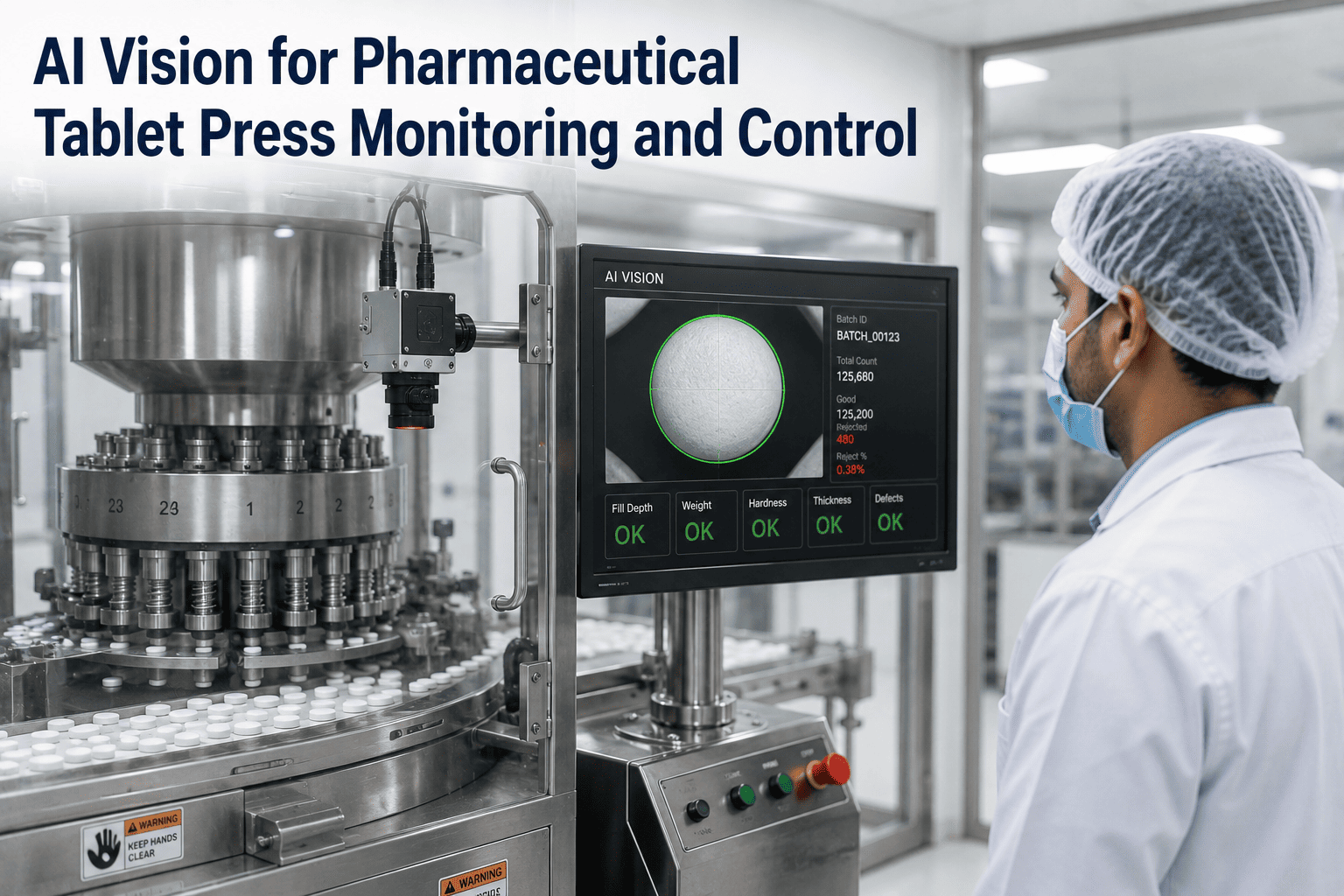
Twelve manual inspectors, three shifts, one oral solid dosage line producing 720,000 tablets per shift. That was the quality inspection footprint at a mid-size generics manufacturer we will call MerivaLabs — until an internal Knapp study revealed the team was catching only 82% of introduced defects on the toughest tablet formats, well below the 95% target their quality agreement with a major retailer required. The board approved a full replacement of manual inspection with AI vision, but only under one non-negotiable condition: the system had to pass a GAMP 5 validation package that would survive an unannounced FDA audit. This case study walks through the 14-week validation, the detection numbers that came out of Performance Qualification, and the 12-month operational report card. If you want to see how the validation documentation was structured, schedule a walkthrough with our pharma team.
99.8% Detection. 75% Lower Inspection Labor. Zero FDA Observations.
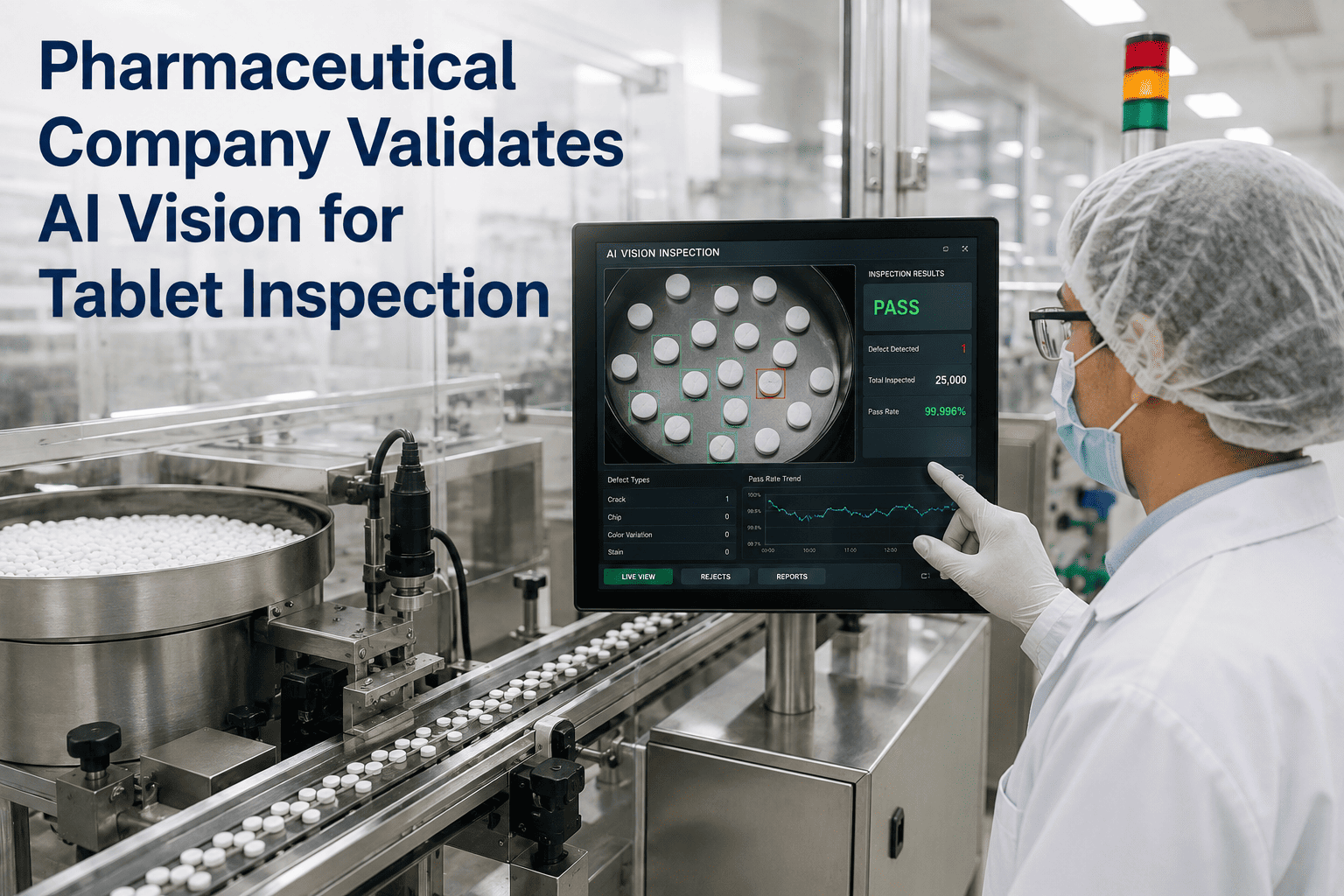
MerivaLabs replaced 12 manual tablet inspectors with iFactory's AI vision layer. The validated system now inspects 100% of tablets at line speed, produces 21 CFR Part 11 audit trails on every unit, and paid back its capital cost in 9 months of operation.
The Manufacturer at a Glance
MerivaLabs (name changed for confidentiality) is a mid-tier generics manufacturer with two FDA-registered facilities in North America. The site profiled in this case study runs film-coated tablet production for cardiovascular and CNS therapeutic categories — a mix of dark-coated tablets, embossed markings, and shape-differentiated products that historically challenged both human inspectors and legacy rule-based vision systems.
Why the Existing Inspection Model Was Failing
The decision to move to AI vision was not driven by cost first — it was driven by risk. A four-week internal audit combined with a customer-mandated Knapp study surfaced three structural problems that no amount of retraining or headcount addition could resolve. Each issue below is documented from MerivaLabs' pre-project assessment report.
Detection Accuracy Below Contractual Threshold
The Knapp study, using a 300-unit challenge set of seeded defects, measured average inspector detection at 82% across shifts — with individual performance ranging from 71% on late night shift to 91% on rested morning inspectors. The retailer's quality agreement specified 95% minimum catch rate for critical defects. Every batch shipped was technically out of contractual conformance.
Fatigue-Driven Performance Drift
Independent research puts human inspector error rate increases at approximately 20% within 30 minutes of continuous repetitive visual work. MerivaLabs' own shift analysis matched this: defect catch rate dropped from 91% in the first inspection hour to 68% by hour four, forcing 15-minute breaks every 45 minutes and effectively reducing usable inspection capacity by 25%.
Documentation Gaps for Audit Response
Manual inspection produced paper batch records with pass/fail per sample lot — but no unit-level record, no timestamp granularity, and no image evidence. During a routine FDA inspection the year prior, an investigator's question about how a specific defect type would be trended could only be answered by pulling paper records from three months and manually tallying — a gap that had already appeared as an observation on the Form 483.
Inspector Turnover and Training Cost
The role had a 34% annual turnover rate. Each new inspector required six weeks of paired training plus a competency qualification before working independently, meaning roughly 20% of the inspection headcount was in training at any given time. Recurring training and qualification cost alone ran to $180K annually before productive hours were counted.
The 14-Week Validation Journey
Deploying AI vision in an FDA-regulated tablet line is not an install-and-run exercise. Every stage of the validation lifecycle produced controlled documentation, formal reviews with MerivaLabs' Quality Assurance team, and pass criteria that had to be met before advancing. Below is the actual sequence, aligned with GAMP 5 methodology and ready for regulatory submission.
Week 1–2 · User Requirements Specification
Formalised the quality-critical requirements: 95% minimum detection on 14 defect categories, unit-level record retention, and integration with the existing MES for batch release signalling. The URS was co-signed by QA, Manufacturing, and IT and became the reference point for every downstream qualification.
Week 3–4 · Design Qualification
Documented that the proposed system architecture — edge inference cameras, on-premise data storage, MES integration layer, and role-based access controls — could meet every URS clause. Included the risk assessment mapping each functional element to its associated GxP impact and validation intensity.
Week 5–6 · Installation Qualification
Verified that hardware was installed to specification: camera focal distances, lighting geometry, network topology, server configurations, and time synchronisation to the site NTP source. Every cable, mount, and calibration certificate captured in the IQ package. Deviation from spec required documented change control before OQ could begin.
Week 7–10 · Operational Qualification
Confirmed the system operated as designed across defined ranges: line speeds from 300K to 500K tablets per hour, ambient lighting variations, camera failure and failover scenarios, alert threshold breaches, and audit trail integrity under simulated tampering attempts. All 47 OQ test scripts executed with QA witness.
Week 11–14 · Performance Qualification
The formal Knapp-style study using a 900-unit challenge set spanning all 14 defect categories across three commercial products. The AI vision system was required to demonstrate ≥95% detection on each category with false reject rate below 0.5%. Actual results: 99.8% overall detection, 0.31% false reject. PQ was signed and the system entered production release.
Manual Inspection vs iFactory AI Vision — Side by Side
This is the comparison MerivaLabs' quality director presented to the board when requesting capital approval. The numbers reflect measured performance on the same tablet lines, using the same defect challenge sets, before and after validation.
Get the Validation Documentation Framework MerivaLabs Used
On a 30-minute walkthrough we can show you the URS-to-PQ documentation structure, the Knapp study design that satisfied FDA scrutiny, and how the same framework maps to your tablet, capsule, or vial line.
The 14 Defect Categories Now Caught in Real Time
During PQ, the system was challenged on every defect category MerivaLabs' quality group considered relevant to their oral solid portfolio. The catalogue below shows the categories, their detection accuracy on the challenge set, and what a missed defect at each category would mean if it reached the market.
Cosmetic and dose uniformity risk. High volume defect on hard-shell coatings; historically the second-most-missed by manual inspection.
Structural failure indicating compression or coating issues. Missed cracks can lead to sub-potent dosing and stability failures.
Compromises release profile on modified-release products. Detectable only under angled lighting — a known blind spot for human eyes.
Signals batch mixing, coating solution drift, or drying failure. AI catches sub-Delta-E2 shifts invisible to inspector eyes under production lighting.
Regulatory identification requirement in most markets. Embossing failures had been a repeat root cause of customer complaints prior to deployment.
Contamination or moisture-driven defect that historically escaped manual sampling because it appears late in batch processing.
Dose uniformity risk when two tablets remain bonded. AI classifier distinguishes true twins from overlapping tablets in the imaging frame.
Contamination event triggering batch quarantine. Sub-millimetre particulate detection was the primary driver for the AI vision approval.
Six additional categories — capping, lamination, black spots, incorrect shape, dimension out-of-spec, and surface texture anomaly — round out the validated defect library. All 14 categories are trended in real time with SPC control limits and automatic batch hold signalling on limit breach.
How the System Satisfies 21 CFR Part 11 and Annex 11
Detection accuracy is only half of what makes an inspection system regulator-defensible. The other half is the electronic records infrastructure. Below is the ALCOA+ architecture MerivaLabs' quality director walked through during their most recent regulatory audit — with zero data-integrity findings.
Every inspection event carries the operator ID, camera node ID, AI model version hash, and batch identifier. No orphan records.
Records stored in an open, human-readable format with searchable structured fields. Original defect images retained for the full retention period, not just pass/fail flags.
Timestamps applied at frame capture, not at record write. NTP synchronised to a Stratum 2 site source with drift monitoring alerts if synchronisation exceeds 200 ms.
Raw images and inference outputs written to write-once storage. Any downstream classification review generates a new record linked to the original — the original is never altered.
Model versioning is under formal change control. Every model retrain triggers a mini-PQ, and the deployed model version is stamped into every inspection record for full lineage traceability.
Full audit trail retention for the required regulatory horizon, immutable storage tier, and structured export in FDA inspection-ready format on demand within 4 hours of request.
The 12-Month Report Card
The numbers below cover the first full year of production operation post-PQ signature. All figures are drawn from MerivaLabs' quality management system, ERP labour reporting, and the annual quality council review.
| Outcome Metric | Pre-Deployment Baseline | Post-Deployment · Year 1 |
|---|---|---|
| Defect detection accuracy | 82% | 99.8% |
| False reject rate | 1.8% | 0.31% |
| Annual inspection labour cost | $1.34M | $335K |
| Batch release cycle time | 72 hours | 18 hours |
| Customer complaints — visual defects | 47 per year | 3 per year |
| Batch rejections attributed to defects | 2.1% of batches | 0.28% of batches |
| FDA Form 483 observations — inspection | 2 in prior audit | 0 in most recent audit |
| Estimated Annual Value Delivered | Baseline | $2.4M |
Value composition: $1.0M in inspection labour savings, $680K in reduced batch rejections and rework, $420K in complaint-related supply chain cost avoidance, and $300K in accelerated batch release converting to earlier revenue recognition.
Frequently Asked Questions
Is AI vision inspection accepted by the FDA for tablet release decisions?
Yes, provided the system is validated to the same rigour as any other GxP computerised system. The FDA does not certify or approve inspection systems directly — it holds manufacturers accountable for demonstrating the system performs its intended function through a documented IQ, OQ, and PQ package aligned with GAMP 5 principles. iFactory delivers this documentation set as part of every pharmaceutical deployment, with model version control, change management protocols, and Knapp study designs that have supported successful inspections at multiple client sites. For a review of the validation package structure, book a session with our regulatory team.
How does the system handle a new product introduction after initial validation?
New product formats follow an abbreviated PQ protocol rather than a full URS-to-PQ cycle. The AI model is either extended with product-specific training data or a new product-specific model is added to the library, followed by a challenge study with the new product's defect reference set. Typical timeline is one to two weeks per new product, versus the initial 14-week deployment. Change control documentation is generated automatically to keep the master validation package current. To discuss how this maps to your product pipeline, contact our support team.
What happens to the human inspection roles being replaced?
In MerivaLabs' case, three of the original twelve inspectors were retained in a verification and second-review capacity — reviewing edge cases the AI flagged with low confidence and performing periodic Knapp challenge studies to confirm sustained performance. The remaining nine inspectors were redeployed into other quality roles: line clearance, in-process sampling, and deviation investigation. Total quality department headcount was retained; the composition shifted from inspection execution to inspection oversight and quality investigation. For a discussion on workforce transition planning, schedule a call with our team.
Can the AI vision system detect defects it has never seen before?
The core detection engine operates in a supervised classification mode across the 14 validated defect categories, so novel defect types outside those categories are not classified in real time. However, the system flags any tablet whose visual signature falls outside the normal distribution of accepted product — an anomaly detection layer that surfaces unknown deviations for human review without classifying them. Confirmed novel defects can be added to the classifier through a controlled model update and abbreviated PQ. This hybrid approach preserves regulatory defensibility while retaining the ability to catch the unexpected. For a live demo of the anomaly layer, book a walkthrough.
How is the AI model change controlled to maintain the validated state?
Every model change — whether a retrain, a new product addition, or a threshold adjustment — is treated as a change to a validated GxP system and follows formal change control. The workflow includes documented change request, impact assessment against ALCOA+ and 21 CFR Part 11 requirements, QA review and approval, abbreviated qualification testing, and update of the master validation package. The deployed model version and hash are stamped into every inspection record produced by that model, so any batch record can be traced back to the exact model configuration that generated it. To review the change control workflow in detail, reach our support team.
Bring the Same Validation Rigour to Your Line
Every FDA-registered facility running manual visual inspection is one Form 483 away from the same conversation MerivaLabs had. Let us show you what a validated AI vision deployment would look like on your tablets, capsules, or blister packs — with the documentation package to match.