Ask two vision engineers whether to standardize a plant on smart cameras or a centralized GPU server, and you will get two confident, opposite answers — and both of them will be right for their own facility. The smart camera versus GPU server question is not a hardware spec sheet comparison, it is an architecture decision that determines how the plant scales, what happens when one inspection point fails, and how much a systems integrator gets paid every time a new station gets added. Get the architecture wrong at station one, and by station twenty the wrong choice has quietly doubled the integration bill. Teams weighing this decision for a new or expanding inspection rollout can book a demo to see how iFactory's architecture handles both models on the same production line.
Two Architectures, One Underlying Trade-Off
Every industrial vision deployment ultimately makes the same underlying architectural choice, even when nobody frames it that way at the start. Machine vision literature describes this as the difference between the distributed model, where each camera has its own dedicated processor for local analysis, and the centralized model, where image data from multiple cameras streams to a central industrial PC or server for collective processing. Every practical decision downstream of this choice — how the system fails, how it scales, what it costs per additional station — traces back to which side of this line you land on.
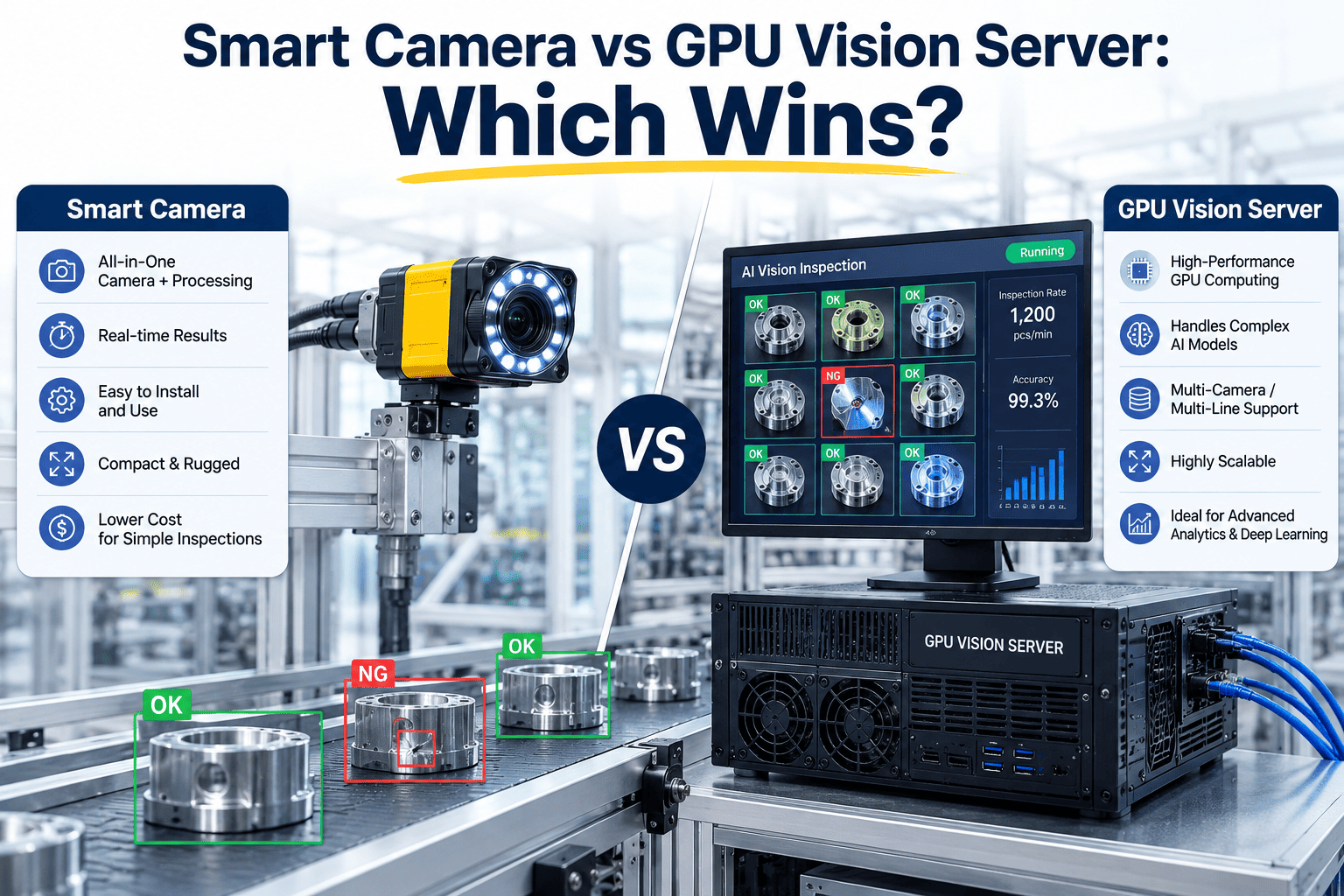
A smart camera is a self-contained, standalone vision system with the image sensor, processor, and decision logic built into a single industrial housing, requiring only power and a network connection to operate independently at its station. A GPU vision server inverts this — the cameras become comparatively simple image-capture devices, and a shared industrial PC equipped with one or more GPUs performs the heavy deep-learning inference for potentially dozens of camera feeds streaming in simultaneously. Neither architecture is a newer or more advanced version of the other — they represent a genuine fork based on where the intelligence physically lives.
Side by Side: What Actually Changes When You Move Compute From the Camera to the Server
The comparison that matters is not a spec sheet — it is what happens operationally on your floor. The table below breaks down the dimensions that actually drive the decision in a real deployment, from what happens when a single station goes down to what the twentieth camera costs to add.
| Dimension | Smart Camera (Distributed) | GPU Vision Server (Centralized) |
|---|---|---|
| Failure blast radius | One station's failure affects only that station — the rest of the line keeps inspecting | A server outage can take down every camera routed to it simultaneously |
| Per-station hardware cost | Higher cost per unit, since every camera carries its own processor | Lower cost per camera once the shared server is already in place |
| Model complexity ceiling | Constrained by the onboard processor — very deep models or high resolution can hit a wall | Effectively as deep and complex as the GPU budget allows, well suited to demanding models |
| Network dependency | Minimal — inference happens locally, network only carries results and metadata | High — full image streams must reach the server reliably and with low latency |
| Scaling to many stations | Linear cost — every new station is a full standalone unit | Often cheaper per additional camera once server headroom exists, until capacity is exhausted |
| Central model management | Updates must be pushed to every individual camera separately | One model update on the server can apply to every connected camera at once |
| Physical footprint at the station | Compact, self-contained unit, no separate compute cabinet needed nearby | Cameras are simple, but a server or edge compute cabinet must be sited and cabled nearby |
The Failure Mode Question: What Happens When Something Breaks
The single most consequential difference between the two architectures rarely shows up in a spec comparison — it shows up the first time something goes wrong in production, and by then it is too late to redesign around it. This is the question worth asking before any other criterion: when this system fails, what stops working?
This is not an argument that centralized architecture is wrong — many facilities run GPU servers in production successfully for years. It is an argument that the failure-mode conversation has to happen explicitly during the architecture decision, with a real answer for redundancy and failover, rather than being discovered the first time a server reboot takes down half the line during a shift.
Four Questions That Actually Decide the Architecture
Rather than treating this as an abstract technology preference, the decision comes down cleanly to four practical questions about your specific line. Answer these honestly before an integrator answers them for you based on whichever hardware they happen to sell.
The Hybrid Reality: Why Most Mature Deployments Run Both
The framing of this as a binary choice is useful for understanding the trade-offs, but it undersells how most mature, multi-line facilities actually operate in practice. Advanced camera vision systems commonly combine processing approaches within a single pipeline — lighter tasks handled locally, heavier deep-learning inference offloaded to more capable compute — and the same logic scales up to the plant level. A facility rarely standardizes every single station on one architecture forever; it matches the architecture to what each specific inspection point actually needs.
A common pattern in growing deployments looks like this: safety-critical or geographically isolated stations run smart cameras for their failure independence, while a cluster of high-throughput stations on one packaging line — where a shared compute room is already nearby and the defect models are demanding — run centralized GPU inference for cost efficiency and easier model updates. Neither choice is compromised by the other, because the two architectures are solving different problems even when they coexist on the same production floor.
There is also a middle layer worth naming explicitly — hybrid edge compute nodes that sit between a fully self-contained smart camera and a full rack-mounted GPU server. These are small, ruggedized industrial compute units, often built around embedded GPU modules, that serve a handful of nearby cameras rather than either one camera or dozens. This middle option is frequently the practical answer for a mid-size cluster of five to ten stations that is too large to justify per-camera smart-camera pricing but too small or too physically spread out to make a full centralized server and its redundancy budget worthwhile. Treating the decision as three tiers — standalone smart camera, small shared edge node, or full centralized server — rather than a strict binary gives most facilities a closer match to their actual station count and layout.
A Realistic Scenario: The Server That Took Down Six Stations at Once
A food packaging plant standardizes an entire new inspection line on a centralized GPU server architecture, largely because the integrator's initial quote for six camera stations came in meaningfully cheaper than six standalone smart cameras would have. The server handles all six feeds comfortably during commissioning and runs cleanly for the first several months, and the lower per-camera cost looks like the obviously correct call.
During a routine software patch cycle four months in, the server needs an unplanned reboot to apply a security update. Because no failover server was ever budgeted — the original cost comparison that favored the centralized architecture did not include the price of true redundancy — the reboot takes all six inspection stations offline simultaneously for eleven minutes. Line supervisors have no automated inspection running across the entire packaging line during that window, and operators fall back to manual visual checks with no formal record of what passed through blind. The plant's quality team, reviewing the incident afterward, calculates that the eleven-minute gap alone likely cost more in manual re-inspection labor and audit-trail cleanup than the original hardware savings the centralized architecture had delivered over its first four months of operation.
The fix the team implements afterward is not to abandon the GPU server architecture — it is to budget for genuine redundancy from the start, treating server uptime as a first-class requirement with the same seriousness as camera resolution or model accuracy. The broader lesson generalizes cleanly: a centralized architecture's lower sticker price is only the real total cost once failover is priced in alongside it, and skipping that line item is how a smart-sounding cost decision turns into an unplanned line-wide outage.
Decision Snapshot: Which Architecture Fits Your Situation
Use the quick-reference summary below as a starting point for narrowing the decision, then validate it against the four questions above before committing budget to either path.