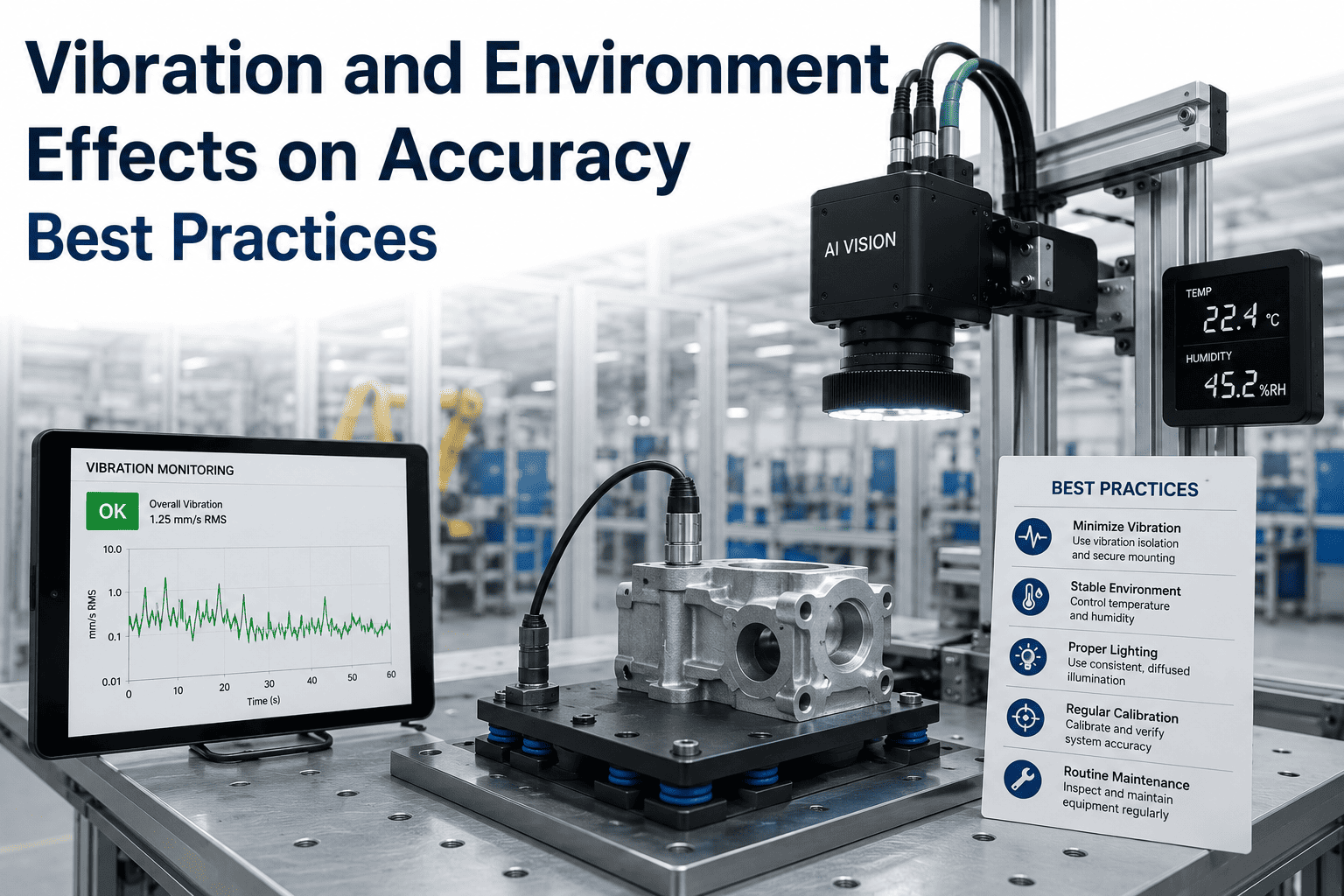
A vision model that scores 99.6% accuracy in a climate-controlled lab can drop to the mid-80s within a week of running beside a stamping press, and the model itself never changed. What changed is everything around it — a ten-degree swing in ambient temperature is enough to physically shift a camera's mounted position by an amount that shows up as measurement error, and high-frequency vibration from a nearby press or conveyor motor can loosen the same mechanical connections that held perfect alignment during commissioning. A 10°C swing in ambient temperature can shift a camera's position by enough to introduce measurable error, and vibration from nearby equipment can loosen mechanical connections and shift the camera's pose entirely. None of this shows up as a software problem, which is exactly why it gets misdiagnosed as one. To find out what's actually degrading your inspection accuracy, book a 30-minute environmental audit.
Your Vision System Didn't Get Worse. Your Floor Did.
Vibration, heat, dust, and lighting drift degrade inspection accuracy in ways that look exactly like an AI problem — until you check the mounting hardware instead of the model.
The Diagnostic Trap: Why Environmental Drift Gets Blamed on the AI
When inspection accuracy drops on the floor after performing well in commissioning or in a vendor's lab demo, the instinctive response is almost always the same: retrain the model, tune the confidence threshold, call the software vendor. That instinct is usually wrong, and it's expensive to be wrong about — retraining a model to compensate for a physically misaligned camera doesn't fix the misalignment, it just teaches the model to work around a moving target, which degrades further the next time conditions shift again. The four patterns below are the most reliable early signals that the problem sits in the physical environment rather than in the model itself, and recognizing them early saves weeks of chasing the wrong fix.
Model Accuracy Degrading Over Weeks
Gradual accuracy decline that seems to track model age is frequently lens contamination building up from dust or oil mist — a maintenance issue, not a model drift issue.
Random, Unexplainable Misreads
Intermittent errors with no clear pattern often trace to vibration-induced micro-shifts in camera position that only manifest when a nearby machine cycles on.
Accuracy Different by Shift
A model performing differently on day shift versus night shift is a strong signal of ambient or overhead lighting drift, not a data or training gap.
Seasonal Accuracy Swings
Performance that dips in summer or winter specifically points to thermal expansion shifting camera mounting position as ambient plant temperature changes.
The Four Environmental Forces Working Against Every Vision Station
Four physical factors account for nearly every case of inspection accuracy degrading after a system leaves the controlled conditions of commissioning. Each one has a distinct mechanism, a distinct symptom pattern, and a distinct fix — and none of them are solved by touching the AI model itself.
Mechanical Shift From Nearby Equipment
High-frequency vibration from presses, conveyors, or motors near an inspection station can loosen mechanical connections over time and shift the camera's pose out of its calibrated alignment. The camera itself may show no visible damage while every measurement it produces quietly drifts.
Mounting Hardware Expanding and Contracting
A ten-degree ambient temperature swing is enough to physically expand or contract standard mounting materials by an amount that shifts camera position and introduces measurable error — without any single dramatic event triggering an alarm.
Dust, Oil Mist, and Coolant Vapor
Airborne particulate accumulates gradually on lenses and protective windows, degrading image quality and introducing a measurement bias that builds slowly enough to escape notice until accuracy has already dropped significantly.
LED Output Decay and Ambient Light Change
LED illumination output decreases gradually over its service life, and ambient light conditions shift through the day and across seasons — both changing what the camera actually captures without anyone adjusting a single setting.
How Much Error Each Factor Actually Introduces
The scale of environmental impact on inspection accuracy is not trivial, and the numbers below explain why plants that skip environmental hardening see accuracy problems that no amount of model retraining resolves. These are the physical realities the hardware has to be specified around, not edge cases to worry about later.
| Environmental Factor | Documented Impact | Typical Root Cause on the Floor |
|---|---|---|
| Temperature swing | 10°C swing shifts camera position enough to introduce measurable error | Standard mounting hardware without low thermal-expansion materials |
| Thermal drift, uncorrected | Measurement error of roughly 2.0 mm per Kelvin without correction | Camera not given time to reach stable operating temperature before use |
| Thermal drift, corrected | Error reduced to below 0.2 mm per Kelvin with active correction enabled | Thermal drift correction feature available but left disabled |
| Vibration exposure | Loosened mechanical connections and shifted camera pose over time | Vision station mounted directly on or near vibration-generating equipment |
| Material variability defects | Conventional inspection methods miss up to 30% of defects on variable materials | Rule-based thresholds unable to distinguish natural texture variation from true flaws |
Not Sure Which of These Four Is Hurting Your Line?
iFactory runs an environmental audit before touching your model — checking mounting stability, thermal exposure, contamination levels, and lighting consistency to find the actual root cause of accuracy drift.
A Composite Scenario: The Accuracy Drop That Followed the Seasons
A metal fabrication plant running an AI vision station for dimensional inspection on stamped brackets noticed a curious pattern over its first full year of operation: accuracy, which had measured above 99% during summer commissioning, drifted down toward the low 90s each winter, then recovered again as the weather warmed. The pattern repeated closely enough across two winters that it stopped looking like coincidence, but the quality team's first instinct — that the model was somehow degrading seasonally — didn't hold up to scrutiny, since a trained model has no mechanism to know what season it is.
An environmental review found the actual cause sitting in plain sight: the vision station's camera was mounted on standard aluminum hardware in an unheated section of the plant, where ambient temperature swung by more than fifteen degrees between summer and winter operation. The aluminum mount expanded and contracted with that swing enough to shift the camera's working distance and angle by a small but consistent amount — enough to push borderline dimensional measurements across the pass-fail threshold on the coldest days, without ever producing an obvious mechanical fault an operator would notice on a walk-through.
The fix didn't touch the AI model at all. The mounting hardware was replaced with a low-thermal-expansion material, and a recalibration routine was added at the start of each shift to re-anchor the reference position regardless of ambient conditions. The seasonal accuracy swing disappeared entirely the following winter — confirming that the entire pattern, which two winters of data had made look like a software mystery, had been a five-dollar mounting bracket problem the whole time.
Hardening a Vision Station: What to Specify Before Installation
The most reliable way to avoid environmental accuracy drift is specifying for it before installation, not diagnosing it after the fact. Documenting the actual environmental conditions at a proposed mounting location — not the plant's general specification sheet, but the specific reality of that exact spot on the floor — determines camera housing, lens selection, cooling requirements, and mounting material, and skipping this step is the most common cause of field failure in vision system deployments. The six items below form a practical checklist an integration team should walk through before a single camera bracket gets bolted to anything.
Document Ambient Temperature Range
Measure actual minimum and maximum temperature at the exact mounting location across a full seasonal cycle, not just the plant's general HVAC specification.
Measure Vibration Amplitude
Identify nearby vibration sources — presses, conveyors, motors — and quantify the actual amplitude reaching the proposed mounting point before selecting hardware and isolation strategy.
Assess Contamination Exposure
Evaluate airborne particulate levels, washdown requirements, and oil or coolant mist exposure to determine the correct IP rating and cleaning schedule.
Characterize Lighting Conditions
Document daylight exposure, overhead fixture schedules, and any reflective surfaces near the inspection zone that could introduce ambient light variation.
Select Low-Expansion Mounting Materials
In locations with significant temperature variation, specify mounting hardware with a low coefficient of thermal expansion rather than standard aluminum or steel brackets.
Enable Active Thermal Drift Correction
Where the camera platform supports it, enable active thermal drift correction rather than relying on passive hardware choices alone — the combination delivers the most stable long-term accuracy.
Preventive Maintenance: What Keeps a Hardened Station Hardened
Specifying the right hardware at installation solves the initial problem, but environmental degradation is ongoing, not one-time — lenses accumulate contamination, LED output decays, and mechanical connections can loosen gradually even with vibration isolation in place. A preventive maintenance rhythm is what keeps a properly specified station performing the way it did on commissioning day, months and years later.
Scheduled Lens Cleaning
Establish a cleaning schedule matched to the plant's actual contamination rate, and monitor image quality metrics as part of routine preventive maintenance rather than waiting for accuracy complaints.
Periodic Recalibration
In environments with meaningful temperature variation, recalibrate at the beginning of each shift, or on a schedule matched to the plant's actual thermal cycle, rather than relying on a single commissioning-day calibration indefinitely.
Mechanical Connection Checks
Inspect and tighten mounting hardware and locking joints on a routine schedule, particularly for stations near vibration sources, before a loosened connection produces a measurable accuracy drop.
Lighting Output Verification
Track LED output over time against its baseline commissioning measurement, and replace or recalibrate illumination before decay becomes significant enough to affect inspection results.
Frequently Asked Questions
The questions below reflect what quality engineers and plant managers most often ask when troubleshooting inspection accuracy that has degraded after a vision system leaves initial commissioning.
How do I tell if my accuracy problem is environmental or actually the AI model?
Look for patterns tied to time, season, or nearby equipment activity rather than to specific part types or defect categories. Accuracy that varies by shift, by season, or that correlates with a nearby machine cycling on is almost always environmental — lighting, thermal, or vibration related. Accuracy that's consistently weak on a specific defect type or part geometry, regardless of when or where it's measured, points more toward a genuine model or training gap. Book a 30-minute audit and we'll help distinguish the two on your specific line.
Can retraining the AI model fix accuracy problems caused by vibration or thermal drift?
Retraining can sometimes mask the symptom temporarily, but it doesn't fix the underlying cause, and it often makes the long-term situation worse. A model retrained to compensate for a physically shifted camera is learning around a moving target — the next time thermal or vibration conditions change again, that compensation breaks down in a new, harder-to-diagnose way. The more durable fix addresses the physical cause directly: stabilize the mounting, correct for thermal drift, isolate from vibration.
What's the actual impact of a 10-degree temperature swing on inspection accuracy?
A ten-degree Celsius ambient swing is enough to shift standard mounting hardware by an amount that introduces measurable positional error in the camera. Without active thermal drift correction, measurement error can run around 2.0 millimetres per Kelvin of temperature change; with correction enabled, that error typically drops to below 0.2 millimetres per Kelvin. The practical difference between those two numbers is often the difference between a station that passes audit and one that quietly produces false rejects on marginal parts. Contact support for guidance on thermal correction for your specific camera platform.
How often should a vision station be recalibrated in a thermally variable environment?
There's no universal answer — the right interval depends on how much the ambient temperature actually swings at that specific mounting location and how sensitive the inspection tolerance is to positional shift. Plants with significant daily or seasonal temperature variation commonly recalibrate at the start of each shift as a conservative baseline, while stations in tightly climate-controlled areas may need far less frequent attention. The safest approach is measuring the actual drift pattern first, then setting a recalibration interval based on that data rather than a generic industry rule of thumb.
Is it worth hardening a vision station for vibration if the equipment nearby doesn't seem that loud?
Audible loudness and the vibration amplitude that actually affects camera stability are not the same thing — a quiet-running motor can still transmit enough high-frequency vibration through a shared structure to loosen mounting connections over months, while a louder but well-isolated machine nearby might transmit almost none. The only reliable way to know is measuring actual vibration amplitude at the proposed mounting point, not estimating it by ear. Visit support for guidance on vibration assessment before installation.
Stop Chasing a Software Fix for a Hardware Problem
iFactory's engineers audit your actual floor conditions — temperature, vibration, contamination, and lighting — before recommending any change to your inspection model. Book a 30-minute walkthrough and find out what's really driving your accuracy numbers.