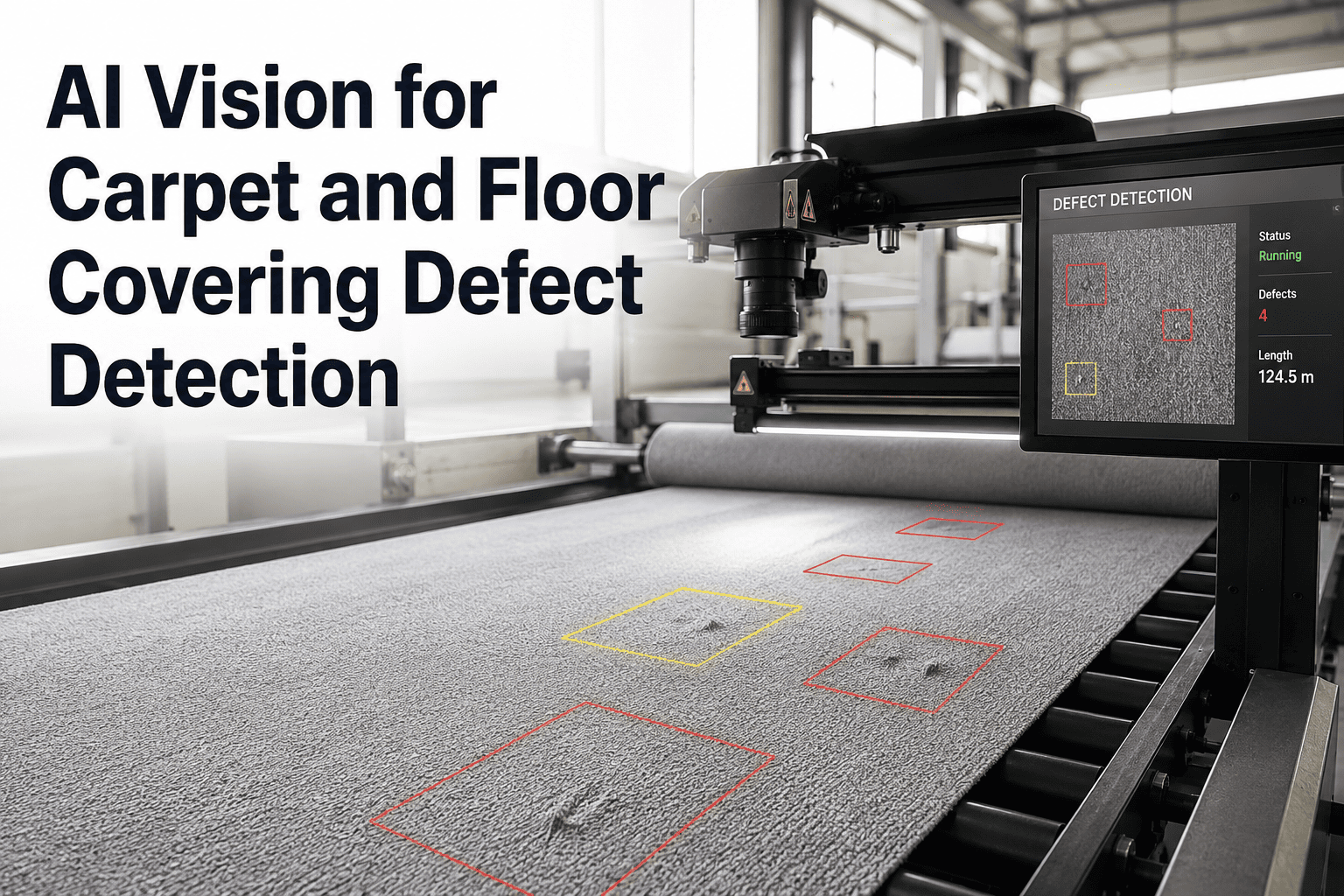
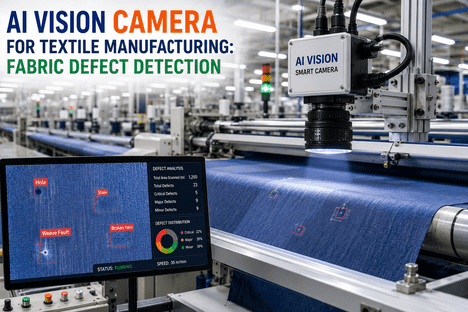
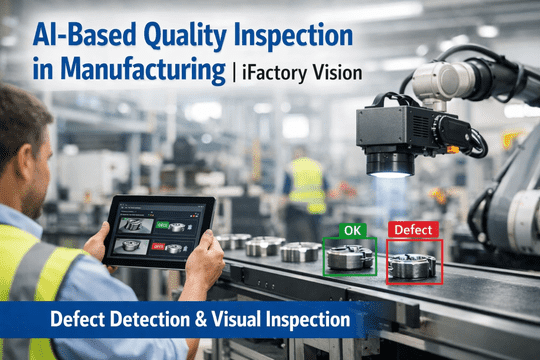
A carpet line runs several metres wide and covers ground fast, which means a single missed defect doesn't cost you one bad square foot, it costs you an entire roll. Tufting skips, color streaks, backing flaws, and pattern misregistration all start small at the point they occur and stay invisible until a human inspector, working a long shift under industrial lighting, happens to be looking at the right few feet of moving pile at the right second. Carpet and floor covering plants have run this way for decades because there was no faster alternative to a trained eye. AI vision cameras now inspect the full web at full line speed, catching what a tired inspector two hours into a shift is statistically likely to miss. To see this running against your own carpet construction, book a demo.
PROCESS-SPECIFIC · CARPET & FLOOR COVERING · DEFECT DETECTION
Catch the Defect Before the Whole Roll Is Downgraded
iFactory's AI vision cameras inspect carpet and floor covering webs at full line speed, flagging tufting skips, color streaks, backing flaws, and pattern misregistration the moment they appear instead of after hours of good production has already run past.
THE FOUR DEFECT FAMILIES
What's Actually Going Wrong on a Carpet Line
Carpet defects don't come from one source, they come from four distinct stages of production, each producing a different visual signature that a camera has to be trained to recognize separately. Lumping them together as "carpet defects" is exactly why generic inspection tooling struggles with this material.
TUFTING
Skipped, Missing, or Misaligned Tufts
A broken yarn, a needle miss, or backing tension variation drops a stitch or shifts a row out of alignment, leaving a gap or streak that runs the length of the machine direction until someone notices.
DYEING
Color Streaks and Shade Variation
Uneven dye uptake across the width of the web produces bands or patches of off-shade pile, often subtle enough under one lighting angle to pass a quick visual check and only show up once installed.
BACKING
Delamination, Bubbling, and Adhesive Starvation
The secondary backing stage can bond unevenly, trapping air pockets or leaving zones where adhesive coverage ran thin, defects that are often invisible from the face side until the carpet is stressed in use.
PATTERN
Pattern Misregistration and Bow or Skew
On patterned carpet, a backing that isn't perfectly straight causes the tufting needles to land off the intended grid, producing a mismatch that becomes obvious the moment two rolls are laid side by side.
Each of these four families demands a different inspection approach, which is why a single generic camera setup tuned for one defect type routinely misses the other three. A backing flaw hidden under the pile isn't caught by the same visual check that spots a color streak on the surface.
THE INSPECTION GAP
Why Manual Inspection Can't Keep Up With Line Speed
Carpet and floor covering webs move continuously, several metres wide, and manual inspection depends entirely on how much of that moving surface a human eye can actually scan before it passes out of view. The physical reality of the job works against consistency no matter how skilled the inspector is.
1
Shift Start
Catch rates begin near their best, with the inspector alert and scanning the full width of the web as it passes the station.
→
2
Hours Into Shift
Repetitive visual strain under industrial lighting sets in, and attention naturally narrows to the areas of the web that drew attention most recently.
→
3
Fatigue Window
Defect catch rates can drop 20-40% by the end of a shift, a documented pattern across manual visual inspection roles, not a reflection of any individual inspector's effort.
→
4
Defect Escapes
A subtle color streak or a backing flaw that never surfaces at the visible face slips through and travels downstream, discovered only when a roll is downgraded or a customer complaint arrives.
This is not a story about inspector skill, it is a story about the limits of sustained human attention applied to a task that never slows down. A camera watching the same width of web at the same line speed does not fatigue at hour six the way a person does, and it applies the same defect standard to the last roll of the shift that it applied to the first.
Get your line's defect escape rate benchmarked
iFactory can run a side-by-side comparison against your current inspection process on your own carpet construction, so you see the gap before committing to anything.
HOW THE CAMERA SEES IT
What AI Vision Catches That the Eye Misses
A vision system trained on carpet doesn't look at the web the way a person does. It doesn't get tired, doesn't lose contrast sensitivity under fluorescent lighting after hour six, and it inspects the full width of every metre that passes rather than sampling whatever section happens to catch attention.
Full-Width Continuous Coverage
The camera array covers the entire width of the web on every pass, not a sampled strip, so a defect at the edge of the roll gets the same scrutiny as one running down the center.
Consistent Standard Across Shifts
The same defect threshold applies at 2am on the third shift as it did at the start of first shift, removing the inspector-to-inspector variation that makes defect severity a matter of who happened to be on the floor.
Low-Contrast Defect Sensitivity
Subtle shade variation and fine tension lines that only show up under a specific lighting angle to the human eye are exactly the kind of low-contrast pattern a trained model is built to pick out consistently.
Machine-Direction Trend Tracking
A defect that starts faint and gradually worsens down the length of the roll, like a slow tension drift, gets flagged as a developing trend rather than only being caught once it becomes visually obvious.
MANUAL VS AI VISION
Side-by-Side on What Actually Changes
The comparison that matters isn't inspector skill against camera precision in the abstract, it's what each approach actually delivers under the real conditions of a running carpet line.
| Factor |
Manual Inspection |
AI Vision Inspection |
| Coverage |
Sampled sections of the web, limited by what the eye can scan at line speed |
Full width, every metre, on every pass |
| Consistency |
Catch rate drops 20-40% by end of shift, varies inspector to inspector |
Same defect threshold applied around the clock, across every shift |
| Defect Types |
Strong on obvious surface defects, weaker on backing and low-contrast shade issues |
Trained separately per defect family, including subtle backing and color signals |
| Response Time |
Defect noticed after the fact, often after multiple metres have already run |
Flagged in real time as the web passes the camera station |
| Data Trail |
Handwritten logs or none, difficult to trace back to a root cause |
Every defect logged with location, type, and timestamp automatically |
The point is not that AI vision replaces every judgment a trained inspector makes, it's that it removes the coverage and consistency problem that no amount of inspector skill can fully solve on a fast-moving, several-metres-wide web.
WHAT THIS COSTS TODAY
The Real Cost of a Defect That Escapes Detection
A roll that gets downgraded or rejected after full production represents hours of machine time and raw material that can't be recovered, and that cost compounds the further downstream a defect travels before it's caught.
AT THE MACHINE
Caught in Real Time
The line stops or the operator is alerted immediately, limiting the defect to a short section instead of letting it run the length of the roll.
AT ROLL INSPECTION
Caught at End of Line
The full roll is already produced by the time the defect is found, meaning the entire run of material and machine time is now at risk of downgrade.
AT THE CUSTOMER
Caught After Shipment
A defect that escapes the plant entirely becomes a returns and reputation cost, arriving as a customer complaint long after the production data that would explain it is gone.
Plants running quality-improvement programs on woven and tufted lines have documented defect rates in the tens of thousands of opportunities per million and daily exposure in the tens of thousands of dollars when a bottleneck between production and inspection capacity goes unaddressed. The earlier a defect is caught in that chain, the smaller the loss.
TURNKEY DELIVERY
How iFactory Deploys Vision on a Carpet Line
iFactory installs a camera array matched to your web width and line speed, trains the model on your own carpet constructions and defect history, and connects the results to a dashboard your quality and production teams already use.
What Gets Built
Camera array sized to your web width, positioned for tufting, dyeing, and backing stages
Defect models trained separately per family: tufting, color, backing, pattern
Real-time alerting to line operators the moment a defect crosses threshold
Automatic defect logging with location, type, and timestamp for every roll
24×7 remote monitoring with trend alerts on developing defect patterns
Deployment Timeline
Weeks 1-4: Line audit, camera placement, data pipeline setup
Weeks 5-8: Model training on your defect history, calibration against live production
Weeks 9-12: Dashboard go-live, alerting activation, operator training
FREQUENTLY ASKED QUESTIONS
What Carpet Plants Ask Before Adding Vision Inspection
Can one camera system really catch tufting, color, backing, and pattern defects at once?
Not with a single generic model, which is why iFactory trains separate detection models for each defect family rather than expecting one setup to catch everything equally well. Tufting skips are a structural pattern in the pile itself, color streaks are a shade-uniformity signal across the width of the web, backing flaws often require different lighting or imaging to surface at all since they can be invisible from the face side, and pattern misregistration is a geometric alignment check specific to patterned constructions. Running these as coordinated models against the same camera array is what makes full-line coverage practical rather than requiring four separate inspection stations.
Book a demo to see how this maps onto your specific carpet construction.
How does the system handle patterned carpet versus solid color constructions?
Patterned carpet needs the model to check geometric alignment against the intended design grid, catching the kind of bow, skew, or misregistration that happens when the backing shifts slightly during tufting and the needles land off pattern. Solid color carpet doesn't have that alignment concern but is more sensitive to subtle shade variation across the width of the web, since there's no pattern to distract the eye from a slight color inconsistency. The model is trained against whichever construction is actually running on your line, so a pattern-alignment check isn't wasted effort on a solid-color roll and vice versa.
Contact our support team to discuss your specific product mix.
Do we need to slow the line down for the camera to catch defects accurately?
No, the entire point of a vision system built for this application is to inspect at your actual production line speed rather than forcing a tradeoff between throughput and coverage. This is precisely the problem manual inspection runs into on a fast, wide web: a human inspector physically cannot scan every metre at full speed, so plants either accept sampled coverage or slow the line to inspect more thoroughly. Camera-based inspection removes that tradeoff because the system captures and processes the full width of the web continuously at whatever speed the line is actually running.
Book a demo to see full-speed inspection running against your current line rate.
What happens when the system flags a defect, does it stop the line automatically?
That depends entirely on how you want it configured, and most plants start with real-time operator alerting rather than automatic line stops so the team retains control over the response while trusting the detection. As confidence builds and defect patterns become well understood, some lines move toward automatic stops or diverter gates for high-severity defects while lower-severity flags continue to route through operator review. Every defect is logged with its location, type, and timestamp regardless of how the response is configured, so the data trail exists either way.
Contact our support team to discuss the right response configuration for your line.
How long does it take to train the model on our specific carpet constructions and defect history?
Most deployments reach full go-live within twelve weeks, with the model training and calibration phase typically running through weeks five to eight once the camera array is installed and your production and defect history data is flowing in. The model is trained on your own carpet constructions and past defect examples rather than a generic dataset, which is what allows it to recognize the specific visual signatures your line actually produces instead of a theoretical defect pattern that may not match your yarn, dye process, or backing system. Ongoing recalibration as new constructions are introduced is a much lighter task than the initial training.
Book a demo to set a realistic timeline against your product mix.
FULL WEB, EVERY METRE, EVERY SHIFT
Stop Losing Full Rolls to Defects You Never Saw
iFactory's AI vision cameras inspect carpet and floor covering webs at full line speed, catching tufting skips, color streaks, backing flaws, and pattern misregistration before a roll's worth of production is already at risk.