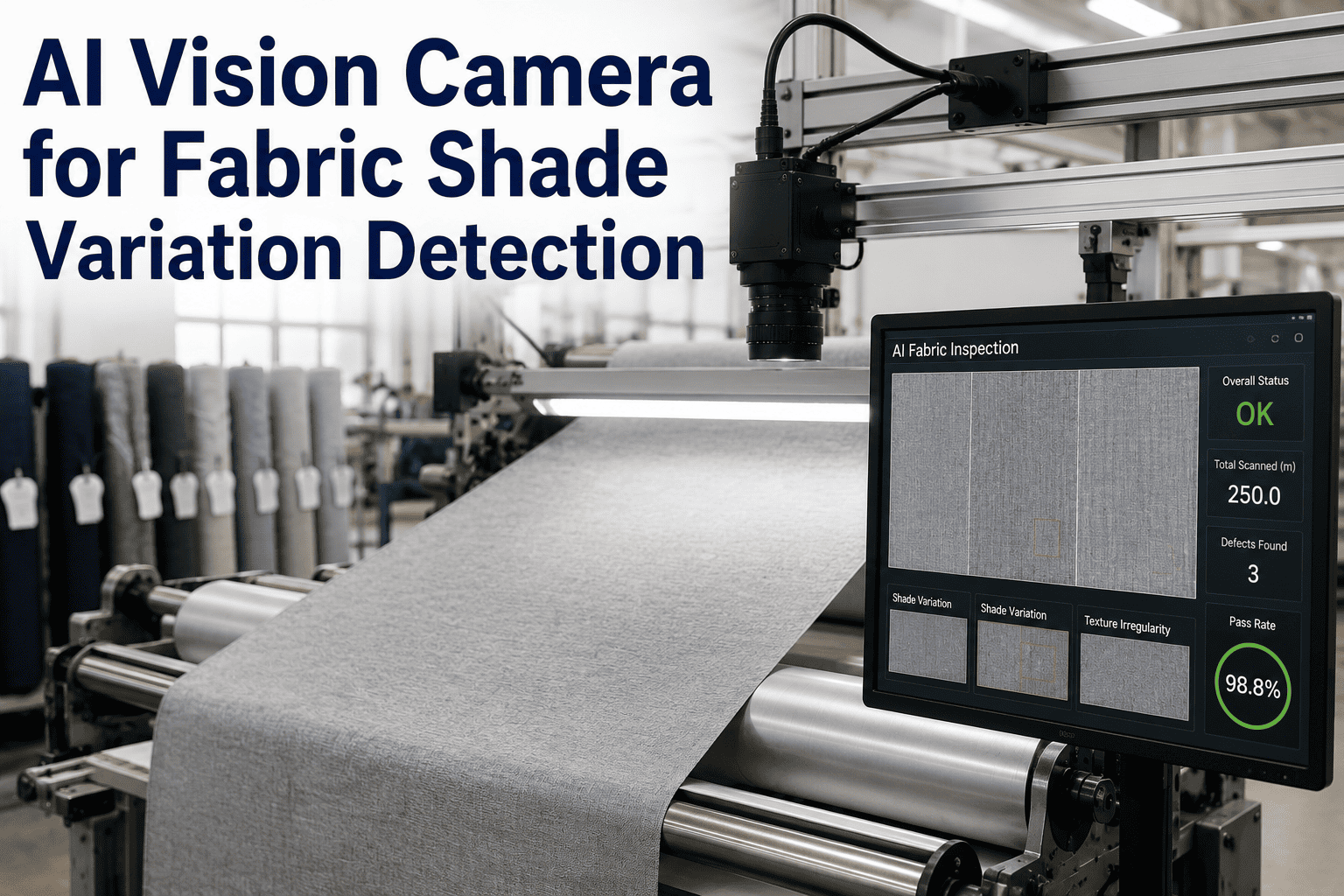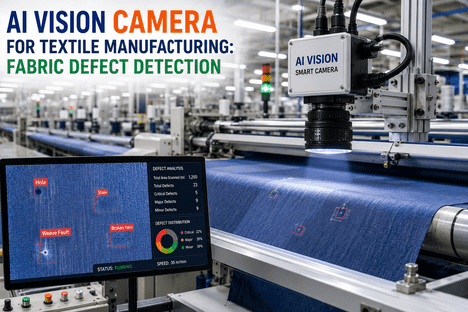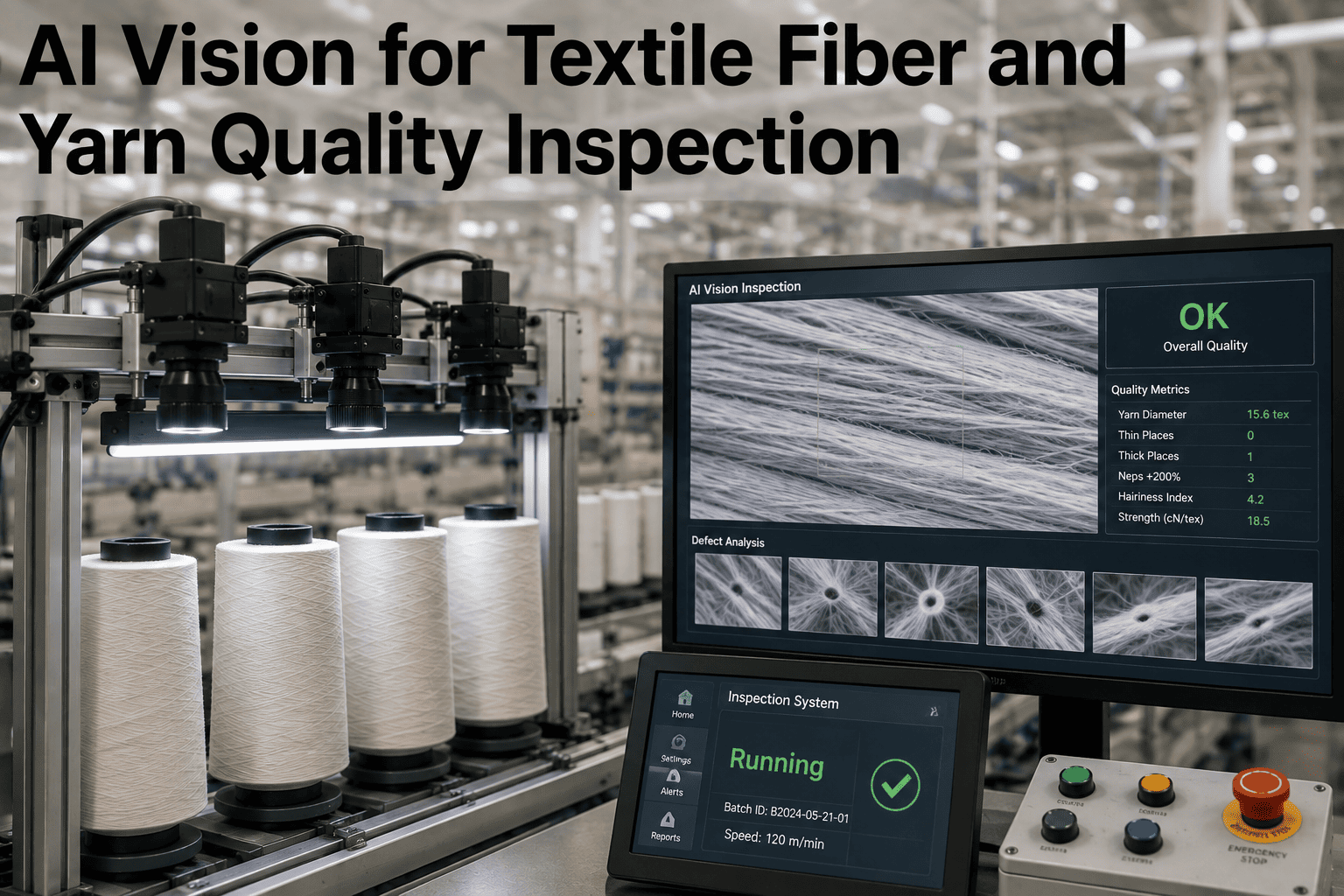
A single foreign fiber buried in a cone of yarn can ruin an entire roll of finished fabric, and by the time it shows up as a dark thread in a light-colored shirt, the cotton has already traveled through carding, spinning, weaving, and dyeing. Human inspectors catch what the eye can see under normal light, at normal speed, for as long as attention holds up across an eight-hour shift. Cameras do not get tired, and they do not blink past a nep the size of a pinhead moving at spindle speed. This piece looks at how AI vision is applied to fiber and yarn inspection on the mill floor, and if contamination or appearance defects are costing you fabric-stage rejections, book a demo to see it running against your own yarn.
Catch the Nep, the Thick Place, and the Foreign Fiber Before They Become a Customer Complaint
AI cameras built for spinning and winding stations detect contamination, neps, thin places, and thick places in real time, giving mills continuous quality coverage that lab sampling was never designed to provide.
Your Quality Lab Is Testing a Fraction of a Percent of What You Actually Ship
Most spinning mills still rely on a lab tester pulling a short bobbin sample every few hours, running it through an evenness tester, and reporting CV percent, thin places, thick places, and nep counts back to production. That report is accurate for the sample it measured. The problem is what it does not measure. A ring frame running continuously for a full shift produces meters upon meters of yarn between each lab sample, and any fault that occurs in the gap simply never gets seen until it surfaces three or four processes later as a visible flaw in woven or knitted fabric.
Foreign fiber contamination follows the same blind spot from an earlier stage entirely. A stray thread of polypropylene bag twine, a strand of hair, a scrap of packaging film picked up during ginning or bale handling rides invisibly through opening, carding, and drawing until it ends up twisted into yarn. Because these contaminants are often light-colored or translucent, a human eye scanning cotton lint on a conveyor under standard lighting misses a meaningful share of them, and the ones that get missed become the streaky, discolored thread that a downstream customer eventually complains about.
Four Defect Families That Drive Most Fabric-Stage Rejections
Not every yarn fault behaves the same way, and a vision system worth deploying has to be tuned separately for each of these categories, since the size, contrast, and speed of appearance differ significantly between them.
Contamination
Polypropylene twine, packaging film, hair, feathers, and colored thread mixed into raw fiber during handling. Often light-colored or transparent, making it hardest to catch under standard visible light without specific imaging technique.
Neps
Small, dense tangles of fiber that were not properly opened during carding. Appear as tiny dark or light dots once fabric is dyed, and are especially visible and damaging in light shades and plain-weave constructions.
Thin Places
Segments where yarn diameter drops well below the running average, typically from drafting irregularities or excess short fiber content. Weakens the yarn and is a leading cause of breaks during weaving and knitting.
Thick Places
Segments where yarn diameter runs well above average, usually from uneven drafting or fiber bunching. Shows up as visible slubs in finished fabric and can jam needles or heald eyes during knitting and weaving.
Industry quality references classify these faults by both severity and length, which is exactly the kind of multi-dimensional judgment a trained vision model handles well and a fatigued human eye handles inconsistently across a long shift. A camera system does not apply looser thresholds in hour seven than it did in hour one.
Lighting and Optics Purpose-Built for Fiber, Not Borrowed From a General Camera
The single biggest reason generic vision systems fail on textile lines is lighting. Cotton lint and yarn are low-contrast subjects, and many of the contaminants that matter most, particularly clear or white plastic film, are nearly invisible under ordinary illumination. Effective fiber and yarn inspection depends on matching the imaging technique to the defect being hunted, not on a single camera and a single light source doing everything.
High-Speed Line-Scan Imaging
Captures the yarn or lint stream one line at a time as it moves, building a continuous, distortion-free image at production speed, which is what makes real-time coverage of every meter possible rather than periodic still shots.
Contrast-Enhancing Illumination
Specific lighting angles and wavelengths make otherwise near-invisible contaminants, such as clear film and light-colored fibers, stand out against the cotton background by exploiting differences in how each material reflects or fluoresces.
Diameter and Density Profiling
The vision model continuously measures apparent yarn diameter and mass density along the length of the thread, flagging any segment that deviates from the running average by more than the configured thick or thin place threshold.
Trained Defect Classification
A deep learning model distinguishes a genuine nep from a normal fiber cluster, and a genuine foreign fiber from a shadow or lint fly, cutting the false alarm rate that made earlier generations of automated inspection unpopular on the floor.
See the Defects Your Current Sampling Is Missing
Bring a spool of your own yarn or a sample of your raw fiber and we will show you, on camera, what an inline AI vision system catches that periodic lab testing structurally cannot. Most mills are surprised by what has been passing through undetected.
Three Stations, Three Different Failure Modes to Guard Against
Fiber and yarn quality is not decided at one point in the process. Each stage introduces its own defect risk, and a mill that only inspects at one station is guaranteed to miss whatever happens at the other two.
Raw Fiber Line
Where foreign fiber contamination is most catchable and most damaging to miss, since a contaminant removed here never has the chance to reach carded sliver, spun yarn, or finished fabric at all.
Spinning Station
Where thin places, thick places, and neps are actually created through drafting and twisting, making this the highest-value point for catching evenness faults the instant they occur rather than hours later.
Cone Winding
The last practical checkpoint before yarn leaves the mill or moves to weaving and knitting, where a vision-assisted check can confirm the electronic yarn clearer did not pass anything it should have caught.
Why a Defect Caught at Spinning Is Worth Far More Than One Caught at Fabric Inspection
The economics of textile quality control follow a simple, well-established rule: the cost of a defect multiplies at every stage it survives. A nep caught in yarn costs almost nothing to address. The same nep, undetected, that dyes into a visible dot on a finished garment can mean a rejected shipment, a chargeback from the buyer, and reputational damage with a customer who now questions every future lot.
This is the core commercial argument for inline vision inspection over lab sampling alone. Every stage a defect is allowed to pass through adds embedded labor, dye, finishing, and logistics cost on top of the original fiber cost, and none of that value is recoverable once the fabric has been cut, sewn, and shipped. Catching contamination and evenness faults at the earliest possible point is not a quality nicety, it is where the actual money is protected.
From a Quarterly Quality Report to an Alert Before the Next Meter Runs
The practical shift a mill feels first is not a dashboard, it is timing. Instead of a quality technician discovering a spike in thin places on a report generated hours after the fact, a supervisor gets a flag the moment a spindle starts drifting out of tolerance, while there is still time to intervene before an entire doff is affected.
That kind of specific, immediate answer is only possible because the system is watching continuously and tagging every flagged event with the station, spindle group, and timestamp automatically, rather than requiring someone to notice a trend in a spreadsheet at the end of the week.
How a Mill Moves From First Conversation to Live Inspection
Deploying AI vision on a spinning or winding line is not a rip-and-replace of existing quality processes. It layers onto what a mill already runs, and the path to live coverage is deliberately staged so nothing gates production before it has been proven.
Sample and Baseline
Cameras run against your own fiber and yarn samples first, establishing what your specific raw material and process baseline actually looks like before any threshold is set.
Station Pilot
One frame or one winding station is instrumented and run in monitoring mode alongside existing lab sampling, so results can be directly compared before anything changes on the floor.
Threshold Tuning
Detection sensitivity is tuned against your customer specifications and internal standards, balancing catch rate against false alarms until the system reflects how your quality team actually grades yarn.
Plant-Wide Rollout
Once validated, coverage extends across additional frames and stations with a shared dashboard, so quality data from every instrumented point rolls up into one plant-wide view.
What Spinning and Quality Teams Usually Ask First
These are the questions that come up in almost every conversation with a mill evaluating inline vision inspection for the first time, answered directly.
Stop Finding Out About Defects at the Fabric Stage
Every meter of yarn that leaves your mill uninspected is a meter your customer might inspect for you, at a much higher cost to your reputation. See what continuous AI vision coverage looks like against your own fiber, your own yarn, and your own quality standards.