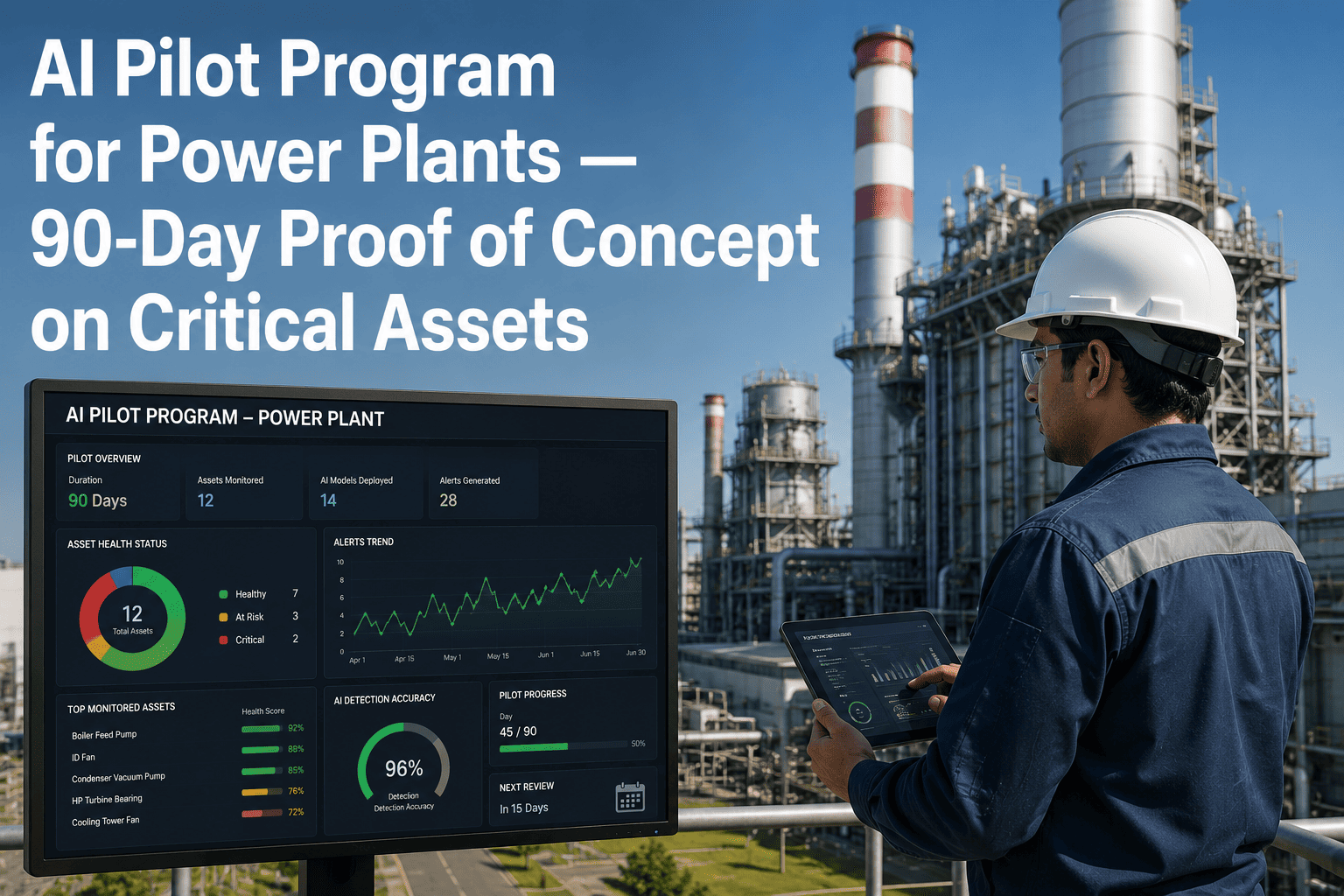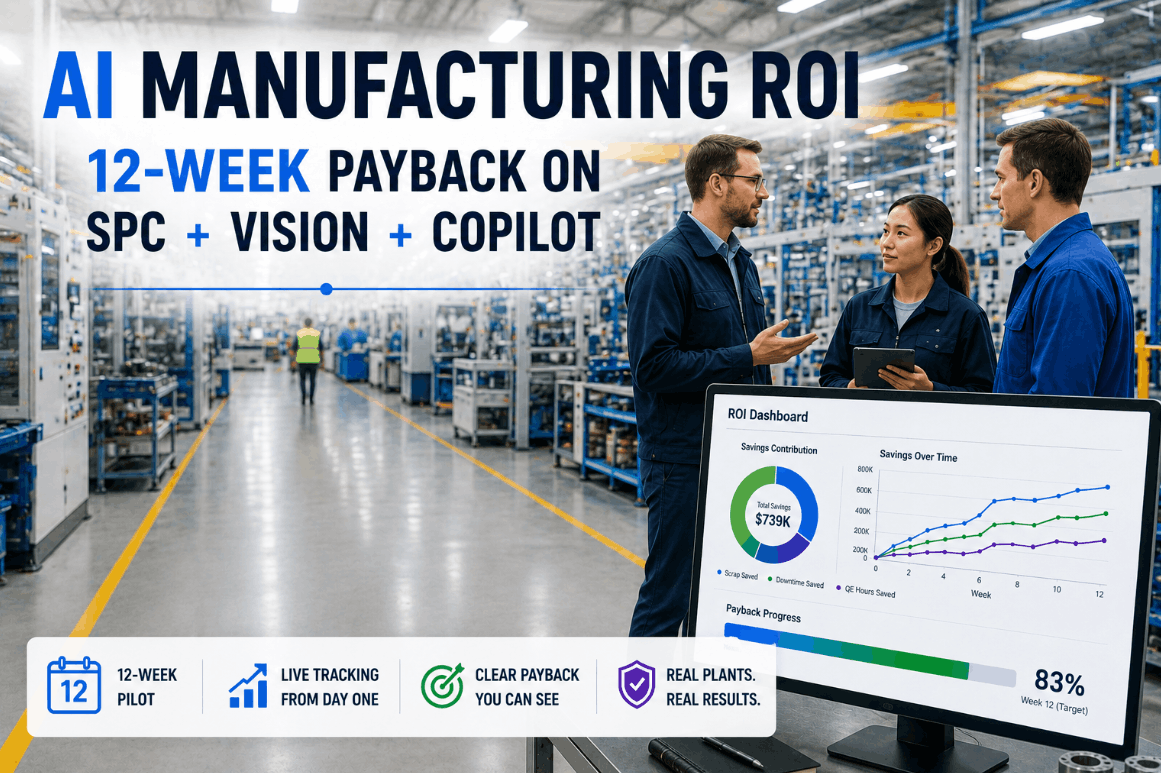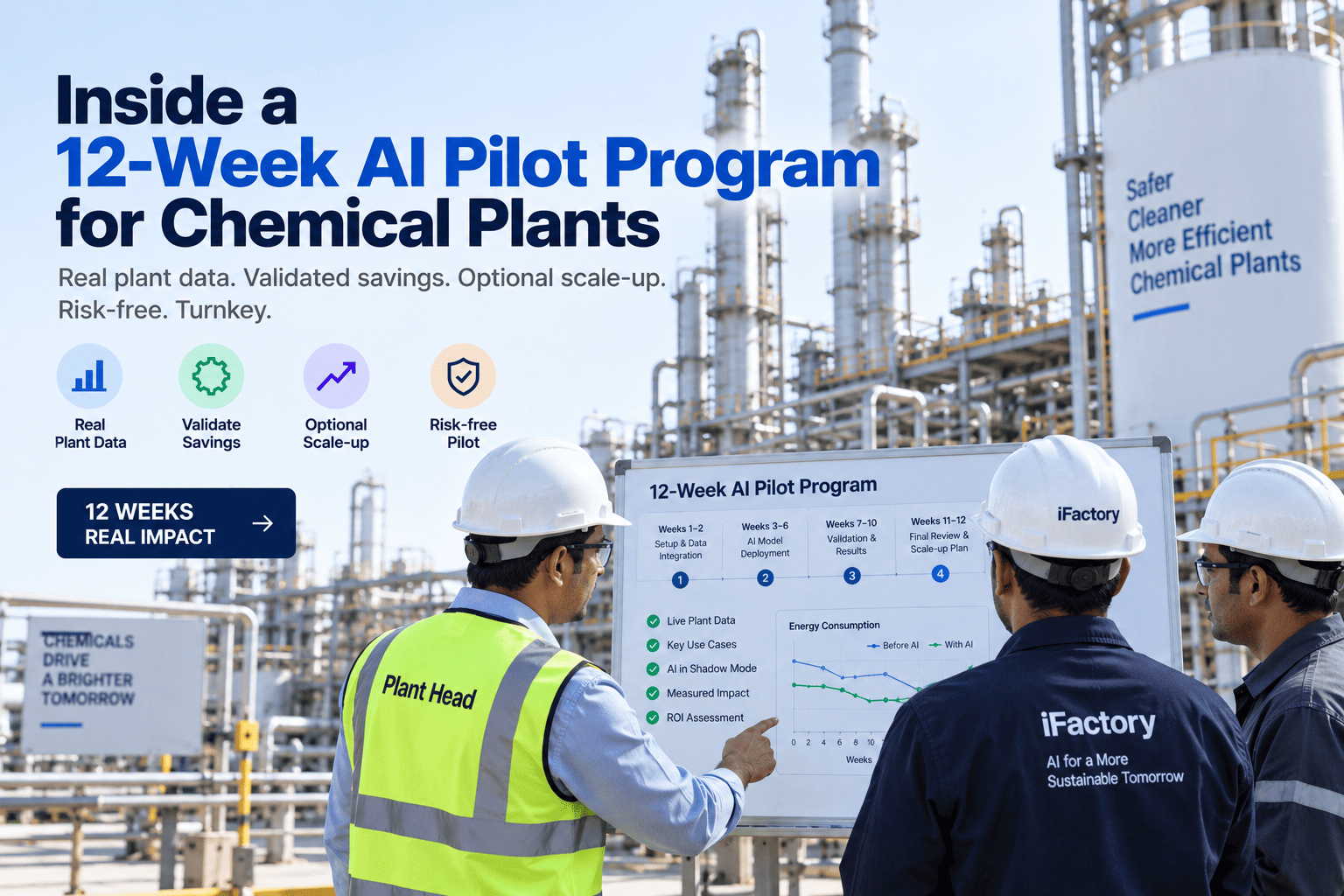
Most plant heads have watched an AI project die the same way: a vendor demos something impressive, a pilot runs for months, everyone celebrates a promising accuracy chart — and then nothing scales, because Finance can't see a dollar of verified savings and the plant never trusted a system it couldn't watch. The industry has a name for it: pilot purgatory — by some measures 30 percent of AI projects are abandoned after the proof-of-concept and only about a third ever reach production. The failure is almost never the technology; it's that the pilot was structured wrong — built to show off a model instead of moving a real KPI, with no agreed line for what success even means. A 12-week pilot done right inverts all of that: your real plant data, shadow mode so it can't touch production, a KPI baselined with Finance up front, and a binary scale-or-walk decision at the end. You can book a demo to scope one for your plant.
Prove It on Your Own Data, Risk-Free, Before You Commit a Dollar
A structured 12-week pilot on your real plant data, running in shadow mode so it never touches operations — ending in Finance-validated savings and a clean scale-or-walk-away decision. No pilot purgatory, no leap of faith.
Pilot Purgatory Is a Structure Problem, Not a Technology Problem
Before the how, it's worth being honest about why so many industrial AI pilots go nowhere — because avoiding those specific traps is the entire design of a good pilot. In almost every stalled project, the model worked fine in a demo; what failed was the frame around it. These are the four traps a 12-week pilot is built to sidestep.
Pilots launched because a capability looked impressive, rather than to move one specific plant pain, end up demonstrating the technology instead of improving an outcome. With no clear tie to yield, energy, or downtime, there's nothing for Finance to bank.
Tags connected, models trained, dashboards delivered — these say nothing about plant performance. A pilot judged on activity produces charts nobody can convert to dollars, which is why it never clears the funding gate to scale.
When nobody agreed up front what result justifies scaling, the pilot drifts into indefinite limbo — neither killed nor deployed, quietly draining resources and eroding leadership's trust in the whole idea.
Treating the pilot as an IT experiment and involving the people who run the plant only at rollout guarantees a system that conflicts with how the plant actually works — and one the floor never adopts.
Shadow Mode: the AI Watches and Recommends, but Never Touches Operations
The single feature that makes a pilot genuinely risk-free is shadow mode, and it's worth understanding exactly what it means, because it's what lets a chemical plant say yes without betting production on an unproven system. In shadow mode the AI runs live on your real process, but its recommendations are recorded, not executed — it never sends a setpoint, never moves a valve, never touches the control system. You get to watch it be right or wrong against reality, with zero exposure.
The AI sees your actual process in real time and generates the recommendations it would act on — but those recommendations only get logged, so nothing it does can affect a batch, a yield, or a safety system. The plant runs exactly as it did before.
Because every recommendation is recorded alongside what the plant actually did and how it turned out, you can see plainly whether the AI would have called it right — building trust with evidence instead of asking for a leap of faith.
Running live in shadow mode exposes what offline modeling never can — delayed measurements, missing data at shift change, recommendations that conflict with an SOP, alerts arriving when the team can't act — so those get solved before anything is ever trusted to act.
Once shadow mode has proven the recommendations, the pilot moves to operator-guided actions within clear guardrails — the operator stays in control and the KPI and safety limits are watched throughout, so trust is earned in steps, never assumed.
Watch the AI Prove Itself Before It Touches Anything
iFactory runs the pilot in shadow mode on your live process — recommendations recorded, never executed — so you see it be right against reality with zero production risk before a single setpoint moves.
Three 4-Week Phases, Each With a Clear Deliverable
The pilot is deliberately time-boxed into three four-week phases, each ending in something concrete you can point to. The structure is what keeps it from drifting — every phase has a job, a deliverable, and a checkpoint, so at any moment you know exactly where it stands and what comes next.
The pre-configured AI server arrives racked and ready and connects to your PLC, SCADA, and historian — no long build. In parallel, and this is the critical part, you baseline the target KPI with Finance in the room, so everyone agrees on the starting number and what a win is worth before the AI does anything. The deliverable: a live data connection and a Finance-agreed baseline.
The AI runs live in shadow mode against your real process, generating recommendations that are recorded but never executed. You watch it against what actually happened, the real-world data issues get surfaced and fixed, and confidence builds on evidence. The deliverable: a validated track record showing what the AI would have done and what it would have been worth.
With shadow mode proven, the pilot moves to operator-guided actions within guardrails, and the KPI delta against the baseline is measured for real. Finance verifies the savings against the number they agreed to in week one. The deliverable: a Finance-validated value report and a clear recommendation on whether the numbers justify scaling.
The Deliverables Are Proof, Not a Slide Deck
A pilot is only worth running if it ends with something a plant head can take to a capital decision. These are the concrete deliverables in your hands at week 12 — each one designed to answer a question a skeptical leadership team will ask before approving any scale-up.
Not a modeled projection — a measured KPI improvement against a baseline Finance agreed to in week one, verified by Finance at week 12. This is the number that clears a capital gate because your own finance team owns it.
The full shadow-mode record of what the AI recommended versus what happened, on your process, not a reference plant — evidence the value case holds on your actual assets and conditions, not someone else's.
Because operators were in it from week one and the guided-action phase happened on the floor, you know whether the workflow actually fits how the plant runs — the adoption signal that separates a pilot that scales from one that stalls.
A clear picture of what scaling looks like — which assets, what integration, what it would cost and return — so the scale decision is made on a concrete plan, not a vague promise of "more of the same."
Scale or Walk Away — There's No "Keep Piloting Forever"
The most important discipline in the whole program is that it ends in a hard decision. Because the scale gate was set before the pilot began and Finance verified the result, week 12 forces a binary choice — and that hard boundary is exactly what separates a disciplined program from pilot purgatory. There is no third option of drifting on indefinitely.
If the Finance-verified savings meet the threshold you agreed up front, you scale — with a documented plan, a proven track record, and operator buy-in already in hand. The capital decision is easy because the evidence is already assembled.
If the numbers don't clear the gate, you walk — and because it ran in shadow mode on a time-boxed trial, you risked no production, made no capital commitment, and still learned exactly where the value was and wasn't. A clean no is a valid, cheap outcome.
A vendor who only wins if you scale has every incentive to keep a dying pilot alive. A pilot designed to produce a clean yes-or-no — with the gate set in advance and Finance holding the number — is one you can trust precisely because walking away is a real, respected outcome, not a failure to be spun. That's the difference between an evaluation and a sales process wearing a pilot's clothing. The 12-week structure exists to get you to a confident decision either way, fast, without the open-ended drain that consumes resources and erodes trust in AI across the whole organization.
Built for the Realities of a Chemical Operation
A chemical plant isn't a software sandbox, and a pilot that ignores that fails on contact with the floor. The program is shaped around the specific realities of a process operation — the constraints that make consumer-AI shortcuts useless here and make shadow mode and Finance discipline essential.
Shadow mode exists precisely because a chemical process has hard safety and quality limits you cannot gamble on. Proving recommendations without touching the control system is the only responsible way to evaluate AI on a live process.
Real plants have legacy control systems, imperfect historians, and data gaps at shift changes. The pilot is built to surface and work with that reality in the shadow phase, not to assume a clean data environment that doesn't exist.
Yield, energy intensity, throughput, reliability — the pilot targets one KPI that genuinely moves the plant's economics, chosen with an accountable process owner, so the result maps directly to the numbers the plant head is measured on.
The pilot connects to the DCS, PLC, SCADA, and historian already running the plant rather than requiring new control infrastructure, so the evaluation reflects your real operation and a scale-up builds on what you have.
Turnkey Setup, Shadow-Mode Proof, Finance-Verified Result
iFactory runs the 12-week pilot as a turnkey, low-risk evaluation: a pre-configured server that grounds fast, a shadow-mode phase that proves value without touching operations, and a Finance-verified result that makes the scale-or-walk decision clean — the whole thing designed to get a plant head to a confident answer in twelve weeks.
What Plant Heads Ask About the 12-Week Pilot
Get a Confident Yes or No in 12 Weeks — Not a Perpetual Experiment
iFactory's 12-week pilot proves AI on your real chemical-plant data in shadow mode, baselines and verifies the savings with your Finance team, and ends in a clean scale-or-walk decision — risk-free, turnkey, and built to escape pilot purgatory.