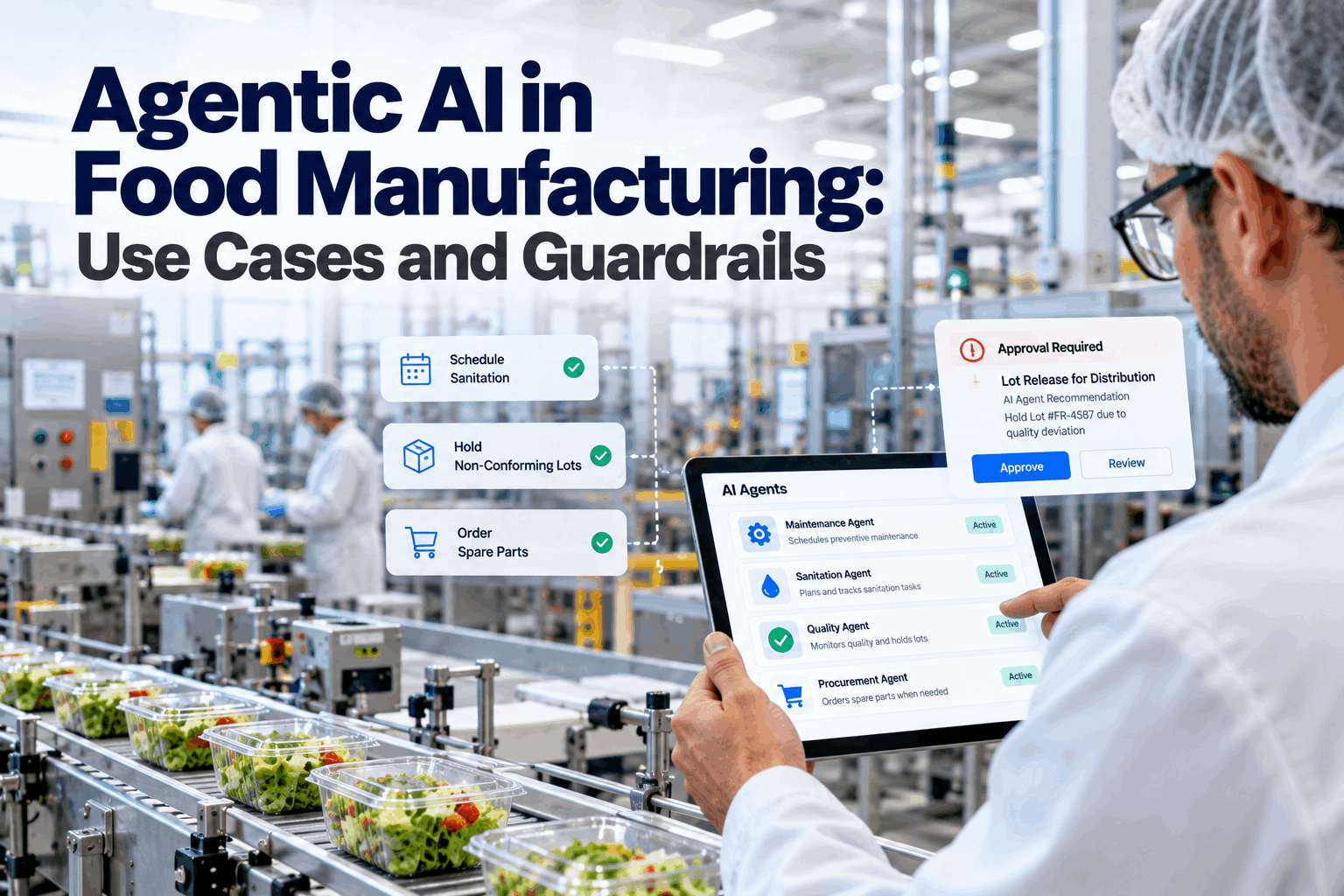
Food plants already have plenty of dashboards. They show a warm cooler, an overrun clean or a failed metal detector check, then wait for someone to notice. Agentic AI goes a step further. An agent can reschedule a clean, order a part or put a lot on hold by itself, inside limits the plant sets. That needs firm guardrails, because some decisions must always stay with people. This guide covers practical use cases, approval gates and how to roll agents out safely. Start with an agent strategy session.
Agentic AI in Food Manufacturing: Use Cases and Guardrails
Agents that act, not just alert, for maintenance, sanitation and quality. Each one works inside set limits, logs every decision, and hands food safety calls like lot release to a person, every time.
- What makes AI agentic, and where it helps a food plant
- Three action tiers and the approval gates between them
- Decision logs that hold up to food safety records rules
What Makes AI Agentic
Dashboards show. Copilots suggest. Agents act.
Most AI in food plants today informs people. An agent is different: it watches data, decides on a next step and carries it out through the plant's own systems, such as the CMMS, the scheduling tool or the quality system. That removes delay from routine decisions, but it also means the agent's limits matter as much as its intelligence. In a food plant, where a wrong release can reach consumers, the design of those limits is a food safety decision in its own right. Our AI specialists can map where agents fit in your plant.
Dashboard
Shows a rising cooler temperature. Waits for someone to look.
Copilot
Answers questions and recommends a step. A person does the work.
Agent
Raises the work order, moves the clean or holds the lot, within limits, and reports what it did.
Use Cases Across the Food Plant
Each agent gets a clear job, clear limits and a clear hand-off.
The grid below shows common agent roles in food manufacturing, what each can do alone, what needs approval and what it must never do. Your own limits will depend on your food safety plan, your products and your systems. Shape them in a use case workshop.
Before any agent goes live, write down in plain words what it may do, what it must ask about and what it must never touch. Have food safety, operations and maintenance leaders sign it. That document becomes the rule set the agent runs on and the first thing an auditor will want to see.
The Guardrail Framework: Three Action Tiers
The one rule that matters most: agents may make things safer, never riskier.
Every action an agent can take falls into one of three tiers. The simplest and most important guardrail in a food plant is asymmetric. An agent may act on its own to make product or people safer, for example by holding a lot or stopping a line on a failed check. It may never act on its own to release product, accept a deviation or loosen a control. Agree your tiers in a guardrail review.
Act alone
Low-risk, reversible and safety-positive actions. Logged and reported.
Act with approval
Actions with cost or production impact. A named person approves first.
Human only
Food safety decisions such as lot release and deviations. The agent prepares the facts, a person decides.
Detect
Agent sees a condition in plant data.
Decide
Chooses an action and checks its tier.
Gate
Acts, asks for approval or hands over.
Log
Records data, reason, action and approver.
Review
People check decisions and tune limits.
Agents That Act, With People Who Decide
Maintenance, sanitation and quality agents working inside your limits, with food safety calls always routed to a named person for sign-off.
Decision Logging That Stands Up to Food Safety Records Rules
If an agent did it, the record must show why.
Food plants already live with strict record rules. Under the FDA's preventive controls rule, 21 CFR 117.165, monitoring and corrective action records must be reviewed by or under the oversight of a preventive controls qualified individual within 7 working days, unless a longer period is justified in writing. Electronic records and signatures used to meet FDA requirements fall under 21 CFR Part 11. And the FDA's food traceability rule under FSMA section 204 now has a compliance date of July 20, 2028. An agent that touches these records must leave a trail people can review. Ask our compliance team how decision logs map to your records.
Every agent decision records
- The data it saw and when
- The rule or limit it applied
- The action taken or proposed
- Who approved, edited or rejected it
What people can do with the log
- Review agent actions in the record review cycle
- Trace any hold or release to a named person
- Show auditors how limits were applied
- Spot rules that need tightening
If your PCQI already reviews monitoring and corrective action records each week, add the agent's actions on food safety records to the same review. That keeps one clear owner for the records and makes sure no agent action goes unchecked.
A Quality Agent at Work
The agent moves fast on safety. The person decides on release.
The exchange below shows the asymmetric rule in practice. The agent holds product the moment a check is missed, prepares the facts and leaves the release decision to QA. Questions about quality agents go to our food safety team.
Rolling Out Agents Safely
Earn autonomy one step at a time.
Agents should start by watching, then suggesting, and only then acting. Each step builds evidence that the agent's choices are sound. Moving an action up a tier should be a recorded decision by the same people who signed the agent's limits, not something that happens quietly because the agent seemed to be doing well. Plan your rollout with our implementation team.
Shadow mode
The agent decides but does not act. People compare its choices with their own.
Approval only
Every action goes through a person, so the team sees how good the proposals are.
Limited autonomy
Low-risk, safety-positive actions move to tier 1 with full logging.
Review and tune
Monthly review of agent actions, overrides and limits.
Every agent should have a simple way for a supervisor to pause it, by area or by action type, without IT help. Agents that can be stopped easily are trusted more readily, and that trust is what lets them do more over time.
Measuring Whether Agents Help
Judge agents on speed, accuracy and how often people overrule them.
Agents should earn their place with evidence. Track a small set of measures from the first day of shadow mode, so you can compare agent choices with your team's and decide when an action is ready to move up a tier. Set the measures in a pilot planning call.
Time to action
From the triggering condition to the action or approval request.
Agreement rate
Share of agent proposals that people approve as proposed.
Override rate
How often people reverse an action the agent took alone.
Plant results
Downtime, sanitation overruns and holds caught early.
If people start reversing an agent's actions more often, something has changed: a new product, a new line layout or a rule that no longer fits. Move that action back to the approval tier while the limits are reviewed, then raise it again once agreement recovers.
Agentic AI Mistakes to Avoid
Speed without guardrails is a food safety risk.
These are the most common problems when plants move from dashboards to agents. A short readiness review can spot them early.
What works
- Written limits signed by food safety
- Agents can hold, never release
- Shadow mode before any autonomy
- Agent actions in the record review
What fails
- One general agent with broad access
- Autonomy granted on day one
- Decisions with no reason logged
- No easy way to pause an agent
How iFactory Runs Agents with Approval Gates
Autonomous Agents with Approval Gates, on your own network.
iFactory's maintenance, sanitation and quality agents act within the limits you set, route higher-impact actions for approval and always send food safety decisions such as lot release to a person for sign-off. They run on an on-prem AI server inside your plant, so production and quality data stay under your control. Fit questions go to our solutions team.
Action tiers
Act alone, act with approval, human only.
Approval gates
Named approvers for every gated action.
Safety-first holds
Agents hold product, people release it.
Decision logs
Data, rule, action and approver on record.
Shadow mode
Agents prove themselves before acting.
Pause controls
Supervisors stop agents by area or action.
Agents support your food safety plan and do not replace it. Your preventive controls qualified individual and QA team keep responsibility for food safety decisions and record review.
Turnkey AI: Delivered, Connected and Live in 6–12 Weeks
You do not build this. It arrives ready.
iFactory ships as a pre-configured NVIDIA AI server with the software pre-loaded, racked and ready. Rack it, plug in power and Ethernet, and the AI is live on your network. Our team handles cabling, network setup, PLC, SCADA, DCS and CMMS integration, CMMS, MES and quality links, operator training and 24×7 remote monitoring. Data stays on your network. For a scope matched to your plant, request a turnkey quote.
Ship, network and data
Server installed. CMMS, scheduling, quality and sanitation systems connected.
Model training and pilot
Agent limits written and signed. Agents run in shadow mode on one line.
Go-live and training
Agents live with approval gates. Teams trained on review. 24×7 monitoring begins.
Frequently Asked Questions
What is agentic AI in food manufacturing?
It is AI that can take actions through plant systems, such as raising work orders, moving a clean or holding a lot, within limits the plant sets, rather than only showing data or making suggestions.
Can an AI agent release a lot?
Not in a well-designed system. Agents can hold product and prepare release records, but lot release and deviation approval should always need a named person's sign-off.
What are approval gates?
Points where an agent must stop and get a named person's approval before acting. They apply to actions with cost, production or food safety impact.
How are agent decisions recorded?
Each decision logs the data seen, the rule applied, the action taken or proposed and the person who approved it, so it can be reviewed with other food safety records.
Which regulations matter for agent records?
Records used for FDA requirements fall under rules such as 21 CFR 117 for preventive controls and 21 CFR Part 11 for electronic records and signatures. Your QA and regulatory teams decide how agent logs fit your records program.
Where should we start?
With a narrow, well-understood task, such as maintenance work orders or sanitation scheduling, in shadow mode. Quality agents usually follow once the team trusts the logs.
Do agents need access to every system?
No. Each agent should have only the access its job needs. A sanitation agent can read the production plan and move cleans, but it has no reason to touch purchasing or quality release.
Can we pause an agent?
Yes. Supervisors can pause an agent by area or action type at any time without IT help.
How do we start?
Start with one line and one agent in shadow mode. A 6-week pilot connects your systems, writes the limits and measures agent choices against your team's. To plan it, contact our team.
Put Agents to Work, Keep Food Safety Human
In thirty minutes we map two or three agent use cases for your plant and draft the limits and approval gates for each. You keep the draft either way.
- 1Your food safety plan summary
- 2Lot hold and release procedure
- 3Sanitation schedule rules
- 4Systems you use for CMMS, MES and QA
- 5One routine decision that always runs late