AI-Powered Advanced Process Control (APC) for Kilns
By Josh Brook on September 19, 2026
Most cement plants already run advanced process control, and most of them run it at a fraction of the hours it was bought for. The pattern is familiar: the system holds the kiln well while conditions are ordinary, then an alternative fuel spike or a coating fall puts the line somewhere the rules were never written for, an operator switches to manual, and it stays in manual for the rest of the shift. The control is not wrong, it is narrow. iFactory's AI optimization engine adds a learned layer on top of your existing APC, trained with reinforcement learning on your plant's own history, so the kiln stays in automatic through the conditions that used to hand it back.
AI Optimization for Cement Pyroprocessing
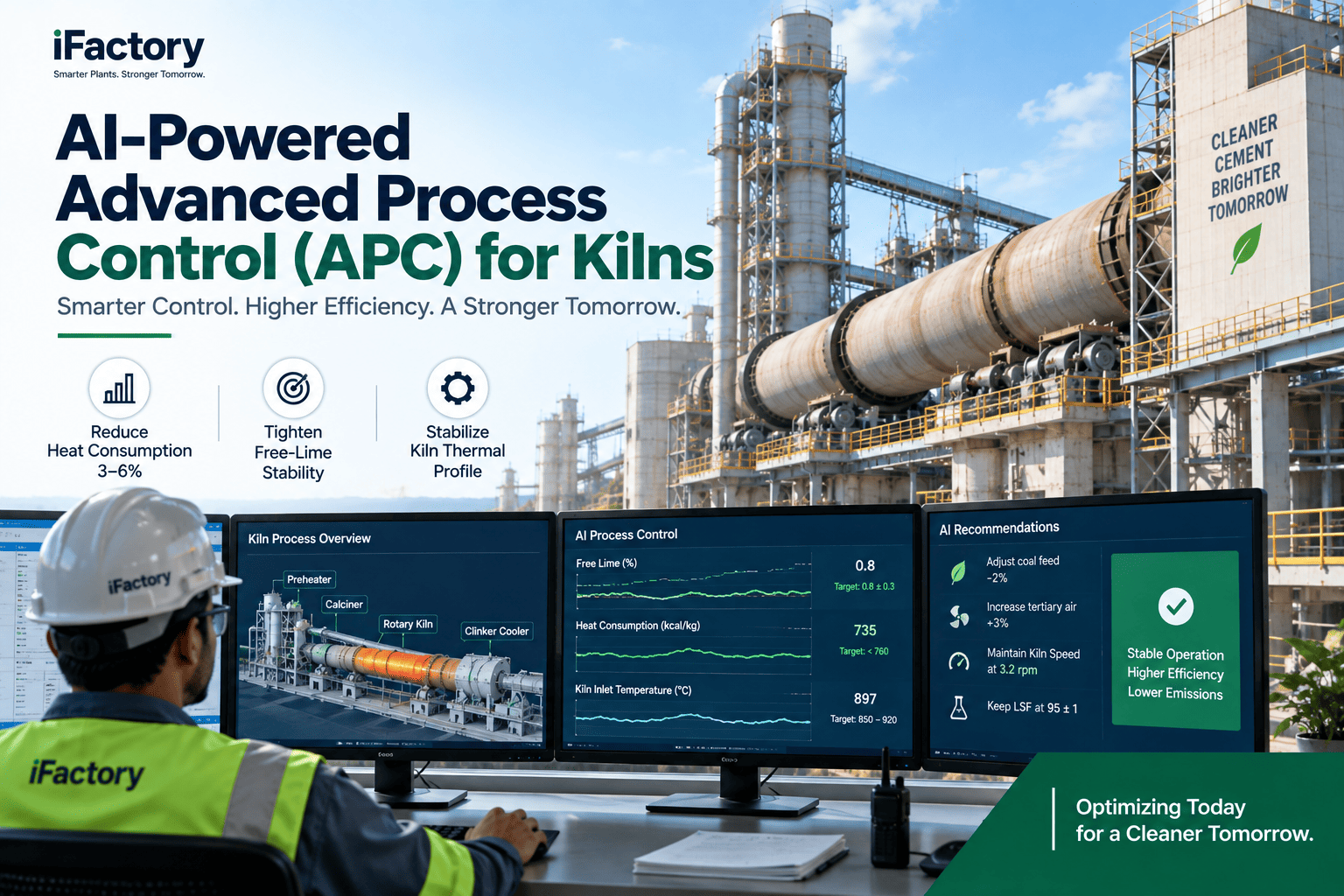
AI-Powered Advanced Process Control for Cement Kilns
Reinforcement learning on top of your existing APC or expert system. Tighten free-lime standard deviation, cut heat consumption by 3 to 6%, and hold the kiln thermal profile steady through the upsets that normally end in manual.
Rules Are Written for the Conditions Somebody Anticipated
A rule-based expert system encodes what good operators did, which is genuinely valuable and genuinely limited. The rules were written against a fuel mix, a raw mix and a set of typical disturbances, and they interpolate poorly outside that. Raise the alternative fuel rate and the calorific value starts swinging; change clinker recipe and burnability moves; let coating build unevenly and the thermal profile stops behaving the way the rules assume. In those moments the controller either acts too weakly or acts on a stale picture of quality, an operator loses confidence, and the line goes to manual. Utilisation, not tuning, is usually where the value is lost: a controller that runs 45% of the hours delivers 45% of the benefit, however good it is when it runs.
A Learned Layer on Top of What You Have
The AI layer does not replace the DCS or the regulatory control underneath it. It sits above your existing control, reads the current state of the line including predicted quality, and proposes the setpoint moves that best satisfy your objectives inside your constraints.
How the AI control layer sits on the kiln
Every move the policy proposes is checked against hard constraints before it is written, and the operator can drop to advisory in one action. The layer is additive, so nothing you already rely on has to be removed to try it.
Learned From Your Kiln, Not From a Rule Book
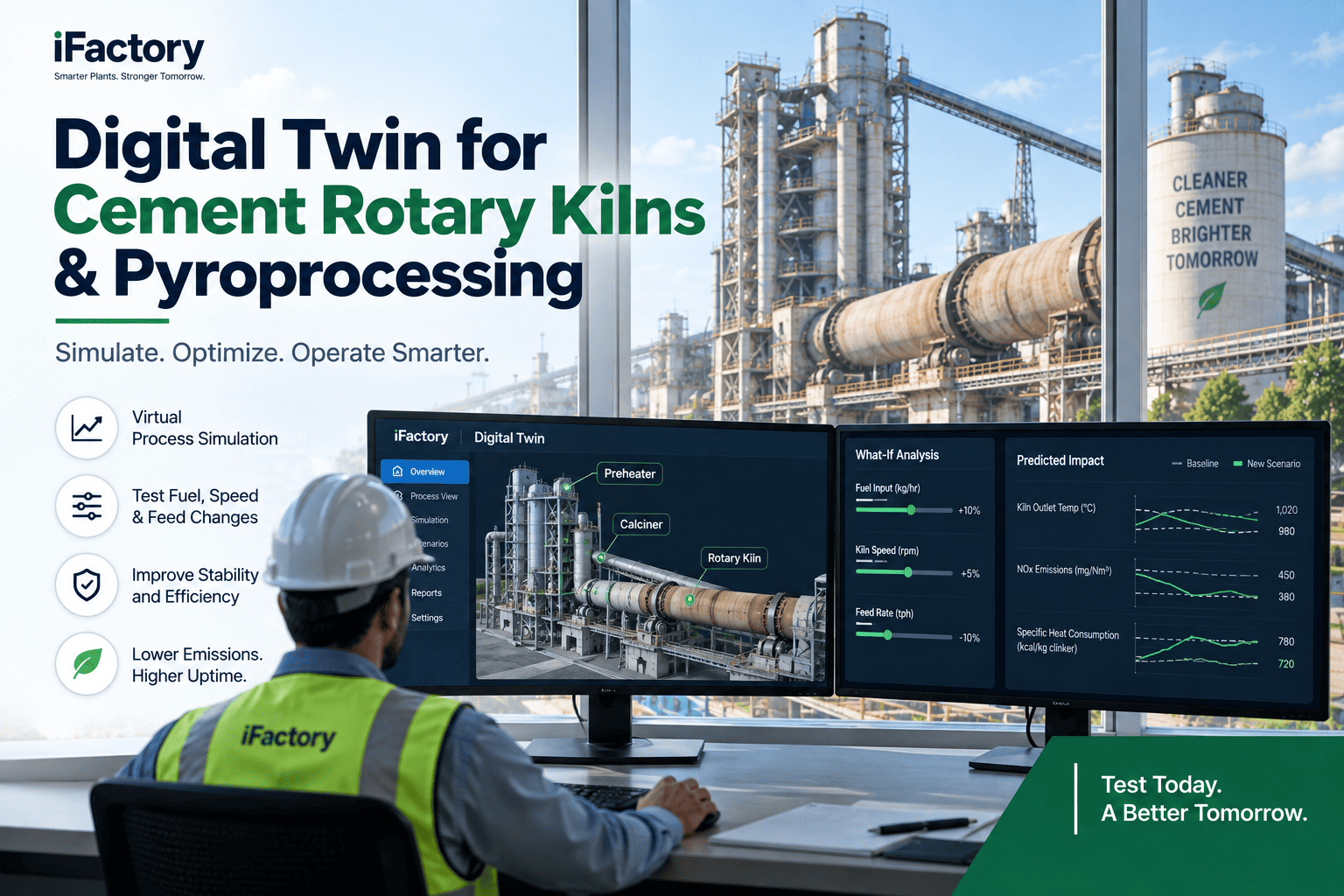
Reinforcement learning fits this problem because kiln control is a sequence of decisions with delayed consequences, which is exactly what rules handle badly. The policy is trained against your historian and against the digital twin, where it can experience thousands of upsets, fuel swings and feed changes without any of them costing clinker. What it learns is the trade-off: how much fuel to add now so the burning zone holds in forty minutes, and when a smaller move is better than a correct one made too late.
Kiln variability under manual, rules and AI control
Savings come from the narrowing band rather than from a bolder setpoint. Once the deviation is smaller, the target can move closer to the limit, and that is where the heat consumption reduction is realised.
Judge It on the Numbers That Matter
Control performance should be reported the way the plant is judged: variability, fuel, stability and how many hours the controller actually held the kiln.
Control performance — kiln 3, first 90 days
Modeclosed loop, constraints enforced
Utilisation94% of run hours
Free lime standard deviation0.48 to 0.26OK
Specific heat consumption-4.2%OK
Burning zone temperature spreadnarrowedOK
Operator interventions per shiftdown sharplyOK
Alternative fuel calorific swingshandled with marginwatch
The fuel saving follows the reduced variability, and the variability holds because the controller stayed in automatic through the fuel swings that previously sent the kiln to manual.
What the AI Layer Coordinates
The gain comes from moving several levers together, with the delays between them accounted for, rather than correcting one at a time.
Feed and kiln speed
Coordinated so bed depth and residence time support the burning zone instead of fighting it during a throughput change.
Fuel and firing split
Kiln and calciner firing balanced for thermal profile and calcination, with alternative fuel variability absorbed as it happens.
Draft and oxygen
Air and draft moved to hold complete combustion without heating excess air, respecting fan capacity as a hard limit.
Quality as a control target
Predicted free lime enters the loop directly, so the controller optimises against clinker quality rather than temperature alone.
What AI-Augmented APC Delivers
The gains are ordinary operational ones, measured on your existing meters.
3-6%
Heat consumption
less fuel per tonne of clinker
Tighter
Free-lime deviation
quality that supports a lower target
More
Hours in automatic
control kept through upsets
Steadier
Thermal profile
better for coating and refractory
Frequently Asked Questions
Do we have to replace our existing expert system or APC?
No. The AI layer is designed to sit above what you already run, using its setpoint interfaces rather than replacing the regulatory control underneath. Most plants keep their existing system as the base and let the learned layer handle the coordination and the conditions the rules struggle with. If your current system is at end of life you can consolidate, but that is a separate decision and not a prerequisite.
Why use reinforcement learning for kiln control?
Because kiln control is a sequence of decisions whose consequences arrive late. A fuel change shows up in the burning zone in tens of minutes and in free lime later still, so the best action now depends on where the line will be then. Reinforcement learning is built for exactly that kind of delayed-reward problem: the policy is rewarded for the state of the kiln after the delay, not for the move itself, which is what a rule can never learn.
Is it safe to let a learned model move kiln setpoints?
Every proposed move passes through a constraint layer before it is written, so limits on temperatures, CO, oxygen, free lime, fan capacity and rate of change are enforced regardless of what the policy suggests. Moves are bounded in size, the operator can drop to advisory instantly, and the system hands back cleanly on any loss of confidence or data quality. Most plants run in advisory mode first and watch the recommendations against what operators would have done before closing the loop.
How much fuel saving is realistic?
Typically 3 to 6% on specific heat consumption, with the wider end of that range on lines that currently run with high variability, low APC utilisation or a high alternative fuel rate. A kiln already held tightly by a well-tuned system has less to recover. The honest way to size it is to measure your current free-lime and burning zone variability first, because the saving comes from the margin that variability forces you to burn.
How long does implementation take?
The policy is trained offline on your historian and, where one exists, against the twin, so the plant is not used as a training ground. From there the usual sequence is a period in advisory mode to build operator trust and verify the constraint handling, then closed loop on one kiln. Getting to a measured result is a matter of months rather than a week, and most of that time is validation rather than installation.
Keep the Kiln in Automatic Through the Hard Hours.
See What an AI Control Layer Would Do on Your Kiln
Bring your historian and your current APC utilisation. We'll measure the variability you are burning margin for, and show what the learned layer recommends on the upsets that sent your kiln to manual.