Most chemical units run well back from their real limits, because PID loops alone cannot hold them close safely. Model predictive control can, and it is usually worth more than any new equipment. The catch is keeping it working once the project team leaves. iFactory's APC / MPC Suite runs on top of your existing DCS and is built to stay in service. To scope it for a unit, book an APC session.
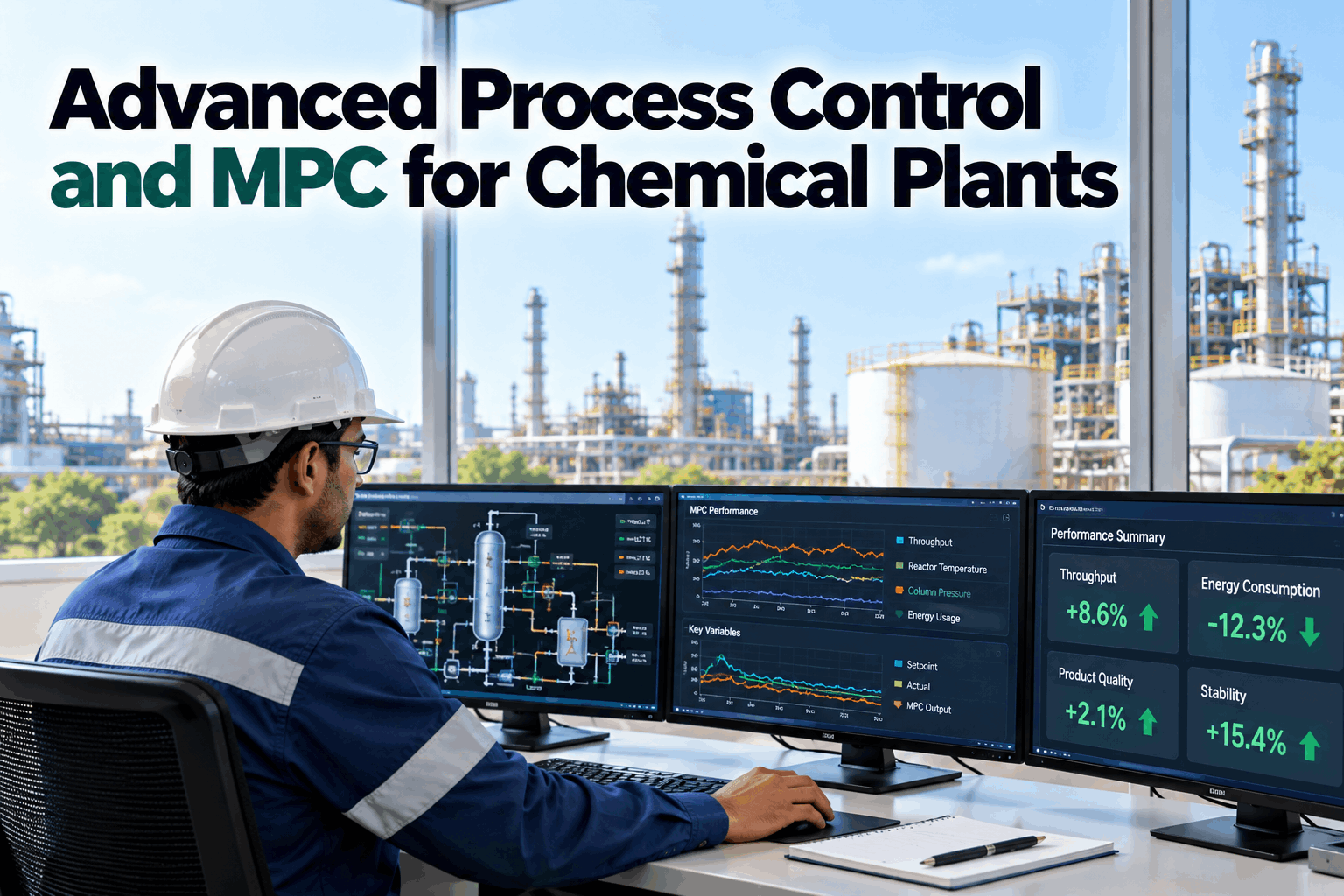
Advanced Process Control and MPC for Chemical Plants
Multivariable control that pushes each unit closer to its real limits, an economic optimizer above it, and the monitoring that keeps both earning after go-live.
- Where MPC sits between your DCS and your economics
- What published sources say it delivers, and what decides your share
- Why most APC fades within two years, and how to stop it
The same limit, a smaller spread, a higher average. That gap between the two averages is where most MPC value comes from. The limit itself never moves, and neither does the safety margin your engineers set.
Where MPC Sits: Above the DCS, Below the Economics
Each layer does one job. MPC is the one that juggles many variables at once.
Your DCS runs single PID loops, each holding one value at its set-point. A distillation column has dozens of them, all pulling on each other. MPC sits above them. It uses a model of how the unit responds to predict the next minutes, then moves several set-points together to keep every limit honoured while pushing toward the best operating point. Our support team can map these layers on your units.
Three kinds of variable
- Manipulated. What MPC can move: set-points such as feed, reflux and steam.
- Controlled. What it must hold or push: purity, temperature, flooding, valve positions.
- Disturbance. What it cannot move but can see coming: feed composition, weather.
Good PID comes first
MPC can only be as good as the loops beneath it. Sticking valves, poorly tuned loops and slow analysers limit any controller placed on top.
Vendor tools such as Emerson's PIDPlus, built for loops with slow or wireless measurements, belong to this base layer. Fix the base first.
What MPC Can Deliver, and What Decides Your Share
Published ranges are a starting point. Your unit's margins decide the rest.
The ranges above come from vendor data and are widely quoted. Some units earn more, some much less. Bigger figures appear in marketing, but they should be proven on your own unit before anyone counts them in a budget. What matters is how far the unit runs from its real limits today, and whether the extra product can be sold. To size this for one unit, book a benefits study.
Where MPC usually pays in a chemical plant
Distillation
Purity held at the edge of spec, with less reflux and reboiler steam. Often the first unit to get MPC.
Reactors
Temperature and feed ratios held tighter, so conversion and yield sit closer to their best.
Furnaces and boilers
Excess air and firing trimmed against limits on tube temperature and emissions.
Dryers and evaporators
Moisture or concentration held close to target, using less steam for each tonne.
On a capacity-limited unit, MPC usually turns its gains into more feed. On a demand-limited unit, the same controller holds rate and cuts energy instead. A benefits study should say which mode your unit is in, rather than adding the best case of each together.
A Benefits Estimate, Worked
The arithmetic behind a typical benefits study, for one distillation column. Change the figures for your unit and the method still holds.
RTO and the Economic Optimizer
MPC answers "how do we get there". The optimizer answers "where should we go".
MPC needs targets. On a simple unit they are fixed: maximise feed, hold purity. When prices, feed quality or product demand change often, the best targets change too. A real-time optimizer uses a steady-state model of the unit to recalculate them every few hours, then hands them to MPC. Ask our optimization engineers whether your units would benefit.
Read the economics
Feed and product prices, utility costs and demand for each grade.
Solve for targets
A steady-state model finds the best-paying point that respects every limit.
Hand over to MPC
MPC moves the unit there smoothly, and holds it as conditions shift.
Many sites start simpler: most MPC packages can carry cost weights of their own, which steer the unit toward cheaper operation without a separate optimizer. A full RTO can follow once the controllers are trusted.
An optimizer is worth it when
- Prices or feed quality change week to week
- Several products or grades compete for capacity
- Units are linked, so one unit's best point depends on another's
Simple targets are enough when
- One product, sold out, at a steady margin
- The best point barely moves from month to month
- MPC itself is not yet running reliably
An APC Project, Step by Step
New project or retrofit of an old controller, the steps are the same.
APC projects go wrong when steps are skipped, usually the base-layer fix or the sustainment plan. The six steps below cover a new controller or the retrofit of one that has fallen out of use. To plan one for your unit, book a project scoping call.
Benefits study
Measure how far the unit runs from its limits, and what closing the gap is worth.
Fix the base layer
Tune PID loops, repair sticking valves, and get analysers reliable.
Plant tests
Small, planned moves on each set-point to see how the unit responds.
Build and simulate
Build the model from the tests and history, and try the controller offline first.
Commission with operators
Switch on in stages, with operators setting the limits and learning the screens.
Sustain
Watch service factor, model fit and benefits every week, and act before they slip.
An old controller that operators have switched off is not always a lost cause. If the base layer is sound and the unit has not changed much, new plant tests and refitted models can bring it back. If the unit has been rebuilt, or the old package is no longer supported, starting fresh is often quicker. The benefits study should answer this before any money is spent.
Why Most APC Fades, and How to Keep It Earning
The controller does not break. The plant changes and the model stops fitting.
A 2020 Hydrocarbon Processing article reported that benefits often fade within 18 to 24 months, and that more than half of installations end up at pre-APC performance or switched off. The main cause is model mismatch: catalysts age, exchangers foul, equipment is replaced, and the model no longer matches the unit. Operators notice, clamp the limits and finally turn it off. Our APC specialists can review an existing controller with you.
Signs a controller is fading
- Service factor slipping below where it started
- Operators narrowing limits again and again
- Predictions drifting away from what the unit does
- Variables left switched off "for now"
What the suite watches
- Hours in service, by controller and variable
- Limit changes by operators, and why
- Model fit for each input and output pair
- Benefit earned, against the baseline, every week
One set of data, three views
- APC engineer. Model fit, service factor and which models to retest.
- Operator. The active limits, and what the controller will do next.
- Plant manager. Benefit earned by each controller, month by month.
MPC writes only set-points to existing loops, within limits your operators set.
Turnkey AI: Delivered, Connected and Live in 6–12 Weeks
You do not build this. It arrives ready.
iFactory ships as a pre-configured NVIDIA AI server, racked and ready, with the software pre-loaded. Rack it, plug in power and Ethernet, and the AI is live on your network.
Our team handles cabling, network setup, PLC and SCADA integration, operator training and 24×7 remote monitoring. The server sits inside your own network, so process data and models stay on site. For a scope matched to your units, request a turnkey quote.
Ship, network and data
Server installed and connected to the DCS and historian. Benefits study and base-layer review for the first unit.
Model training and pilot
Plant tests, model build and offline simulation. Controller commissioned in stages with operators.
Go-live and training
Controller in closed loop. Operators and APC engineers trained. Sustainment monitoring and 24×7 remote support begin.
Frequently Asked Questions
What is model predictive control?
A control method that uses a model of how a unit responds to predict its next few minutes, then moves several set-points together to meet targets without breaking limits. It handles many interacting variables at once, which single PID loops cannot. In a chemical plant that usually means columns, reactors and furnaces, where every move affects several other values.
Does it work with our DCS?
It runs on its own server and connects to the DCS through standard interfaces such as OPC UA. It writes set-points to existing PID loops, within limits your operators set. If the link is lost, the DCS keeps control on its own, and safety systems are never touched.
What throughput and energy gains are realistic?
Published vendor figures put typical gains at about 3 to 5% throughput, and up to 3 to 10% lower specific energy. Some units do better and some worse. A benefits study on your unit gives the figure to plan with, and the gain is usually taken as throughput or energy, not both in full.
We already have DMC3. Do we need this?
Not to replace it. Many sites run AspenTech's DMC3 or another MPC package. The suite can be used to watch and sustain existing controllers, and to cover units that have none. Which route suits you comes out of the first review.
What does an APC project need from us?
Access to the DCS and historian, time from an operations lead and an instrument technician, permission for planned plant tests, and operators who will help set limits during commissioning. Plant tests are small, planned moves made during steady running, and they are scheduled with operations so they never clash with a product change or a start-up.
How do you stop the controller fading?
By watching it every week. The suite tracks service factor, operator limit changes, model fit and benefit earned, and flags the specific model that needs retesting, before operators lose trust and switch it off.
How long until the first controller is live?
Six to twelve weeks from delivery for a typical first unit, depending on the base-layer work needed. We need a place for the server, DCS and historian access, and a window for plant tests. To check your set-up first, contact our team.
Bring One Unit and Its Limits
In thirty minutes we look at how far one unit runs from its limits today, and what a benefits study would need to measure. You keep the notes whether or not you go further with iFactory.
- 1A process flow sketch of the unit
- 2The limits operators work to, and why
- 3Three months of key tags from the historian
- 4Any existing APC, and whether it is on
- 5The margin on extra product, or the energy cost