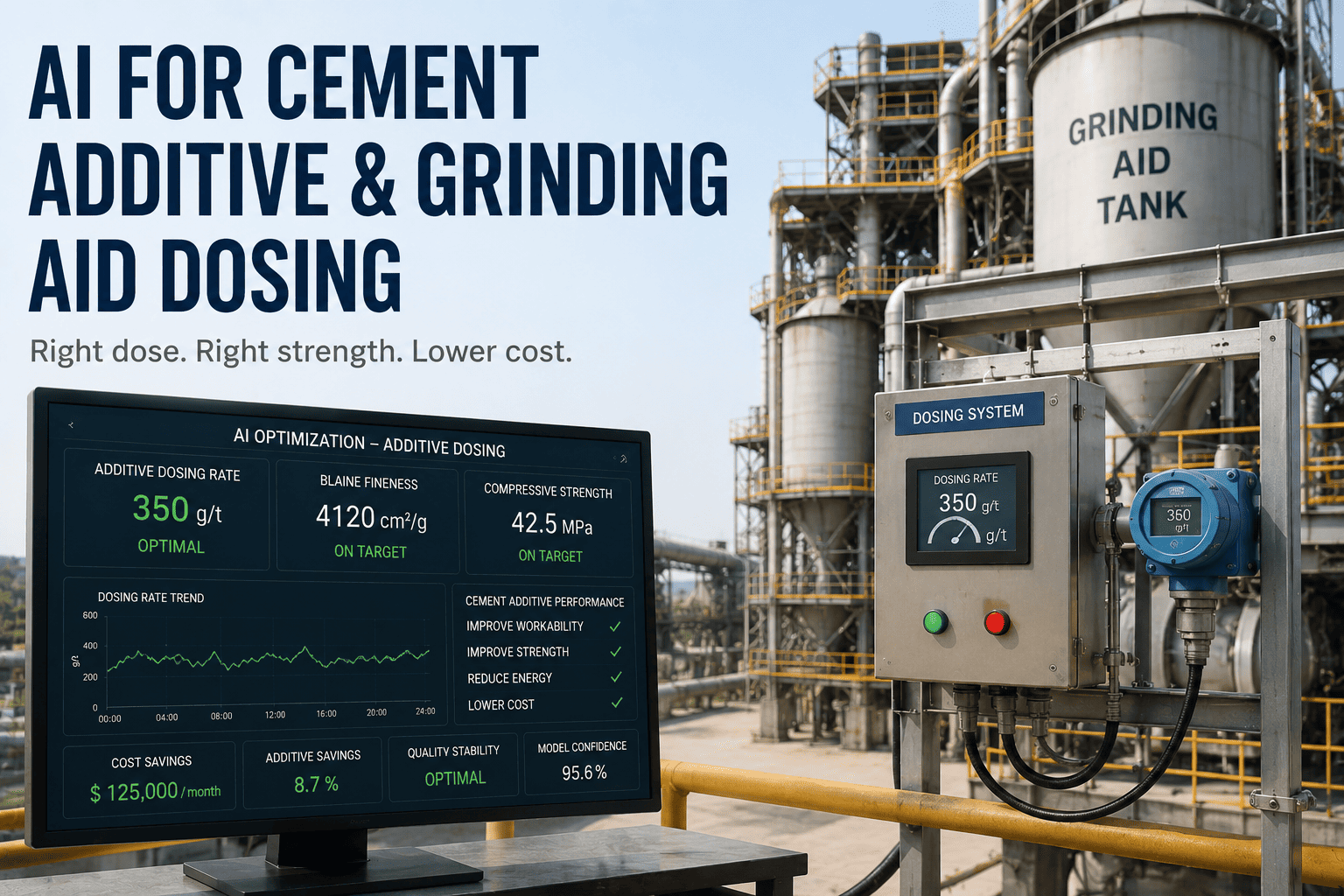
The grinding aid and cement additive line is one of the few places a cement plant pays real money by the gram — and one of the few it rarely questions. The dosage pump is set once, usually on the generous side, because nobody wants to be responsible for cement that misses strength. So the plant pays that conservative dose on every tonne, of every product, forever, whether the cement needed it or not. The catch is that additives do not reward you in a straight line: past a certain point you are buying no extra benefit at all, just spending. iFactory's additive optimization AI right-sizes grinding-aid and quality-improver dosage to the product and target actually running — hitting strength and Blaine without paying for over-dose across the mix.
Additive Optimization for Cement Plants
AI for Cement Additive and Grinding Aid Dosing
iFactory learns how each product responds to grinding aid and quality enhancer, then sets the minimum dose that still hits Blaine and strength — product by product, continuously — so you stop paying for additive that buys nothing.
The Additive Line Is Real Money, Dosed by the Gram
Grinding aids and performance additives are potent and priced accordingly. Dosed at a few hundred grams per tonne, they add up to a meaningful line in variable cost — and unlike energy, that line is almost never optimized. A single fixed dose gets carried across OPC, blended cements, and high-early products alike, sized for the hardest case so it is safe for all of them. That safety margin is exactly the problem: for most of what the mill makes, the dose is higher than it needs to be, and the difference is spent for nothing.
Additives Do Not Work in a Straight Line
Double the dose and you do not double the benefit. Additive response saturates: below a threshold you miss your target, through a sweet spot each gram earns its keep, and beyond it the curve flattens and extra dose buys almost no extra strength or fineness. The whole game is finding the point where the curve meets your target — the minimum effective dose — and not a gram more.
Additive dose response: where the benefit stops
Between the minimum dose and the typical fixed dose, the curve is nearly flat. Every gram in that band is additive you buy and benefit you never receive.
Wrong in Either Direction Costs You
Dosing is a narrow target with a penalty on both sides. Too little and the cement misses spec. Too much and the money leaves quietly. The right dose is the line between them, and because it moves with product and conditions, a fixed setting sits on the wrong side of it most of the time.
Under-dose
Strength and Blaine fall short of target
Off-spec risk and customer complaints
Re-grinding or re-blending to recover
Quality reputation on the line
Over-dose
Additive paid for with no added benefit
Margin lost quietly on every tonne
Possible set or flow side effects
Waste that never shows on a quality report
iFactory holds the line between them — the minimum dose that still hits every target, adjusted as the product and clinker change.
One Dose Cannot Fit Every Product
A plant that makes OPC, blended cements, and high-early products is running three different chemistries through one pump. Each needs a different amount of aid and enhancer to reach its own target, and clinker reactivity shifts the requirement further. A single fixed dose over-serves the easy products and can still under-serve the demanding one. Right-sizing means a different, correct dose for each — not one compromise for all.
OPC
Lower dose reaches target
Blended / SCM
Higher dose supports strength
High-early
Highest demand for enhancer
What the Additive Actually Buys
Right-sizing is not only about spending less. Used well, additives are an investment that pays back — the point is to capture that return deliberately rather than pay for a dose and leave the benefit on the table.
Grinding aid
Better grinding efficiency
More throughput, lower kWh/t, or finer product
Quality enhancer
Higher strength
Room to lower clinker factor — cost and CO2 down
How much of your additive spend is buying benefit you already have? Book a 30-minute demo and we'll map your dose response against your targets.
How iFactory Right-Sizes the Dose
The engine learns how your products respond to dose, predicts whether the current setting will hit Blaine and strength under today's conditions, and sets the leanest dose that still clears every target — then adjusts as the mill and product change.
Learn
Maps the dose-response of each product from dosing, quality, and mill data.
Predict
Estimates the Blaine and strength the current dose will deliver right now.
Right-size
Sets the minimum dose that clears the targets, per product, continuously.
What Right-Sized Dosing Delivers
Treating dosage as a variable to optimize rather than a fixed setting turns a blind cost into a managed one — with quality protected the whole way.
↓ spend
Additive cost
the over-dose band stops being paid for
Held
Quality targets
Blaine and strength still cleared, every product
Per
Product dosing
the right dose for each, not one compromise
Room
Clinker factor
enhancer used deliberately to lower it
Frequently Asked Questions
How does the AI know what dose hits strength if strength is a lab test?
It learns the relationship between dose, mill conditions, and your lab strength and Blaine results over time, so it can predict the response of a given dose before the lab confirms it. Your lab remains the reference and keeps the model calibrated. The AI fills the gap between tests, and the leaner dose is validated against your normal quality checks, not assumed.
Will cutting the dose put our quality at risk?
The objective is the minimum dose that still clears every target, not the lowest possible dose. Because additive response saturates, most fixed doses sit well past the point of useful benefit, so there is room to reduce spend without touching the safety margin on quality. The engine works to the target, and targets are held first.
Does it work across our whole product range?
Yes, and the product range is where it helps most. Each product, from OPC to blended and high-early cements, has its own dose response and its own target, and the engine doses each one to its own optimum through changeovers rather than applying a single compromise dose to all of them.
Can it help us increase SCM and lower clinker factor?
Performance enhancers can raise strength, which creates room to substitute more clinker with SCM while holding strength. Dosing the enhancer precisely lets you capture that room deliberately, so the additive spend translates into a lower clinker factor and the cost and CO2 savings that come with it, rather than sitting idle.
What do we need to get started?
Your dosing data, mill and quality data, and lab strength and Blaine history. Most plants already have these. The best next step is a demo on your own data, where we map your products' dose responses against their targets and show where the fixed dose is spending more than the benefit it returns.
Stop Paying for Additive That Buys Nothing.
See Your Dose Response Against Your Targets
Bring your dosing, quality, and lab data. We'll map how each product responds to grinding aid and enhancer, show where the fixed dose overshoots the benefit, and what right-sizing across the mix would return — with strength and Blaine still held.