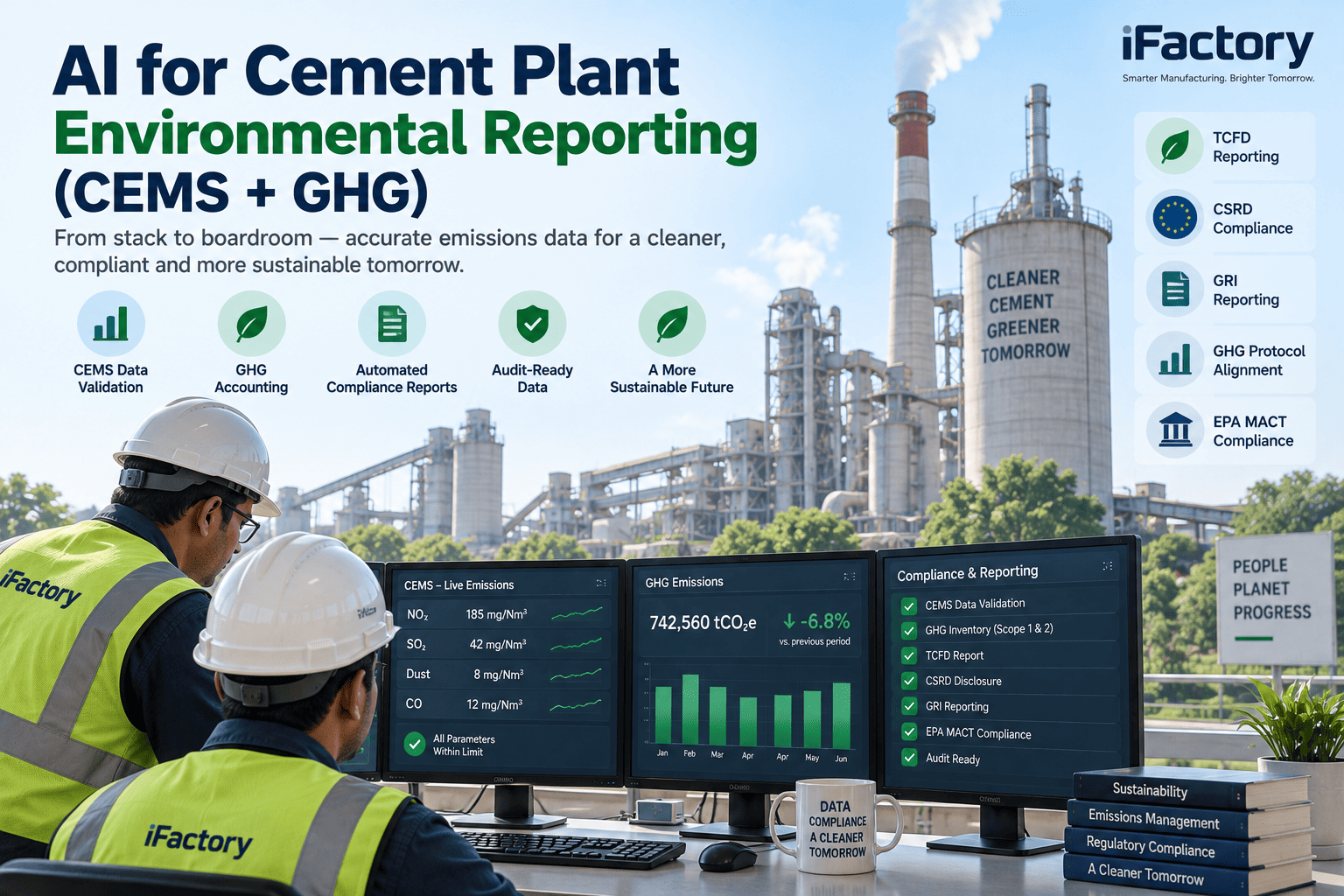
A cement plant's environmental report used to be a quarterly PDF the sustainability lead assembled from CEMS spreadsheets, kiln operator logs, and utility bills. That model does not survive CSRD, TCFD, or the reasonable-assurance requirements that come with them. Continuous emissions monitoring data has to be validated to EPA Method 6C or EN 14181 rigor. Scope 1, 2, and 3 accounting has to align with the GHG Protocol and be traceable to source. Board-level disclosure has to reconcile with what the CEMS actually recorded — every reporting period, every kiln, every clinker line. AI-driven reporting closes the gap between the stack reading and the boardroom slide with one auditable data path.
iFactory / Cement environmental reporting
From Stack Reading to Boardroom Slide — One Defensible Data Path
Automated CEMS validation, Scope 1/2/3 GHG accounting to the GHG Protocol, and reporting-ready outputs for CSRD, TCFD, GRI, and CDP — every number reconciled to its source with reasonable-assurance audit trail.
SOURCE
CEMS · fuel · power
↓
↓
REPORT
CSRD · TCFD · GRI · CDP
CEMS
continuous validation
Scope 1 + 2 + 3
to GHG Protocol
CSRD · TCFD · GRI
assurance-ready
The Problem in the Sustainability Function
Environmental reporting in a cement plant sits on three data sources never designed to work together. The CEMS records NOx, SOx, CO, particulate, and often CO2 continuously — with quarterly data-availability targets and calibration audits the environmental engineer knows intimately. Plant SCADA and utility meters record fuel consumption, power draw, and clinker production. Purchasing records embodied-carbon inputs for Scope 3. Getting from those to a CSRD-ready ESRS E1 disclosure or a CDP response is a manual reconciliation consuming weeks per cycle — and every hand-off is a chance for a number to drift from its source. When the auditor asks how you got from stack ppm to tonnes CO2e, the answer needs to be one traceable path.
Where the Reporting Chain Actually Breaks
Environmental reporting fails in the same four handoffs at almost every cement operation. Each is a defensibility gap that a CSRD or ISSB auditor will find.
CEMS spreadsheet
Stack ppm exported to Excel, converted to tonnes with a formula, aggregated by hand. Formula errors, unit slips, and rounding decisions never captured in the audit trail.
Emission factor lag
Scope 2 electricity emissions calculated using last year's grid factor because the current one was not updated in the tool. The report shows numbers that do not match the current published factor.
Scope 3 estimate
Cement, alternative fuels, and clinker imports estimated with generic industry averages instead of supplier-specific data. Reasonable-assurance auditor rejects the methodology.
Version drift
The number in the CDP response does not match the CSRD ESRS E1 filing does not match the internal board deck. Each was assembled separately from the same source spreadsheets.
What Good Looks Like in Reporting
A working environmental reporting system holds four disciplines together — validated CEMS data, live GHG accounting, framework-mapped output, and reconciled disclosure across every audience.
CEMS Validation
Continuous emissions data validated against EPA Method 6C and EN 14181 rules — data availability, calibration drift, span-check compliance — with the fill-in rules applied per your permit conditions.
Validated to method
Live GHG Accounting
Scope 1 from CEMS and fuel data. Scope 2 from live grid factors. Scope 3 from supplier-specific data where available and industry factors where not — with the methodology tagged.
Source-tagged
Framework Mapping
Same underlying numbers mapped to CSRD ESRS E1, TCFD metrics, GRI 305, CDP climate, GHG Protocol — every framework's specific disclosure line pulled from one source of truth.
One truth, many frames
Assurance Trail
Every reported number linked to its source reading, calculation method, emission factor, and validation status — the trail a reasonable-assurance auditor asks for.
Auditor-defensible
How iFactory AI Fits
iFactory AI overlays your CEMS acquisition system, plant historian, utility meters, and procurement platform — adding the validation, accounting, and framework-mapping layer without replacing the systems your environmental team already trusts.
Emissions Ledger
Reporting Layer
Every emission source with reading, calculation method, emission factor, and validation status — the single ledger CSRD assurance and CDP verification pull from.
Method Library
Reporting Layer
EPA Method 6C, EN 14181, GHG Protocol Corporate Standard and Scope 2 Guidance — the calculation methodologies applied consistently across every reporting period.
Framework Output
Reporting + Overlay
CSRD ESRS E1, TCFD metrics, GRI 305, CDP climate, SEC climate rule — each framework's specific line output from the same source data with disclosure-ready formatting.
Assurance Package
Reporting Layer
Auditor-ready package for reasonable assurance — source system extracts, validation logs, calculation traces, and version history — exportable at any period close.
Ask your sustainability lead how many spreadsheets it takes to go from CEMS to the annual CDP response. If the answer is more than three, the reconciliation risk is already material — and the CSRD reasonable-assurance auditor is going to find it. See environmental reporting live.
12-Week Rollout on One Kiln Line
One kiln line, one full reporting period, twelve weeks. The pilot is scoped to prove the CEMS-to-report path is defensible for one line and one framework before rolling out to the full plant and every framework in scope.
Weeks 1–2
Source Mapping
Map CEMS channels, fuel meters, power meters, and procurement feeds for one kiln line. Baseline the current reporting spreadsheet path and identify the handoff gaps.
Weeks 3–4
Method Config
Configure EPA Method 6C or EN 14181 validation rules per your permit. Load GHG Protocol Scope 1/2/3 methodology. Grid emission factor sources set. Verified against a known historic period.
Weeks 5–8
Live on One Line
Live validation and accounting on one kiln line. Weekly review with the environmental engineer refines factor selection and validation thresholds. First framework output (CSRD or CDP) produced.
Weeks 9–12
Assurance Ready
Full reporting period closes on the pilot line. Auditor-ready package produced. Reconciliation against parallel spreadsheet-based report. Rollout to full plant and remaining frameworks decided.
Who Owns the KPI
Environmental reporting crosses sustainability, plant operations, finance, and legal. Each function needs a specific number they own or the reporting chain fragments back into disconnected spreadsheets.
Environmental Engineer
CEMS data availability %
Owns the source data quality — the continuous data availability against permit target. Every hour of missing data is a fill-in decision that has to be defensible.
Sustainability Lead
Reporting cycle time
Owns the reporting velocity — the time from period close to framework-ready output. Weeks under the current spreadsheet model; days is the target with the reporting layer live.
Finance / ESG
Assurance opinion level
Owns the disclosure outcome — the assurance opinion (limited or reasonable) the external assurance provider issues on the report. Reasonable assurance is where CSRD is heading.
Plant Manager
Emissions per tonne clinker
Owns the operational KPI — the emission intensity per tonne of clinker produced, reconciled against the CEMS reading. The number the board actually asks about.
FAQ
Does this replace our existing CEMS or acquisition system?
No. The CEMS analysers, the acquisition system (Sick, ABB, Emerson, Horiba, Opsis), and the permit-mandated data flow to the regulator stay exactly as they are. This layer reads the validated CEMS data via the standard interface (OPC, Modbus, XML export) and adds the corporate reporting chain on top. Everything the environmental engineer already does for permit compliance continues; what's new is the reporting-side traceability that CSRD and ISSB now require. Nothing about your permit reporting changes.
How does it stay current with framework updates — CSRD ESRS updates, GHG Protocol revisions, CDP guidance?
The framework mappings are maintained centrally and updated with each release — CSRD ESRS E1 revisions, GHG Protocol Scope 2 Guidance updates, CDP annual questionnaire changes, GRI 305 updates. Your underlying source data doesn't change; what changes is how it's mapped to the disclosed line. New calculation methodology (like a Scope 2 market-based vs location-based selection) is a configuration change, not a code change.
Book a demo to see the framework library and update cadence.
What about Scope 3 — cement is heavy on category 1 and 4, is that automated too?
Scope 3 category 1 (purchased goods and services — mainly clinker, gypsum, additives, alternative fuels) and category 4 (upstream transport) automate to the extent your procurement and logistics data feeds are structured. Supplier-specific emission factors are prioritized where the supplier provides them (increasing under CSRD supplier engagement); industry averages from GCCA, WBCSD CSI, or DEFRA fill in where they don't. Categories 5, 11, 12 (downstream) are typically estimated with disclosed methodology since primary data is rarely available. The methodology per category is tagged in the disclosure so the assurance provider can trace it.
Stop reconciling CEMS to CSRD from spreadsheets.
Trace One Kiln Line From Stack to CSRD Line Item
Bring one kiln line's CEMS data extract for a recent month, your current sustainability report, and the framework you have to file next (CSRD ESRS E1, CDP, TCFD). We'll walk the source-to-disclosure trace live and quantify the reconciliation gaps.
GHG Protocol
Scope 1 · 2 · 3
Reasonable
assurance ready