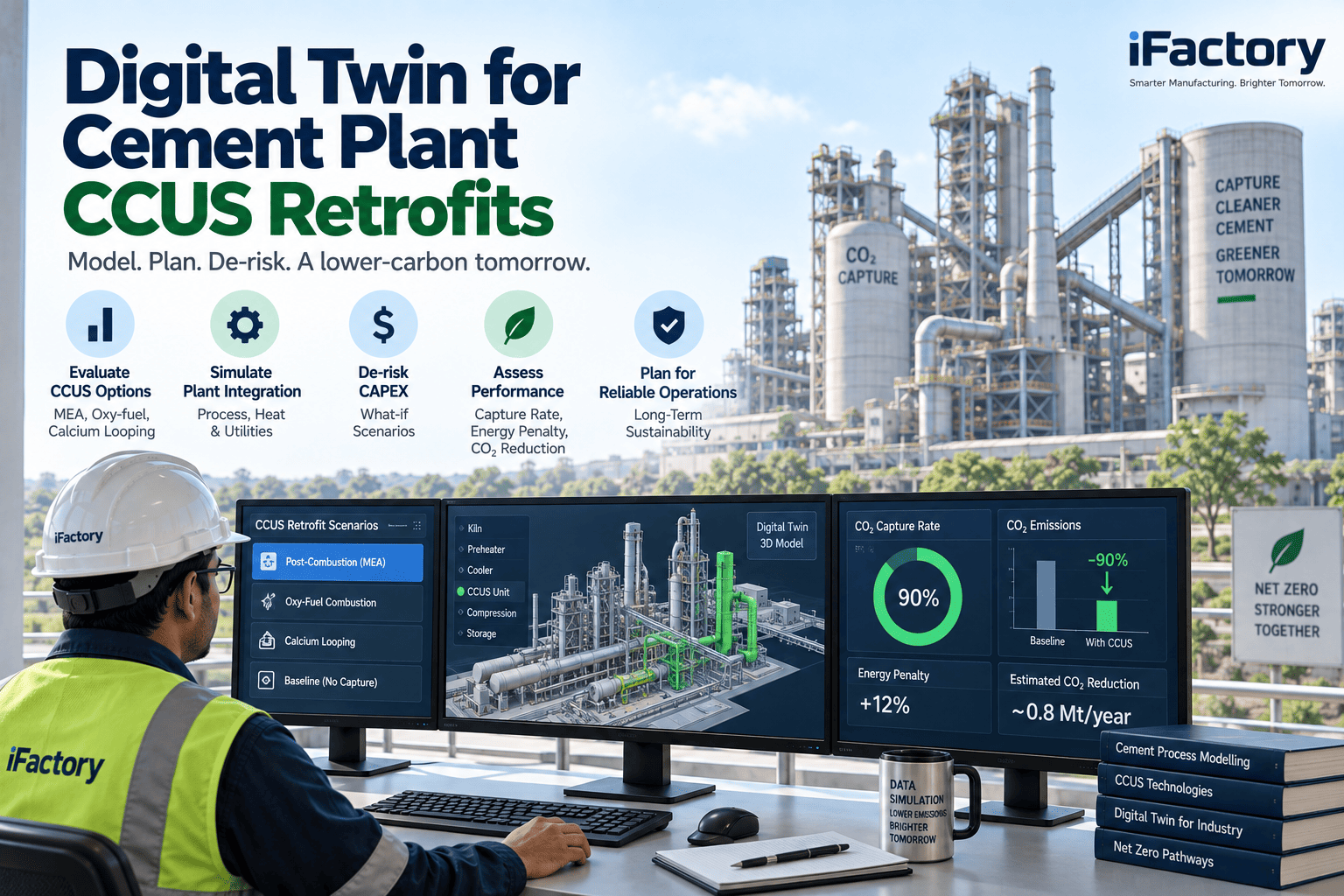
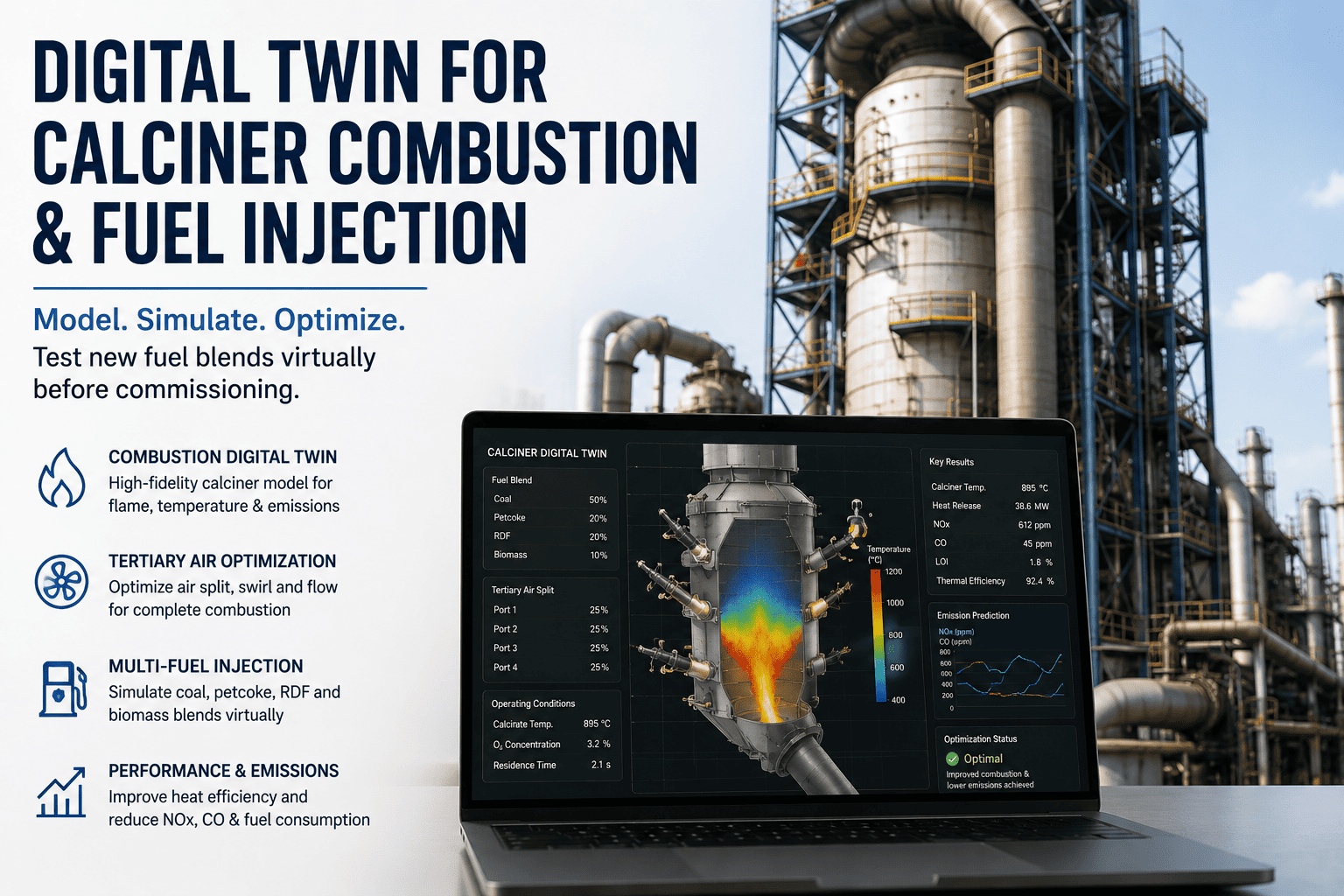
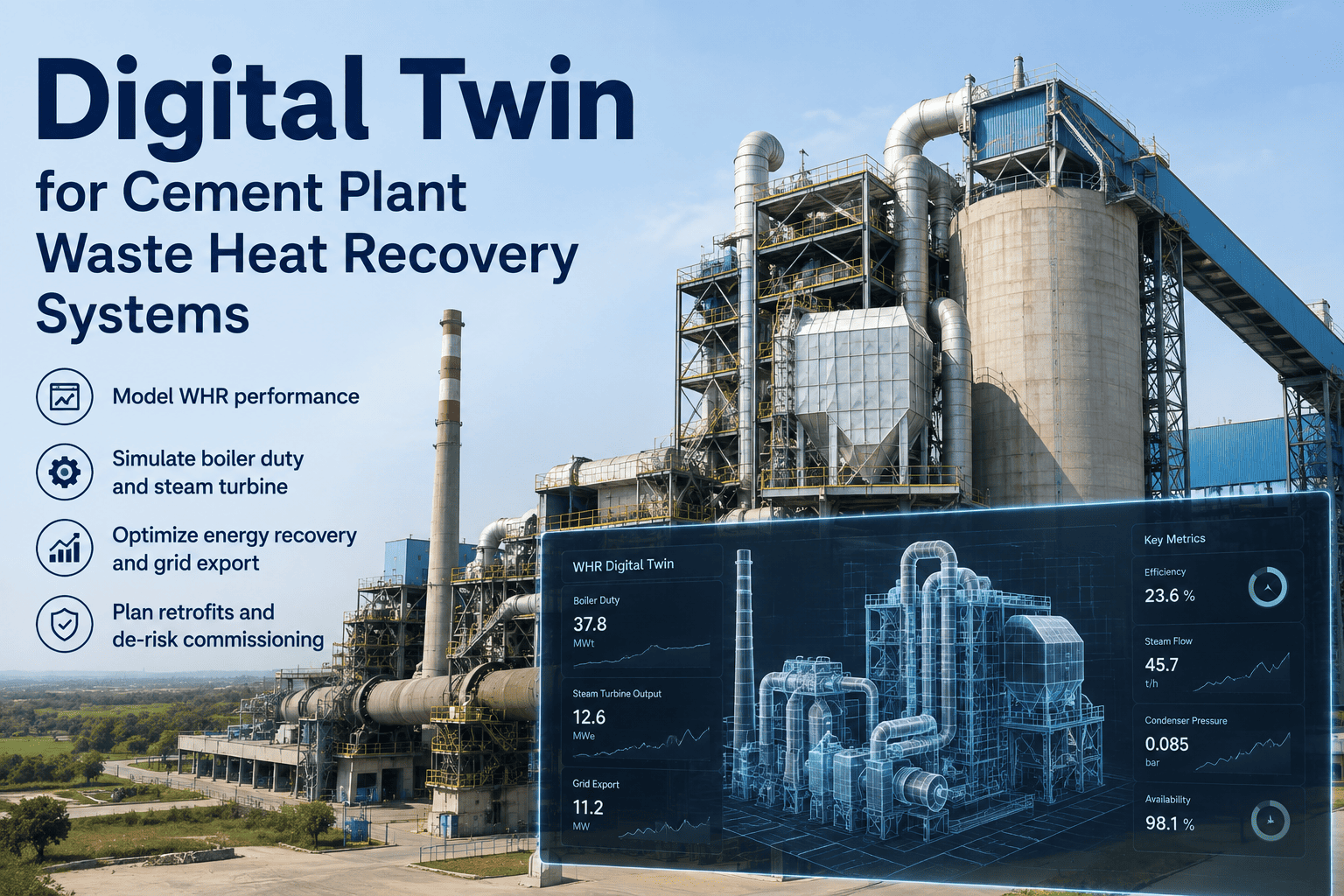
A CCUS retrofit on a running cement plant is the largest capital decision the operation will make this decade. Heidelberg's Brevik project in Norway is the first full-scale amine capture on a cement plant; Edmonton is following with Shell CANSOLV; LEILAC-1 and LEILAC-2 are proving direct calciner-integrated separation at €20-25 per tonne target; calcium looping pilots at La Pereda and CLEANKER are advancing. Each has different retrofit footprint, energy penalty, integration risk with the pyro-processing line, and post-retrofit reliability profile. A digital twin lets the capital projects team model every option against the actual plant — kiln, preheater tower, cooler, mill, utilities — before committing hundreds of millions to steel in the ground.
iFactory / Cement CCUS digital twin
Model MEA, Oxy-Fuel, Calcium Looping, and Direct Separation on Your Actual Plant
Digital twin of your cement plant's pyro-processing line and utilities — model each CCUS retrofit option against your baseline, quantify CAPEX exposure, energy penalty, and post-retrofit reliability before commitment.
MEA amine (post-combustion)
Brevik · Edmonton
Oxy-fuel combustion
CEMCAP pilots
Calcium looping (CaL)
CLEANKER · La Pereda
Direct separation (LEILAC)
LEILAC 1 · 2
4 tech paths
MEA · oxy-fuel · CaL · direct
Your plant
baseline modelled from actuals
Pre-FEED
CAPEX de-risk before commitment
The Problem in Capital CCUS Planning
A cement plant looking at CCUS retrofit has four broad technology paths (MEA-amine post-combustion, oxy-fuel combustion, calcium looping, direct separation) and a growing set of vendor variants inside each. Every path changes the plant's steam and power balance, adds significant footprint and utility loads, and modifies the CO2, dust, and moisture profile the existing equipment sees. Vendor techno-economic models are built for a reference plant — not yours. Your plant has specific preheater height, cooler design, kiln alt-fuel share, water availability, grid connection, and adjacent-land constraints that a reference model cannot capture. Committing to a technology path on vendor references, then discovering integration problems during FEED, is where cement CCUS projects lose time and money.
Where the CCUS Case Actually Slips
CCUS retrofit projects miss their case in the same predictable ways — because the reference model was never validated against the specific plant. A twin catches these before FEED.
Steam balance broken
MEA amine retrofit needs 3-4 GJ/t CO2 of low-pressure steam. The reference case assumed availability; the actual plant has no spare steam and needs a new boiler nobody costed.
Preheater re-engineering
Oxy-fuel retrofit changes the preheater CO2 and O2 profile substantially. The existing cyclones and calciner were sized for air combustion. Post-retrofit reliability drops unexpectedly.
Footprint overrun
Amine absorber tower and stripper need a footprint the plant plot map showed as available. Detailed layout shows utility runs and equipment access clashes. CAPEX and schedule slip.
Grid connection tight
CCUS raises electrical load by 30-50%. The plant's existing grid connection has 10% headroom. New substation and utility approval was not in the base case.
What Good Looks Like in Pre-FEED
A working CCUS digital twin holds four disciplines together — validated baseline of the existing plant, tech-path scenario library, stress-test of reliability and cost, and pre-FEED-ready outputs for vendor selection.
Validated Baseline
Digital twin of the pyro-processing line, mills, utilities, and grid — calibrated against 12+ months of actual plant data. Baseline heat, mass, and CO2 balance the retrofit is measured against.
Baseline from actuals
Tech-Path Library
MEA amine, oxy-fuel, calcium looping (integrated and tail-end), and direct separation (LEILAC-style) modelled as retrofit scenarios on your baseline — with vendor-configurable parameters.
Four paths, your plant
Stress-Test Reliability
Retrofit twin runs against upset conditions, alt-fuel excursions, and coincident equipment fails — post-retrofit availability quantified before commitment, not discovered at commissioning.
Availability, not just CAPEX
Pre-FEED Outputs
CAPEX range, OPEX range, energy penalty, footprint, integration risk register — the pre-FEED package that supports vendor down-selection and board sanction.
Ready for board sanction
How iFactory AI Fits
iFactory AI builds the plant digital twin from your DCS historian, lab system, and design drawings — then overlays each CCUS retrofit option as a modelled configuration on the same baseline, supported by vendor-published techno-economics from Heidelberg Brevik, Edmonton, LEILAC 1/2, CEMCAP, and CLEANKER.
Plant Twin
Twin Layer
Heat, mass, CO2, and utility balance of your pyro-processing line, mills, and utilities — calibrated to 12+ months of DCS historian and lab data.
Retrofit Scenarios
Twin + Vendor
Four CCUS technology paths modelled as retrofits on the baseline. Vendor-specific parameters (Shell CANSOLV, Aker, Calix LEILAC, oxy-fuel EPC) configurable per scenario.
Reliability Case
Twin Layer
Post-retrofit availability under normal and upset conditions — the number that turns nameplate capacity into realistic captured tonnes per year.
Sanction Package
Twin + Reporting
CAPEX range, OPEX range, energy penalty, footprint, and risk register per scenario — pre-FEED output that supports vendor selection and board investment sanction.
If your CCUS business case is currently built on vendor reference numbers instead of your own plant's validated baseline, the integration risk is unpriced. That risk shows up either in the FEED cost overrun or in the post-commissioning reliability shortfall. Book a CCUS feasibility session — we'll walk one retrofit scenario on your baseline live.
16-Week Twin Build on One Kiln Line
One kiln line, one CCUS technology path (with option to add a second), sixteen weeks. The pilot builds the validated plant twin, models the primary retrofit scenario, and produces a pre-FEED-ready sanction package.
Weeks 1–3
Data & Design
Pull 12+ months of DCS historian, lab, and utility data for the kiln line. Load design drawings, plot plan, equipment data sheets. Baseline heat and mass balance validated.
Weeks 4–8
Twin Calibrated
Twin calibrated against actual plant performance. Deviations investigated and reconciled. Baseline CO2, energy, and utility profile signed off by the process team.
Weeks 9–13
Retrofit Modeled
Primary CCUS scenario (MEA, oxy-fuel, CaL, or LEILAC) modelled on the baseline. Vendor parameters loaded. Steam, power, and footprint impact quantified. Upset-condition stress-tests run.
Weeks 14–16
Sanction Package
Pre-FEED package produced — CAPEX range, OPEX, energy penalty, footprint, availability, and risk register. Reviewed with capital projects. Second scenario or full FEED handoff scoped.
Who Owns the KPI
A CCUS retrofit crosses capital projects, process engineering, operations, and executive sponsorship. Each function needs a specific number they own or the pre-FEED slips back into vendor-reference guesswork.
Capital Projects
Pre-FEED CAPEX range accuracy
Owns the investment case — the CAPEX range that goes to board sanction. Pilot deliverable is a range validated against the plant twin, not vendor reference alone.
Process Engineering
Post-retrofit availability %
Owns the operational risk — the projected plant availability after retrofit under normal and upset conditions. Retrofit that gives 92% is worse than retrofit that gives 96% at similar CAPEX.
Operations Head
Energy penalty and utility impact
Owns the running cost — kWh per tonne CO2 captured and steam demand impact on the pyro-processing line. Turns nameplate captured tonnes into realistic annual delivery.
ESG / Executive
Captured tonnes CO2 per year
Owns the strategic outcome — the annual captured CO2 tonnage that flows into the corporate net-zero commitment. The number that reconciles CAPEX to climate target.
FAQ
How mature is CCUS on cement — is it worth committing to a technology path now?
It depends on which path and which market. MEA amine is at full-scale first-mover deployment (Heidelberg Brevik in Norway, Edmonton in Canada with Shell CANSOLV) — the technology risk is retrofit-integration risk more than fundamental process risk. Direct separation (LEILAC) is at demonstration scale (LEILAC-1 done, LEILAC-2 in construction) with the strongest cost-per-tonne target but limited to calcination emissions only. Oxy-fuel and calcium looping are at pilot to demonstration stage with more integration variables. A twin lets a plant defer the technology commitment until after seeing scenarios modelled on the actual baseline — which is exactly the point of pre-FEED.
How does this compare to running a vendor FEED study?
It precedes FEED, doesn't replace it. FEED is executed by an EPC (Technip Energies on Edmonton, for example) with a chosen vendor and produces the ±20% definitive estimate for board sanction. Pre-FEED with a digital twin is what lets you enter FEED with the right technology path already selected against your plant — instead of paying for two or three parallel FEEDs to find that out. The typical output of the twin phase is a down-selected technology and a validated basis-of-design that FEED starts from.
Book a session to see the pre-FEED to FEED handoff structure.
What about CO2 transport and storage — is that in the twin scope?
Optional. The core twin scope is the plant boundary — capture, integration with pyro-processing, and delivery to a compressed CO2 export point at battery limit. CO2 transport (pipeline, ship, or truck) and storage (saline aquifer, depleted field, mineralisation, or utilisation) are downstream infrastructure with their own techno-economics and typically their own project structure. Where the destination is known (a shared corridor like Northern Lights, or a Class VI well permit under way), the twin can include the delivery-pressure and specification match. Where it's undetermined, the twin outputs a battery-limit specification the transport partner works to.
Stop building your CCUS case on vendor reference plants.
Model One CCUS Retrofit on Your Actual Baseline
Bring 12 months of DCS historian for one kiln line, plant design drawings, and the CCUS technology you're most seriously considering. We'll scope the twin build, walk one retrofit scenario live, and quantify the integration risk your vendor case is currently hiding.