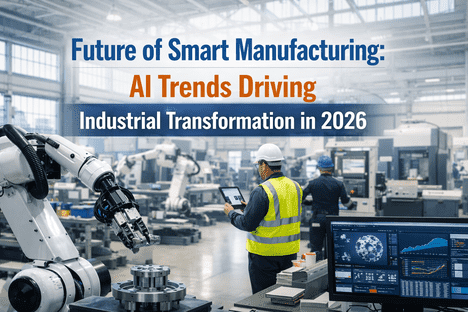
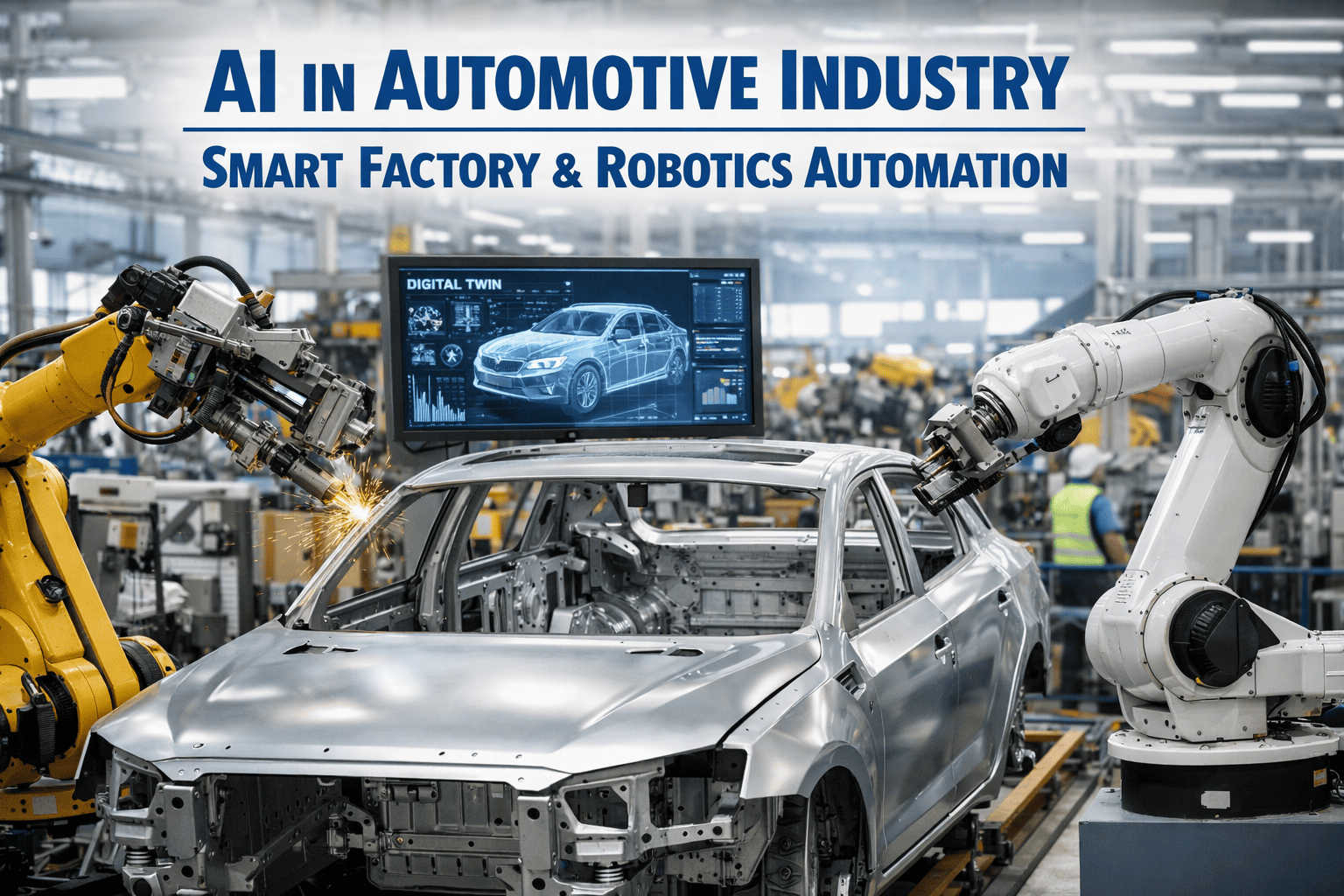
The collaborative robot market reached $11.3 billion in 2026 with 28% annual growth, while the autonomous mobile robot (AMR) market hit $3.4 billion and is accelerating toward $17 billion by 2035 at 19.5% CAGR. Over 210,000 cobot units shipped in the last four quarters alone. The driving force is clear: AI is transforming robots from rigid, pre-programmed machines into adaptive systems that perceive their environment, make independent decisions, and continuously improve their performance. Modern AI-powered robots don't just repeat tasks — they detect unexpected obstacles, update routes instantly, adapt to product variations, and coordinate with dozens of other robots in real-time swarm intelligence. Cobot investments routinely pay for themselves in 6-12 months through energy savings, reduced scrap rates, and 24/7 uninterrupted operating capacity. AMR deployments reduce order fulfillment cycle times by up to 40% and directly address labor gaps that can reach 20% of the required workforce. And with Robot-as-a-Service (RaaS) models, even SMEs can deploy robotic automation without massive capital outlay. iFactory provides the AI orchestration platform that manages your entire robot fleet — industrial robots, cobots, AMRs, and mobile manipulators — delivering real-time health monitoring, predictive maintenance, task coordination, and performance analytics from a single dashboard.
The Robot Taxonomy: Industrial Robots, Cobots, AMRs & Beyond
Not all robots are the same — and the right automation strategy usually combines multiple robot types, each optimized for different tasks. iFactory manages all types from a single platform, providing unified health monitoring, task scheduling, and predictive maintenance across your entire robotic fleet.
High-Speed, High-Precision
Welding, painting, material handling, assembly at 100+ cycles/minute. Fixed installations in caged cells. FANUC, ABB, KUKA, Yaskawa. Ideal for high-volume, repetitive tasks where speed and precision outweigh flexibility.
Speed: Fastest | Payload: Up to 2,300 kg | Flexibility: LowHuman-Robot Collaboration
Work side-by-side with humans without safety cages. Machine tending, pick-and-place, quality inspection, screw driving. Stop automatically on contact. Universal Robots, FANUC CR, ABB GoFa. Re-deployable to new tasks in hours.
Speed: Moderate | Payload: Up to 25 kg | Flexibility: HighAutonomous Material Transport
Self-navigating robots that transport materials between stations, warehouses, and production lines. No fixed tracks or guides. SLAM navigation, fleet coordination, obstacle avoidance. Reduce material handling labor by 30-50%.
Speed: 2 m/s | Payload: Up to 1,500 kg | Flexibility: HighestAMR + Cobot Arm Combined
Autonomous navigation plus manipulation capability. Can travel to a workstation, pick parts, perform assembly or inspection, then move to the next station. The most flexible industrial robot category for mixed-model manufacturing.
Speed: Moderate | Payload: Up to 15 kg arm | Flexibility: HighestAI Makes Robots Intelligent: What Changes with AI
Traditional robots follow fixed programs. AI-powered robots perceive, reason, and adapt. This is the difference between a machine that repeats a trajectory and a system that understands what it's doing and why.
Fixed path programming — any product variation requires manual reprogramming by a specialist
Vision-guided picking adapts to part orientation, size, and color automatically — handles variation without reprogramming
Fixed maintenance schedule — replace bearings every 10,000 hours whether they need it or not
Predictive maintenance — AI monitors vibration, temperature, and current to predict exact failure timing for each joint
AMR follows fixed routes — stops and waits when path is blocked until human intervenes
Dynamic path planning — AMR reroutes autonomously around obstacles, optimizes fleet traffic in real time
iFactory Robot Fleet Management Platform
Managing a mixed fleet of industrial robots, cobots, and AMRs from different vendors is the central challenge of modern factory automation. iFactory provides a vendor-agnostic orchestration layer that monitors, coordinates, and maintains your entire robotic fleet.
Health Monitoring
Real-time condition monitoring of every joint, motor, gearbox, and controller across your robot fleet. Vibration, temperature, and current signature analysis detects degradation before failure.
Predictive Maintenance
AI predicts robot component failures 2-8 weeks in advance. Auto-generated maintenance work orders with failure mode, affected joint, and optimal repair window. Extend robot lifespan 20-40%.
Task Orchestration
Coordinate multi-robot workflows: AMR delivers material to cobot station, cobot assembles component, another AMR transports finished part. Sequence optimization across the entire fleet.
OEE & Analytics
Robot utilization, cycle time, idle time, error rates, and throughput tracked per robot, per cell, per line. Identify underperforming robots and bottleneck stations driving fleet-wide optimization.
Industry Applications
AI robotics delivers value across every manufacturing sector — with industry-specific workflows optimized for each vertical's unique material handling, assembly, and quality requirements.
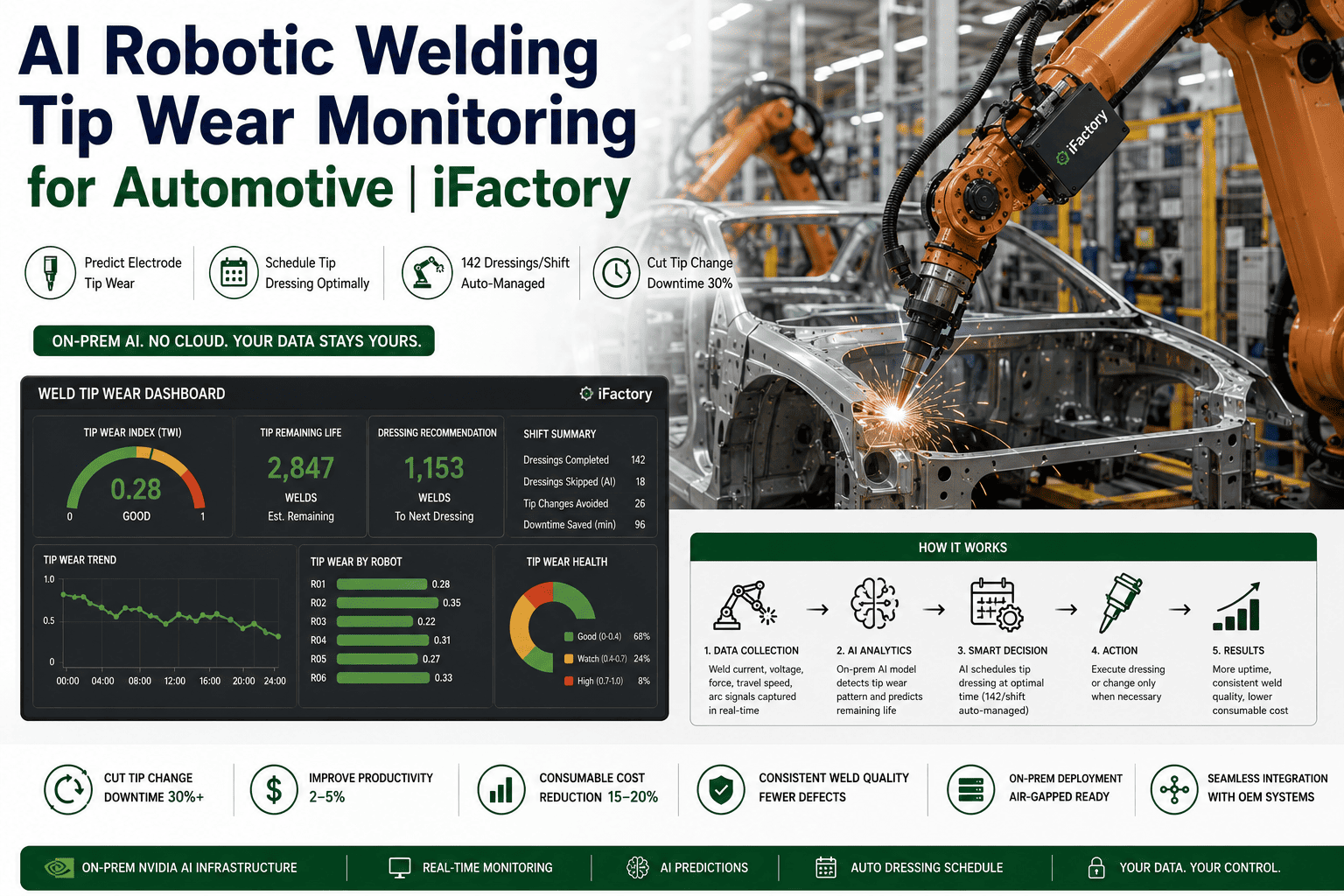
Body welding (300-400 welds per frame), paint application, assembly, part transfer between stations. BMW welds half a million studs daily with AI-guided correction. AMRs deliver components to line-side stations.
PCB assembly, component placement, soldering, testing, packaging. Cobots handle micro-precision tasks alongside human operators. AMRs manage WIP transport between cleanroom zones.
Palletizing, case packing, pick-and-place, sortation. Cobots handle delicate products that industrial robots would damage. AMRs transport finished goods from line-end to warehouse staging.
Sterile filling, packaging, lab sample transport, cleanroom material handling. Cobots perform repetitive precision tasks in controlled environments. AMRs automate inter-departmental transport.
Welding, grinding, deburring, machine tending, heavy part handling. Industrial robots handle high-payload tasks, cobots manage machine loading/unloading for CNC centers.
Goods-to-person picking (50-60% of AMR deployments), pallet transport, sortation, truck loading. AMR fleets reduce fulfillment cycle times by 40% and address 20% workforce gaps.
ROI: What Robotic Automation Actually Delivers
Faster Fulfillment
AMR deployments reduce order cycle times by up to 40%, enabling same-shift fulfillment without facility expansion
Material Handling Savings
Labor reduction from AMR automation of transport, staging, and delivery tasks between production zones
Uninterrupted Operation
Robots don't fatigue, don't take breaks, and maintain consistent quality across all shifts — tripling effective capacity
Digital Twin Optimization
Simulating robot workflows in digital twins improves task allocation efficiency by over 25% before physical deployment
Frequently Asked Questions
One Platform. Every Robot. Complete Fleet Intelligence.
iFactory manages your entire robotic fleet — industrial robots, cobots, AMRs, and mobile manipulators — delivering AI-powered health monitoring, predictive maintenance, task orchestration, and performance analytics from a single dashboard.