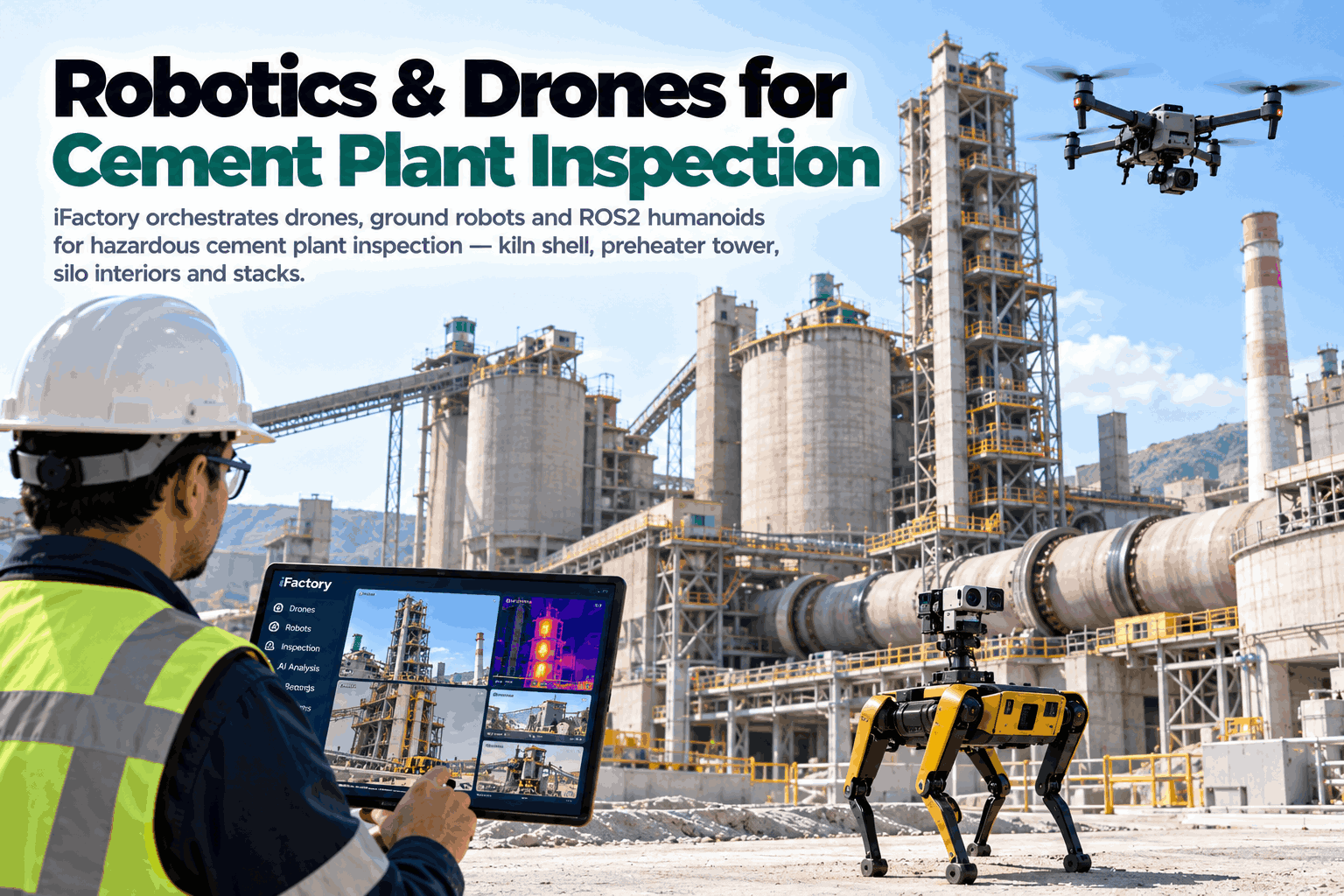
Some of a cement plant's most important inspections happen in its worst places: inside silos, up preheater towers, beside hot kiln shells and at the top of stacks. Drones and robots can now reach many of them without putting people at risk. iFactory's Robotics AI and AI Vision plan the missions, read what the machines see, and turn findings into work orders. To plan a first mission, book a robotics session.
Robotics and Drones for Cement Plant Inspection
One system to plan and run drone, ground robot and humanoid missions across kiln, preheater, silos and stacks, with AI that reads every image and flags what needs attention.
- Which robot suits which cement plant task
- How ready each kind of robot really is
- The safety rules that still apply when a machine goes in
Outdoor drone
Stacks, the outside of the preheater tower, kiln shell and stockpiles.
Indoor caged drone
Silo interiors, cyclones, ducts and other tight confined spaces.
Legged ground robot
Routine rounds: thermal, acoustic and visual checks, every day.
Humanoid
Tasks that need hands, such as valves and panels.
Readiness is our own judgement from published deployments. Humanoids are included because they are coming, not because they are ready for hot, dusty plant floors today.
Where People Should Not Have to Go
Every cement plant has places that are hot, high, dusty or enclosed. They still need checking.
Today those inspections usually mean scaffolding, rope access teams, confined space permits or a planned stop in production. Many can now be done by a machine, at least in part, with people reviewing the results from a safe place, often the same day. Our support team can go through your plant area by area.
A robot collects images and readings far more often than a person can. An experienced inspector still decides what a finding means and what to do. The best results come from robots doing the rounds and people doing the judging.
Robots can take on today
- Routine thermal and acoustic rounds
- Silo, cyclone and duct visual checks
- Stack and tower exterior surveys
- Stockpile volume measurement
Better left to people for now
- Repairs and blockage clearing
- Judging whether a finding is serious
- Work needing fine hand skills
- Anything in a zone the robot is not certified for
Choosing the Right Robot for the Job
No single machine covers a cement plant. A small, mixed fleet usually does.
Drones are best for height and for enclosed spaces. Legged robots are best for routine, repeated rounds on stairs, walkways and platforms. Humanoids may one day handle tasks that need hands, but they are not ready for production use in cement plants today. To match machines to your inspection list, book a fleet planning call.
Drones
- Outdoor. Stacks, towers, kiln shell and stockpile volumes.
- Indoor, caged. Silos, cyclones and ducts, flying safely in contact with walls.
- Sensors. High-resolution cameras, thermal cameras, laser scanners.
- Limits. Battery time, dust, and local flight rules outdoors.
Ground robots
- Legged. Climb stairs and walk platforms on fixed routes.
- Sensors. Thermal, acoustic leak detection, vibration, gauge reading.
- Hazardous zones. Only models certified for that zone may enter.
- Humanoids. Early trials. Safety is still an open engineering problem.
Sensors, and what each one finds
At the 2025 ROS-Industrial Conference, speakers described safety in humanoid systems as a critical research and engineering frontier, with balance loss and autonomy making old "safe state" ideas insufficient. iFactory can orchestrate ROS 2 humanoids in supervised trials. We would not put one on a kiln platform unattended yet.
One Silo Inspection, Two Ways
A silo interior is a classic confined space. Here is the same inspection done by people and by an indoor drone.
Orchestration: One System for Every Robot
Different robots, different vendors, one plan and one set of results.
Each robot maker has its own software. A plant with three kinds of robot can easily end up with three screens, three logins and three separate piles of images. iFactory sits above them: it plans missions, sends them to each robot through its own interface or ROS 2, collects the results in one place and reads them with AI vision. Ask our robotics engineers which of your robots it can connect.
Plan
Missions built from your inspection list, by area, frequency and robot.
Dispatch
Sent to each robot or drone, with routes and points to check.
Collect
Images, thermal maps, sounds and readings gathered in one store.
Read
AI vision looks for heat, cracks, build-up, leaks and wear.
Compare
Each point checked against its own history, so change stands out.
Act
Findings go to engineers, and confirmed ones become work orders.
A single thermal image of a cyclone means very little on its own. The same spot photographed every day for a month shows when it changed. That is how a cold reading at a normally hot point gave a cement plant days of warning of a blockage.
The quickest wins come from one robot on one route, repeated daily until the team trusts the results. A thermal round of the preheater and kiln platforms is a common first choice. Add areas and robots once the first route is earning its keep.
The Safety Rules Still Apply
A robot removes people from danger. It does not remove the rules.
Cement plants have dust explosion zones around coal and fuel handling, confined spaces such as silos and cyclones, high temperatures and moving machinery. Any robot or drone working there must fit within the plant's existing safety system, never bypass it. To review your zones and permits, book a safety review.
Before a robot goes in
- Check the area's hazardous zone and the robot's certification for it
- Agree the permit and isolation rules for robot missions
- Plan what happens if a robot falls, stalls or loses signal
- Follow local flight rules for outdoor drones
What stays with people
- Deciding what a finding means
- Entering for repairs when needed
- Rescue, if a robot is stuck in a confined space
- Signing off that an area is safe
Explosion-protected robots exist for some zones, but most standard robots and drones are not certified for dust explosion areas. Treat certification as a hard limit.
Kiln platforms and cooler areas are hot, and cement dust gets into everything. Robots need protection rated for those conditions, regular cleaning and a maintenance plan of their own. A robot that is often out of service quickly loses the team's trust, so plan its care from day one.
From Images to Work Orders
Thousands of images a week are only useful if someone acts on the few that matter.
Robots generate far more images and readings than any maintenance team could look at by hand. The platform reads every image and reading, ranks findings by risk and sends the important ones to the right engineer. It runs on an NVIDIA server inside your network, so plant images and inspection records stay on site and under your control. Our integration team can confirm how it connects to your maintenance system.
Heat
Kiln shell hot spots, cyclone temperature changes and bearing heat.
Structure
Cracks, corrosion and wear on stacks, ducts, platforms and silo walls.
Build-up
Material on silo walls, in cyclones and along conveyors.
Leaks
Air, gas and dust leaks, heard by acoustic sensors or seen on camera, often long before anyone notices them.
Robots and drones need a reliable wireless connection to send results back and receive new missions. Silos, galleries and thick concrete towers often block wireless signals. A short site survey of network coverage, done early, saves a lot of trouble later.
One set of findings, three views
- Maintenance engineer. Findings by area, with images and history.
- Process engineer. Kiln, preheater and cyclone trends.
- Plant manager. Inspections done, findings acted on, entries avoided.
Robots collect. AI reads. People decide.
Turnkey AI: Delivered, Connected and Live in 6–12 Weeks
You do not build this. It arrives ready.
iFactory ships as a pre-configured NVIDIA AI server, racked and ready, with the software pre-loaded. Rack it, plug in power and Ethernet, and the AI is live on your network.
Our team handles cabling, network setup, PLC and SCADA integration, operator training and 24×7 remote monitoring. The server sits inside your own network, so inspection images and plant data stay on site. For a scope matched to your plant, request a turnkey quote.
Ship, network and data
Server installed. First robots and drones connected. Inspection list, zones and permits agreed.
Model training and pilot
First missions flown and walked. AI vision tuned to your equipment and checked by your engineers.
Go-live and training
Missions on a schedule, findings linked to your CMMS. Staff trained. 24×7 remote monitoring begins.
Frequently Asked Questions
Can drones inspect inside a cement silo?
Yes. Caged indoor drones are built to fly in enclosed spaces and bump into walls safely. They record video, images and sometimes 3D scans of the walls, build-up and liners, so most routine inspections need no one to enter at all. Repairs may still need a person inside, but they go in knowing exactly where to look and what they will find.
Which robots does iFactory work with?
The platform is designed to connect to drones and ground robots through their own interfaces or through ROS 2, the open robotics framework. Which models are supported at your site is confirmed during scoping, before any hardware is bought.
Are humanoid robots ready for cement plants?
Not for unattended production work, in our view. They are promising for tasks that need hands, but safety is still an open engineering problem. We support supervised trials, and recommend drones and legged robots for routine inspection today. We will revisit that advice as the technology and its safety standards mature.
Can robots enter the coal mill area?
Only robots certified for that hazardous zone. Most standard robots and drones are not, and should never be sent in to save time. Your zone classification and the robot's certification decide, and the platform will not plan a mission into a zone the robot is not cleared for.
What does AI vision look for?
Hot and cold spots, cracks, corrosion, material build-up, leaks and wear. Each point is compared with its own history, so changes stand out, and findings are ranked by risk before they reach an engineer. Engineers confirm or reject each finding, which teaches the model your plant.
Do we need our own robots first?
Not necessarily. We can help you choose and source the right machines for your inspection list, or connect the ones you already have. Many plants start by renting or leasing a drone for a pilot before buying.
How long does it take to go live?
Six to twelve weeks from delivery for a first set of missions. We need a place for the server, network coverage in the areas the robots work, and time with your maintenance and safety teams. To check your set-up first, contact our team.
Bring Your Inspection List
In thirty minutes we go through your recurring inspections, mark which ones a drone or robot could take on, and flag the ones that should stay with people. You keep the list whether or not you go further with iFactory.
- 1Your list of recurring inspections
- 2Your hazardous area classification drawings
- 3Confined spaces and how often they are entered
- 4Any drones or robots you already use
- 5Your last three findings that caused a stop