In every batch-driven manufacturing plant, material consumption is the single most error-prone data point in the production record. Most facilities still rely on end-of-shift manual back-flushing or periodic inventory adjustments to report what was consumed on the line — a workflow that introduces hours of latency, data drift between actual usage and SAP records, and costly inventory discrepancies that ripple into procurement, costing, and production planning. The MBGMCR IDoc (Material Batch Goods Movement Confirmation Report) is SAP's standard mechanism for posting consumption in real time, but without an automation layer that converts actual machine telemetry into the required IDoc structure, manufacturers are left with a choice between expensive manual data entry and inaccurate theoretical consumption models. iFactory solves this by building the MBGMCR IDoc automatically from PLC-level production data — every kilogram consumed is posted to SAP MM the moment it leaves the hopper, not at the end of the shift.
The Hidden Cost of Delayed Material Consumption Data
Why End-of-Shift Back-Flushing Creates a Margin-Leakage Problem
When material consumption is posted hours after it actually occurs, the ripple effects are immediate and compounding. Procurement systems operate with stale inventory positions, production controllers make confirmation decisions based on theoretical BOM consumption rather than actual usage, and costing modules accrue variances that require manual reconciliation every month. In a 500,000 TPA batch processing plant, even a 2% drift between actual and posted consumption translates into more than $150,000 in annual material misallocation and emergency order costs.
The core issue is not a lack of data — it is a lack of automated data translation. PLCs already register every material discharge, weigh hopper release, and batch transfer at the machine level. The missing layer is a system that converts this production telemetry into the SAP MBGMCR IDoc format and posts it to SAP MM without human intervention. Without this automation layer, manufacturers accept a 4-to-6 hour confirmation lag that distorts every downstream process from MRP to production costing.
| Failure Mode | Primary Impact | Secondary Operational Risk | Annualized Cost Range |
|---|---|---|---|
| End-of-Shift Back-Flushing Drift | Inventory Inaccuracy | Procurement Mismatch | $120K – $280K |
| Manual Data Entry in SAP | Batch Record Errors | Regulatory Compliance Risk | $65K – $145K |
| Theoretical BOM vs Actual Gap | Excess WIP Material | Production Order Variance | $95K – $210K |
| Late Consumption Posting | MRP Cycle Distortion | Stockout / Restock Cost | $140K – $320K |
| Siloed Confirmation Workflow | Confirmation Delay | Costing Discrepancy | $85K – $175K |
How Automated MBGMCR IDoc Posting Works
From PLC Signal to SAP Posting in Seconds
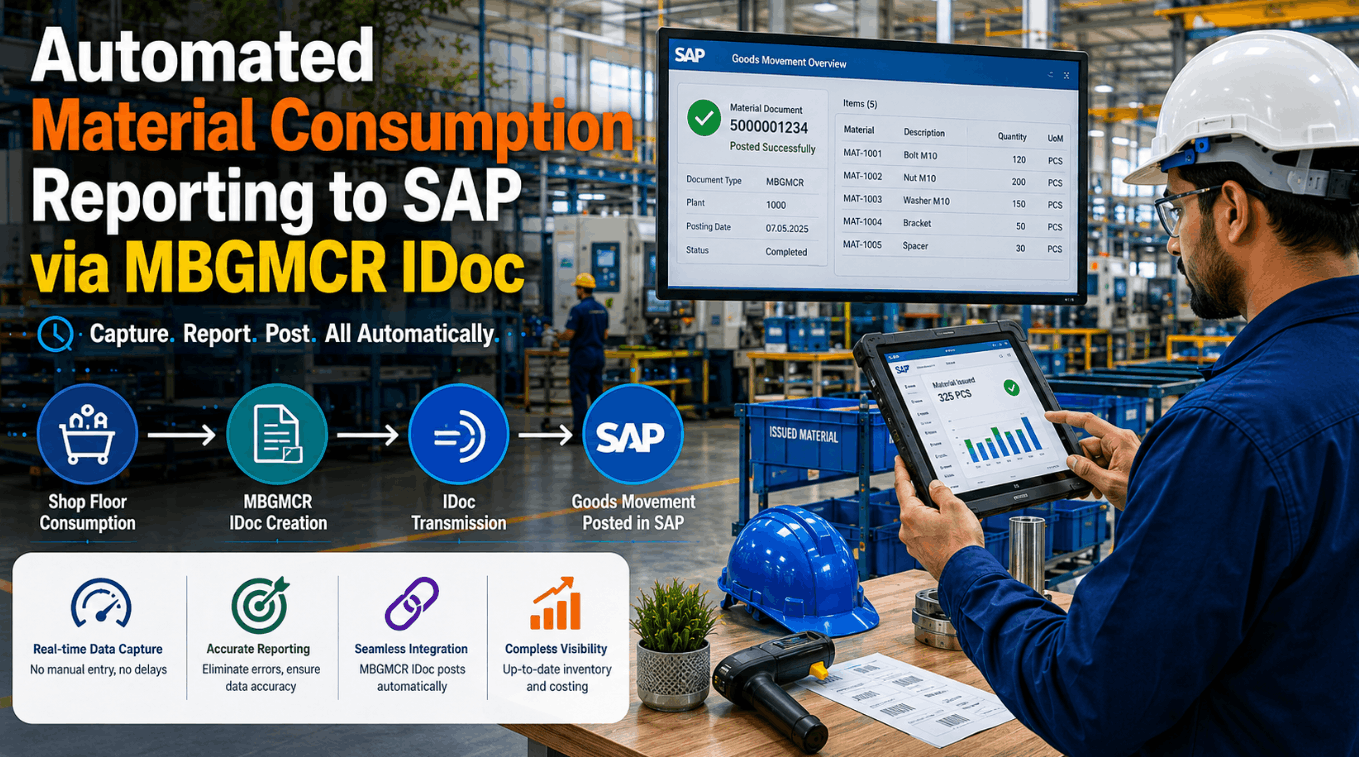
iFactory ingests raw production signals from PLCs, scales, and flow meters — then applies a deterministic mapping engine that constructs the MBGMCR IDoc with the exact field structure SAP MM expects. The process runs continuously, posting each consumption event as a discrete goods movement without batch aggregation or shift-end summaries.
This workflow eliminates the manual data entry bottleneck and the end-of-shift confirmation drift. Production controllers can see material consumption in SAP MM within seconds of the machine-level event — not hours later during the shift closeout. To see this automation in action on your own process data, Book a Demo with our SAP integration engineering team.
Measurable Impact of Real-Time Material Confirmation
What Full MBGMCR Automation Delivers to Your Production Operations
The return on MBGMCR automation is not theoretical — it is measurable in the first costing cycle. Plants that deploy automated real-time consumption posting see procurement accuracy improve within weeks, MRP cycle reliability increase, and the end-of-month reconciliation effort drop from several days to a few hours. If your plant is still reconciling theoretical BOM consumption against physical inventory, you are carrying a cost burden that automation can eliminate. Book a Demo to see how iFactory's consumption engine calculates and reports your specific ROI.
Architecture for Real-Time SAP Material Posting
Building the Digital Bridge Between Production and SAP MM
A robust MBGMCR automation architecture requires four core capabilities: deterministic telemetry ingestion, MBGMCR field mapping, secure IDoc transmission, and real-time reconciliation. iFactory delivers all four within a single platform that integrates with existing Level-1 and Level-2 systems without custom middleware.
Closing the Consumption-to-Confirmation Gap
Why Delayed Material Posting Is a Competitive Liability
In a manufacturing environment where every kilogram of material carries a cost and every production order must be confirmed against actual usage, the gap between consumption and confirmation is a direct drain on operational margins. Plants that rely on end-of-shift back-flushing or manual SAP data entry are operating with a structural information lag that distorts procurement, inflates WIP, and generates avoidable costing variances. iFactory's MBGMCR automation closes this gap completely — converting raw PLC telemetry into confirmed SAP MM postings in real time, without human intervention. If your plant is still waiting until the end of the shift to know what was consumed, you are not just running inefficiently — you are running with a blind spot that costs real money every day. Book a Demo to start your automated consumption posting pilot.
Frequently Asked Questions
What is the MBGMCR IDoc in SAP?
The MBGMCR IDoc is SAP's standard electronic document for posting material batch goods movement confirmations, enabling automated consumption reporting from production to SAP MM.
How does automated MBGMCR posting differ from back-flushing?
Automated MBGMCR posting uses actual PLC telemetry in real time, while back-flushing relies on theoretical BOM consumption posted at shift end or order completion.
What data is required to build an MBGMCR IDoc from PLC signals?
The IDoc requires material number, batch, quantity, production order, movement type, and plant/storage location — all mapped automatically from production telemetry.
Can iFactory integrate with existing SAP ECC or S/4HANA systems?
Yes, iFactory integrates with both SAP ECC and S/4HANA through standard IDoc interfaces without requiring custom ABAP development or middleware.
How quickly can MBGMCR automation reduce inventory discrepancies?
Most facilities see inventory accuracy improve to over 98% within the first month of deployment, eliminating end-of-shift data gaps.