A coal-fired boiler is always balancing competing goals. More excess air burns out carbon more completely but raises dry flue gas loss and fan power. Less air lowers NOx formation but can increase unburnt carbon and slagging. Coal quality changes by the hour, mills wear and burners drift. Operators juggle all of this with limited time and fixed set points. Combustion optimization uses models of the boiler to find the air, fuel and damper settings that meet emissions limits while cutting losses, and keeps finding them as conditions change. This guide explains the variables involved, how AI-based optimization works, what results to expect and how to prove them. To see combustion optimization on a real boiler, book a short walkthrough.
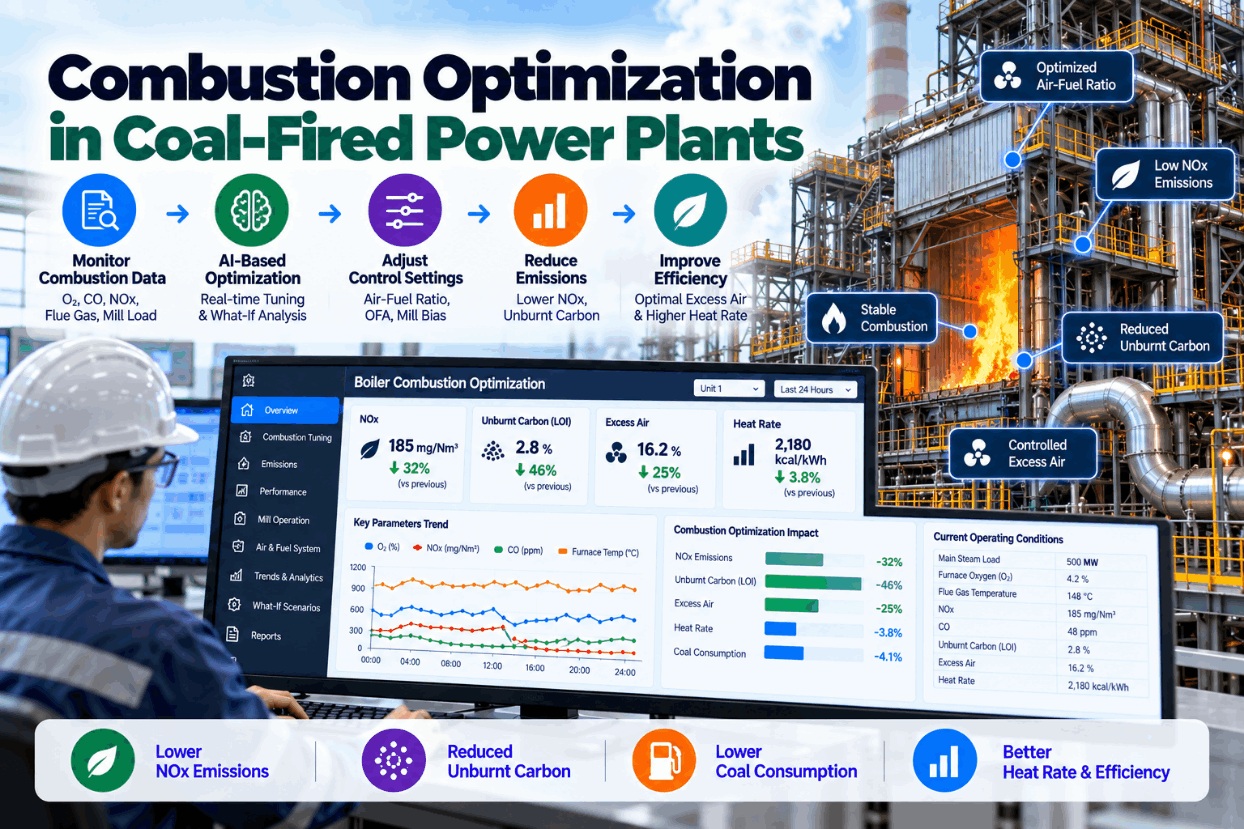
Combustion Optimization in Coal-Fired Power Plants: Lower NOx, Unburnt Carbon and Excess Air Together
Boiler models that learn how air, fuel and dampers affect efficiency and emissions, and recommend set points that balance both as coal and load change.
Why Combustion Is Hard to Get Right by Hand
Combustion tuning is usually done during commissioning or after major work, then left alone. Set points for oxygen, damper positions and burner tilts are chosen for typical conditions. But conditions are rarely typical. Coal from different mines and seams varies in calorific value, volatiles, moisture and ash. Mills wear between overhauls. Load follows the grid. Slag builds up and is blown off. A setting that was right last month may be wrong today.
The result is a boiler run with safety margins: extra oxygen to avoid unburnt carbon and CO, conservative air staging to avoid tube problems. Every margin costs efficiency. Sargent & Lundy’s estimates, cited in an EIA analysis of coal plant heat rate improvement, put the value of neural network combustion controls at around 150 Btu/kWh, and EPRI studies cited in the same report documented 3–5% heat rate improvements through various measures.
Emissions limits add pressure. The December 2015 notification in India set NOx limits by installation date, and some limits have since been revised, so check the current rules for your units. We can review your boiler’s constraints on a call.
The Variables That Decide Combustion Performance
Combustion optimization works on a small set of controllable variables, within limits set by safety, equipment and emissions.
The difficulty is that these variables interact. Changing overfire air affects NOx, unburnt carbon, steam temperatures and spray flows all at once. That interaction is what models capture and people struggle to. See the interactions in a demo.
The Central Trade-Off: Air Versus Everything Else
Most combustion decisions come down to how much air, and where.
- More complete burnout, lower unburnt carbon
- Lower CO and more stable flames
- Higher dry flue gas loss
- More fan power
- Often higher NOx
- Higher flue gas volume through equipment
- Lower flue gas loss and fan power
- Lower NOx with good staging
- Needs good fuel and air distribution
- Risk of CO and unburnt carbon if pushed too far
- Requires reliable oxygen measurement
- Needs continuous adjustment as coal changes
Load matters too: the best oxygen level at full load is rarely the best at 60% load.
The optimum sits close to the point where CO starts to rise or unburnt carbon increases. That point moves with coal quality, mill condition and load. Holding the boiler near it by hand is impractical; a model that knows where it is right now can.
Oxygen measurement quality is critical. A drifting or unrepresentative probe can send any optimizer the wrong way, so probe health is part of every optimization project.
How AI-Based Combustion Optimization Works
Modern combustion optimization combines data-driven models of the boiler with an optimizer that respects its constraints.
Historian data on air, fuel, dampers, emissions, temperatures and coal quality.
Neural networks or hybrid models learn how set points affect efficiency and emissions.
An optimizer searches for set points that improve the objective within constraints.
Recommendations shown to operators, or written to the DCS in closed loop.
Models retrained as coal, equipment and operation change.
Recent research has applied deep learning and reinforcement learning to coal boiler combustion with promising results, and neural network optimizers have been used commercially for decades. The practical question is not whether the model works in a paper, but whether it stays reliable on your boiler with your coal and your instruments.
Most plants start in advisory mode, where operators see and accept recommendations. Closed loop follows once trust is built and the control system integration is proven. Both modes need clear limits on how far and how fast set points may move.
Advisory mode also shows operators why each recommendation is made, which builds the trust closed loop needs. Our engineers agree those limits with your control team.
What Makes Coal Boilers Special
Coal combustion adds challenges that gas-fired units do not face.
Calorific value, moisture, volatiles and ash change with every rake or shipment.
Mill wear and classifier settings change fineness and flame behaviour.
Ash deposits change heat absorption and must be managed with sootblowing.
Carbon in fly ash is both a loss and an ash quality issue for sale or use.
Air heater leakage distorts oxygen readings and adds fan load.
Combustion changes affect downstream SCR, FGD and ESP performance.
Good optimizers include coal quality inputs, from online analysers or lab data, so recommendations follow the fuel rather than lagging behind it. Coal data links are part of the integration.
Proving Combustion Optimization Results
Claims are easy; proof needs a baseline compared at like-for-like conditions.
| KPI | What it shows | Compare at |
|---|---|---|
| Excess oxygen | Air reduction achieved | Same load band and coal type |
| Dry flue gas loss | Efficiency effect of air and exit temperature | Same ambient and load |
| Unburnt carbon in fly ash | Burnout quality | Same coal and mill combination |
| NOx at stack | Emissions effect | Same load and SCR status |
| Fan power | Auxiliary power saved | Same load |
| Spray flows and steam temperatures | Side effects on the steam cycle | Same load |
Two methods work well. On-off testing alternates periods with and without the optimizer at similar conditions. Regression baselines model performance before optimization and compare actual results with that model afterward. Both need enough data to average out coal and ambient variation.
Reporting results against a baseline, rather than against the best day before, keeps them credible with management and auditors. We set up the baseline in the first pilot weeks.
Combustion Optimization Readiness Checklist
Check these before starting, because instrument and equipment problems limit any optimizer.
Fixing a few dampers and probes often delivers part of the gain before the optimizer starts. We include a readiness review in every project plan.
Where the Value Comes From
Combustion optimization usually pays through several small gains at once.
The size of each gain depends on how far the boiler currently runs from its optimum. Units with high oxygen margins, variable coal and manual tuning have the most to gain. Units already well tuned gain less but still benefit from holding the optimum as conditions change.
A short data review shows where your boiler sits before any commitment. Book one with our boiler experts.
How iFactory Delivers Combustion Optimization
Hybrid models trained on your unit’s historian data.
Efficiency and NOx balanced within safety and equipment limits.
Recommendations with reasons shown to operators.
Set points written to the DCS once trust is built.
Recommendations follow the fuel being burned.
Results proven at like-for-like conditions.
It works with your existing DCS and historian. Share three months of data and we will show your boiler’s optimization potential in a session.
See How Far Your Boiler Runs From Its Optimum
Share three months of boiler data. We model your unit, estimate the gap between current and optimal settings and run the optimizer in advisory mode for a pilot period.
Excess O2 running 0.6 points above the optimizer’s target at 80% load. Unburnt carbon in fly ash stable. Advisory: trim O2 and bias SOFA dampers.
An Advisory Accepted on Shift
This exchange shows how a shift charge engineer might use iFactory’s combustion advisor.
iFactory ships as a pre-configured NVIDIA AI server, racked and ready with the combustion modelling and optimization models loaded. Rack it, plug in power and Ethernet, and the AI is live on your network. Our scope covers sensors and data connections across boilers, mills, fans and emissions systems, DCS, PLC/SCADA, historian and ERP integration, cabling and network setup, operator and quality team training, and 24×7 remote monitoring.
Server installed, DCS and historian links live, historical operating, performance and maintenance data loaded.
Models calibrated on your own unit data, then run in advisory mode on one unit with your operations and performance engineers reviewing every output.
Rollout to the agreed units under your change management, operator and engineer training, and 24×7 remote monitoring in place.
Software, server and integration come as one package. For pricing on your units, contact our sales team.
Frequently Asked Questions
It uses models of the boiler to find the air, fuel, damper and burner settings that reduce losses and emissions within safety and equipment limits, and adjusts them as coal and load change.
It depends on how far the boiler runs from its optimum. Sargent & Lundy estimates cited by EIA put neural network controls at around 150 Btu/kWh for a typical coal unit.
Yes. Better air staging and lower excess air reduce NOx formation at source, which can ease SCR reagent use or improve compliance margins.
It can. Most plants start in advisory mode, where operators accept recommendations, and move to closed loop after trust and control integration are proven.
Reliable oxygen and CO measurement, stack NOx analysers, air and coal flow measurements and working dampers. Instrument problems limit any optimizer.
A typical rollout takes 6–12 weeks from data review and modelling to advisory use on one unit. Plan it with our engineers.
Run Your Boiler at Its Optimum, Every Shift
iFactory learns your boiler, recommends settings that cut losses and NOx together and keeps adjusting as coal and load change, with every result proven against a fair baseline.
Illustrative. Each KPI is compared with a baseline at matching load and coal quality.