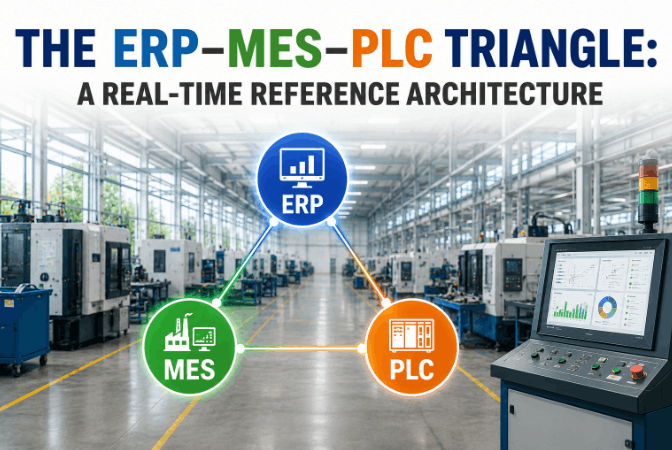
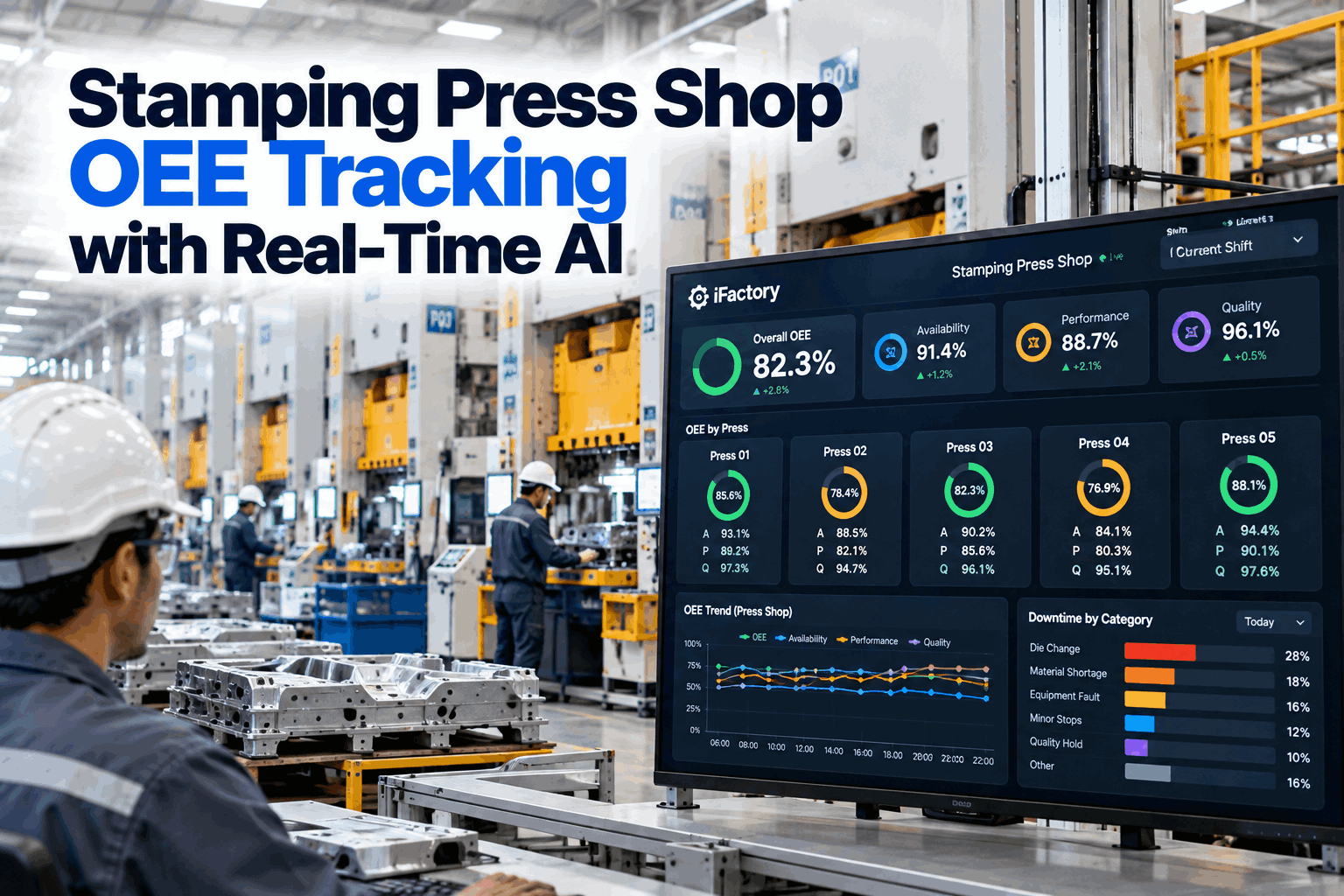
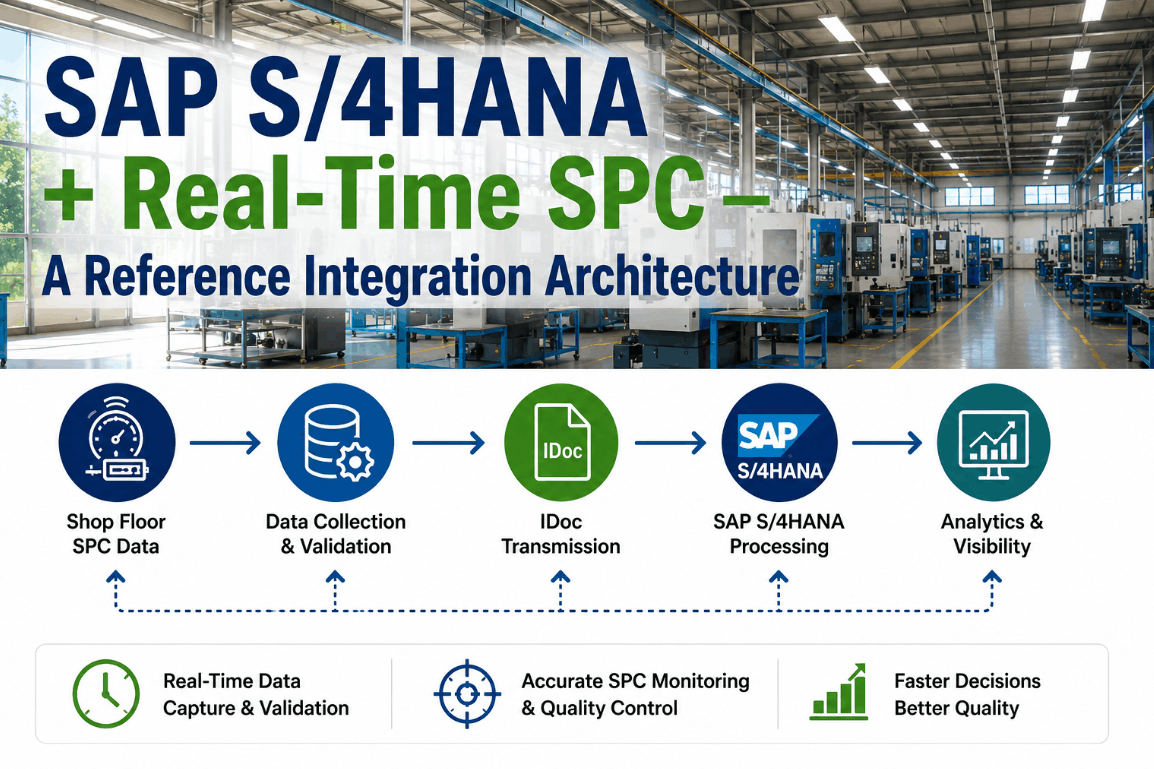
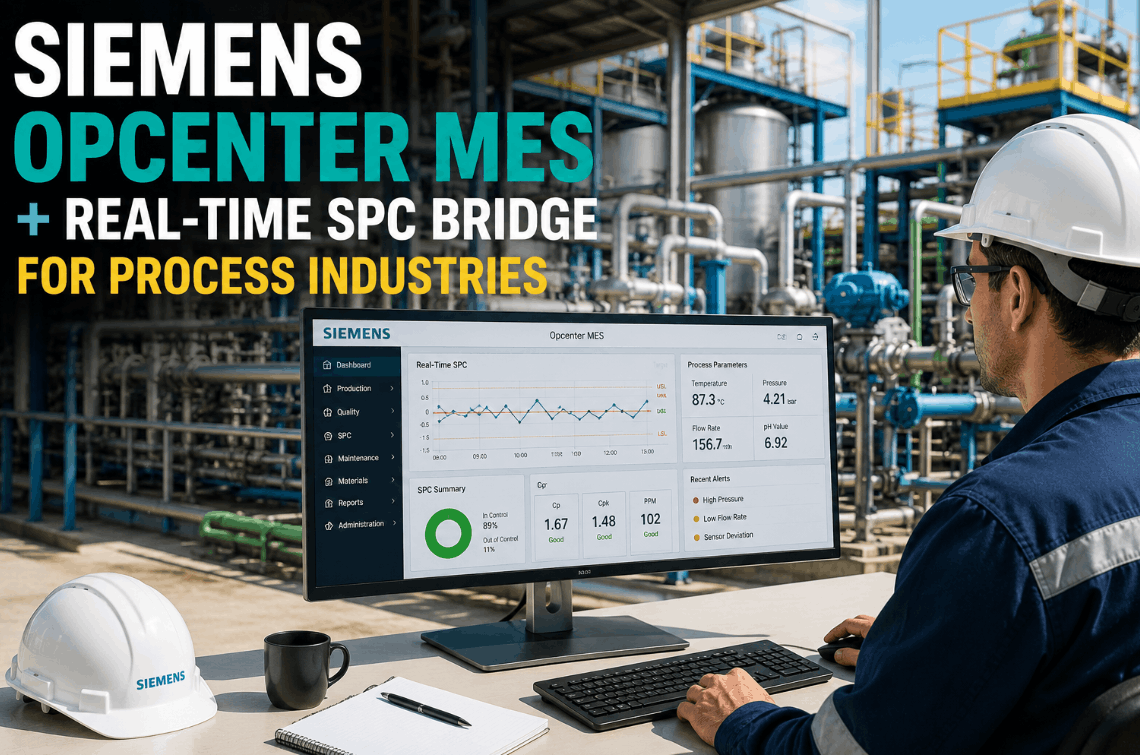
The ERP–MES–PLC Triangle: A Real-Time Reference Architecture
By Henry Green on June 3, 2026
Most smart factory initiatives stall not because of missing sensors or insufficient compute — they stall because the three foundational layers of industrial automation, ERP, MES, and PLC, were never designed to exchange data in real time. The ERP system runs on a transactional database optimized for batch processing. The PLC operates on deterministic scan cycles measured in milliseconds. The MES sits in between, expected to reconcile both worlds without a standardized data contract. The result is a triangle that passes data through manual exports, scheduled file drops, and middleware that breaks whenever any one of the three systems gets updated. iFactory closes that triangle with an ISA-95-aligned integration stack that connects your legacy OT and ERP layers through a durable industrial message bus, normalizes data through a standards-based connector, and delivers real-time production intelligence through AI-powered analytics — without replacing any of the systems your floor already depends on. Book a Demo to see the reference architecture running live on a plant network similar to yours.
ISA-95
Reference model alignment across all four functional levels — L1 through L4
<200ms
End-to-end latency from PLC tag change to AI platform anomaly flag
Zero
Rip-and-replace required — connector reads legacy OT without protocol changes
REST + Webhooks
Modern northbound API surface for ERP, BI, and cloud platform consumption
Ready to close the ERP–MES–PLC triangle at your facility?
iFactory's ISA-95-aligned integration stack connects your existing OT, MES, and ERP layers without protocol changes, system replacements, or months of custom middleware development.
Why the Triangle Breaks: Root Causes in ERP–MES–PLC Integration
The integration challenge between ERP, MES, and PLC is architectural, not incidental. Each layer was engineered by a different discipline for a different purpose, and the interfaces between them were typically solved by whoever had the budget and the deadline — not by a coherent system design. Understanding where and why the triangle breaks is the prerequisite to specifying an architecture that actually holds.
Protocol Incompatibility
PLCs speak Modbus, EtherNet/IP, and PROFINET. ERPs expose BAPI calls and RFC interfaces. MES platforms often implement proprietary APIs. No two layers share a native protocol, so every connection requires a translation layer that must be maintained independently.
Temporal Mismatch
PLC scan cycles run at 10–100ms. MES batch windows run at 1–5 minutes. ERP transactions run hourly or nightly. Reconciling these time horizons without a durable message queue means data is either dropped, duplicated, or permanently out of sync.
Context Loss at Boundaries
Production order context lives in the ERP. Process parameter context lives in the PLC historian. Neither layer exchanges enough metadata for the other to make decisions. The MES is expected to correlate data across both without a shared semantic model.
Point-to-Point Brittleness
Most plants solve integration one connection at a time — a custom script from the DCS historian to the MES, a flat-file export from the MES to the ERP. Each point-to-point link is a single point of failure that breaks silently when either system updates its schema or API version.
No Canonical Data Model
Without ISA-95 alignment, the same concept — a work order, a defect, a machine state — is represented differently in each layer. Data transformation code accumulates in middleware scripts that no one owns and no one documents until a migration forces the issue.
No Observability Layer
When integration breaks, the only signal is a downstream symptom — a missing production record, an ERP inventory discrepancy, a quality dashboard that stops updating. There is no integration health monitoring, no message delivery audit, and no alerting until a human notices the gap.
The ISA-95 Reference Architecture: Four Levels, One Data Contract
ISA-95, the international standard for integrating enterprise and control systems, defines a five-level functional hierarchy that maps cleanly to the physical architecture of a manufacturing plant. iFactory's integration stack is aligned to this model, providing a structured data contract at every level boundary — from the PLC tag on the production floor to the corporate analytics dashboard in the boardroom.
L4 — Enterprise
ERP (SAP, Oracle, Infor) · MRP · Financial Systems
Business planning, financial consolidation, procurement, and inventory management. iFactory exposes a REST and webhook API surface that integrates with any ERP's production order, BOM, and inventory interfaces — no SAP ABAP custom coding required.
MSMQ · REST · Webhooks
L3 — Operations
MES · LIMS · Quality Management · Scheduling
Manufacturing execution, production tracking, quality control, and scheduling. iFactory's AI platform operates at this level — consuming normalized OT data, executing SPC logic, managing recipe masters, generating CAPA workflows, and publishing production events back to L4.
iFactory Connector · OPC-UA · Modbus TCP
L2 — Control
SCADA · DCS · HMI · Historian
Supervisory control, process visualization, and real-time data collection. iFactory's connector reads from any OSIsoft PI, Aspentech IP21, GE Proficy, or Wonderware historian without requiring write-back access — preserving OT network security while capturing the full process data stream.
EtherNet/IP · PROFINET · Modbus RTU
L1 — Field
PLCs · PACs · CNCs · Drives · Smart Sensors
The physical control layer — PLCs executing ladder logic, CNCs running G-code, drives managing motor speed. iFactory reads tag data from Allen-Bradley, Siemens, Mitsubishi, and Omron controllers via standard industrial protocols without modifying existing PLC programs.
iFactory's Integration Stack: MSMQ, Connector, and AI Platform
The technical implementation of a closed ERP–MES–PLC triangle requires three components working in sequence: a durable message transport that handles the temporal mismatch between layers, a connector that normalizes protocol-specific data into a canonical format, and an AI platform that adds analytical value at the L3 boundary. iFactory provides all three as an integrated stack, not three separate products requiring separate maintenance contracts.
Component
Function
Protocols Supported
Key Capability
MSMQ Transport
Durable, ordered message delivery between all three layers with guaranteed at-least-once delivery and configurable retry logic
AMQP, MQTT, MSMQ native, Kafka-compatible
Survives network outages without data loss; messages queue locally and replay on reconnect
iFactory Connector
Read-only data extraction from legacy OT systems — PLCs, historians, SCADA — with schema mapping to ISA-95 canonical objects
Zero write-back to OT — read-only at protocol level, not just policy level
AI Platform
L3 intelligence layer: SPC, recipe master management, AI Copilot for process engineers, and automated CAPA generation
REST API, Webhooks, OData, SOAP (ERP northbound)
Closed-loop: receives production orders from ERP, executes quality logic, publishes results back to ERP and CMMS
AI Platform Capabilities at the L3 Boundary
Once the MSMQ transport and connector have normalized OT data into the ISA-95 canonical model, iFactory's AI platform delivers five categories of operational intelligence at the manufacturing execution layer — each consuming cross-layer data that was previously inaccessible in a unified context.
01
Recipe Master Management
Pulls production order and BOM data from the ERP (L4), matches it to the active recipe version in the AI platform, and verifies that PLC setpoints (L1) match the recipe specification before the production run begins. Deviation triggers an alert and a CAPA record without manual intervention.
02
Statistical Process Control (SPC)
Continuously monitors process variables streamed from SCADA and PLC historians against control limits trained on your plant's historical data. Western Electric rules and Nelson rules applied in real time — not as a post-shift report. Out-of-control signals route directly to the responsible operator and quality engineer.
03
AI Copilot for Process Engineers
A conversational interface trained on your plant's process data, quality records, and maintenance history. Process engineers query in plain English — "Why did Cpk drop on Line 3 last Tuesday?" — and receive answers derived from cross-layer data correlation, not manual spreadsheet analysis.
04
Automated CAPA Generation
When SPC or AI anomaly detection identifies a process excursion, the platform auto-generates a structured CAPA record with root cause hypothesis, supporting data, and recommended corrective action. The CAPA writes back to your CMMS or quality management system via the REST connector.
05
Closed-Loop ERP Feedback
Production actuals — actual yield, cycle time, scrap rate, and quality disposition — publish back to the ERP production order through the webhook interface, closing the planning-vs-actuals loop that most MES implementations leave open. No manual data entry, no batch reconciliation at shift end.
Expert Review: What Smart Factory Architects Get Wrong About Integration
The most common mistake I see in smart factory integration projects is treating the MES as the integration hub. The MES is an execution system — it was never designed to be a message broker, a protocol translator, and an analytics platform simultaneously. When you load it with integration responsibilities it wasn't architected to carry, you get an MES that performs poorly as an execution system and fails as an integration layer. The right architecture puts a durable message transport in the middle, keeps the MES focused on execution, and gives the analytical intelligence layer its own compute and data access path. The triangle works when each vertex does one thing well and the edges between them are standards-based and independently monitored.
Smart Factory Integration Architect
Industrial Automation and MES Practice — 19 Years, ISA Member
ISA-95 is the right model, but most teams implement it as a documentation standard rather than an engineering specification. The value of ISA-95 is not the diagram — it is the data object definitions at each level boundary. If your ERP and your MES agree on what a "production order" object contains and how it is identified, the integration is maintainable. If they each define it differently, you are maintaining a translation layer forever. iFactory's connector maps legacy OT data to ISA-95 B2MML objects at ingestion, which means the AI platform and the ERP are working with the same semantic model from day one. That is the difference between an integration project and an integration architecture.
Manufacturing IT Director
Discrete and Process Manufacturing, 14 Years — CISA, ISA-95 Practitioner
Frequently Asked Questions
No. iFactory's connector reads tag data from PLCs using standard industrial protocols (OPC-UA, Modbus TCP, EtherNet/IP) in read-only mode — existing PLC programs, scan cycles, and logic are untouched.
SAP (via RFC/BAPI and REST), Oracle EBS, Infor LN/M3, and Microsoft Dynamics 365 are supported with pre-built connectors; any ERP with a REST or SOAP interface is connectable within the standard implementation scope.
Messages are persisted locally at the connector node during any network interruption and replayed in order when connectivity is restored — no production data is lost and no manual reconciliation is required after reconnection.
iFactory is designed to sit alongside and enhance an existing MES, providing the SPC, AI analytics, and closed-loop ERP feedback that most MES platforms do not natively deliver — not to replace the execution capabilities the MES already provides.
Connector installation and historian integration complete in Weeks 1–2; ERP API mapping and AI platform configuration complete in Weeks 3–4; full closed-loop operation with SPC and CAPA live by Week 5 for a standard single-plant deployment.
Conclusion: A Triangle That Closes — and Stays Closed
The ERP–MES–PLC integration problem is not new, and it is not unsolvable. What has historically made it persistent is the absence of a stack that addresses all three layers simultaneously — a durable transport, a standards-aligned connector, and an AI platform that adds analytical value at the operations boundary, all maintained as a single product by a single vendor. iFactory's ISA-95-aligned architecture closes the triangle with a message-based backbone that tolerates the temporal mismatches between layers, a read-only connector that normalizes legacy OT data without modifying existing systems, and an AI platform that delivers recipe management, SPC, AI Copilot, and automated CAPA from the normalized data stream. The result is a manufacturing integration architecture that is deployable in five weeks, maintainable by your existing IT and OT teams, and capable of evolving as your ERP or control layer systems change — because the standards-based interfaces between layers absorb change rather than breaking under it.
Connect Your ERP, MES, and PLC Into One Real-Time Architecture
iFactory's ISA-95-aligned integration stack delivers a closed ERP–MES–PLC triangle with durable MSMQ transport, a read-only OT connector, and AI-powered SPC, recipe management, and CAPA — deployed in five weeks without replacing any existing system.