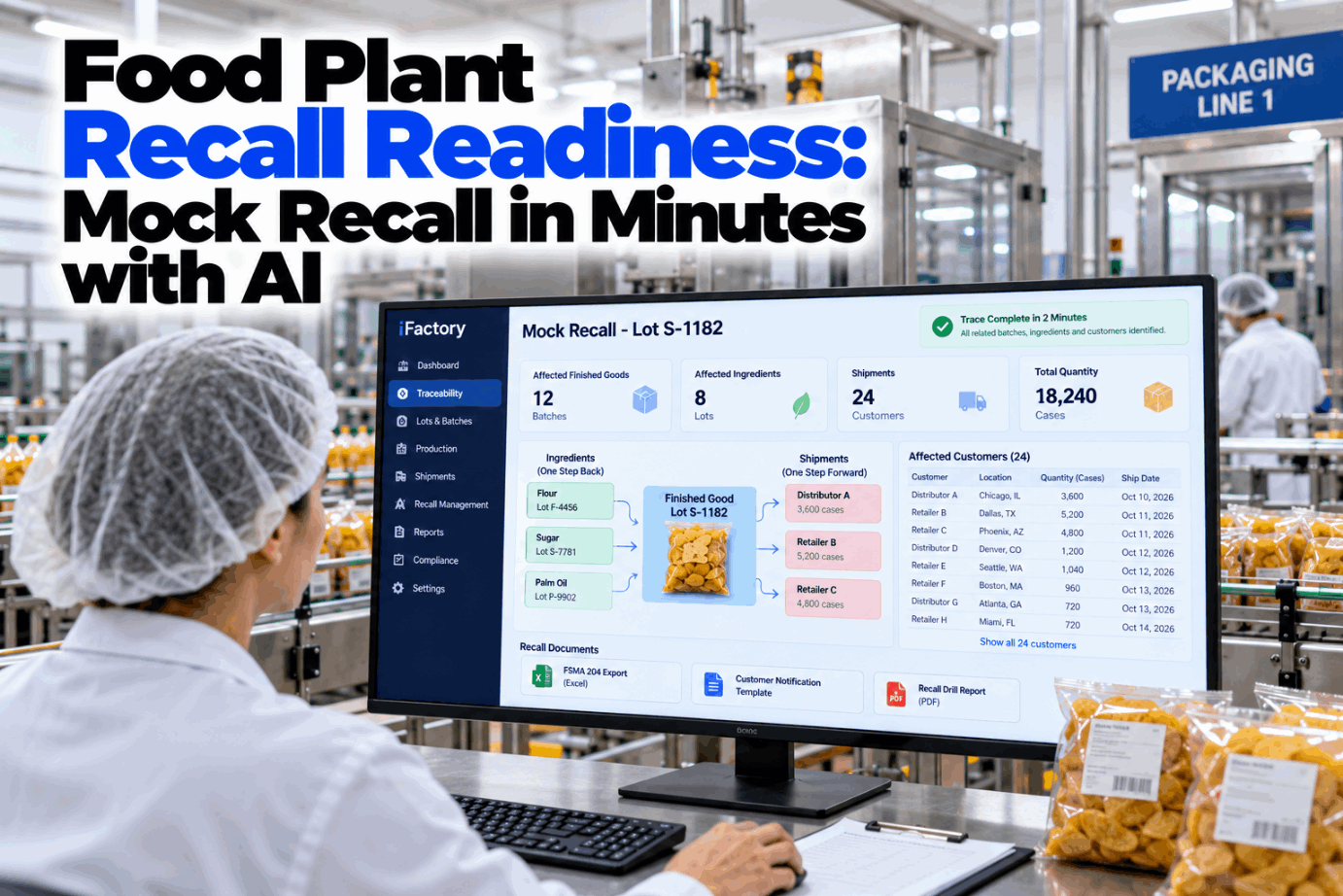
When a supplier calls about a bad ingredient lot, the first question is simple: where did it go? In many plants the answer still means pulling receiving logs, batch sheets and shipping records by hand while the clock runs. A traceability agent answers it from one request, tracing the lot back to its source and forward to every batch, case and customer. See a full drill on sample plant data in a short mock recall demo.
Say the Lot Number, Get Every Batch, Case and Customer
With the iFactory Traceability Agent, one spoken or typed request returns all affected batches and customers. It also builds the FSMA 204 sortable spreadsheet, so a mock recall becomes a short drill instead of a lost afternoon.
Three US Rules Behind Every Mock Recall
A mock recall tests more than one rule at once. The recall plan sits in your food safety plan, which a PCQI must prepare or oversee. The Bioterrorism Act records rules set the basic one-step-back, one-step-forward trace. The Food Traceability Rule adds detailed records for listed foods. Check which rules apply to each product with our compliance team.
The original date was January 20, 2026. FDA proposed moving it to July 20, 2028 in August 2025, and in November 2025 Congress directed FDA not to enforce the rule before July 20, 2028.
One Step Back, One Step Forward, and the Gap in the Middle
The one up, one down rule covers what crosses your dock. Most failed mock recalls break inside the plant, where an ingredient lot is split across batches, blended into rework or carried over between runs. If those internal links are not recorded, the trace stops at the receiving dock, and the only safe answer is to recall everything made in that period. Show us where your links are weakest in a trace review.
The Key Data Elements a Food Plant Must Hold
For foods on the Food Traceability List, such as soft cheeses, shell eggs, nut butters, fresh-cut produce and ready-to-eat deli salads, the rule asks for key data elements at each critical tracking event. A manufacturer mostly records three events. Transformation is where a new traceability lot code is assigned. The matrix shows each event, its data and where gaps tend to appear. Map your records against it with our traceability team.
How the Agent Answers "Trace Lot S-1182"
The agent reads the records you already keep in ERP, WMS, MES and batch sheets, and walks the links between them. It doesn't guess a missing link. Where one is missing, it marks the gap and keeps going, because finding gaps is the real point of a drill. Each step is logged so QA can check the work. Watch the full walk on sample data in a traceability walkthrough.
A Drill You Can Start From the Plant Floor
Ask for a trace in plain words. The agent confirms what it heard and whether this is a drill, then returns the batches, customers and quantities. Nobody is contacted unless people decide to.
Class I, II or III: What Changes and Who Decides
FDA assigns a recall class based on its health hazard evaluation under 21 CFR 7.3(m). The class shapes how fast and how deep the recall must go, but the trace data you need is the same for all of them. The agent never classifies a recall, decides scope or contacts customers. It gives people the facts to do that quickly. Plan your notification steps with our recall planning team.
Mass Balance: The Check That Proves a Trace Is Complete
Finding the customers is half the test. The other half is proving that every kilo or case is accounted for, whether it was used, shipped, stocked, sampled or scrapped. A trace that finds the right lots but can't balance the quantities is not complete. The example uses assumed figures to show the arithmetic. Run a balance on your own lot in a drill session.
Run the same balance on each finished lot: cases made against cases shipped, on site, held as retains and destroyed. A shortfall points to a record gap, not a rounding error.
How Often to Drill, and What to Measure
SQF requires the withdrawal and recall procedure to be reviewed and tested at least annually, and SQFI must be told within 24 hours of a real recall. BRCGS Food Safety Issue 9 requires a traceability test at least annually, achievable within 4 hours as guidance, and an annual incident management test that covers recall. Treat those as the minimum. Set your drill plan with our support team.
A Mock Recall Record You Can Reuse
Auditors want to see what was tested, how long it took and what you fixed. Keep one record per drill with these fields, whether the trace is run by hand or by the agent. The agent fills most of them as it works, and QA completes the rest. Get a blank version in a records walkthrough.
Three Drill Scenarios, Illustrated
Vary the starting point from drill to drill, because each one tests a different part of the chain. An ingredient start tests receiving and batch links. A line and date start tests production records. A packaging start tests whether pack materials are recorded at all. These are illustrations of how a drill typically runs, not case studies. Ask our support team to load your own scenarios.
Traceability Agent, Connectors and AI Server in One Package
iFactory delivers the Traceability Agent as a turnkey bundle. A pre-configured NVIDIA AI server ships racked and ready with the agent, voice requests and connectors to your ERP, WMS and MES pre-loaded, so lot data stays on site. You rack it, plug in power and Ethernet, and the AI is live. To scope it for your plant, request a turnkey quote.
- Pre-configured NVIDIA AI edge server, racked and ready
- Connectors for ERP, WMS, MES and scanned batch sheets
- Lot links for receiving, batches, rework and shipping
- Spoken or typed trace requests with confirm-back
- FSMA 204 sortable spreadsheet in FDA's suggested layout
- Mock recall records, mass balance and gap lists
- 24×7 remote monitoring of the agent and hardware
Server installed, lot records connected, internal links mapped from receipt to shipment.
Traces run on past lots and checked against manual results, gaps listed and fixed.
A full mock recall run with the recall team, records signed, drill plan set for the year.
Recall Readiness Built on the Records You Already Keep
iFactory doesn't ask you to change your ERP or WMS. It links the records you have and shows where they break. Our support team can walk you through a pilot plan.
What Plant Managers Ask About Mock Recalls
Know Where Every Lot Went Before Anyone Asks
Connect your lot records, run a drill on any lot by voice and fix the gaps before a real recall finds them. The full system is delivered turnkey and goes live in 6 to 12 weeks.