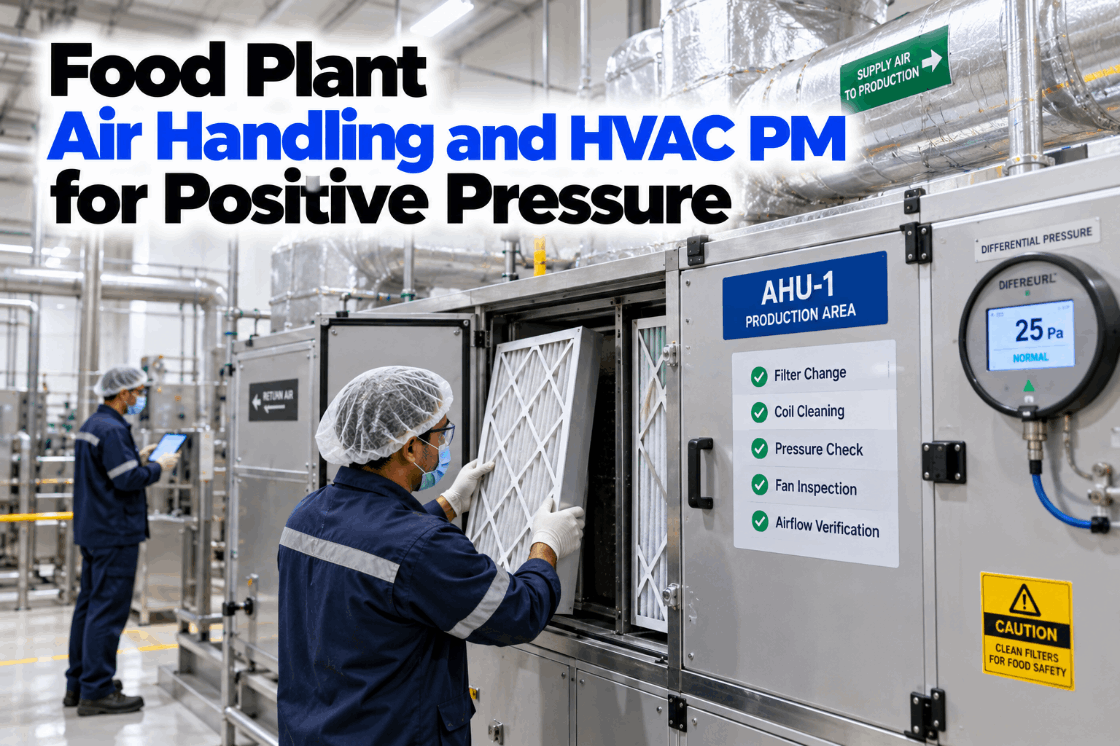
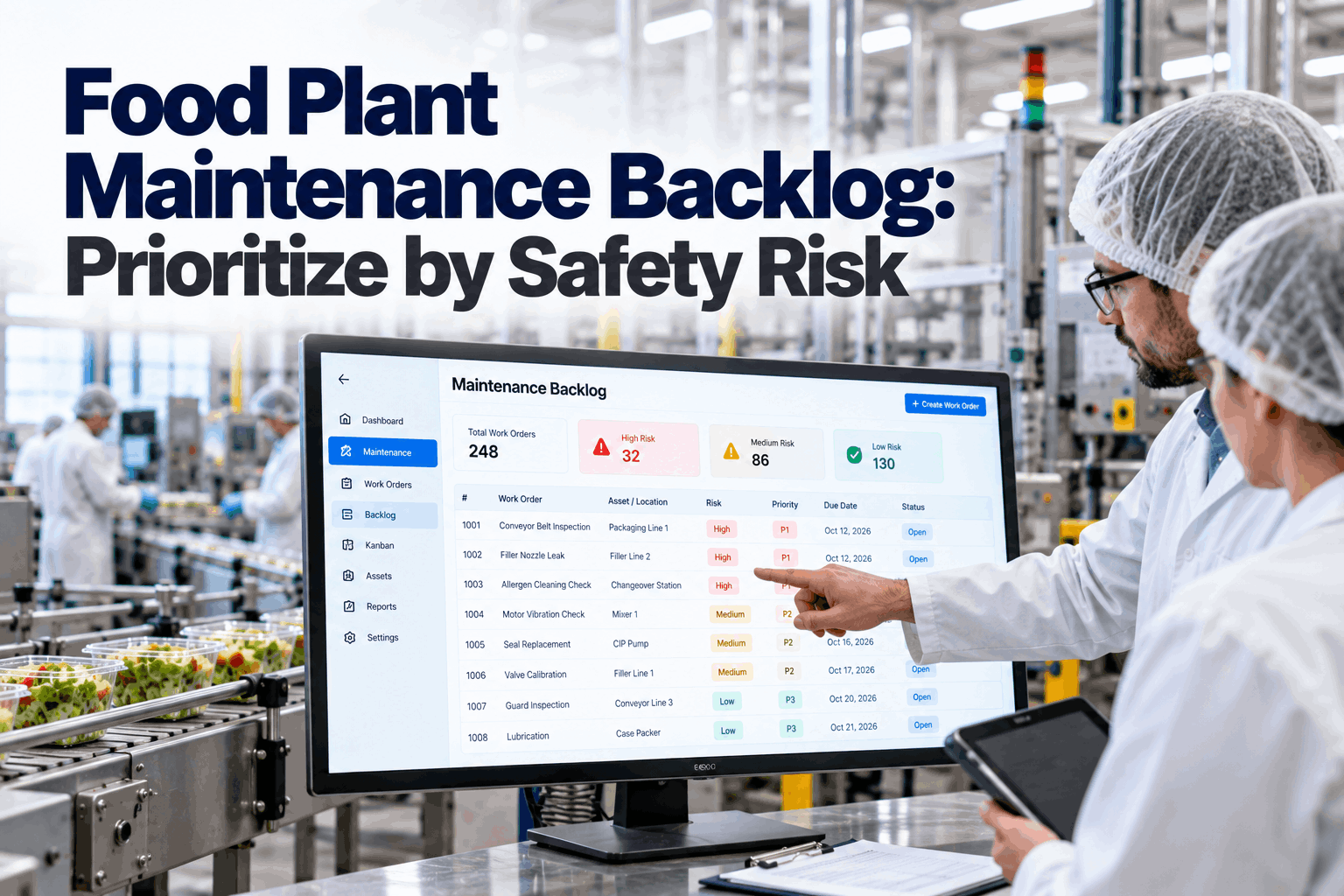
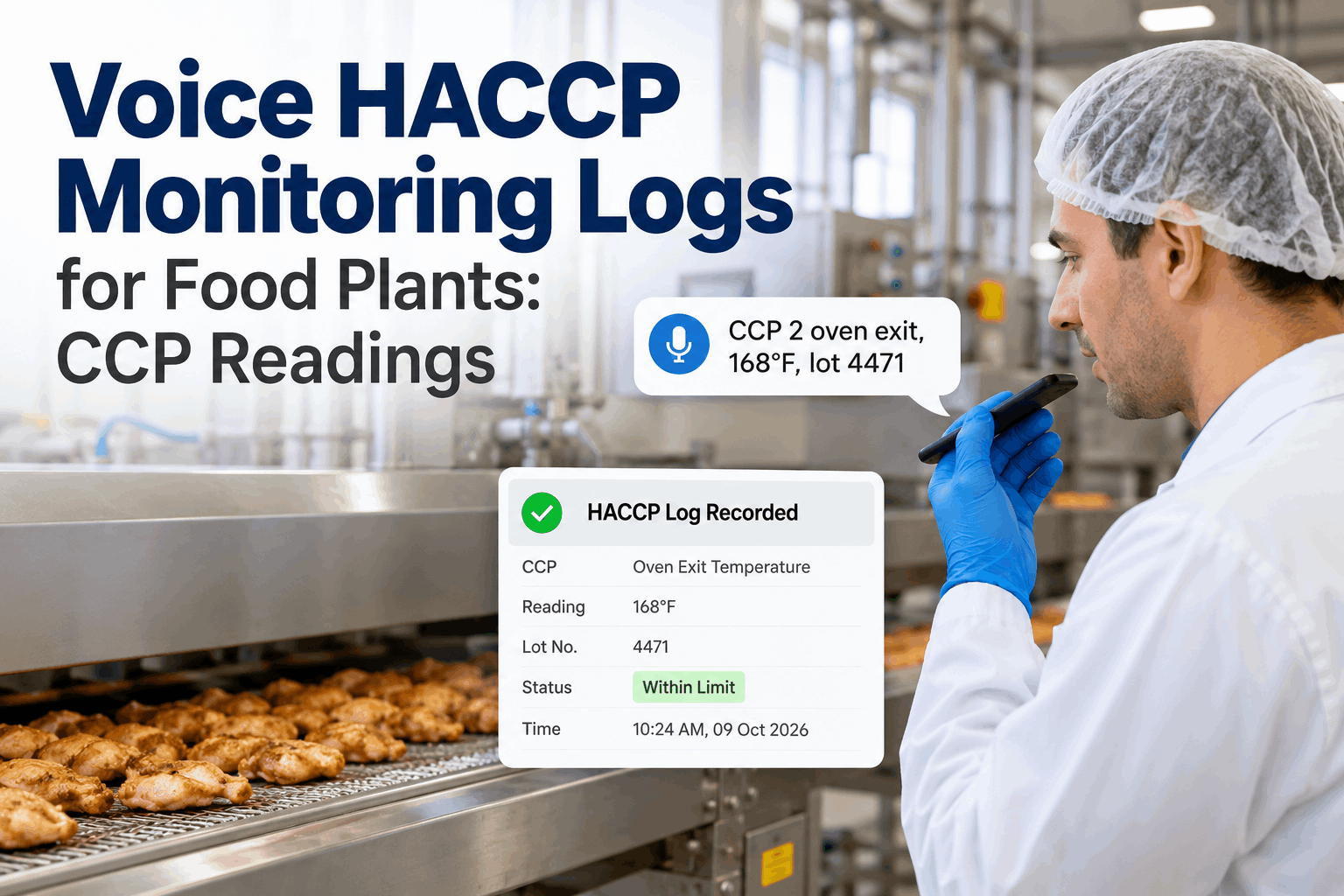
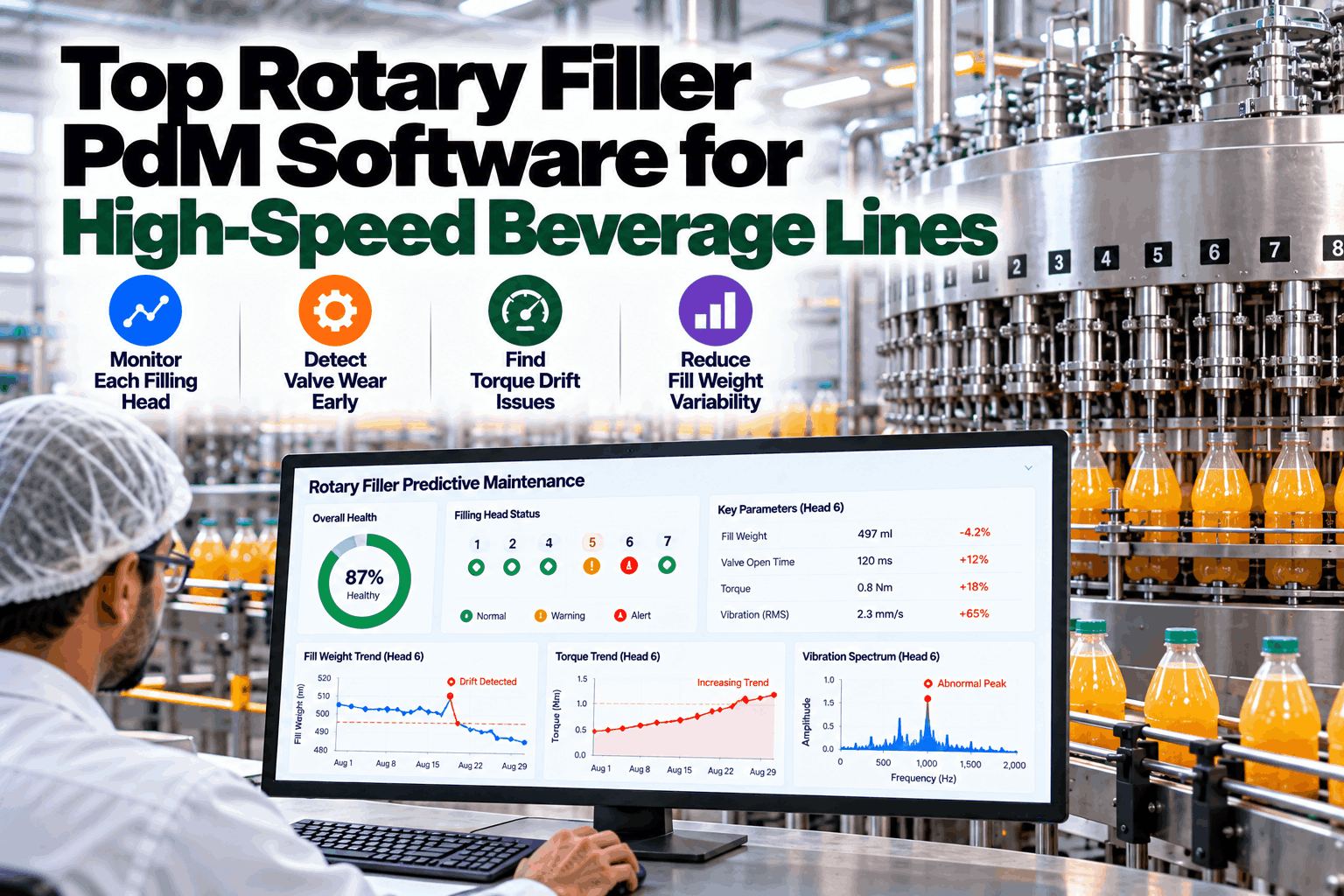
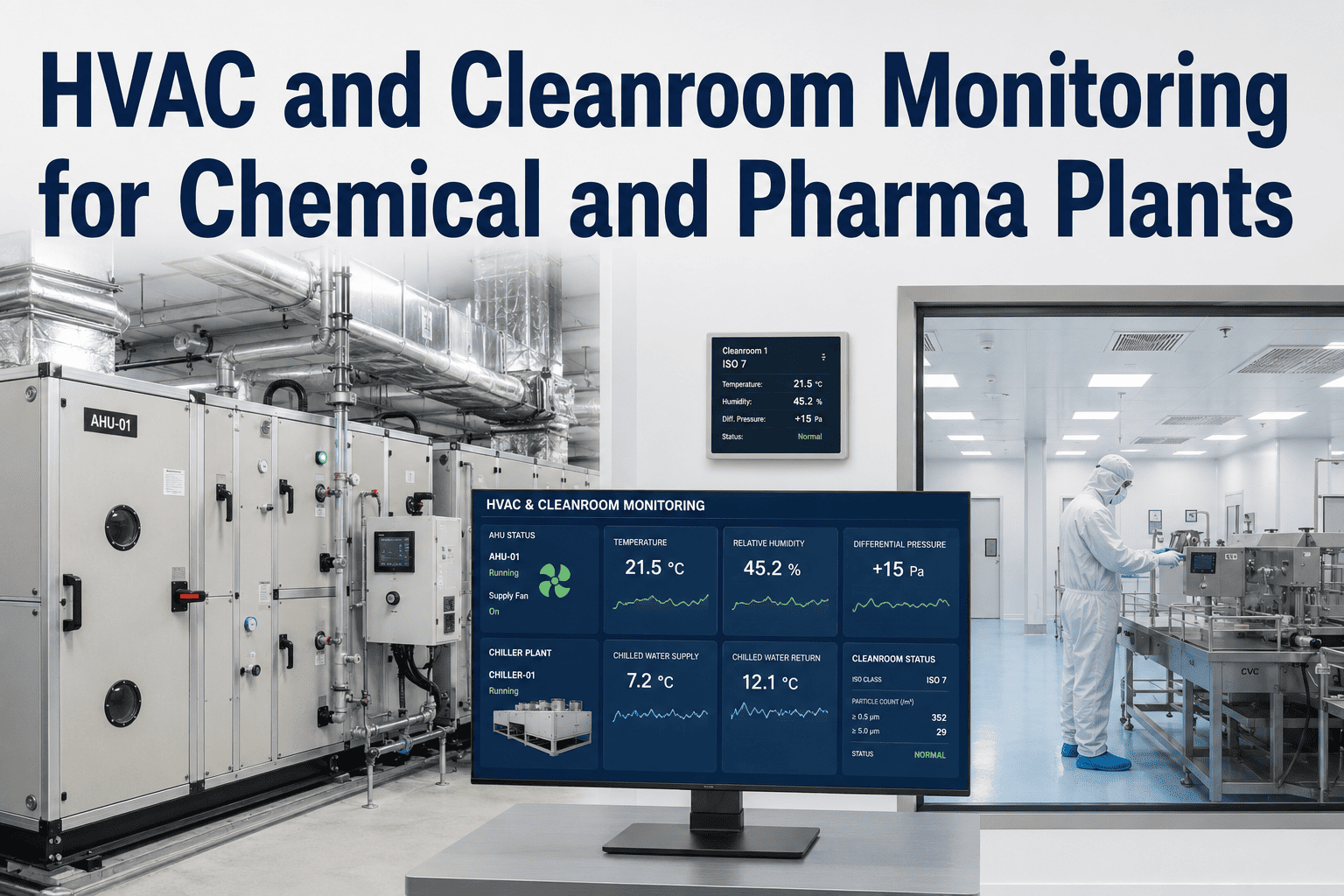
In a high-care or high-risk room, the air is part of the hygiene barrier. If the room loses positive pressure, air from a dirtier area can carry contamination in. If a coil pan holds water, or a ceiling sits colder than the dew point, the HVAC system itself can drip onto open product. Food plant HVAC PM keeps the pressure cascade, the filters and the coils working as one barrier. See it in a short pressure monitoring demo.
PM + PRESSURE MONITORING · HIGH CARE AIR
Hold the Pressure Cascade, Change Filters on Need and Stop Ceiling Drips
iFactory reads room differential pressure sensors, raises filter changes when filter pressure says so and warns when a surface nears the dew point. Coil inspections are logged by voice, so high-care rooms stay protected between audits.
High-risk room HR-2 · AHU-4Cascade OK
Live room view · Sanitation window tonight
Room vs high carePositive, inside plant band
Final filter pressureNear change point
Ceiling dew point marginNarrowing after washdown
Coil and drain pan checkDue today
Voice log · AHU-4 · 07:40"AHU-4 coil clean, drain pan dry, trap flowing."
POSITIVE PRESSURE ROOM
The Pressure Cascade From High Risk to Outside
Air should always move from the cleanest room toward the least clean. BRCGS Food Safety Issue 9 requires high-risk areas to receive sufficient changes of filtered air, with the filter specification and air change frequency documented in a risk assessment that covers positive pressure relative to surrounding areas. FDA's draft Listeria guidance also recommends positive pressure on the ready-to-eat side. The pressure steps themselves are plant-defined by design and validation. Map your cascade in a room pressure review.
High risk
Highest pressureFiltered air supply, positive to every neighbouring roomHigh care
Positive to low riskFiltered air, with pressure set by the risk assessmentLow risk
Lower pressureAir leaves high care and flows toward these areasDocks and outside
Reference pointDoors, docks and openings where the cascade is most often lost
Plant-defined targets
Write each room's target band and alarm limit into the PM system. Common reasons for lost pressure are doors held open, loaded filters, slipping fan belts and extract fans added without rebalancing the system.
HEPA FILTER FOOD
Filter Classes and What Each Standard Means
Filter names vary by standard. ISO 16890 groups general ventilation filters by the particle sizes they capture, MERV ratings come from ASHRAE 52.2, and EN 1822 grades high-efficiency filters by their efficiency at the most penetrating particle size. Many plants use HEPA as the final stage for high-risk rooms, but the right specification is the one your risk assessment documents. Match filters to rooms with our HVAC team.
ISO
ISO 16890Groups ePM1, ePM2.5, ePM10 and Coarse, by the particle size range captured
MERV
ASHRAE 52.2MERV 13 sits roughly with the former EN 779 F7 class, MERV 14 with F8
E10–E12
EN 1822 EPA classesAt least 85%, 95% and 99.5% efficiency at the most penetrating particle size
H13–H14
EN 1822 HEPA classesAt least 99.95% and 99.995% efficiency at the most penetrating particle size
DIFFERENTIAL PRESSURE MONITORING
Change Filters When the Pressure Says So
Every filter bank should have a pressure gauge or transmitter across it. As a filter loads, its pressure differential rises, and the maker gives a recommended final value for change. Calendar changes waste good filters or leave loaded ones in place. A sudden fall matters too: it can mean a torn filter or a seal that lets air bypass. Set your change points in a short demo.
Clean
Initial reading recorded when the filter is fittedLoading
Rising steadily, no action needed yetPlan change
Nearing the maker's final value. WO raised for the next windowChange now
At or past the final value, fan struggling to hold airflowBypass suspect
Sudden fall in pressure. Inspect for a tear or seal gap
Room Pressure Alarms That Name the Cause
iFactory reads room and filter pressures together, so a falling room pressure is linked to its likely reason: a loaded filter, a door left open or a fan running slow. The right person gets the right job.
High risk · Maintenance lead and iFactory
Maintenance leadHR-2 went below its band at 10:20. What happened?
iFactoryThe dispatch door to high care was open for 6 minutes. Pressure recovered when it closed. Filters and fan speed were normal.
Maintenance leadAnd the dip at 14:00?
iFactoryDifferent cause. The AHU-4 final filter is near its change point and the fan is at full speed. Filter change WO raised for tonight's sanitation window.
CEILING CONDENSATION RISK
Dew Point: The Number Behind Ceiling Drips
Under 21 CFR 117.20(b)(4), plants must be built so that drip or condensate from fixtures, ducts and pipes does not contaminate food, food-contact surfaces or packaging. Condensation forms when a surface is colder than the dew point of the air around it. Washdown steam and door openings raise the dew point, while chilled ceilings, ducts and pipes sit close to it. iFactory compares room humidity with surface temperatures and warns before the margin closes. Review your cold rooms with our support team.
Room air temperature10°C, assumed
Relative humidity after washdown80%, assumed
Dew point, Magnus approximationAbout 6.7°C
Chilled duct surface temperature6.0°C, assumed
Margin to dew point6.0 − 6.7 = −0.7°C, the duct will sweat
A margin at or below zero means condensate is already forming. Plants usually set a warning margin above zero, chosen in their own risk assessment, so action starts before the first drip. FDA's draft Listeria guidance also advises keeping rooms as dry as possible.
COIL CLEANING
Coils, Drain Pans and Traps: Where Listeria Can Hide
Cooling coils pull water out of the air, and that water has to leave. A drain pan that holds water, a blocked trap or a dirty coil gives Listeria a wet place to grow inside the air system. FDA's draft Listeria guidance asks for refrigeration condensate to drain to a sanitary drain with an air gap, and for a cleaning schedule for hoses and drip pans. In a high-risk AHU, coil cleaning is a hygiene event, not just a repair. Plan it in a PM planning session.
1PlanBooked into a sanitation window, product removed or covered
2IsolateAHU locked out, downstream filters protected from spray
3Clean coilApproved cleaner, rinsed until the water runs clear
4Pan and trapPan cleaned and sanitised, slope and trap flow confirmed
5VerifySwabs taken where your environmental plan calls for them
6RecordVoice log with photos against the work order
HIGH CARE AIR
What the Rules and Guidance Say About Plant Air
Air handling sits under food safety rules, not just building services. The references below are the ones auditors most often connect to HVAC upkeep. Each one maps to a set of PM tasks and records, which is where a pressure-led program earns its keep. Check your own mapping with our food safety team.
FOOD PLANT HVAC PM TEMPLATE
Monthly AHU and Room Checklist for High-Care Areas
Use this checklist as a starting point and adjust the tasks and intervals to your AHU maker and site risk assessment. Tick the boxes here, or speak each item on a voice round so the answers land in the work order. Any failed item should raise a WO before the round closes. See it on your own units in a checklist walkthrough.
FOOD PLANT HVAC PM EXAMPLES
Three Illustrations From High-Care Rooms
These examples show how pressure-led PM usually plays out. They are illustrations, not case studies, and the right response always follows your own procedures. Talk through your own rooms with our HVAC team.
Pressure dips at shift change
A door, not the AHUTrends matched each dip to the dispatch door. A door alarm and closer fixed it without touching the fan.Filter pressure fell overnight
Torn bag filter foundThe sudden fall flagged a bypass. The filter was changed and the duct downstream checked before production.Drips over a slicer
Uninsulated chilled pipeThe dew point margin closed after every washdown. Insulation was repaired and extract run time extended.
FOOD PLANT HVAC PM IMPLEMENTATION GUIDE
Five Steps to Pressure-Led HVAC PM
Most plants already have AHUs, filters and some pressure gauges. The step change comes from reading them continuously and tying every PM to a reading. Plan the first rooms in a planning session.
1
Map rooms and AHUsWhich unit serves which zone, and the order of the pressure cascade.
2
Set plant-defined bandsRoom pressure targets and alarm limits from design and validation records.
3
Fit and check sensorsRoom and filter pressure transmitters, checked against a reference gauge.
4
Link PMs to readingsFilter changes from filter pressure, coil checks from humidity and run hours.
5
Review every monthQA and maintenance look at pressure, filter and condensation records together.
FOOD PLANT HVAC PM BEST PRACTICES
Six Measures Worth Reviewing Every Month
Record a baseline for each one before go-live, then review them monthly with QA, sanitation and maintenance in the same room. Each group controls part of the result. Ask our support team to help set the baseline.
Time below pressure bandMinutes per room per week outside the plant-defined band
Filter changes on needShare of changes triggered by filter pressure, not the calendar
Condensation alertsDew point warnings by room, and how fast they were closed
Coil and pan PMs on timeHigh-risk and high-care AHU hygiene tasks done as planned
Sensor checks currentRoom and filter pressure sensors checked within their interval
Swabs near air systemsEnvironmental results at diffusers, pans and drains over time
TURNKEY AI DEPLOYMENT
Pressure Sensors, PM Logic and NVIDIA Server in One Package
iFactory delivers PM and Pressure Monitoring as a turnkey bundle. Room and filter pressure sensors, humidity and surface temperature inputs are connected, and a pre-configured NVIDIA AI server ships racked and ready with cascade and condensation models pre-loaded. You rack it, plug in power and Ethernet, and the AI is live. To scope it for your rooms, request a turnkey quote.
What's Included
- Pre-configured NVIDIA AI edge server, racked and ready
- Room differential pressure sensors and links to existing ones
- Filter pressure transmitters on every AHU bank
- Filter change WOs driven by filter pressure
- Condensation risk alerts from dew point margins
- Voice-logged coil and drain pan inspections
- 24×7 remote monitoring of models and hardware
Live in 6–12 weeks
Wk 1–4
Map and Install
Rooms, AHUs and cascade mapped, sensors fitted and checked, server installed.
Wk 5–8
Baseline and Tune
Pressure bands and dew point margins set with QA, alerts run silently and reviewed.
Wk 9–12
Go-Live and Training
Alerts, filter WOs and voice inspections switched on, teams trained.
HOW iFACTORY FITS
Food Plant HVAC PM Software Built Around the Hygiene Barrier
iFactory treats air handling as part of food safety, with readings, PMs and records in one place. Our support team can walk you through a pilot plan.
1
Watches room pressure. Every high-risk and high-care room is read continuously against its band.
2
Changes filters on need. Filter pressure raises the WO, and a sudden fall flags a bypass.
3
Warns before drips. Dew point margins on chilled surfaces raise condensation risk alerts.
4
Logs coil checks by voice. Coil, pan and trap inspections are spoken, confirmed and filed.
1000+
Industrial clients running iFactory
99.9%
Platform uptime for round-the-clock rooms
6-12 wks
From racked server to live pressure alerts
FREQUENTLY ASKED QUESTIONS
What Plant Managers Ask About Food Plant HVAC PM
What is a positive pressure room in a food plant?
It is a room supplied with more filtered air than it loses, so air leaks outward through doors and gaps rather than inward. High-risk and high-care rooms are kept positive to the areas around them, so air from lower-risk areas cannot carry contamination in.
What differential pressure should high-care rooms hold?
BRCGS asks for positive pressure based on a documented risk assessment, but does not set one figure. Targets are plant-defined by the HVAC design and validated on site. What matters for maintenance is that each room has a written band, an alarm limit and a record that it was held.
Do high-risk rooms need HEPA filters?
BRCGS requires sufficient changes of filtered air for high-risk areas, with the filter specification documented in a risk assessment. Many plants choose an EN 1822 H13 or H14 final stage, but the specification should come from your own assessment of the air source and the product.
When should AHU filters be changed?
When the pressure differential across the filter reaches the maker's recommended final value, or sooner if the risk assessment says so. A gauge or transmitter on each bank makes this simple. A sudden fall in that reading should also trigger an inspection, since it can mean a tear or bypass.
Why do condensate drain pans matter for Listeria?
Standing water in a pan or a blocked trap is a wet harbourage inside the air system, close to where air enters the room. FDA's draft Listeria guidance asks for condensate to drain to a sanitary drain with an air gap and for drip pans to be on a cleaning schedule.
How do we start?
Start with one high-risk room and the AHU that serves it. Fit or connect room and filter pressure sensors, agree the pressure band with QA, add humidity and surface temperature for dew point and move filter changes onto pressure triggers. Our
support team can plan that pilot with you.
Keep Every High-Care Room Positive, Dry and Documented
Read room pressures continuously, change filters when they need it, catch condensation before it drips and log coil checks by voice. The full system is delivered turnkey and goes live in 6 to 12 weeks.
Example week summary · High-care air
Room pressuresRead against plant bands
FiltersChanged on filter pressure
CondensationDew point margins watched
Coil checksLogged by voice with photos
Every room traceable by pressure and time