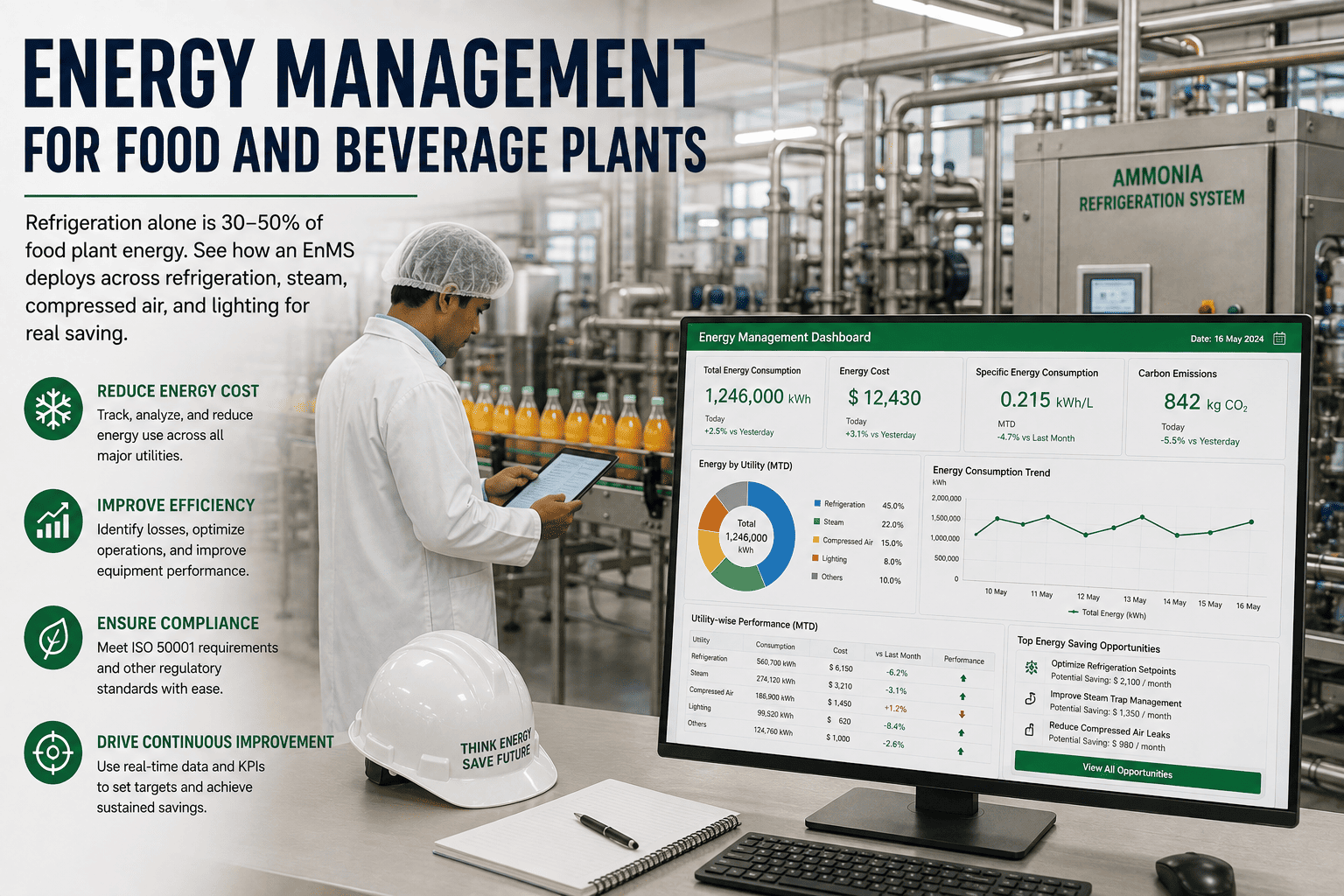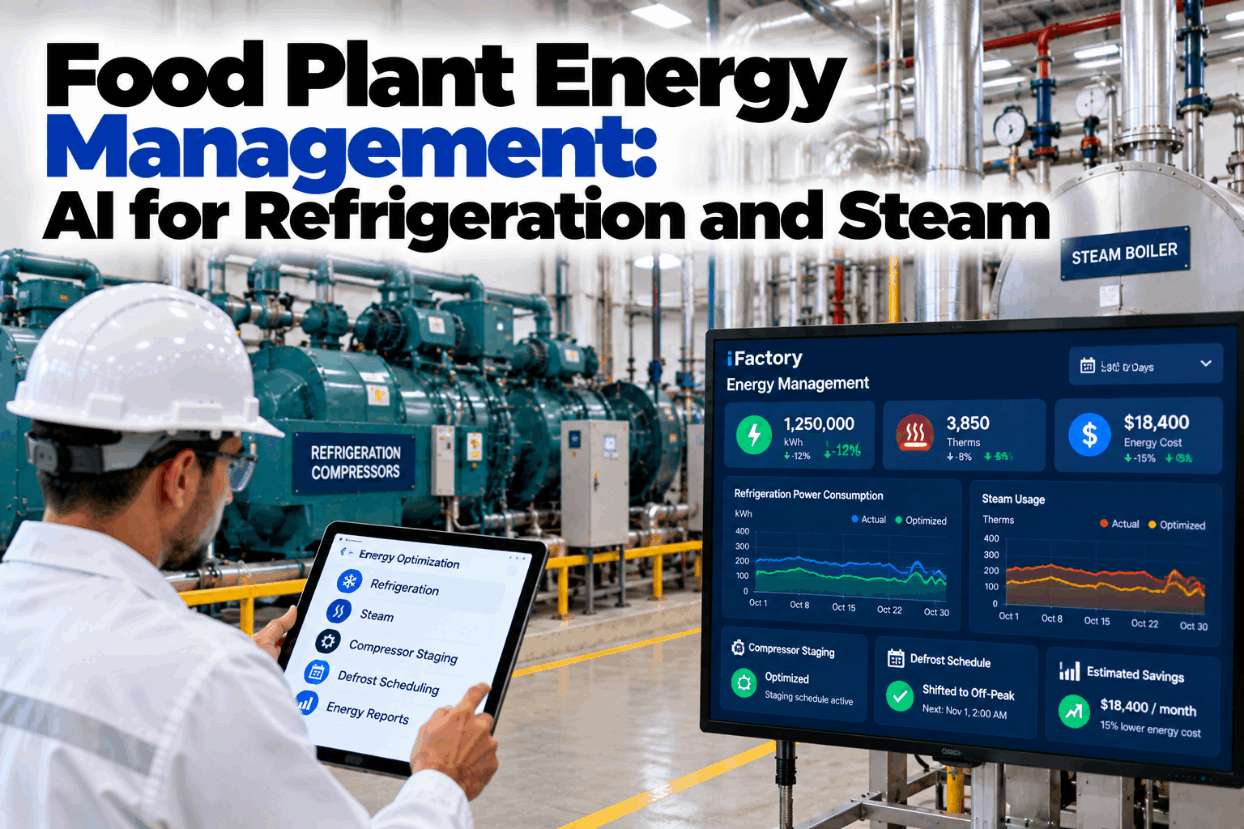
In most food plants, two systems decide the size of the utility bill: the refrigeration plant that chills and freezes product, and the boilers that raise steam for cooking, blanching, retorts and cleaning. Both often run on timers set years ago. An energy agent watches both loads against production and moves the controllable work, such as defrosts and compressor staging, out of the costly hours without touching product temperatures. See it on refrigeration and boiler data in a short energy agent demo.
Cut Refrigeration and Steam Cost Without Touching Product Temperature
iFactory Energy Agent tracks kWh and therms per unit produced, schedules defrosts and compressor staging away from peak hours, and reports savings when you ask by voice. Product temperature limits stay in charge of every move.
Refrigeration and Steam Set Most of the Bill
The ENERGY STAR guide for fruit and vegetable processing, written by Lawrence Berkeley National Laboratory from US manufacturing energy survey data, shows how lopsided the loads are. In canneries, about 80% of natural gas went to boilers for steam, and about a quarter of electricity went to process cooling and refrigeration. In frozen fruit, juice and vegetable plants, boilers took 78% of the gas and refrigeration took around half of the electricity. Your own split will differ by product, so measure it before you plan. Read your own meter data in an energy review.
Run Fewer Compressors, Closer to Full Load
Most screw compressors reduce capacity with a slide valve, and power does not fall in step with capacity, so two machines sharing a load at half capacity each waste energy. A DNV GL paper for ACEEE notes that screw compressors are more efficient at full load and that proper sequencing saves energy. A Control Engineering article by the refrigeration designer Stellar puts it more sharply: two equal compressors at 50% each can need 30% more horsepower. The fix is staging logic. Base machines run at full slide, and one trim machine, ideally on a variable speed drive, follows the load. Review your staging with our refrigeration engineers.
The right bands depend on machine sizes, which compressors have drives, suction groups and the maker's minimum speed. The agent learns them from your compressor data and proposes a sequence for your engineers to approve.
Defrost When the Coil Needs It, Not When the Clock Says
Most ammonia plants use hot gas defrost, which sends warm discharge gas through the coil. Every defrost puts heat into the room that the plant must then remove. A refrigeration guide prepared for the NSW Office of Environment and Heritage makes the point plainly: time-based defrosts run at fixed intervals regardless of conditions, while variable defrost spaces them by how hard the coil has worked. Timed defrosts also tend to land together, so several rooms recover at once, often in the afternoon peak. Plan a demand defrost trial in a defrost trial call.
The 15 Minutes That Set Your Demand Charge
Many industrial tariffs bill demand separately from energy. Reading Municipal Light Department, for example, defines demand as the highest kilowatts registered in any 15-minute interval in the billing cycle. Its tariff also carries a ratchet, so billed demand cannot fall below 80% of the previous summer's maximum. That means one bad quarter hour can cost money for months. In a food plant, the usual culprits are coincident defrost recovery, a blast freezer pull-down and boiler auxiliaries starting together. The worked example uses assumed inputs only. Run the sum on your own tariff with our support team.
It watches the running 15-minute average against a limit you set. When the average climbs, it holds the next defrost, delays a non-urgent pull-down or staggers a compressor start, always inside product temperature limits.
Ask Your Energy Question Out Loud
Ask the Energy Agent what changed, where and why. It answers with kWh and therms per unit, points to the cause and tells you what it has already moved.
Where Steam Energy Leaks Out of the Loop
On the gas side, losses hide along the steam loop rather than in one machine. US Department of Energy Steam Tip Sheet #1 says that in systems left 3 to 5 years without trap maintenance, 15% to 30% of traps may have failed, often letting live steam into the condensate return. Steam Tip Sheet #8 adds that returned condensate is usually 130°F to 225°F and can hold more than 10% of the steam's total energy. Condensate sent to drain wastes that heat, the water and its treatment chemicals. See which loop points to meter first in a steam loop review.
kWh per Pound and Therms per Pound, Worked Through
A monthly bill can't tell you whether the plant got better or just made a different product mix. Energy per unit can, if you measure it per line. The example below uses assumed figures for a plant with a frozen vegetable line and a canning line. Neither line changes its efficiency between weeks, yet the plant totals move a lot because the mix shifts toward the freezing line. That is why the agent reports per line first and plant second. Our metering team can help you build your own per-line view.
Plant kWh per pound rose about 11% and therms per pound fell about 14%, with no change on either line. Judge each line against its own target, and only compare plant totals at the same mix.
Save Energy Without Putting Product at Risk
Energy work in a food plant fails when it fights food safety or production. The habits below keep refrigeration energy savings and steam savings inside the limits that QA and operations already own. Talk these rules through in a planning session.
Prove the Savings Before You Report Them
Savings are never metered directly. They are the gap between what the plant used and what it would have used without the change. The International Performance Measurement and Verification Protocol (IPMVP) frames this as baseline energy minus reporting-period energy, plus or minus adjustments for things like production volume and weather. It offers four options, from measuring one system to modelling the whole site. The worked example uses an assumed baseline model. Agree your method with finance, with help from our support team.
A Weekly Energy Review on One Page
A short weekly review keeps energy in front of the people who can act on it. Fill in one sheet per line, read it out in the production meeting and send actions to maintenance. The Energy Agent fills most fields for you. See a filled example in a short demo.
Three Situations the Agent Handles Every Week
These are illustrations, not case studies. Walk through your own scenarios with our support team.
Energy Agent, Connectors and AI Server in One Package
iFactory delivers the Energy Agent as a turnkey bundle. A pre-configured NVIDIA AI server ships racked and ready, with the agent, the refrigeration and boiler connectors and the energy models pre-loaded, so control decisions are made on site. You rack it, plug in power and Ethernet, and the AI is live. To scope it for your plant, request a turnkey quote.
- Pre-configured NVIDIA AI edge server, racked and ready
- Connectors for refrigeration controls, boilers and the BMS
- Metering plan for compressors, boilers and main incomer
- Staging, defrost and demand limit rules set with your engineers
- Production counts linked for kWh and therms per unit
- Voice queries on headsets, handhelds and desktop
- 24×7 remote monitoring of models and hardware
Server installed, meters and controls linked, production counts mapped, data collection started.
Baseline model built, staging and defrost advice given in advisory mode for operators to approve.
Approved rules automated inside limits, voice queries switched on, verified savings reporting started.
Food Plant Energy Management Software That Answers by Voice
The Energy Agent is built for plants where refrigeration and steam carry the bill and product safety comes first. Our support team can walk you through a pilot plan.
What Plant Managers Ask About Food Plant Energy Management
Know Your Energy per Pound Every Week
Put refrigeration and steam under one agent, keep defrosts and compressor stages out of the peak and get verified savings when you ask. The full system is delivered turnkey and goes live in 6 to 12 weeks.