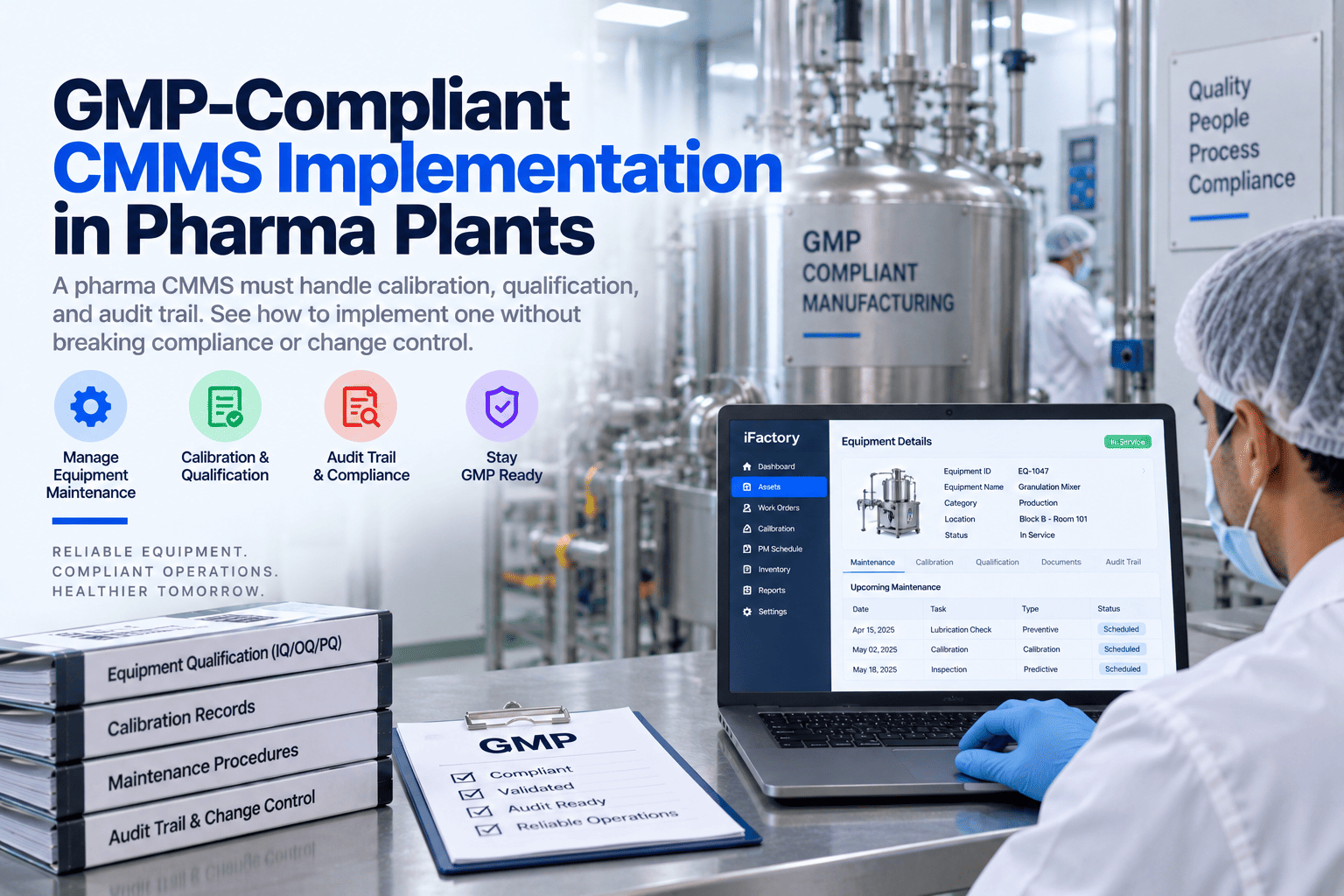
Implementing a CMMS in a pharma plant is a different animal, because the CMMS isn't just a maintenance tool that happens to sit in a regulated facility — it's a GxP system in its own right. The calibration records, the PMs on qualified equipment, the equipment logs it holds are the GMP evidence an FDA inspector will demand on arrival, with zero prep time. That reframes the project: the system itself has to be validated before it issues a single production work order, its 21 CFR Part 11 controls have to be live from day one, and every change after go-live is a controlled change. The real risk isn't downtime — it's ending up with an unvalidated system generating GMP records, a data-integrity finding waiting to happen. Get the sequence right and you reach a validated go-live in weeks, not a six-month project. You can book a demo to see a GMP-configured rollout.
A Pharma CMMS Is a Validated System, Not Just Work-Order Software
Calibration, equipment qualification, and a Part 11 audit trail make a pharma CMMS a GxP system that has to be validated before go-live. Here's how to implement one without breaking compliance or change control — and reach a validated go-live in weeks.
The Records Are Evidence, So the System Is Regulated
In an ordinary plant a CMMS is an efficiency tool. In a pharma plant its records are used to demonstrate GMP compliance — which makes the CMMS itself a regulated system subject to the same scrutiny as any electronic record. Understanding that shift is the whole basis for implementing it correctly. These are the things that make a pharma CMMS fundamentally different.
Because its records demonstrate GMP compliance, the CMMS has to be validated — documented evidence it functions as intended in your environment — before it issues a single work order in production. Validation isn't a follow-up task; it's a prerequisite to going live.
An FDA inspector requests calibration history, PM records, and equipment qualification status immediately on arrival, with no preparation time. The records have to be validated, audit-trailed, and retrievable at all times — compliant between inspections, not just during them.
A spreadsheet has no audit trail, no access controls preventing modification, and no system validation — so FDA inspectors consistently cite spreadsheet-based maintenance records as a data-integrity deficiency. A validated electronic system is the only defensible option for GMP records.
Once validated, the system can't just be "updated." Every post-validation configuration change is a controlled change with documentation and assessment, so change control has to be part of the implementation from day one, not added afterward.
What 21 CFR Part 11 Actually Requires of the System
Every FDA inspector evaluates the same four control areas when reviewing a maintenance system used in a GMP environment — and missing any one is a finding waiting to happen. These aren't abstract principles; they're specific, checkable technical controls the CMMS has to deliver. This is what Part 11 demands.
Documented evidence — typically a GAMP 5 Category 4 IQ/OQ/PQ package with a signed URS, functional spec, traceability matrix, and validation summary report — proving the system functions as intended in your specific production environment. This is the foundation the other three controls sit on.
Each signature uniquely attributable to one individual, displayed with printed name, timestamp, and signing meaning — Author, Reviewer, Approver — and permanently bound to the signed record. Logging in once and clicking through a session doesn't satisfy it; each signing action requires the signature.
A secure, computer-generated, time-stamped audit trail recording every change to a record — the old value, new value, who, when, and why — that users cannot alter for their own entries, retained as long as the record and available for the periodic review the standard expects.
Role-based access that ensures only authorized users perform their functions and that records can't be modified by anyone without the authority — the control that makes attribution and the audit trail meaningful rather than nominal.
21 CFR Part 11 and EU GMP Annex 11 define what has to be achieved to make a computerized system trustworthy — but they deliberately don't prescribe how. That gap is filled by GAMP 5, the ISPE guide that's the global standard for computer system validation done in a structured, risk-based way. A pharma CMMS is classified under GAMP 5 as Category 4 — configured product software: a commercial platform configured to your GxP use cases without bespoke source code, which is exactly the category that lets validation be efficient and vendor-supported rather than a ground-up custom effort.
Go Live Validated, With Part 11 Built In
iFactory delivers a pre-built GAMP 5 Category 4 validation package and native Part 11 controls — audit trail, bound e-signatures, access control — so the four control areas an inspector checks are satisfied before your first production work order.
The Maintenance Records That Are Also Compliance Records
What makes pharma maintenance GxP-critical is that specific records — calibration, qualified-equipment PM, equipment logs — directly support product quality and are inspected as compliance evidence. A pharma CMMS has to treat these as the regulated records they are, not ordinary work orders. This is the maintenance data that carries compliance weight.
Every GxP instrument's calibration schedule, results, and tolerance status tracked so nothing goes overdue — because an out-of-calibration instrument used in production triggers a batch investigation, a potential recall, and a 483 observation. Calibration is the highest-consequence record the CMMS holds.
Preventive maintenance on qualified equipment has to be scheduled, performed, and documented against the equipment's qualified state, so the asset stays in its validated condition and the PM record proves it did.
A complete electronic log per asset documenting PM, calibration, and cleaning-validation activity — the equipment-qualification evidence an inspector or a client audit asks to see, held as one retrievable record rather than scattered across binders.
When a calibration comes back out of tolerance, the impact on the instrument's prior use has to be assessed and documented — the CMMS routes it as an event, so a failed calibration triggers the investigation it requires instead of being quietly logged.
The Right Order: Validated Before a Single Production Work Order
The whole risk of a pharma CMMS rollout is doing it in the wrong order — issuing GMP work orders from a system that isn't yet validated. A properly sequenced implementation front-loads the compliance work so the system is validated, Part 11-active, and change-controlled before it goes live in production. This is the sequence that keeps the rollout from breaking compliance.
Classify which assets and records are GMP-critical, and produce a signed User Requirements Specification defining the system's intended use, user roles, data criticality, and the regulatory predicates it has to satisfy. Everything downstream traces back to this document.
Run the installation, operational, and performance qualification protocols against the URS — with a pre-built Category 4 package and vendor-supplied scripts, this is a scoped exercise rather than a ground-up validation, producing the test evidence and traceability matrix an inspector expects.
Design the work-order, calibration, and PM workflows for GMP use, turn on the audit trail and electronic signatures, and set role-based access — so the Part 11 controls are live before the first production record is created, not retrofitted afterward.
Import existing PM schedules and calibration registers to pre-populate the asset database, qualify the users who'll operate the system, and only then issue the first production work order — with change control already in place to govern every configuration change from that point on.
A Validated System Stays Validated Only If Changes Are Controlled
The most common way a validated CMMS quietly loses compliance is an uncontrolled change — a configuration tweak, a new workflow, a system update applied without assessment. Keeping the system in its validated state for its whole life is a discipline the implementation has to establish, not an afterthought. This is what a maintained validation lifecycle requires.
A post-validation change — a workflow edit, a new asset type, a permission change — goes through change control with an impact assessment and documentation, so a change that affects validated function is caught and re-tested rather than silently altering a validated system.
The URS, protocols, and traceability matrix are maintained as the system evolves and as vendor updates arrive, so the validation package always reflects the system as it actually runs — not as it was two years and several changes ago.
The audit trail is reviewed on a schedule for anomalies and unusual patterns, and each review documented, because Part 11 expects not just that an audit trail exists but that it's actively reviewed — a step plants often build the trail for and then never do.
The full CSV package — URS, protocols, test evidence, traceability matrix, change records — stays assembled and exportable, so producing it for an FDA, EMA, or MHRA inspection is a fast retrieval, not a scramble to reconstruct a validation history.
Validated, Part 11-Ready, Change-Controlled From Day One
iFactory implements a pharma CMMS as a GxP system from the start: a pre-built GAMP 5 Category 4 validation package, native Part 11 controls, calibration and qualification management, and change control built in — so the rollout reaches a validated go-live in weeks and the system stays compliant for its whole life, not just at launch.
What Pharma Maintenance Teams Ask About CMMS Implementation
Implement a Pharma CMMS Without Breaking Compliance
iFactory delivers a validated, Part 11-ready, change-controlled CMMS with pre-built GAMP 5 packages and native calibration and qualification management — so you reach a validated go-live in weeks and stay inspection-ready every day after.