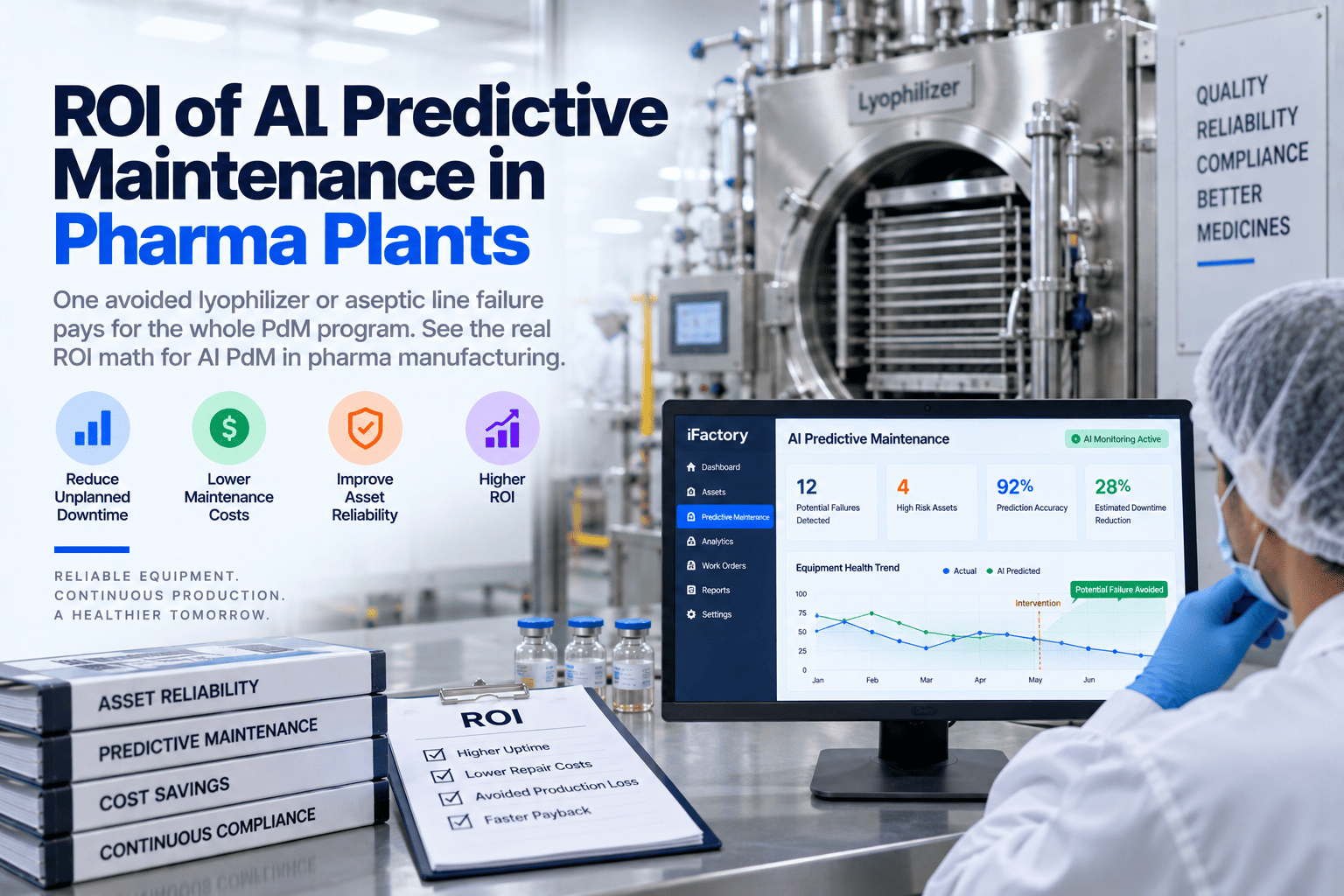
Most pharma PdM business cases get rejected for the same reason: they're modeled wrong. The instinct is to justify predictive maintenance the way every other industry does — by the downtime it avoids. But in pharma that's the smallest driver, because pharma assets run intermittently with large planned-maintenance windows that already absorb most of what would be unplanned downtime elsewhere. So the avoided-downtime number comes out small, the ROI lands at a limp one-to-two-times, and Finance says no. The real value lives in the drivers that don't exist in other industries — the avoided batch loss and the avoided GMP deviation — and those are enormous. A single failure mid-batch can destroy a batch worth five hundred thousand to five million dollars and trigger an investigation costing six figures on its own. Disaggregate those drivers honestly and the ROI comes out at a real three-to-seven-times. You can book a demo to model it on your equipment.
One Avoided Lyophilizer or Aseptic-Line Failure Pays for the Whole Program
The standard "avoided downtime" model undersells pharma PdM and gets it rejected. The real ROI is in avoided batch loss and avoided GMP deviations — drivers that make a single prevented failure pay for the entire investment.
Collapsing Everything Into "Avoided Downtime" Kills the Business Case
The single biggest modeling mistake in pharma PdM is collapsing all the value into avoided downtime because it's the easiest number to estimate. That collapse produces ROI in the one-to-two-times range that doesn't justify the investment — and it's not that PdM has poor returns in pharma, it's that the model is measuring the wrong thing. Understanding why is the whole basis of a defensible case.
Pharma manufacturing isn't optimized for asset utilization the way discrete manufacturing is — many assets run intermittently, with large planned-maintenance windows that absorb a big share of what would be unplanned downtime elsewhere. So the avoided-downtime number is materially smaller here by design.
Avoided downtime is the easiest driver to estimate, which is exactly why teams lean on it — and exactly why the resulting ROI is weak. Building the case on the one driver that's smallest in pharma is how a genuinely strong investment ends up looking marginal.
The pharma-specific value — avoided batch loss, avoided deviations, avoided re-qualification — is harder to estimate, so it gets omitted or buried. But those are the drivers that are actually large, and leaving them out is what produces the indefensible one-to-two-times number.
The work of separating the value into its real, distinct drivers — each estimated on its own — is what turns a one-to-two-times case into a three-to-seven-times one. And the higher number isn't inflated; the drivers underneath it are real, not invented.
Four Drivers, and the Big Ones Are Uniquely Pharma
A defensible pharma PdM business case breaks the value into its distinct drivers and estimates each honestly. Three of the four are far larger in pharma than in any other industry, which is exactly why the disaggregated model produces such different numbers. These are the drivers, roughly in order of size.
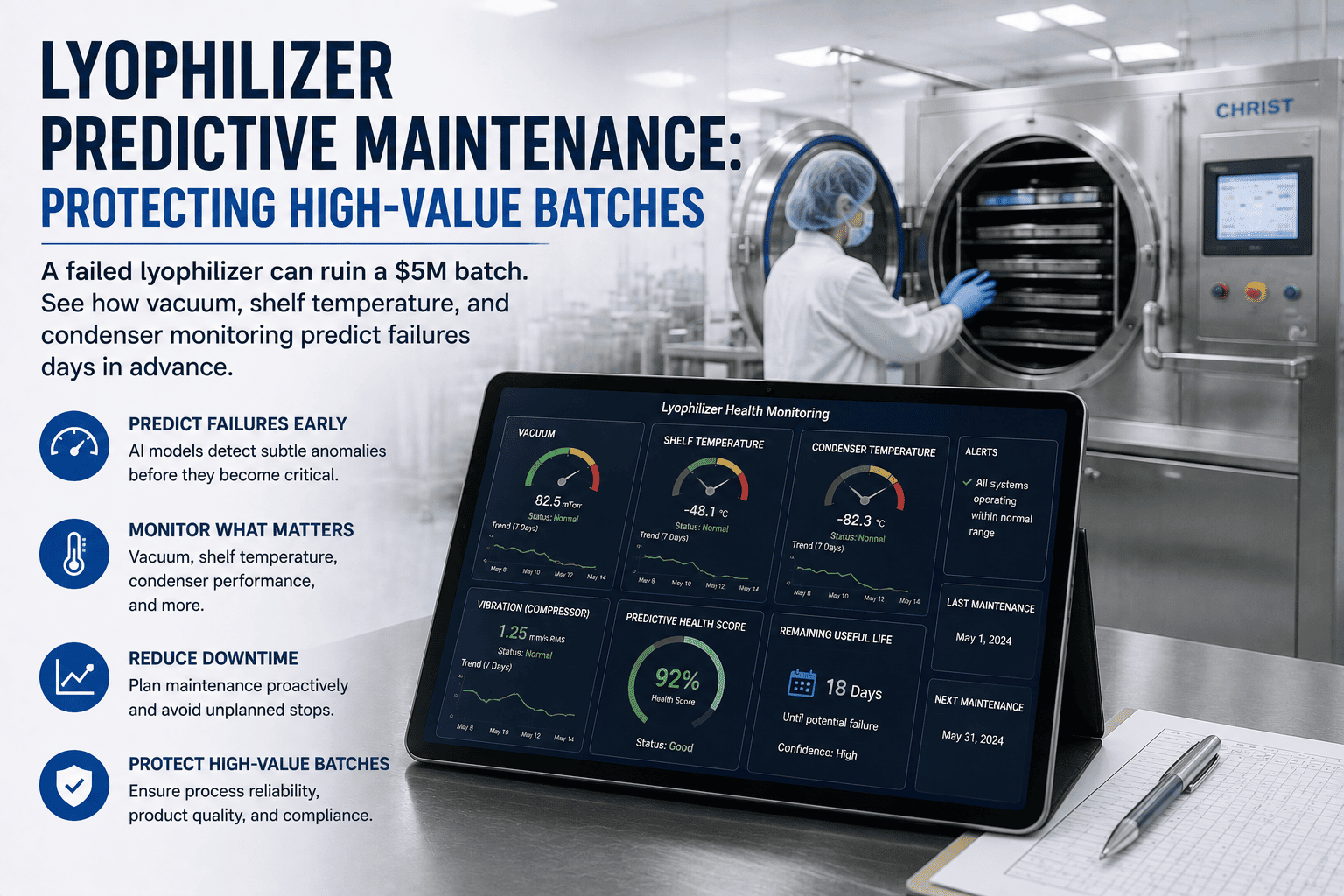
A failure mid-batch can destroy the entire run, and a pharmaceutical batch is worth between $500,000 and several million dollars for biologics and parenteral products — a lyophilizer batch failure alone runs from $500K on a small scale to over $5M for a commercial biologics run. This driver alone can dwarf the entire program cost from a single prevented event.
A deviation triggered by equipment failure isn't just a maintenance event — it triggers investigation, root-cause analysis, CAPA, a possible batch-impact assessment, and possible regulatory notification. The fully-loaded cost of a single significant deviation runs $100K to $500K, and frequent deviations hurt your inspection posture in ways that cost more downstream. This is often the largest driver and the least well understood.
The classic driver still counts — an unplanned GMP-equipment shutdown averages around $420,000 in lost production plus re-qualification, and aseptic filling-line downtime runs about $450,000 an hour. It's just smaller here relative to the batch and deviation drivers, so it belongs in the model as one line, not the whole case.
Condition-based intervention replaces calendar-based over-maintenance, cutting the labor, parts, and — critically in pharma — the re-qualification cost of touching validated equipment more often than its condition warrants. A recurring saving that compounds across the asset base.
Model the Drivers That Actually Justify PdM
iFactory builds the disaggregated business case on your equipment — batch loss, deviations, downtime, and over-maintenance each estimated on their own — so the ROI reflects the real three-to-seven-times return, not the collapsed one-to-two-times.
Why a Single Prevented Event Pays for Everything
The meta promise isn't marketing — it's arithmetic. When a batch is worth millions and a deviation costs six figures, the value of preventing one significant failure is on a completely different scale from the annual cost of a monitoring program. Walk the numbers on a single lyophilizer or aseptic-line save and the payback is obvious.
A mid-batch equipment failure in pharma isn't a single cost — it's the lost batch worth up to millions, plus the deviation investigation, plus potential product destruction, plus an FDA finding if the pattern indicates inadequate equipment control. The consequences stack.
Set the fully-loaded cost of one prevented mid-batch failure — batch plus deviation plus downtime — against the annual cost of the PdM program, and the single event typically exceeds the whole year's investment. That's the "one failure pays for it" claim, made concrete.
In one survey, 68 percent of pharma manufacturers running preventive maintenance alone reported at least one unplanned equipment failure per production cycle. The scheduled maintenance was done; the gap was between reactive troubleshooting and predictive intelligence. The events the model prevents actually happen.
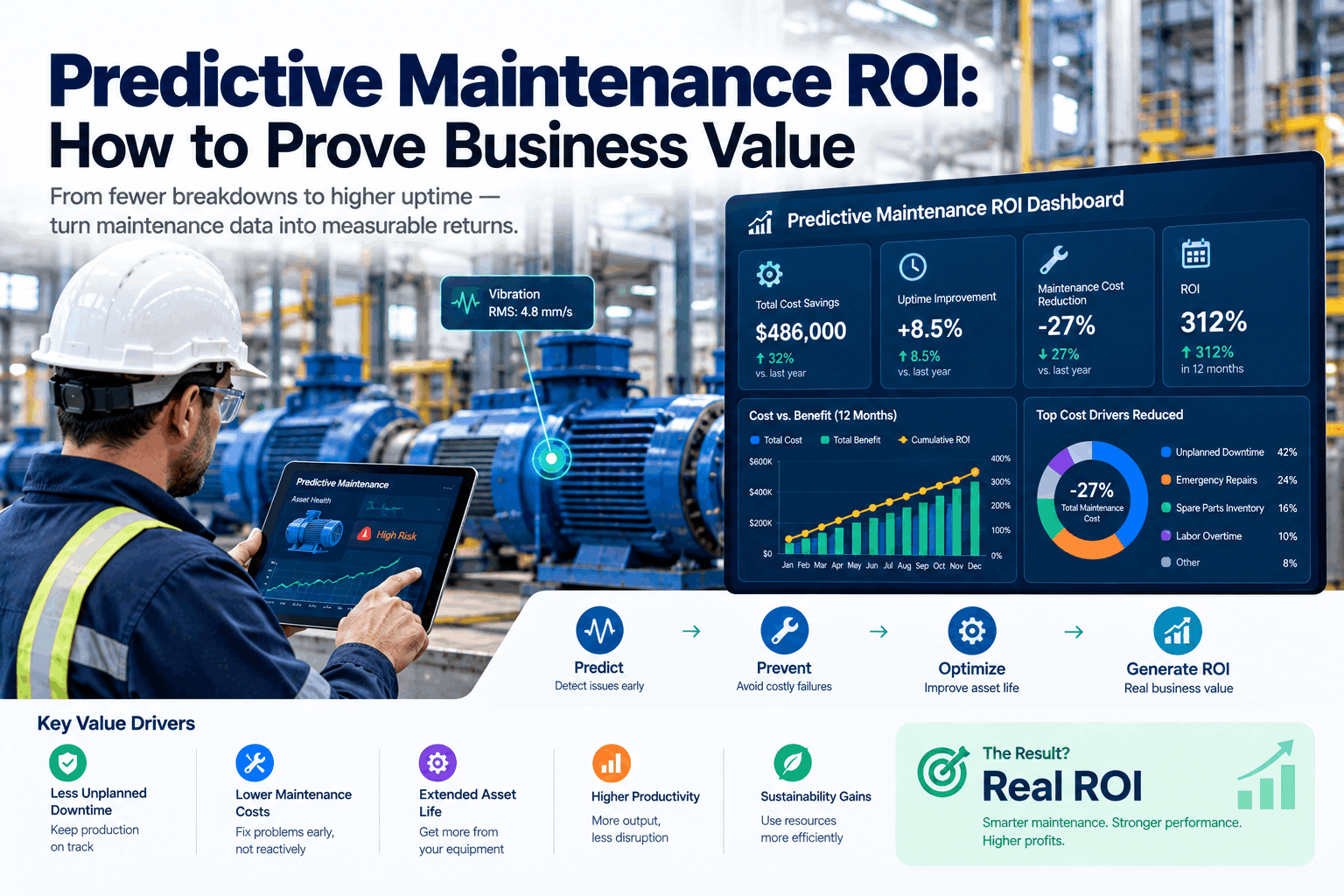
Once a single prevented failure has covered the program, every additional avoided deviation, every over-maintenance dollar saved, and every hour of downtime avoided is pure return — which is how the disaggregated ROI reaches three-to-seven-times over a year.
Catch the Degradation Early Enough to Fix It in a Planned Window
The ROI is only real if the failures are genuinely preventable in a way that avoids the batch and deviation cost — and that comes down to lead time. AI models detect the degradation signature early enough that the fix moves entirely outside the production window, into planned downtime, which is what turns a catastrophic mid-batch failure into a routine scheduled repair. This is how the value is actually captured.
Machine-learning models trained on pharmaceutical equipment detect the early signatures — bearing harmonics, winding-resistance change, seal wear, vacuum and condenser alarm patterns — with 48-hour or greater lead time, often 20 to 40 days, well before catastrophic failure.
With that warning, maintenance is scheduled during a planned window completely outside the production run — so the repair that would have destroyed a batch mid-process becomes a routine job done when nothing is at stake. The lead time is what converts the cost.
Sensor data, PLC telemetry, process-historian feeds, environmental monitoring, and operator shift observations feed one predictive model, so degradation is caught from whatever signal shows it first rather than a single sensor working alone.
On assets like lyophilizers, the pattern in vacuum, condenser, and shelf-temperature alarms over time is one of the most reliable predictors available — provided every alarm is logged with timestamp and disposition rather than just cleared from the panel, which the platform ensures.
The Assets Where the Business Case Is Strongest
Not every asset returns equally. The strongest business cases concentrate where the pharma-specific value drivers are largest — high batch value, high deviation risk, and a heavy planned-maintenance burden. Targeting these first is how a program proves its ROI quickly and earns the expansion. These are the highest-return candidates.
Long, high-value biologics runs where a mid-cycle failure destroys a batch worth up to $5M, and where alarm data is a rich predictive input — the archetypal case where one prevented failure pays for the program outright.
Fill-finish sits at the highest-risk intersection of cost and compliance, with downtime around $450K an hour and failure modes — pump-seal wear, tubing fatigue, needle drift — that are measurable precursors to batch loss and 483 observations.
Mixers, granulators, centrifuges, and bioreactors where a parameter deviation mid-batch ruins the run — high batch value plus high deviation risk makes their two largest drivers both large.
Equipment carrying heavy calendar-based PM and re-qualification is where the over-maintenance driver is largest, so condition-based intervention returns strongly even before counting a single avoided failure.
A Defensible Business Case, Delivered on Your Equipment
iFactory builds the pharma PdM case the way that actually justifies it — disaggregated value drivers estimated on your assets, degradation caught with weeks of lead time so failures are fixed in planned windows, and the maintenance record kept GMP-compliant throughout. The result is a three-to-seven-times return you can take to Finance, not a collapsed number that gets rejected.
What Maintenance Teams Ask About Pharma PdM ROI
Build the PdM Case That Finance Actually Approves
iFactory models pharma PdM ROI the right way — batch loss, deviations, downtime, and over-maintenance disaggregated on your equipment — and delivers the lead time to prevent the failures that pay for it, so one avoided lyophilizer or aseptic-line event covers the whole program.