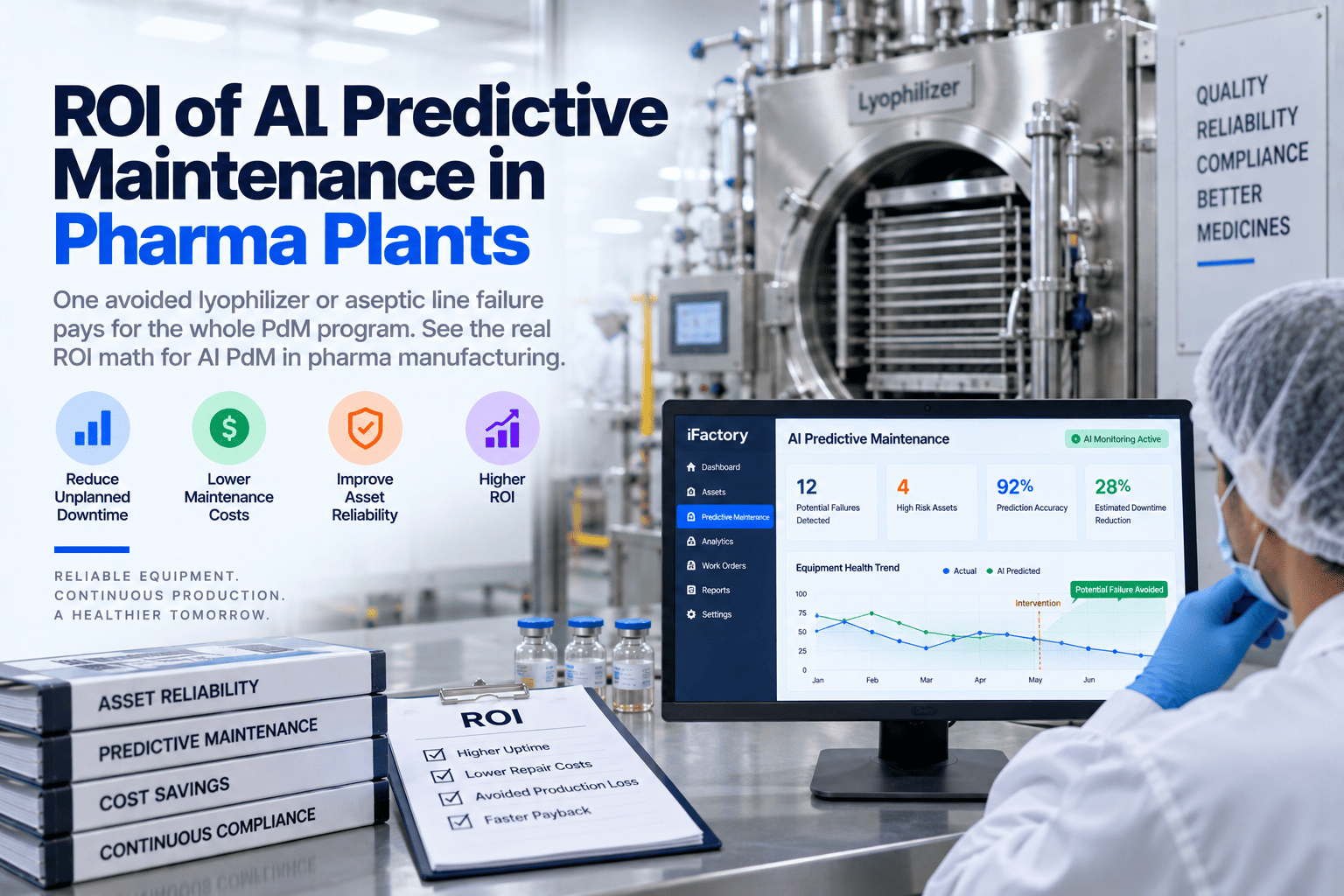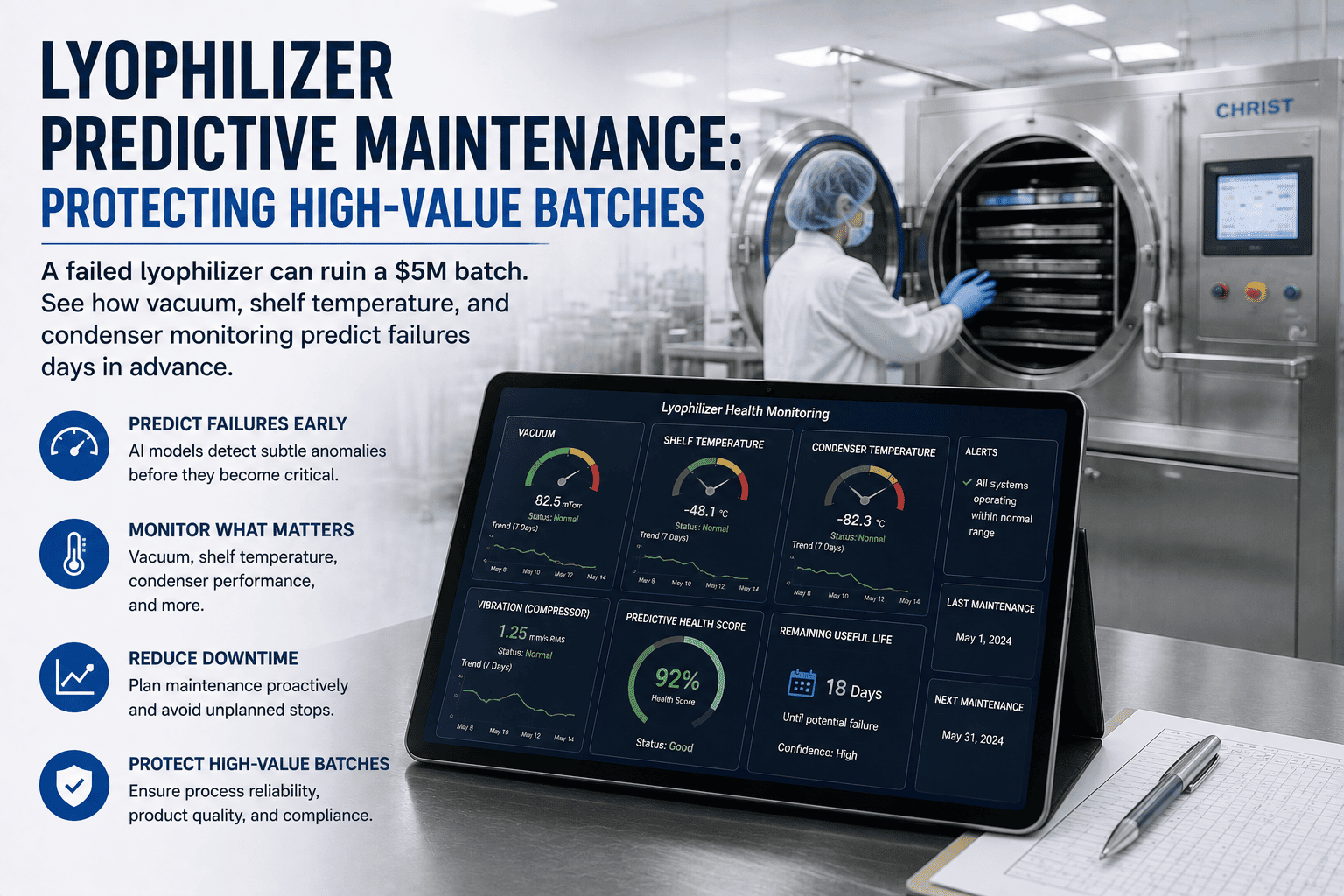
A single failed lyophilizer cycle can destroy an entire batch, and in commercial biologics manufacturing that batch can be worth anywhere from $500,000 to more than $5 million once raw material, processing time, deviation investigation, and lost production window are counted. The cruel part is that most of these failures do not arrive without warning — a vacuum pump edging toward seal failure, a condenser slowly losing its ability to hold temperature, or a shelf fluid circuit drifting out of uniformity all send signals days before they take a batch down mid-cycle. The difference between a caught degradation and a lost lot usually comes down to whether anyone was trending the right parameters. iFactory monitors vacuum integrity, shelf temperature, and condenser performance continuously and flags the drift before it becomes a batch loss. See how it works — book a demo.
A Freeze Dryer Rarely Fails Silently — It Fails After Days of Warning Signs
Vacuum drift, condenser temperature creep, and shelf non-uniformity are readable long before they take down a multi-million-dollar batch. iFactory trends the three parameters that matter and turns early degradation into a scheduled repair instead of a mid-cycle catastrophe.
The Economics That Make Lyophilizer Reliability Non-Negotiable
What iFactory Watches on Every Lyophilizer
Lyophilizer failures cluster around three subsystems, and each one degrades in a readable pattern before it fails outright. iFactory trends all three continuously rather than checking them only at the pre-batch leak test, which catches a problem that developed since the last cycle but misses one developing mid-run.
Chamber pressure sits in the low-millitorr range during sublimation, and a validated leak rate is typically held under roughly 10 to 30 microns per hour. A slow upward trend in leak rate across successive cycles is one of the clearest predictors of an imminent seal or gasket failure — the kind of drift a single pre-batch test can pass while the trend line is quietly climbing toward a mid-cycle vacuum loss.
Shelf temperature drives the entire drying profile, and uniformity across the shelf surface directly determines vial-to-vial consistency. When the heat transfer fluid circuit or a circulation pump begins to degrade, uniformity drifts before any single sensor breaches an alarm limit — a pattern visible in trended data but invisible to a threshold alarm watching each probe in isolation.
The condenser captures water vapor by re-freezing it onto cold coils, typically holding somewhere in the −50°C to −80°C range depending on design, and FDA guidance treats it as a GMP-critical component in its own right. Rising condenser temperature, falling ice capacity, or degrading defrost-cycle efficiency all signal a refrigeration or compressor problem developing well before the condenser can no longer protect the vacuum.
See these three signals trended on your own lyophilizers
iFactory connects to the parameters your freeze dryers already record and turns them into failure-lead-time your maintenance team can act on before a batch is at risk.
Why On-Schedule Maintenance Still Loses Batches
Calendar-based preventive maintenance is required and valuable, but it replaces components at fixed intervals regardless of actual wear state — which means it cannot catch a degradation that develops between two scheduled services, and it can trigger unnecessary revalidation when parts are changed before they need to be.
| Reliability Factor | Calendar-Based PM Only | iFactory Predictive Monitoring |
|---|---|---|
| Degradation between services | Undetected until the next scheduled check or a failure | Trended continuously, flagged as it develops |
| Pre-batch leak test | Pass or fail at one moment in time | Leak-rate trend seen across cycles, not one snapshot |
| Mid-cycle failure risk | Discovered when the batch is already lost | Warning days ahead, before the cycle is committed |
| Component replacement | Fixed interval, sometimes before wear justifies it | Condition-based, timed to actual degradation |
| Repair scheduling | Emergency intervention when it fails unexpectedly | Planned into the next changeover window |
How a Warning Becomes a Work Order, Not a Batch Loss
iFactory turns a degradation trend into a documented, scheduled intervention that fits into a planned production gap rather than an emergency mid-run response.
Your Alarm History Is Already a Predictive Dataset
One of the most reliable predictive inputs a lyophilizer produces is its own alarm history. Patterns in vacuum alarms, condenser temperature alarms, and shelf deviation alarms over time reveal a developing equipment issue well before any single event causes a batch loss — but only if every alarm is logged with a timestamp and a disposition, rather than acknowledged and cleared from the panel and forgotten.
That last part is where most operations lose the signal. An alarm that is silenced without being recorded leaves no trend to read, so the same fault can recur cycle after cycle without ever assembling into a pattern anyone can act on. iFactory captures alarm history structurally, links it to the asset, and surfaces the recurring patterns that point to a specific degrading component — turning a stream of individually-dismissed alarms into a maintenance signal the team can actually use.
Protect your next high-value batch
Give your maintenance team the failure lead-time to fix a degrading lyophilizer on a schedule instead of losing a lot to a mid-cycle surprise.
What Pharma Maintenance Teams Ask About Lyophilizer PdM
Turn Lyophilizer Degradation Into a Scheduled Repair
Vacuum, shelf temperature, and condenser performance all warn you before they fail. iFactory makes sure someone is watching the trend — so the next signal becomes a work order, not a destroyed batch.