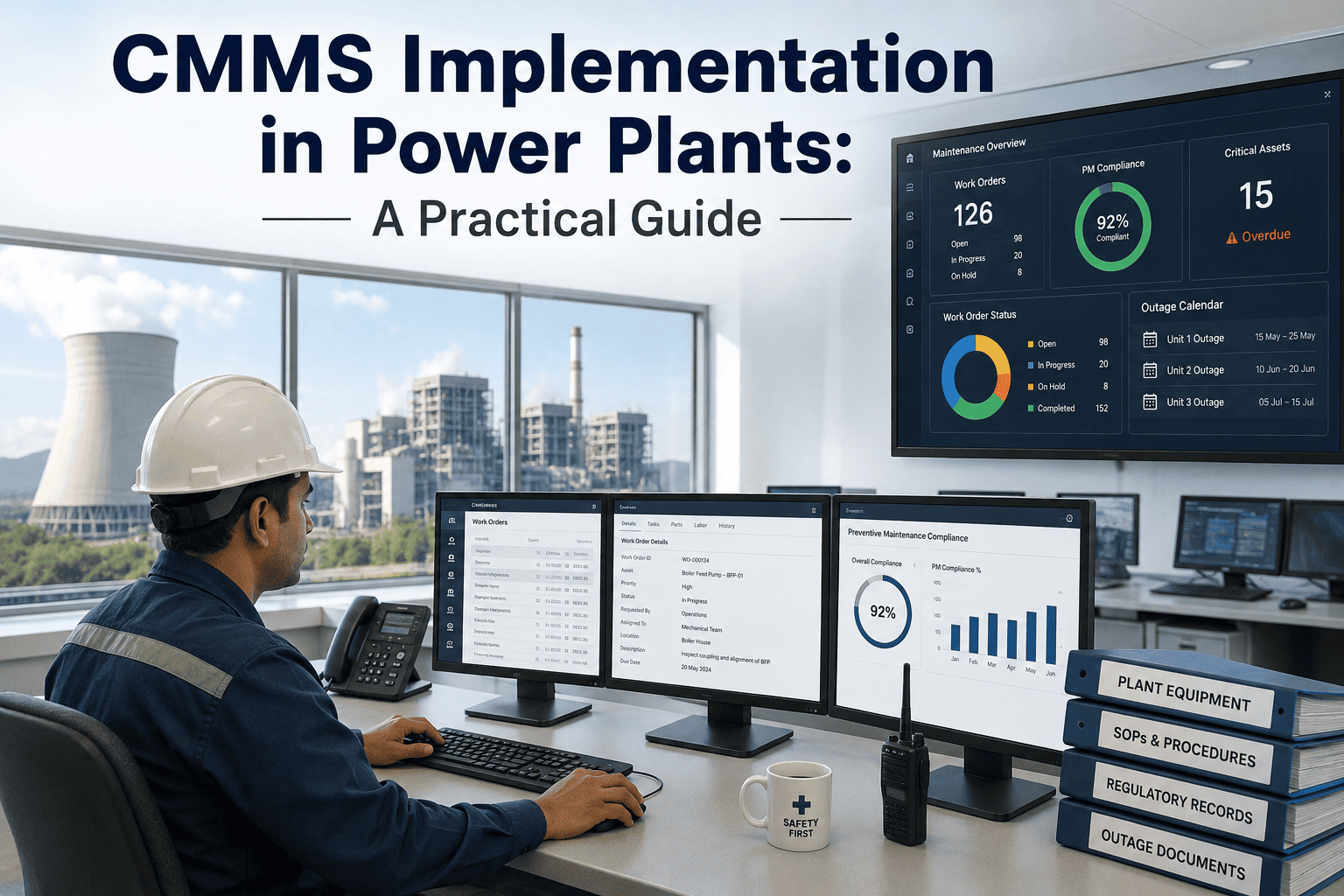
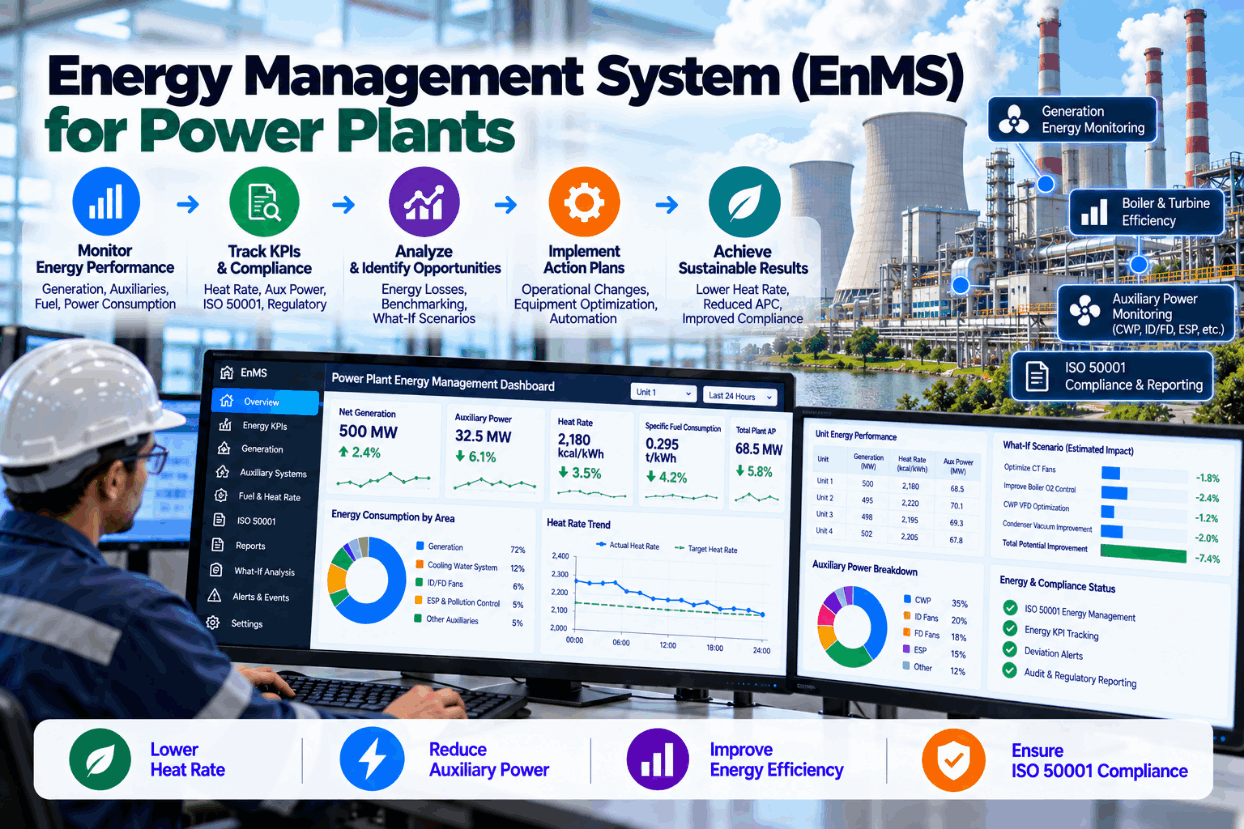
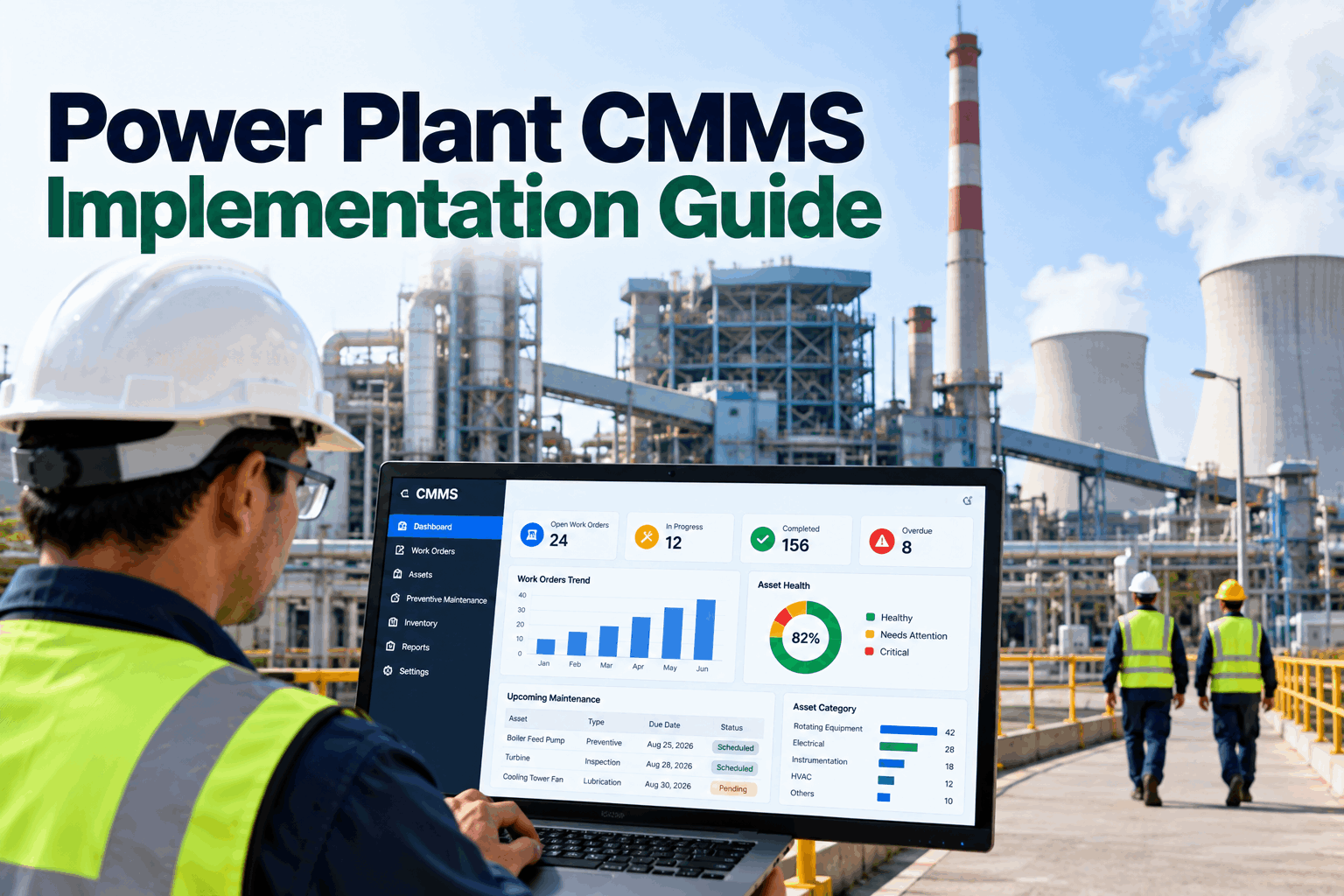
A power plant CMMS is not a bigger version of a factory CMMS. When a machine fails on a production line, output slows; when a turbine trips, megawatts leave the grid instantly — triggering reliability penalties, capacity clawbacks, and regulatory scrutiny that dwarf the repair bill. That is why a generation CMMS has to handle three things an ordinary one does not: planned outages measured in five-figure-per-hour stakes, asset criticality that decides what gets scoped, and regulatory records an inspector can demand within 72 hours. The hardest part of rolling one out is doing it without breaking the planned maintenance cycle you already depend on. This guide walks through a phased implementation that keeps PM running throughout. To see how the analytics layer fits on top, book a demo.
MAINTENANCE RELIABILITY · POWER GENERATION · CMMS IMPLEMENTATION
Roll Out a Power Plant CMMS Without Breaking the PM Cycle
Outages, criticality, and regulatory records make a generation CMMS unlike any other. See the phased implementation that stands up work orders, asset criticality, and audit-ready records while your planned maintenance keeps running.
WHY THE STAKES ARE DIFFERENT HERE
What a Generation CMMS Is Actually Protecting
$50K–150K
Forced-outage cost per hour for a typical combined-cycle unit
30–45%
Reduction in unplanned outages plants report after deploying a digital maintenance platform
72 hr
Window in which inspectors can demand timestamped PM records
60%
Cut in compliance-documentation time once records are captured on every work order
A power plant carries the most demanding asset mix in industrial maintenance — gas turbines with blade clearances in thousandths of an inch, HRSG pressure parts under creep and fatigue, steam turbines with critical alignment tolerances. Each class needs its own inspection protocols, OEM intervals, and regulatory documentation, which is exactly why the implementation cannot be generic.
THE THREE THINGS A POWER PLANT CMMS MUST HANDLE
Outages, Criticality, and Regulatory Records
These three requirements are what separate a generation CMMS from a general one, and each has to be designed into the implementation from the start rather than bolted on afterward.
An outage is where a year of deferred work comes due at once, and scope is decided by data or by default. A generation CMMS compiles the planned-outage scope automatically from overdue PMs, assets with condition alerts, inspection intervals falling in the window, and regulatory work due — then scores each candidate task by risk so low-value items can be challenged instead of carried in by habit.
Scope from overdue PMs + alerts
Risk-scored task list
Critical-path scheduling
02
Asset Criticality Ranking
Criticality is the foundation everything else stands on — without it, alert routing and work-order priority cannot function. Every maintainable asset sits at the correct hierarchy level with a criticality tier assigned, so a Tier A gas turbine and a non-critical service pump are never treated the same. This ranking is what lets the CMMS decide, automatically, what is mandatory in an outage and what must justify its cost.
Tiered asset hierarchy
Priority-driven routing
Consequence-based PM
03
Regulatory Record Capture
NERC, OSHA, EPA, and insurance records are usually assembled manually in parallel with the work — a double-work burden that leaves audit gaps. A generation CMMS captures the record on the work order itself: every PM and repair stored as a timestamped, photo-supported entry linked to the specific asset, with failure codes aligned to a standard taxonomy, so a compliance history report for any date range or asset class is generated on demand rather than compiled over weeks.
Record on every work order
Timestamped and photo-backed
Audit package on demand
Put an analytics layer on your maintenance data
iFactory reads your CMMS and condition-monitoring data to surface failure patterns and forecast asset wear — so outage scope and criticality decisions are driven by evidence, not habit.
THE PHASED ROLLOUT
Implementing Without Stopping the Planned Maintenance Cycle
The mistake that breaks a CMMS rollout is trying to switch everything at once while PM deadlines keep coming. The safer path builds value in phases, each one standing on the last, so the planned maintenance cycle never goes dark during cutover.
1
Audit and Clean the Asset Register
Get every maintainable asset into the correct hierarchy level with a criticality tier assigned — this clean register is the prerequisite for everything else, because alert routing and work-order priority cannot function without it. Do this before importing a single work order.
2
Stand Up Work Orders and PM Scheduling First
The first phase focuses on structured work-order capture and PM scheduling, which on its own typically cuts unplanned reactive work by 20–35%. Existing PM routines move into the system and keep running on schedule — the cycle continues, now captured as data instead of on paper.
3
Standardize Failure Codes and Close Shadow Trackers
Apply a consistent failure-code taxonomy across every equipment class, and enforce the CMMS as the single system of record — closing the parallel Excel trackers and shadow databases that quietly fragment the data. This is what makes later failure-pattern analysis possible.
4
Phase In Condition Monitoring on the Top Tier
Introduce sensor and condition-monitoring integration starting with the two or three highest-criticality assets — the gas turbines and major pumps — rather than waiting for a full-facility IoT deployment before any value is realized. Value comes from the critical few first.
5
Turn Accumulated Data Into Prediction and Outage Scope
Once 60-plus days of asset-linked work-order data exist, failure patterns become statistically visible, and the same data feeds outage-scope compilation and audit-ready compliance reporting. This is where an analytics layer starts forecasting wear and pre-scheduling replacements into the next planned window.
BEFORE AND AFTER THE ROLLOUT
What Changes for the Maintenance Team
The work itself does not change — turbines still need their OEM-interval inspections, HRSG parts still need thickness trending. What changes is whether that work is scheduled, prioritized, and documented by a system or by memory and spreadsheets.
| Maintenance Function |
Paper / Spreadsheet |
Implemented CMMS |
| Outage scope development |
Built from memory and last year's list |
Compiled from overdue PMs, alerts, and regulatory due dates |
| Task prioritization |
Whatever feels urgent that week |
Driven by asset criticality tier |
| Compliance records |
Assembled manually over weeks before an audit |
Captured on every work order, reportable on demand |
| Failure history |
Scattered across shadow trackers |
One taxonomy, statistically analyzable |
| PM compliance visibility |
Unknown until something is missed |
Tracked continuously against schedule |
Make your next audit a report, not a scramble
Once maintenance records live on the work order, a NERC or OSHA history package for any date range is generated on demand — turning weeks of binder prep into a request that returns in minutes.
FREQUENTLY ASKED QUESTIONS
Common Questions About Power Plant CMMS Implementation
How do we implement without disrupting our current PM schedule?
The rollout is phased specifically so the planned maintenance cycle never stops. The first phase moves your existing PM routines into structured work-order scheduling — they keep running on their intervals, just captured as data now — before any sensor integration or advanced analytics are added. Because the early phases are about digitizing what you already do rather than changing it, the cutover strengthens the PM cycle rather than interrupting it. Sensor integration and prediction come later, once the work-order foundation is stable.
What has to happen before we load any work orders?
A clean asset register with criticality rankings has to come first — it is the foundation everything else depends on. Every maintainable asset needs to sit at the correct hierarchy level with a criticality tier assigned, because condition-alert routing and work-order priority simply cannot function correctly without it. Loading work orders onto a messy or incomplete register just moves the disorganization into a new system. Auditing and cleaning that register is genuinely step one, ahead of any data import.
How does the CMMS help with outage scope specifically?
It compiles the candidate scope automatically from four sources — overdue PMs, assets carrying condition alerts, inspection intervals falling within the outage window, and regulatory work that is due — then scores each task by risk so the low-value items can be challenged rather than carried in by default. On a real 21-day combined-cycle outage, that kind of criticality-driven review let a team challenge dozens of low-value tasks and finish ahead of schedule. Without the data to quantify criticality, those tasks tend to stay in scope simply because no one can prove they shouldn't.
Where does iFactory fit if we already have or are choosing a CMMS?
iFactory is the analytics and AI layer that sits on top of the maintenance-record and condition-monitoring data your CMMS collects. The CMMS is the system of record for work orders, criticality, and compliance history; iFactory reads that data plus sensor streams to surface failure patterns, forecast asset wear, and support outage-scope and criticality decisions with evidence. It complements the CMMS foundation rather than replacing it, which is why a clean, well-structured implementation matters — better data in means better prediction out.
How quickly do we see value from the implementation?
The first phase — structured work-order capture and PM scheduling — typically reduces unplanned reactive work by 20–35% on its own, before any predictive capability is switched on. Compliance documentation time drops in the same early window because records are now captured on the work order rather than assembled before an audit. The deeper value, statistically visible failure patterns and wear forecasting, arrives once roughly 60 days of asset-linked work-order data have accumulated.
Contact our support team to map a phased timeline against your plant's asset mix and outage calendar.
CLEAN REGISTER, RUNNING PM, RECORDS ON DEMAND
Implement Your Power Plant CMMS the Way That Sticks
Outages, criticality, and regulatory records demand a generation-specific rollout — phased so the PM cycle never stops. iFactory turns the maintenance data that implementation captures into failure prediction and evidence-driven outage planning.