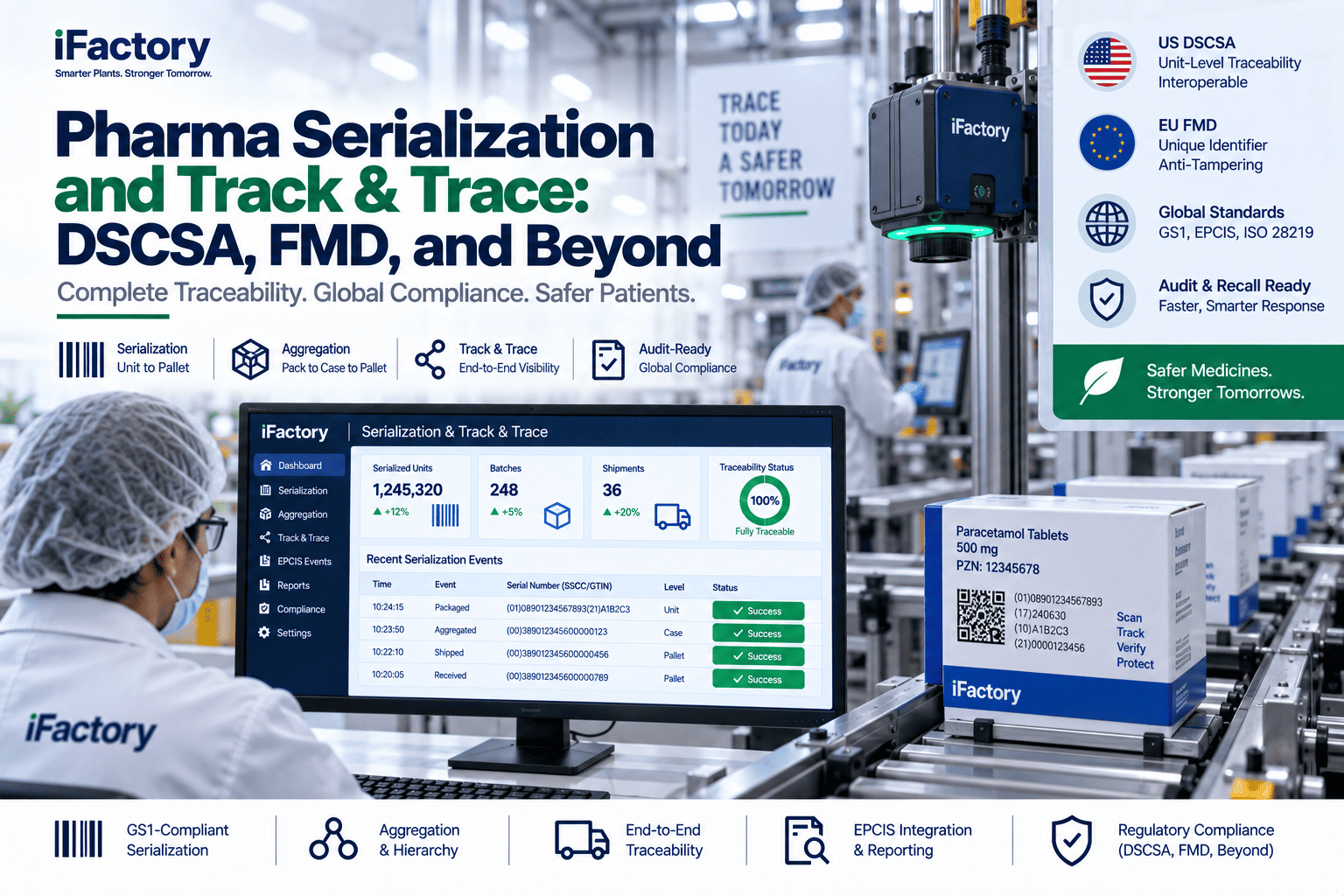
Serialization stopped being a project the day enforcement went live. As of May 27, 2025, US manufacturers must send serialized product data in GS1 EPCIS format for every package they ship — no test transactions, no grace period. Wholesalers followed on August 27, and dispensers with 26+ pharmacists on November 27. In parallel, the EU FMD has been enforced since 2019, and 78 countries now operate under WHO GDP serialization guidance. Selling Rx product without EPCIS data is now non-compliance, and unresolved aggregation exceptions are sending an estimated 0.5% of Rx product daily into quarantine or return workflows.
iFactory / DSCSA + FMD track & trace
Ship Every Package With Its Serial, Its Aggregation, and Its EPCIS Event
A serialization stack that handles GS1 SGTIN + SSCC, parent-child aggregation across every packaging level, EPCIS 2.0 exchange with trading partners, and DSCSA / FMD / WHO GDP compliance in one workflow.
1
Unit / saleable
GTIN + serial (SGTIN-96)
↑
2
Bundle / carton
Parent-child aggregation event
↑
3
Case
SSCC + aggregation event
↑
4
Pallet + shipment
EPCIS shipping event to trading partner
May 27, 2025
US manufacturer enforcement live
GS1 EPCIS
FDA-recommended standard
0.5% daily
Rx quarantined for exception issues
The Problem on the Floor
Serialization is deceptively simple to describe and difficult to run at scale. Every saleable unit needs a GS1 SGTIN-96 identifier, every parent packaging level needs an SSCC and an aggregation event linking children to parent, and every shipment needs an EPCIS event exchanged with the trading partner in a format their system can consume. AmerisourceBergen’s early pilots found onboarding a single manufacturer takes 2 to 3 months, and unresolved aggregation exceptions have been sending an estimated 0.5% of Rx product daily into quarantine or return workflows. Verification requests from downstream partners must be answered within 24 hours, every hour of every day.
What Escapes Into the System of Record Today
The problem is not “we don’t serialize.” The problem is what happens between serialization at the packaging line and the EPCIS message arriving at the wholesaler — aggregation errors, master-data mismatches, and exception handling that most systems were never designed for.
Paper batch log
Serialization done at the line, aggregation attempted manually, exceptions logged on a shift sheet. Nothing ties the shift-sheet exception to the wholesaler’s later rejection message.
Spreadsheet
EPCIS exception queue managed on a spreadsheet. Each exception researched manually against line records. Onboarding a new wholesaler takes 8–12 weeks of ad-hoc reconciliation.
Chart recorder / data logger
Line vision system captures each serial and aggregation event locally. Data extracted at end of shift. If a wholesaler rejects a shipment three days later, no one can quickly reconstruct what actually happened at the line.
Nowhere at all
Verification requests from downstream partners often land in shared inboxes with 24-hour response windows. Missed responses accumulate as compliance risk that surfaces during trading-partner audits.
What the WMS Actually Does
A serialization stack that actually holds up under enforcement is not one system — it is a coordinated set of capabilities from line-level capture through EPCIS exchange, with exception handling built in from the start rather than bolted on after the first wholesaler rejection.
Line Capture
Serial and aggregation events captured at every packaging level with vision or scanner confirmation. Master data validated at capture, not at export.
Level: unit, carton, case, pallet
EPCIS Exchange
EPCIS 2.0 messages generated per GS1 standard for commissioning, aggregation, shipping, and receiving events. Sent to trading partners in their required format.
Standard: GS1 EPCIS 2.0
Exception Handling
HDA five-category framework built into the queue: Data Issue, Product No Data, Data No Product, Packaging/Labeling, Unavailable for Distribution. Each has a defined workflow.
Framework: HDA guidelines
Verification Response
24-hour verification request workflow — a downstream partner asks whether a specific serial is authentic, and the system responds automatically within the DSCSA window.
Response: <24h automated
What Gets Written to the System of Record
The serialization record is not just the serial. It is the full lifecycle event chain — commissioning, aggregation, shipping, verification, disaggregation — held in a way that answers a trading-partner query or an FDA request without a reconstruction project.
Serial Master
Serialization Repo
Every serial ever commissioned, its aggregation history, current status, and ownership — the queryable record verification requests hit against.
EPCIS Event Log
GS1 EPCIS 2.0
Every commissioning, aggregation, shipping, and receiving event stored in EPCIS format — exportable to any trading partner or regulator on demand.
Exception Queue
Compliance Layer
Every trading-partner exception categorised, assigned, tracked to closure. Aging exceptions surface for escalation before they generate rejections.
Trading Partner Config
Integration Layer
Every wholesaler and distributor’s specific EPCIS format, master-data requirements, and exception-handling preferences stored and enforced automatically.
Ask your compliance lead how many EPCIS exceptions were open at end of last week and how many aging beyond 7 days. If the number is a shrug or a guess, the trading-partner rejection risk is invisible. Book a compliance review — we’ll audit your current exception queue.
12-Week Pilot Shape on One Warehouse
One SKU family, one trading partner, twelve weeks. The pilot is scoped to prove the four capabilities work together on your line, your master data, and your wholesaler’s exception rules — before a broader rollout.
Weeks 1–2
Data & Line Audit
Audit current serialization: line-level capture accuracy, master-data completeness, current exception rate with target wholesaler, EPCIS format alignment.
Weeks 3–4
Onboarding & Config
Trading-partner-specific EPCIS format configured. Master data reconciled. Exception categorisation aligned to HDA framework. 24-hour verification workflow tested.
Weeks 5–8
Parallel Ship
Ship one SKU family in parallel: existing serialization system plus new stack. Every exception researched in both systems. Closure time compared.
Weeks 9–12
Cutover Decision
Twelve-week metrics reviewed: exception rate, closure time, verification response time, master-data drift. Cutover to new stack decided based on data.
Who Owns the KPI
Serialization crosses IT, quality, packaging, and commercial. Every function needs a specific KPI or the compliance program has no accountability past project close.
Compliance Lead
EPCIS exceptions open >7 days
Owns the aging exception queue — exceptions that age past 7 days generate wholesaler rejections. This is the leading indicator that matters.
Packaging Manager
Line commissioning accuracy %
Owns the capture quality — what percentage of serialized units make it through the line with correct aggregation on first pass. Rework drives exception rate.
IT / Master Data
Verification response time (target <2h)
Owns the systems that answer verification requests — 24-hour DSCSA window is the ceiling, but sub-2-hour is the working target for trading-partner trust.
Commercial / Supply
Rx units returned/quarantined due to serialization
Owns the outcome number — how much product actually got quarantined or returned because of serialization failures. This is where all the above shows up on the P&L.
FAQ
What exactly changed with the May 2025 DSCSA deadline?
Before May 27, 2025, manufacturers were required to serialize but the enforcement of serialized data exchange had been in stabilization. As of that date, FDA fully enforces the requirement to exchange serialized transaction information in EPCIS format for every shipment to every trading partner. Wholesalers followed on August 27, 2025, and dispensers with more than 25 pharmacists on November 27, 2025 (smaller dispensers on November 27, 2026). Practically: selling Rx without matching EPCIS data is now a violation, and downstream partners can and do reject product that arrives without correct serialized data.
How does exception handling actually work in practice?
The HDA Exceptions Handling Guidelines categorize discrepancies into five types: Data Issue (EPCIS message has an error), Product No Data (physical shipment arrived without matching EPCIS), Data No Product (EPCIS arrived without physical shipment), Packaging and Labeling (mismatch between EPCIS and label), and Unavailable for Distribution (product cannot be sold pending resolution). Each category has a defined resolution workflow, an owning role, and a target closure time. The serialization stack routes exceptions into the correct queue automatically at receipt, so the compliance lead sees categorized, aging exceptions rather than an undifferentiated inbox.
Book a demo to see the exception categorisation on live wholesaler data.
What about international markets — does one system handle DSCSA, FMD, and other regimes?
The GS1 EPCIS standard is used across DSCSA (US), FMD (EU), and most WHO GDP jurisdictions. The unique identifiers differ (SGTIN-96 vs FMD unique identifier vs country-specific schemes) and the required master-data attributes vary, but the underlying event model is the same. A modern serialization stack holds all the schemes and applies the correct one per SKU and per destination market. This matters for a manufacturer shipping the same product into multiple regions — the packaging line captures the serial once, the system generates the market-appropriate compliance record on shipment.
Stop absorbing wholesaler rejections your data caused.
See One SKU’s Full DSCSA Compliance Loop End-to-End
Bring one SKU family, your current EPCIS exception rate with one wholesaler, and one recent verification request. We’ll show the line-to-EPCIS-to-wholesaler flow live and audit where exceptions are eating margin.