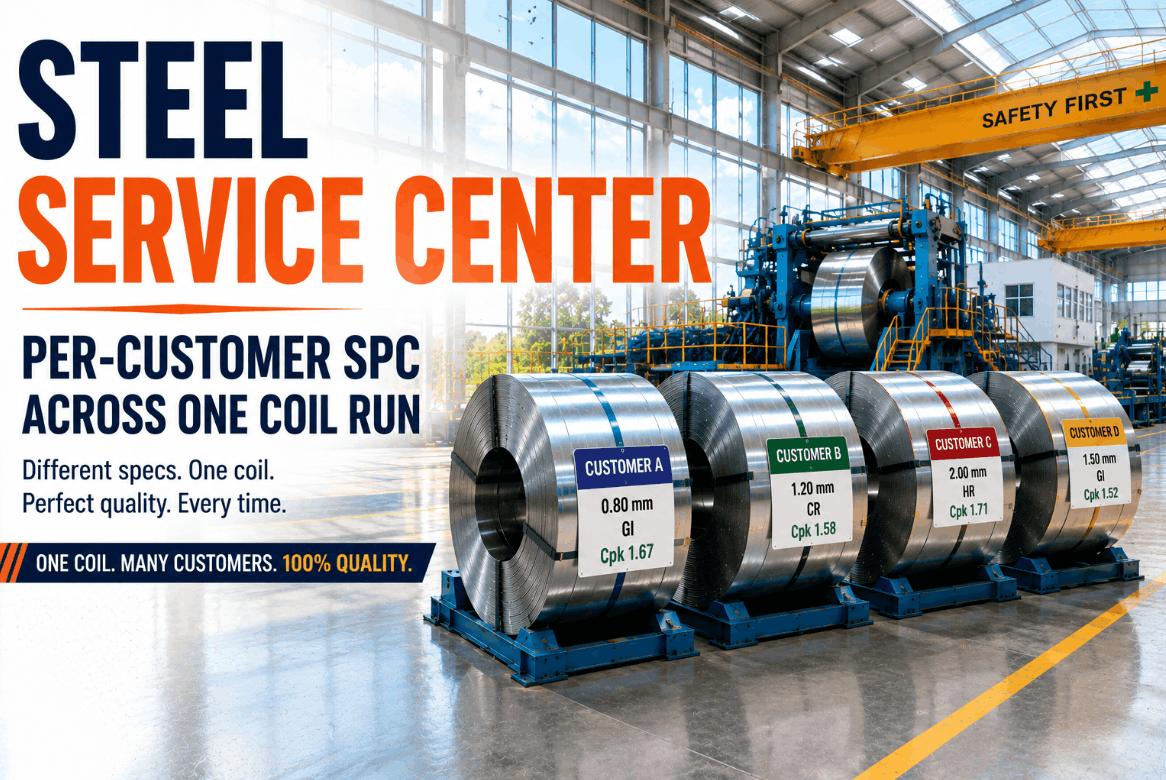
Steel service centers operate under a quality constraint that no mill-side SPC system was designed to handle: a single master coil slitting into multiple slit coils, each destined for a different customer, each governed by a different specification, each requiring its own Cpk record, and each needing a shipment-ready audit pack produced automatically at the moment the order is packed. A Tier-1 automotive stamping customer on Position 3 wants Cpk ≥ 1.67 on width with a ±0.005" tolerance. An HVAC fabricator on Position 7 wants Cpk ≥ 1.33 on the same width characteristic with a ±0.010" tolerance. A cut-to-length customer taking the edge trim wants a flatness certification tied to their specific length and pack configuration. Running all three from one coil, one slitting line setup, one shift — and producing three separate, customer-formatted quality records that satisfy each customer's incoming inspection requirements — is a quality management problem that spreadsheet-based SPC and single-customer quality platforms were never built to solve. iFactory holds per-customer Cpk per slit, per cut, and per pack — recipe per customer, audit per shipment — automatically, from a single connected processing line. Book a Demo to see how iFactory manages multi-customer quality documentation across a live slitting or cut-to-length operation.
One Coil. Multiple Customers. One Platform That Holds Every Cpk Separately.
iFactory tracks per-customer width, thickness, flatness, and edge quality Cpk across every slit position, every cut length, and every pack configuration — generating a shipment-ready audit document per customer order from a single coil run.
Why Multi-Customer SPC Is the Defining Quality Challenge in Steel Service Center Operations
Every steel service center quality manager understands the fundamental tension at the core of the business model: the economic efficiency of processing comes from running multiple customer orders through the same slitting or cut-to-length setup, often from the same master coil, in the same production window. The quality challenge is that each of those customer orders carries its own specification — its own width tolerance, its own thickness tolerance, its own flatness requirement, its own edge condition requirement — and each customer expects a quality record demonstrating that their specific specification was met on their specific slit positions or cut lengths, not on the coil run as a whole.
The service centers that are losing automotive, appliance, and precision stamping customers to competitors are almost never losing on price alone. They are losing on quality documentation: the inability to produce a per-shipment Cpk summary, a per-customer width and thickness capability record, or a shipment audit pack that satisfies a Tier-1 customer's incoming quality requirements without a multi-day manual reconstruction effort. When quality managers at service centers Book a Demo with iFactory, the most common discovery is that the data needed to produce those records is already being generated on the slitting line — it simply has no system to capture it per customer, per slit position, and per shipment.
Per-Customer Width Cpk
Width tolerance varies by customer even on the same slit position. iFactory maintains separate Cpk calculations for each customer's tolerance band — not a single Cpk for the full run that averages across multiple specifications and misrepresents capability for every individual customer.
Per-Slit-Position Thickness Tracking
Thickness variation across the width of a master coil means slit positions at the center and edges of the coil have different gauge profiles. iFactory tracks thickness Cpk per slit position — the only architecture that gives accurate capability reporting for each customer's material.
Cut-to-Length Flatness Per Pack
Flatness specifications for cut-to-length orders vary by end application — automotive blanking has tighter bow and cross-bow limits than general fabrication. iFactory records flatness measurements per pack, per customer specification, and generates the customer's specific flatness certification format automatically.
Edge Quality Per Customer Requirement
Burr height, edge condition classification, and edge wave specifications differ across stamping, roll forming, and laser cutting customers. iFactory applies the correct edge quality specification per customer order and records conformance to that standard — not to a generic "acceptable" classification that satisfies no customer precisely.
Per-Customer Recipe + Per-Shipment Audit Pack: The iFactory Service Center Architecture
The iFactory service center quality platform is built around two concepts that do not exist in conventional SPC software: the customer recipe and the shipment audit pack. A customer recipe is the complete quality specification for a specific customer's orders — width tolerance, thickness tolerance, flatness limit, edge condition, Cpk minimum, and any customer-specific quality clause requirements — stored in the platform and applied automatically whenever that customer's order is active on the processing line. A shipment audit pack is the complete quality documentation package generated at pack completion — control charts, Cpk summary, measurement records, and certificate of conformance — formatted to that customer's incoming quality documentation requirements, not to a generic service center standard. Together, these two capabilities solve the multi-customer quality problem that has prevented service centers from scaling their quality programs alongside their processing volume.
Customer Recipe Configuration
Every customer's quality specification loaded into iFactory as a named recipe: width tolerance, thickness tolerance, flatness limit, burr height standard, Cpk minimum per characteristic, and any customer-specific quality clauses. Recipes are version-controlled and linked to the customer's order number at job entry — no manual spec lookup at the slitter.
Slit-Position Assignment and Live Monitoring
Each slit position on the line is assigned to a customer order. As the run progresses, iFactory collects width, edge quality, and thickness measurements per slit position and applies the correct customer tolerance to each position's data stream — running parallel SPC control charts, one per customer, simultaneously on the same coil run.
Real-Time Cpk and Out-of-Spec Alert
Cpk is calculated live per customer per characteristic as measurements are entered. When any customer's Cpk drops below their specified minimum, iFactory alerts the line operator immediately — before the full coil is processed to that customer's order — with the affected slit position, the characteristic at issue, and the current capability value.
Pack Completion and Automatic Audit Pack Generation
When a customer's slit coils or CTL packs are completed, iFactory automatically assembles the shipment audit pack: control charts for each monitored characteristic, Cpk summary table, individual measurement records, and a certificate of conformance — all formatted to that customer's documentation specification, ready to print or email without any manual assembly.
Coil-Level Traceability and Heat Linkage
Every slit coil and CTL pack is linked to the master coil ID, the mill certificate, the heat number, and the processing line setup parameters at the time of processing. When a customer opens a SCAR or incoming rejection, iFactory produces the full traceability record — from the customer's pack ID back to the master coil and mill certificate — in a single query.
What Changes When Per-Customer SPC Replaces Run-Level Quality Reporting
Most steel service centers currently operate one of two quality documentation models: a single Cpk for the entire coil run that is reported to all customers regardless of their individual tolerance bands, or a manual documentation process where quality personnel reconstruct per-customer capability records from raw measurement sheets after the run is complete. Neither model satisfies the incoming quality requirements of automotive Tier-1 suppliers, appliance OEMs, or precision metal fabricators — customers who specify per-shipment Cpk minimums by characteristic and will issue SCARs when the documentation is missing or non-conforming. Book a Demo to see iFactory's per-customer quality documentation output compared against your current customer quality requirements.
| Quality Documentation Element | Traditional Run-Level Approach | iFactory Per-Customer SPC | Customer Impact |
|---|---|---|---|
| Width Cpk Reporting | Single Cpk for full run; all customers receive same value regardless of their tolerance | Separate Cpk per customer per slit position; each customer's tolerance applied to their position's data only | Automotive Tier-1 SCAR rate on width documentation eliminated; customer-specific capability demonstrated |
| Thickness Capability | Average thickness reported; positional variation across coil width not separated by customer | Thickness Cpk per slit position linked to customer order; center vs. edge coil position variation captured per recipient | Edge-position customers no longer receive capability data dominated by center-coil measurements |
| Flatness Documentation (CTL) | Generic flatness statement or single bow measurement per order; no per-pack records | Flatness measured per pack, recorded against customer's specific bow and cross-bow limits, certification per pack | Stamping customers receive flatness certification tied to their pack, not to the run average |
| Shipment Audit Pack Assembly | Manual reconstruction from shift measurement sheets; 1–3 days lead time; version control errors common | Auto-generated at pack completion; customer format applied; available at ship dock | Customer incoming quality hold on arrival eliminated; audit pack in customer's system before shipment departs |
| SCAR Response Traceability | Manual lookup through paper records; coil-to-cert linkage often requires multiple systems and days | Master coil ID → slit position → customer pack → mill certificate in single query; complete traceability in minutes | SCAR 8D response time reduced; root cause traceable to specific coil position and processing setup parameters |
| Multi-Customer Cpk Dashboard | Not available; no system view of capability by customer across all active orders | Live dashboard showing Cpk by customer, by characteristic, across all active orders on all processing lines | Operations management visibility into which customers are at SCAR risk before shipment departs |
Six Quality Management Gaps That Cost Steel Service Centers Customers and Margin
The service centers that lose precision customers to competitors with stronger quality programs almost always have the same gaps. These are not equipment problems or processing capability problems — they are quality management system problems that prevent an operationally capable service center from demonstrating that capability to the customers whose business justifies the investment in high-precision slitting and leveling equipment.
A single Cpk calculated across the full run and reported to all customers regardless of their individual tolerance bands misrepresents capability for every customer on the run — overstating it for tight-tolerance customers and understating it for wide-tolerance ones.
Thickness varies across the width of a master coil — edge positions run thinner than center positions on most hot and cold-rolled products. Blending thickness data from all slit positions into a single Cpk produces a capability number that accurately describes none of them.
Quality documentation assembled manually after the run from shift sheets and measurement logs introduces transcription errors, version control failures, and a 1–3 day lag between shipment and documentation delivery that triggers incoming quality holds at precision customers.
Customer specifications stored in order entry systems or PDF files rather than directly in the SPC platform means the line operator is not alerted in real time when a customer's specific tolerance is being approached — only when a generic alarm threshold is crossed.
Master coil traceability maintained by the mill certificate system often does not extend to individual slit coil IDs — leaving service centers unable to respond to SCAR requests with the coil-specific traceability that automotive and defense customers require.
Service centers operating multiple slitting and CTL lines have no consolidated view of which customer orders are at capability risk across all active runs — missing the opportunity to intervene before a substandard shipment departs and triggers a customer quality event.
Closing these gaps requires a quality platform designed for the multi-customer, multi-specification operating model of a steel service center — not an adaptation of a mill-side SPC system that assumes one customer per run. Service center operations managers regularly Book a Demo to benchmark their current documentation capability against the requirements of their highest-value customers.
"The misconception I see consistently at service centers that are losing automotive customers is that the problem is processing capability — the assumption that they need a better slitter or a more precise leveler. In nearly every case I have reviewed, the slitting line can already hold the tolerance the customer requires. The problem is quality documentation: they cannot produce a per-customer Cpk for each slit position, a per-pack flatness certification tied to the customer's specific bow limit, and a shipment audit pack formatted to the customer's incoming quality specification — automatically, at ship time, without a quality engineer spending two days reconstructing it from raw data. Automotive and appliance customers have raised their documentation requirements materially in the past three years. A service center that was winning business in 2020 on processing quality alone is losing it in 2025 to a competitor with equivalent processing capability and a quality management platform that produces the audit evidence automatically. The investment in iFactory's per-customer SPC architecture pays back in retained customer contracts, not just in reduced internal scrap."
Per-Customer Quality Documentation Is Now a Table-Stakes Requirement — Not a Differentiator
The steel service centers that will retain precision manufacturing customers over the next five years are the ones that can demonstrate per-customer process capability, per-shipment quality documentation, and coil-level traceability as standard operating practice — not as a premium offering or a manual reconstruction effort triggered by a customer audit. The bar was raised by automotive Tier-1 programs, and it has now propagated to appliance OEMs, HVAC fabricators, and precision metal fabricators who process service center-supplied coil on high-speed stamping and roll forming lines where incoming quality failures stop production.
iFactory's per-customer SPC platform gives service center operations the architecture that this requirement demands: customer recipes applied at the slit position level, parallel Cpk calculations running simultaneously for every customer on every active coil run, automatic shipment audit pack generation at pack completion, and complete slit-coil traceability back to the master coil and mill certificate. The data is already being generated on your processing line. The question is whether your quality management system is organized to hold it per customer, per slit, per shipment — or whether the next SCAR from your best automotive account is going to take your quality team three days to respond to. Book a Demo to see iFactory's multi-customer SPC dashboard running against a representative sample of your service center's customer specifications.
Deploy iFactory's Per-Customer SPC Platform Across Your Steel Service Center
Connect your slitting lines and CTL equipment to iFactory — and run per-customer Cpk, per-slit-position capability tracking, and automatic shipment audit documentation from a single platform across your entire processing operation.
Steel Service Center Per-Customer SPC — Common Questions
Each slit position is assigned to a named customer recipe — containing that customer's width tolerance, Cpk minimum, edge condition standard, and any quality clauses — so the platform runs parallel control charts simultaneously, one per customer, applying each customer's specification only to the measurements from their assigned positions on the coil.
Yes — each customer's audit pack template is configured in iFactory with the specific characteristics, format, and content requirements that customer's incoming quality program specifies; at pack completion the document is generated automatically in that format, ready to accompany the shipment without any manual assembly or formatting.
iFactory links every slit coil ID and CTL pack ID to the master coil at job entry, automatically maintaining the chain from customer pack → slit position → master coil ID → mill certificate and heat number so that a SCAR traceability request returns the complete record in a single query without manual document reconstruction.
Yes — iFactory calculates Cpk continuously per customer per characteristic as measurements are entered, and alerts the line operator when any customer's capability falls below their specified minimum — identifying the affected slit position and characteristic so the operator can take corrective action before the full order is processed.
Most service center deployments reach live per-customer Cpk and automated audit pack generation within 6–10 weeks — with customer recipe configuration and the first automated audit pack output typically delivered within 30 days of go-live; Book a Demo for a scoping assessment specific to your line configuration and customer mix.



-—-mold-level-and-tundish-spc-for-slab-quality.png)