Running a single production line for six different customers sounds efficient on paper—until you realize that each of those customers ships with a distinct gauge band, a separate Cpk threshold, a proprietary audit report format, and a zero-tolerance policy for receiving data that belongs to a competitor. For Key Account Quality Leads, this is not a hypothetical. It is Tuesday morning. The operational reality of serving multiple OEM accounts from shared equipment is that your quality system must be simultaneously precise and completely isolated—holding every customer's specification as if it were the only one, while never contaminating one account's data with another's. iFactory's multi-customer recipe library makes this possible. Each customer account gets its own gauge band, its own live Cpk targets, and its own audit pack—built automatically from the same production stream, with zero manual switching between spec sets. Book a Demo to see how iFactory manages six customer specs from one plant simultaneously.
Same Line. Six Customers. Six Spec Sets. Zero Confusion.
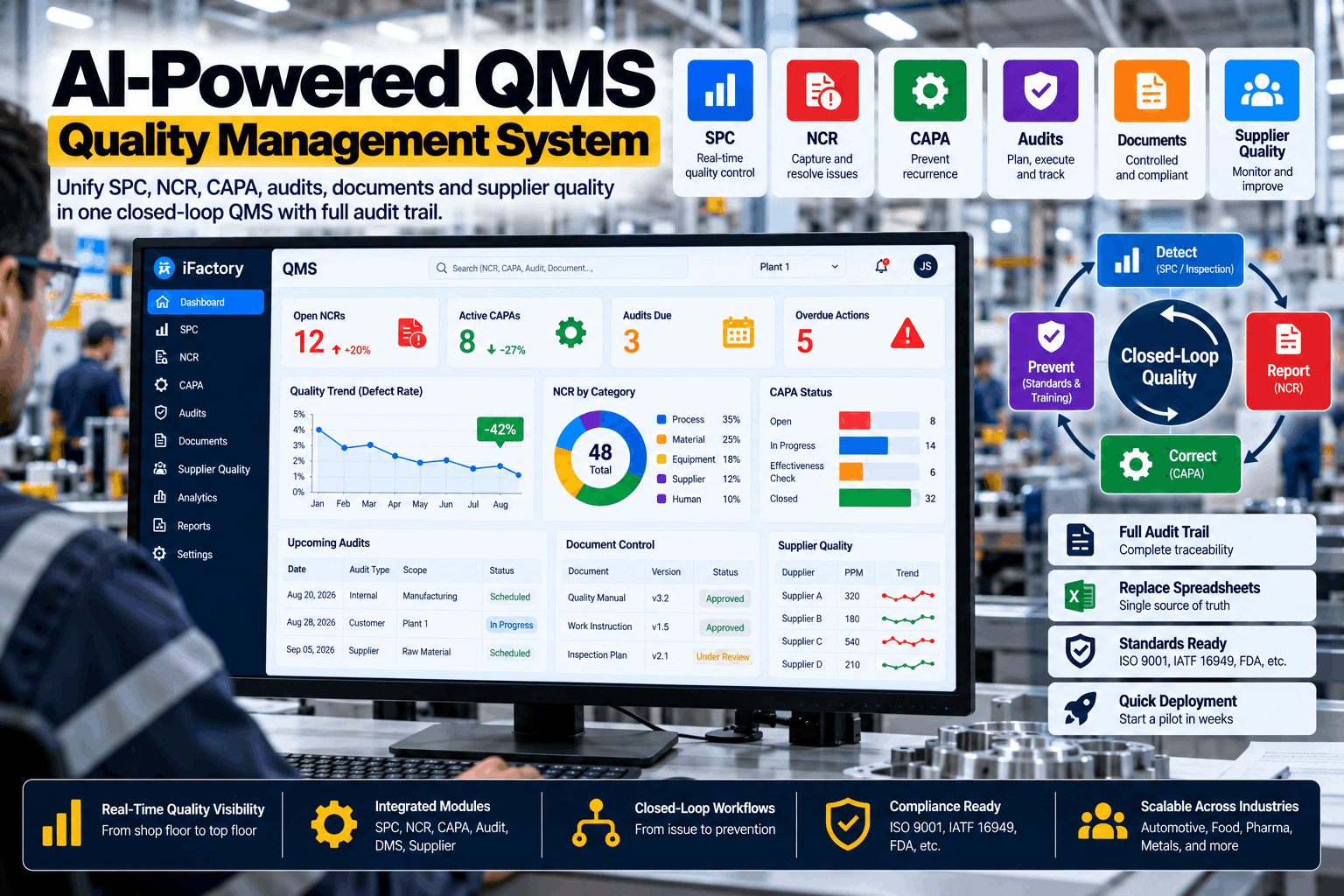
iFactory holds your entire multi-customer recipe library simultaneously—per-customer gauge bands, per-customer Cpk targets, and per-customer audit packs generated automatically from shared production data.
Why Shared Lines and Siloed Specs Are a Quality Time Bomb
The fundamental tension in key account quality management is that manufacturing efficiency pushes toward consolidation—run everything on the same line, at the same time, with the same operators. Customer contractual requirements push in the opposite direction—each account demands that their specification be treated as absolute, their Cpk data be isolated, and their audit evidence be formatted precisely to their own submission template. When this tension is managed through spreadsheets, manual spec switching, and end-of-run report compilation, the failure modes are predictable: a gauge band from Customer A leaks into Customer B's SPC chart, a Cpk report gets built from the wrong spec limits, or an audit pack is submitted late because a quality technician spent three days assembling it manually. iFactory eliminates this category of risk entirely by storing each customer's full specification profile in a dedicated recipe library, activating the correct spec set the moment a customer-coded production order opens, and building the audit evidence in real time as parts run. For Key Account Quality Leads managing complex, multi-customer plants, Book a Demo to see the recipe library architecture in action.
Spec Crossover Risk
Manual spec switching between customer orders creates silent crossover events—production runs evaluated against the wrong gauge band, with no system-level guardrail to catch it before shipment.
Manual Audit Pack Assembly
Compiling a customer-specific audit report from raw SPC data, formatted to that customer's submission template, can consume two to three days of quality engineering time per submission cycle.
Fragmented Cpk Reporting
When Cpk is calculated from a pooled data set rather than per-customer spec limits, reported capability is meaningless—a Cpk of 1.67 built on the wrong tolerance window is not a Cpk at all.
Competing Customer Scorecards
Key accounts measure your performance on their own scorecards, in their own formats, on their own cadence. A single quality system that cannot segregate and report per-account data will always be playing catch-up.
How iFactory's Multi-Customer Recipe Library Works
iFactory's recipe library is built around the concept of customer-isolated quality contexts. Each customer is a distinct profile in the platform—with their own gauge tolerances, their own SPC control rules, their own Cpk minimum thresholds, and their own audit report template. When a production order opens, the platform activates that customer's quality context automatically. Every measurement, every SPC signal, and every capability calculation runs against that customer's parameters exclusively. Book a Demo to walk through a live recipe library configuration.
Customer Recipe Profile Setup
Each key account is configured as a named recipe profile containing their specific gauge band (USL/LSL), target Cpk minimums, SPC chart run rules, measurement frequency, and audit report format preferences. Profiles are version-controlled and change-log tracked.
Order-Triggered Context Activation
When a production order is opened for a specific customer, iFactory activates that customer's recipe context automatically. Operators see only the tolerances relevant to the active customer. No manual spec selection. No clipboard switching.
Live Per-Customer SPC Execution
Every measurement taken during the order runs through that customer's SPC chart in real time. Control limits, warning bands, and out-of-control signals are computed against that customer's gauge band—not a plant average, not a blended tolerance.
Per-Customer Cpk Calculation
Cpk is calculated continuously against the active customer's spec limits. The platform flags any production window where Cpk drops below that customer's minimum threshold—giving the Key Account Quality Lead a real-time capability signal, not a post-run spreadsheet exercise.
Auto-Built Per-Customer Audit Pack
When the order closes, iFactory assembles the customer's audit pack automatically—control charts, Cpk summary, deviation log, and corrective action records—formatted to that customer's submission template. One click. Zero manual compilation.
Managing Multi-Customer Quality: Traditional vs. iFactory
The difference between a manual multi-customer quality system and iFactory's recipe-driven platform is not just operational speed—it is a structural difference in risk exposure. This comparison covers the dimensions that matter most when you are accountable to multiple key accounts simultaneously.
| Quality Dimension | Manual / Spreadsheet-Based | iFactory Multi-Customer Platform |
|---|---|---|
| Spec Activation | Operator manually selects spec set per order from a shared folder | Customer recipe auto-activates when production order opens |
| Gauge Band Isolation | Risk of applying wrong customer's tolerance window | Each customer's USL/LSL locked to their profile—no crossover possible |
| SPC Chart Type | Generic plant-wide chart; no per-customer rule differentiation | Per-customer chart with customer-specific run rules and control limit sensitivity |
| Cpk Reporting | Post-run Excel calculation; prone to spec version errors | Live Cpk calculated continuously against active customer's exact spec limits |
| Audit Pack Assembly | 2–3 days of manual report compilation per customer per cycle | Auto-assembled at order close; formatted to customer's submission template |
| Data Segregation | All customers share the same data tables; filter errors create exposure | Hard customer-level data isolation; no cross-contamination of account records |
| Customer Scorecard Support | Manual extraction and reformatting for each account's KPI format | Per-customer dashboard with account-specific KPIs exportable on demand |
What Each Customer Account Gets — Automatically
When your key accounts request quality evidence, they are not asking for raw data—they are asking for their data, formatted their way, covering their specification, with their Cpk targets applied. iFactory delivers that structure without any manual effort from your quality team. Book a Demo to review a sample per-customer audit pack export.
Per-Customer SPC Control Charts
Xbar-R and individuals charts computed exclusively against that customer's gauge band, showing in-control and out-of-control points clearly identified with timestamps and operator attribution.
Per-Customer Cpk Summary Report
Capability indices (Cp, Cpk, Pp, Ppk) calculated against that customer's exact spec limits, with trend lines across multiple production runs showing whether capability is stable, improving, or degrading.
Deviation and Corrective Action Log
Every out-of-spec event tied to that customer's order, with the deviation magnitude, the corrective action taken, the responsible operator, and the closure timestamp—all in a single traceable record.
Lot Traceability Chain
Full lot-to-lot traceability linking incoming material lot codes to finished goods lot IDs, with every measurement record within each lot accessible in a single export for recall readiness.
Customer Scorecard Dashboard
A dedicated per-account quality dashboard tracking that customer's key performance indicators—Cpk trend, OOC rate, first-pass yield, and on-time delivery quality—exportable in their preferred format.
Formatted Audit Pack Export
The complete audit submission package—charts, Cpk report, deviation log, traceability chain—assembled automatically at order close and formatted to that customer's specific submission template.
What Key Account Quality Leads Gain from iFactory
The operational impact of eliminating manual spec management and per-customer report assembly is measurable across several dimensions that matter directly to key account relationships.
What Key Account Quality Leads Are Saying
"We were running five OEM accounts off a single coil line, and our audit preparation process had become a second full-time job for two quality engineers. Every customer had different gauge tolerances, different Cpk minimums, and different report formats—and we were managing all of it manually in Excel. After deploying iFactory's recipe library, each customer profile is locked in the system. When their order runs, their spec is active. When their order closes, their audit pack is already built. We stopped producing customer quality escapes from spec crossover entirely, and our last three key account audits required zero pre-audit preparation from our team."
One Plant. Every Customer. No Compromises.
Managing customer-specific quality from shared production infrastructure is not a new challenge. But the tooling available to address it has fundamentally changed. A quality system built on spreadsheets, manual spec switching, and end-of-shift report compilation is not capable of meeting the data isolation and audit evidence standards that modern key accounts expect. iFactory's multi-customer recipe library provides the structural answer: each customer's gauge band, Cpk targets, SPC configuration, and audit pack format are stored and activated automatically—not managed manually by a quality team working against the clock.
For Key Account Quality Leads responsible for maintaining multiple OEM relationships from a single plant, iFactory turns what was a chronic operational liability into a competitive differentiator. When every customer gets their own quality evidence, built in real time, formatted to their standard, the conversation with that customer shifts from defense to performance.
Frequently Asked Questions — Customer-Specific Quality Management
Can iFactory hold different gauge band tolerances for different customers running on the same line?
Yes. Each customer recipe profile stores its own USL and LSL independently. The correct gauge band activates automatically when that customer's production order opens, with no operator intervention required.
How does iFactory prevent one customer's SPC data from appearing in another customer's report?
Customer data is stored in hard-isolated account contexts within the platform. There is no shared data table between customer profiles—records are separated at the database level, making cross-contamination structurally impossible.
Does iFactory support different Cpk minimum thresholds per customer?
Yes. Each customer profile includes a configurable Cpk minimum. The platform flags any production window where live Cpk drops below that customer's threshold in real time, not at the end of the run.
Can audit pack formats be customized per customer?
Yes. iFactory supports per-customer audit report templates so that each account receives their quality documentation in the exact format and layout their submission process requires, auto-populated from live production data.
How many customer recipe profiles can iFactory manage simultaneously?
The platform supports an unlimited number of customer recipe profiles. Whether you are managing three key accounts or fifteen from the same production line, each account maintains a fully independent quality context.
Your Key Accounts Deserve Their Own Quality Evidence. iFactory Builds It Automatically.
Give every customer their own gauge band, their own live Cpk, and their own audit pack—generated in real time from the same production line, without a single spreadsheet.