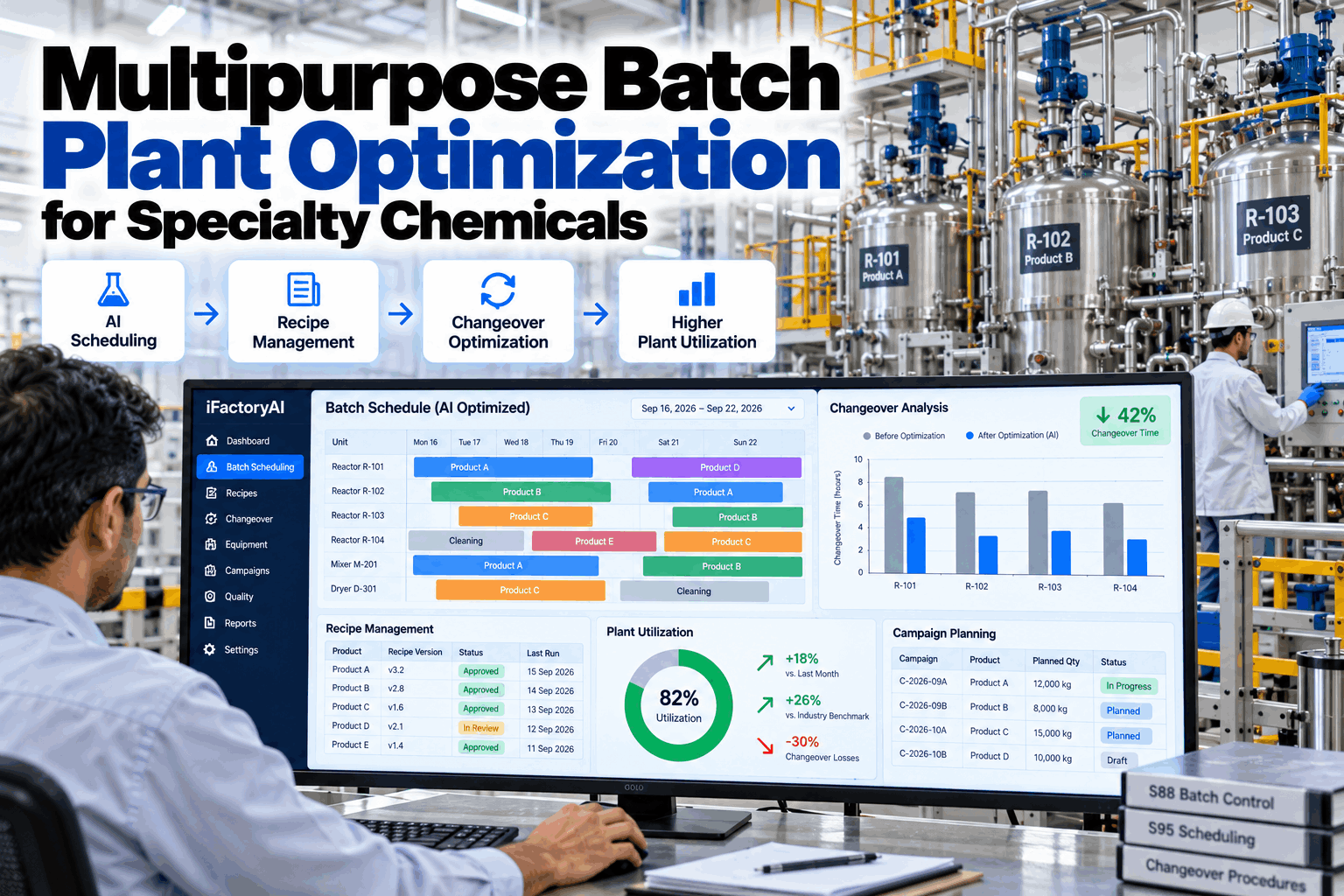
This week, one glass-lined reactor runs three products for two customers. Each switch needs a full clean, a swab result and a QC release before the next charge. When one campaign slips by a shift, the whole schedule behind it moves. This guide shows how AI scheduling, S88 recipes and smarter changeovers keep a multipurpose batch plant on plan. Start with a schedule review.
Multipurpose Batch Plant Optimization for Specialty Chemicals
Plan campaigns across shared reactors, dryers and filters with one view of recipes, cleaning and release. AI builds a feasible schedule, cuts changeovers and re-plans in minutes when a batch, a raw material or a customer date moves.
- Scheduling shared equipment trains without conflicts
- S88 recipes that move between trains
- Changeover and cleaning time cut by sequence
Why Multipurpose Plants Are So Hard to Schedule
Every product competes for the same reactors, and every switch costs a clean.
A dedicated plant runs one product on one line. A multipurpose plant runs dozens of products on shared equipment, in changing combinations, often for different customers. The scheduler is solving a puzzle where every piece depends on the others: which train can run which recipe, how long the clean takes between two products, when the raw material arrives and when QC can release the last batch. Spreadsheets cannot hold all of that at once, and a planner cannot test many options by hand. Our planning specialists can map your constraints.
Shared equipment
Reactors, filters and dryers are used by many products, often in different trains.
Product-pair cleaning
Clean time depends on what ran before and what runs next.
Campaign length
Longer campaigns cut cleans but tie up equipment and stock.
Hold times
Intermediates can only wait so long before the next step.
QC release
Analysis and cleaning verification gate the next batch.
People and skills
Certain steps need trained operators on the shift.
Reactors get the attention, but the real constraint in many specialty plants is a shared filter, dryer or QC lab. Build the schedule around whichever step limits the train, or the plan will look full on paper and stall on the floor. The bottleneck can also move as the product mix changes, so check it each planning cycle.
S88 Recipes: The Backbone of a Flexible Plant
Write the recipe once, run it on any train that can make it.
ISA-88 gives batch plants a common language. It separates what to make, the recipe, from where to make it, the equipment, and gives both a shared structure that every team can read. That separation is what lets a multipurpose plant move a product between trains without rewriting it. The standard defines four recipe types, from the chemistry in a lab to the control recipe running in a specific vessel. Map your recipes to S88 in a recipe review.
The chemistry and process, independent of any site or equipment.
Adapted to one site's materials, rules and language.
Written for a specific class of equipment that can run it.
The running copy for one batch on one unit, with actual values.
Procedural model
- Procedure
- Unit procedure
- Operation
- Phase
Physical model
- Process cell
- Unit
- Equipment module
- Control module
ISA-95 defines how the plant floor and business systems exchange orders, schedules and results. In a batch plant, it is the bridge between customer orders in ERP and the control recipes that run on each unit, so the schedule and the floor stay in step.
Cutting Changeover Time by Sequence
The fastest clean is the one the schedule avoids.
Not all changeovers cost the same. Moving between two batches of one product may need only a rinse. Moving between two products with different chemistry or potency may need a full clean, a verification swab and a lab release. A good schedule groups products to keep the expensive cleans rare. Questions about your cleaning rules go to our process team.
Longer campaigns
- Fewer cleans and swabs
- Higher output per reactor week
- More stock and longer wait for other products
Shorter campaigns
- Faster response to orders
- Lower stock and hold risk
- More cleaning time and more release steps
Record the clean needed and its real duration for every product pair that shares equipment. The schedule can only cut changeovers it can see, and actual durations are often far from the standard times in the SOP. Include the time to get swab or rinse results back from the lab, since release often takes longer than the clean itself.
What Better Sequencing Frees Up
Every full clean avoided returns reactor hours, cleaning solvent and lab time. Across a quarter of campaigns, the freed capacity is often enough to take on new business without new equipment.
How AI Batch Scheduling Works
All the constraints in, one feasible plan out.
AI scheduling reads orders, recipes, equipment capability, the cleaning matrix, stock and QC capacity, then builds a plan that respects every hard rule. It weighs soft goals such as fewer cleans, on-time delivery and higher utilisation, and shows the trade-off. When something changes, it re-plans the affected part instead of starting over. Plan a trial with a scheduling trial.
Inputs
- Customer orders and due dates
- Master recipes and batch sizes
- Which units can run which recipe
- Cleaning matrix by product pair
- Raw material and intermediate stock
- QC and operator capacity
Outputs
- Sequence per unit and train
- Campaign lengths
- Clean and release slots
- Material call-offs
- Late-order warnings
- What-if comparisons
Hard rules can never be broken: qualified equipment, required cleans, hold time limits and release steps. Goals are traded against each other: fewer cleans, on-time delivery, lower stock and higher utilisation. Keeping the two apart lets planners see exactly what each schedule gives up, and why.
What CDMOs Need on Top
Every customer brings their own process, rules and paperwork.
Contract manufacturers face everything a multipurpose plant does, plus customer-specific requirements on every campaign. The schedule has to respect each client's process, documentation and release steps without losing sight of the plant as a whole. Customer confidentiality also matters, since recipes and volumes for one client must never be visible to another. Questions about CDMO workflows go to our support desk.
Faster recipe start-up
Client processes brought into S88 master recipes and mapped to qualified units.
Per-client constraints
Dedicated equipment, cleaning limits and approvals set per customer.
Electronic history
Control recipe values, deviations and releases kept for each batch.
Confident promises
New requests tested against the live plan before the sales team commits.
When a new customer asks for capacity, test the request against the live schedule before saying yes. A quote built on real equipment, cleaning and release time protects existing customers and stops the plant from promising dates it cannot meet.
Batch Scheduling Mistakes to Avoid
Most bad schedules were built on missing data.
AI cannot fix a plan built on wrong batch times, unrecorded cleans or equipment that is not really qualified. The first weeks of any project are about getting those inputs right. A short rollout plan session helps set the order.
What works
- Batch and clean times taken from actual history
- Equipment qualification kept current per recipe
- Hard rules and soft goals clearly separated
- Planners able to lock and adjust parts of the plan
What fails
- Using SOP standard times that nobody achieves
- Recipes tied to one vessel instead of an equipment class
- Ignoring QC and cleaning verification time
- Re-planning the whole month for every small change
Track how closely each campaign followed the plan. Gaps between planned and actual batch, clean and release times show where the model needs better data and where the floor needs support. Share the result with planners and shift leads, so the plan and the floor improve together rather than drifting apart.
How iFactory Batch Scheduling AI Works
Recipes, equipment and orders in one on-prem planning engine.
iFactory Batch Scheduling AI connects to your ERP, batch control system, LIMS and historian through an on-prem AI server inside your network. It holds the S88 recipe and equipment models, learns real batch and clean times from history and builds schedules planners can trust and adjust. Fit questions go to our solutions team.
Feasible schedules
Plans that respect equipment, cleaning, hold time, QC and staffing rules.
S88 recipe management
Master recipes linked to equipment classes so products move between trains.
Changeover optimisation
Sequences chosen to cut full cleans using your product-pair cleaning matrix.
What-if planning
Rush orders, late materials and equipment outages tested before committing.
Learned durations
Batch, clean and release times learned from history instead of SOP estimates.
ERP and batch links
Orders in from ERP, control recipes out to the batch system, results back.
Results depend on your recipes, equipment data and how closely the plan is followed. We measure changeovers, utilisation and on-time delivery on your own data during the pilot, rather than promising a general figure.
Turnkey AI: Delivered, Connected and Live in 6–12 Weeks
You do not build this. It arrives ready.
iFactory ships as a pre-configured NVIDIA AI server with the software pre-loaded, racked and ready. Rack it, plug in power and Ethernet, and the AI is live on your network. Our team handles cabling, network setup, PLC, DCS, batch system, ERP and LIMS integration, planner training and 24×7 remote monitoring. Recipes and customer data stay on your network. For a scope matched to your plant, request a turnkey quote.
Ship, network and data
Server installed. Orders, recipes, equipment lists and batch history connected.
Model training and pilot
Cleaning matrix and durations learned from history. Pilot schedules on one train.
Go-live and training
Plant-wide scheduling live. Planners trained. 24×7 monitoring begins.
Frequently Asked Questions
What is a multipurpose batch plant?
It is a plant where shared equipment, such as reactors, filters and dryers, makes many different products in batches and campaigns. Specialty chemical makers and CDMOs use them to serve many products and customers with one set of assets.
What is ISA-88 and why does it matter here?
ISA-88, or S88, is the batch control standard. It separates recipes from equipment and defines general, site, master and control recipes. That separation lets one recipe run on any qualified train, which is essential in a multipurpose plant.
How does ISA-95 relate to batch scheduling?
ISA-95 defines how business systems and the plant floor exchange information. For scheduling, it links customer orders in ERP to the batches planned and run on the floor, and sends results back.
How does AI reduce changeover time?
It uses your cleaning matrix to sequence products so that full cleans are rarer, groups compatible products into campaigns and plans cleaning verification and release into the schedule instead of discovering it late.
Can the schedule handle customer-specific rules?
Yes. Dedicated equipment, approval steps, cleaning limits and documentation needs can be set per customer, and the schedule respects them alongside plant-wide rules.
Does our recipe and customer data leave the plant?
No. The scheduling AI runs on an on-prem server inside your network, which matters for CDMOs bound by customer confidentiality.
What is campaign manufacturing?
It means running several batches of the same product back to back on the same equipment before switching. Campaigns cut cleaning and changeover time, but longer ones tie up equipment and raise stock, so the best length depends on demand and cleaning cost.
Do we need a batch control system first?
No. Scheduling can start from orders, recipes, equipment lists and past batch times, even if recipes are still run from paper. Connecting a batch control system later lets control recipes flow straight from the schedule to the units.
How do we start?
Start with one equipment train and its main products. A 6-week pilot connects orders, recipes and batch history, learns real durations and produces the first feasible schedules. To plan it, contact our team.
Run More Batches on the Same Reactors
In thirty minutes we look at your trains, recipes, cleaning rules and how campaigns are planned today. You keep the notes whether or not you go further with iFactory.
- 1Your current campaign plan
- 2Equipment list and which units run which products
- 3Cleaning rules between product pairs
- 4Three months of actual batch and clean times
- 5The order you struggled to fit last quarter