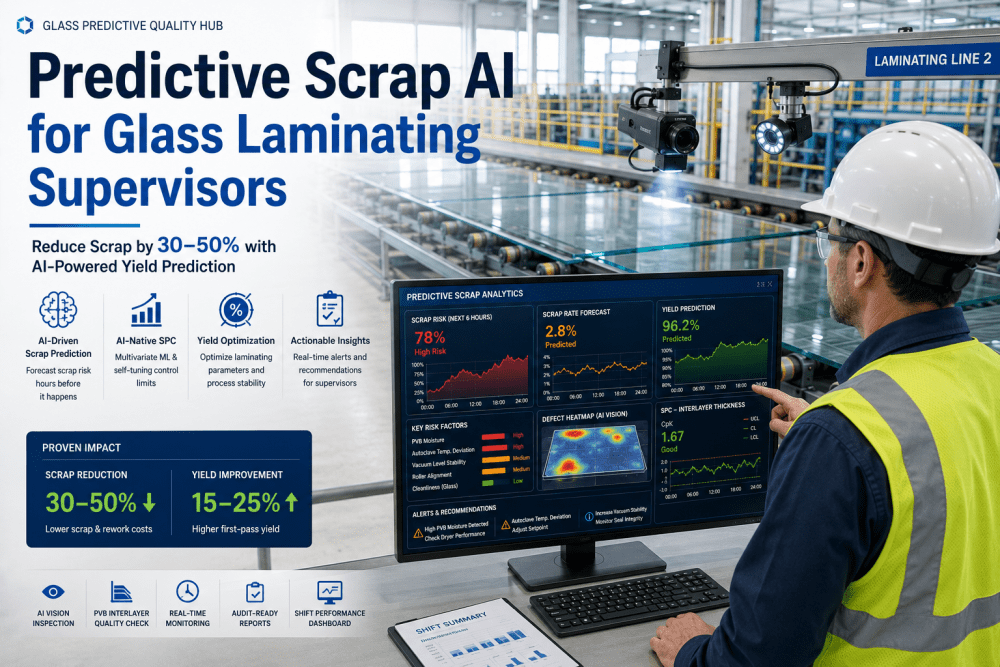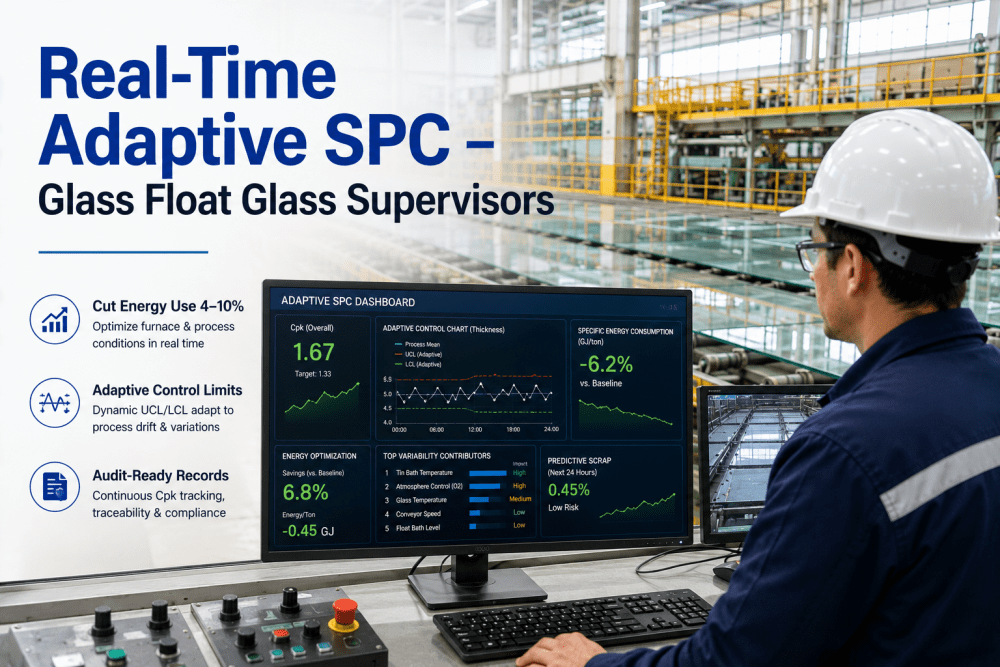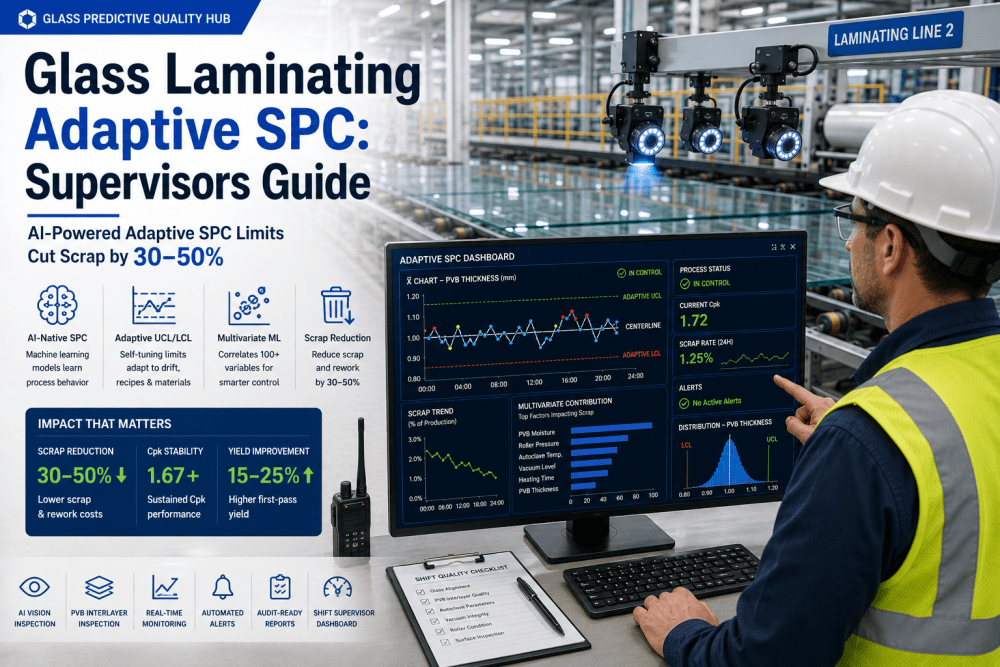
Adaptive SPC limits for glass laminating transform how supervisors approach scrap reduction by replacing static control limits with self-tuning thresholds that adjust to process drift, material variation, and ambient conditions in real time. Conventional SPC relies on fixed upper and lower control limits calculated from a historical baseline — but glass laminating processes are inherently non-stationary. PVB moisture content varies by lot, autoclave temperature gradients drift with seal wear, and ambient humidity shifts across seasons. Fixed limits generate excessive false alarms during normal variation or miss genuine defects when the process shifts. iFactory's adaptive SPC platform continuously recalculates control limits using multivariate machine learning models that distinguish common-cause variation from special-cause events — enabling supervisors to reduce scrap by 30–50% while maintaining statistically valid process control. Book a Demo to review the adaptive SPC architecture for your laminating operation.
Why Fixed SPC Limits Fail in Glass Laminating
Glass laminating supervisors rely on SPC charts to monitor process stability, but fixed control limits calculated from a static baseline cannot account for the inherent variability of laminating processes. When limits are too narrow, supervisors chase normal process variation with unnecessary adjustments. When limits are too wide, genuine defects pass through undetected until final inspection. The result is elevated scrap rates and reduced confidence in the SPC system as a decision-making tool.
How Adaptive SPC Transforms Process Control for Supervisors
iFactory's adaptive SPC platform combines multivariate machine learning, real-time limit calculation, and automated corrective action into a single workflow designed for shift-floor supervisors. The system continuously evaluates process behavior against dynamic norms that reflect current material, equipment, and environmental conditions — delivering actionable intelligence instead of static alarms. Supervisors evaluating their scrap reduction strategy regularly Book a Demo to see adaptive SPC configured for their laminating parameters.
The platform calculates dynamic upper and lower control limits for each laminating parameter using multivariate machine learning models trained on 24 months of production data. Models incorporate PVB lot characteristics, equipment condition metrics, ambient temperature and humidity, and production rate to establish context-specific control limits. When a new PVB lot is introduced, limits automatically widen or narrow based on the material's inherent variability — maintaining statistical validity without generating false alarms.
Real-time SPC dashboards display dynamic control limits alongside actual parameter readings, with color-coded alerts that distinguish common-cause variation from special-cause events. Green indicates normal operation within adaptive limits. Yellow signals a parameter approaching the dynamic threshold. Red indicates a special-cause event requiring immediate investigation. Supervisors receive alerts on shift-floor tablets with the specific variable, deviation magnitude, and recommended corrective action.
When a special-cause event is detected, the adaptive SPC platform automatically generates a corrective action recommendation based on the specific variable deviation and current process context. The recommendation is converted into a CMMS work order with the parameter history, dynamic limit threshold, deviation magnitude, and suggested parameter adjustment. Corrective action completion is tracked, and recurrence is monitored to confirm the fix is effective.
Implementation Framework for Laminating Lines
Deploying adaptive SPC follows a structured methodology designed for glass laminating environments — integrating with existing sensor infrastructure and control systems without production downtime.
Measurable Scrap Reduction Results
Within 8 weeks of deploying adaptive SPC across six laminating lines, the production team documented measurable improvements in scrap reduction, alarm validity, and process capability — validated through production data and quality system records.
| Metric | Fixed SPC Limits | Adaptive SPC Limits | Improvement |
|---|---|---|---|
| Monthly Scrap Rate | 8.6% | 4.8% | 44% reduction |
| False Alarm Rate (per shift) | 5.3 | 3.2 | 40% reduction |
| Special-Cause Detection Time | 3.2 hours | 1.1 hours | 66% faster |
| Cpk Stability Range (weekly) | ±0.38 | ±0.11 | 71% improvement |
| Process Adjustment Frequency | 8.2 per shift | 4.1 per shift | 50% reduction |
| Supervisor Time on Prevention | 35% of shift | 72% of shift | +37 points |
What Industry Experts Say
Building a Smarter SPC Strategy for Laminating Operations
The transition from fixed to adaptive SPC limits transforms how supervisors manage process control in glass laminating. Instead of chasing false alarms or missing genuine defects, supervisors gain a statistically valid monitoring system that adjusts to real-time conditions — enabling earlier intervention, fewer unnecessary adjustments, and sustained scrap reduction. The iFactory platform integrates adaptive SPC with existing CMMS, MES, and quality systems to create a unified process control workflow.
Frequently Asked Questions
Traditional fixed-limit SPC calculates control limits once from a historical baseline and applies them indefinitely. Adaptive SPC recalculates limits dynamically — every 30 seconds — using multivariate machine learning models that incorporate current material lot characteristics, equipment condition metrics, and ambient conditions. This enables the system to distinguish between common-cause variation (normal process fluctuation) and special-cause events (genuine defects requiring intervention), reducing false alarms by 40% while improving defect detection sensitivity.
Adaptive SPC limits are applied to all critical laminating parameters including pre-press nip roll temperature and pressure, autoclave temperature gradient across zones, autoclave pressure ramp rate, cool-down rate profile, PVB moisture content at layup, glass preparation cleanliness scores, ambient temperature and humidity, and final bond quality metrics. Each parameter has a machine learning model that determines the appropriate dynamic limit calculation based on its historical behavior and sensitivity to material and environmental factors.
The platform connects to existing laminating line PLCs, autoclave controllers, pre-press systems, and environmental sensors via OPC-UA and Modbus TCP. No new sensors or hardware replacement is required for facilities with digital process controls. Historical data from 24+ months is used for initial model training. For facilities with limited digital infrastructure, iFactory provides IoT retrofitting packages for temperature, pressure, and humidity monitoring with edge gateway connectivity.
Adaptive SPC limits adjust within one production cycle of detecting a material or condition change. When a new PVB lot is introduced, the platform identifies the lot-specific characteristics through sensor data and production parameters within the first 3–5 cycles. Dynamic limits automatically recalibrate to the new material's inherent variability profile — widening or narrowing as appropriate — without requiring manual intervention or supervisor input.
Facilities with 4+ laminating lines and scrap rates exceeding 6% typically recover platform investment within 3–5 months. Primary ROI drivers include scrap material cost reduction, eliminated false alarm investigation time, reduced process adjustment labor, improved Cpk reducing customer quality rejections, and extended equipment life through proactive drift detection. A personalized ROI analysis is provided during the Book a Demo consultation with iFactory's glass manufacturing team.