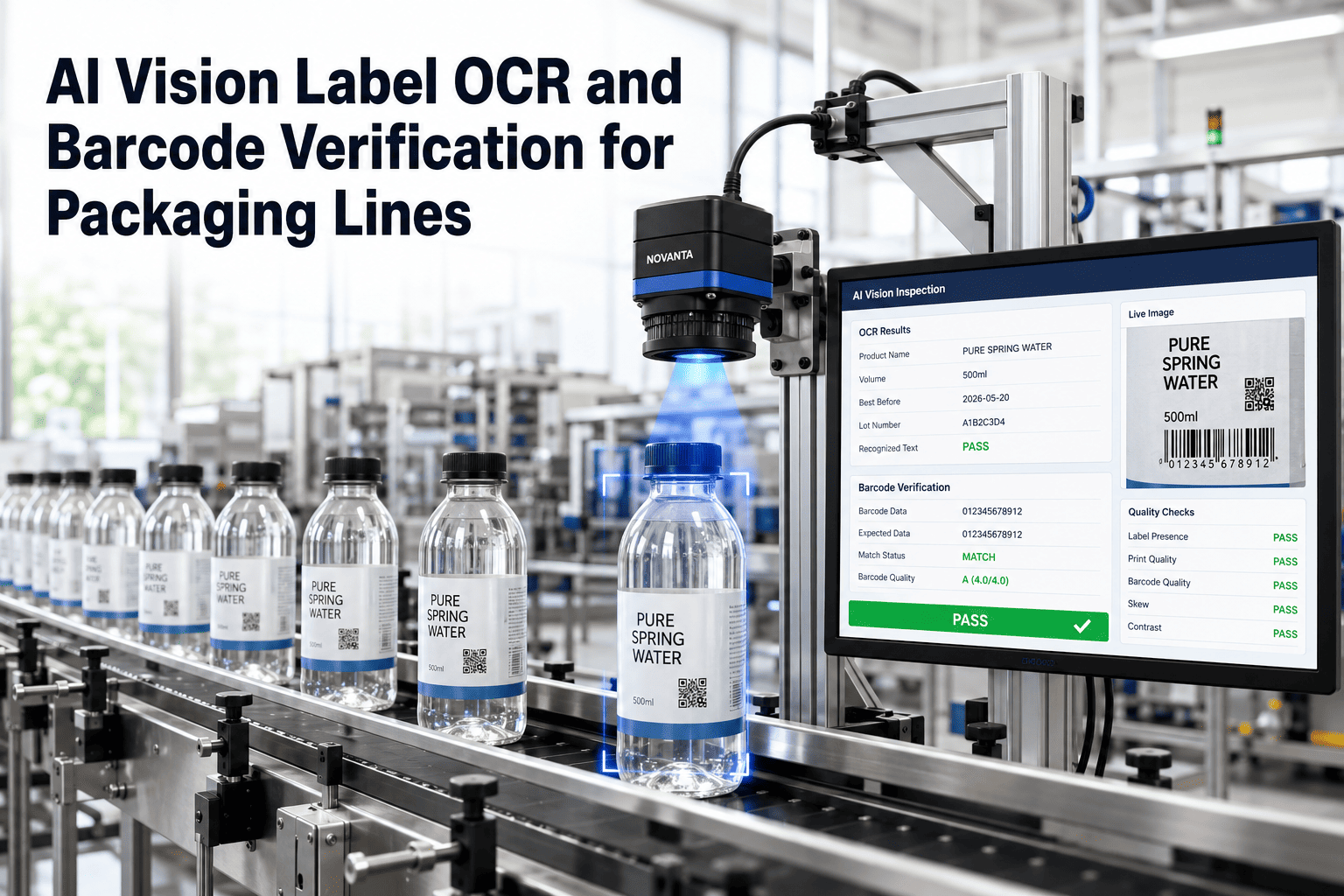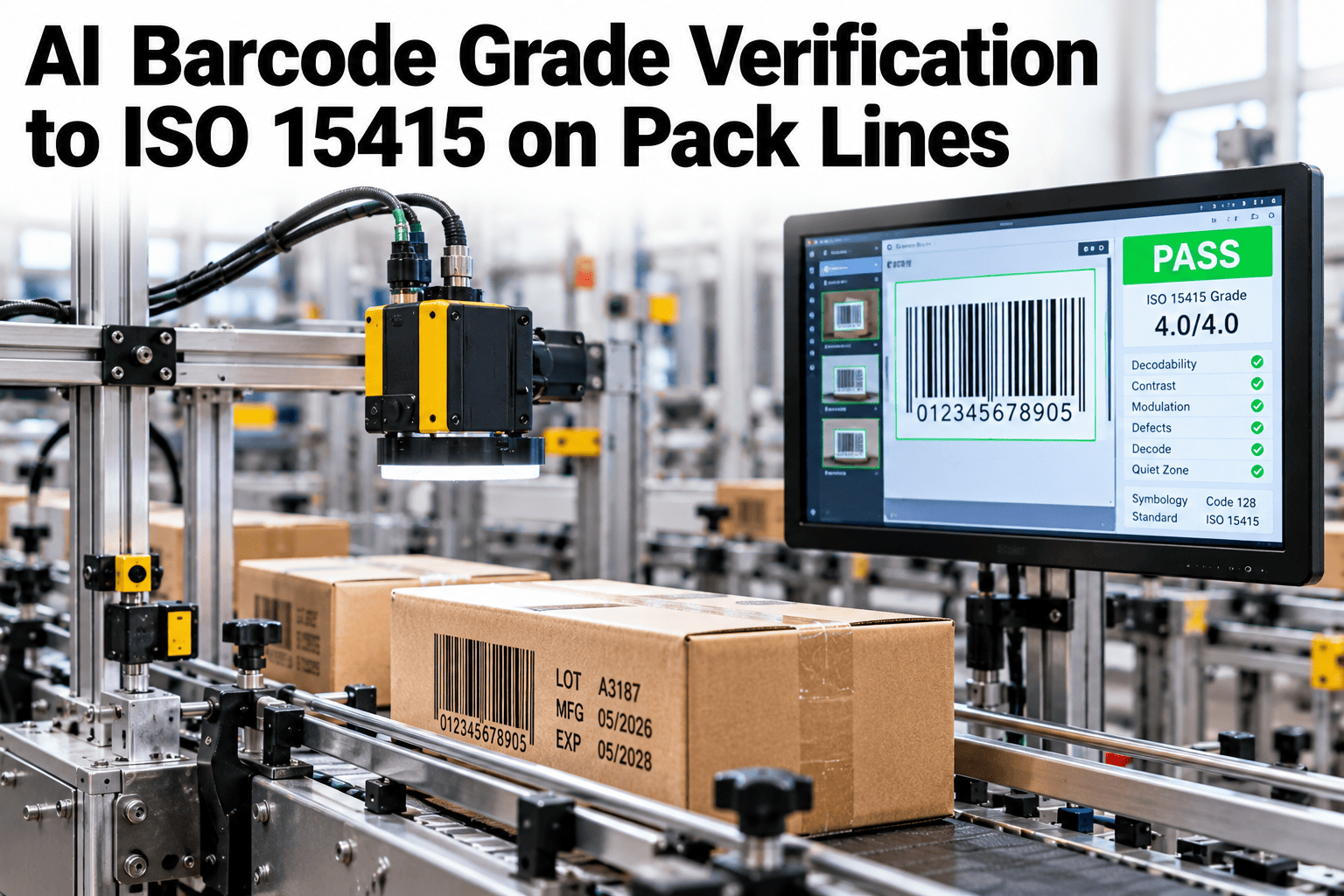
A barcode that scans cleanly on the plant floor, under controlled lighting with a handheld scanner held at the ideal angle, can still fail at a retail distribution center running a fixed automated scanner under very different conditions. Scanning in the plant confirms the code is readable right now, under these conditions; it says nothing about the print quality margin that keeps it readable under worse ones. ISO 15415 grading measures that margin directly, scoring contrast, decode quality and several other parameters against the actual standard retailers and distribution centers expect, not just a pass or fail scan result. Packaging quality managers relying on a simple scan check can see barcode grade verification run against ISO 15415 live before the next shipment gets flagged at a distribution center.
AI Barcode Grade Verification to ISO 15415 on Pack Lines
Print quality checked against the actual grading standard, not just whether the code scans on the plant floor.
Why "It Scanned" Isn't the Same as "It's Graded Well"
A scan confirms readability under one set of conditions. Grading measures how much margin exists beyond that.
A code scanning fine today may be barely above the readability threshold under different conditions.
Plant handheld scanners and retail fixed scanners read codes under very different conditions.
A failed scan at a distribution center can trigger chargebacks or rejected shipments.
Grading against ISO 15415 shows the actual quality margin, not just whether the code happened to scan once.
What ISO 15415 Actually Measures
The standard scores several distinct parameters, not a single readability number.
| Parameter | What It Checks |
|---|---|
| Symbol contrast | Difference between the darkest and lightest elements of the code |
| Print growth | Whether printed elements match their intended size |
| Decode quality | Whether the code decodes correctly against the expected data |
| Fixed pattern damage | Whether finder and alignment patterns are intact and undamaged |
Grade Your Own Codes Against the ISO Standard
Book a 30-minute session and bring a sample of printed codes. iFactory AI will show the actual ISO 15415 grade behind each one.
What iFactory AI Supports
Codes are graded continuously on the line, not sampled periodically or checked only with a handheld scanner.
Continuous ISO 15415 Grading
Every code is graded on the line against the full standard, not sampled occasionally.
Print Quality Trending
Grade trends over time flag a printer or plate wearing down before codes start failing outright.
GS1 Compliance Checks
Codes are checked against GS1 and retailer-specific compliance requirements.
Scan Failure Prevention
Low-grade codes are flagged before shipment, not discovered at a distribution center.
iFactory AI integrates camera-based grading with existing pack lines. Scope covers camera setup, grading model calibration, team training and ongoing support.
Expert Review
The grade trend over time is often more valuable than any single grade on its own. A print head or plate wearing down shows up as a slow decline in grade well before a code actually fails to scan, giving the quality team a window to act before shipments are affected.
Chargebacks and rejected shipments tied to scan failures are usually traced back to a code that scanned fine at the plant but had almost no quality margin beyond that. Grading against the actual standard is what catches that gap before a distribution center does.
Frequently Asked Questions
How is ISO 15415 grading different from a standard barcode scanner check?
A standard scanner confirms the code decodes correctly under its own reading conditions, while ISO 15415 grading measures specific quality parameters like contrast and print growth that determine how much margin exists beyond a simple pass. A code can scan and still grade poorly. See both checks compared in a live session.
What grade do most retailers actually require?
Requirements vary by retailer and contract, with many major retailers specifying a minimum grade in their packaging compliance guidelines. Ask support about checking your specific retailer requirements.
Can this grade 2D codes as well as traditional barcodes?
Yes, grading covers both linear barcodes and 2D codes such as QR and DataMatrix, each against the appropriate standard for that symbology. Request a 2D code grading example.
Does this replace our handheld verifier equipment?
Continuous line grading complements a handheld verifier rather than replacing it outright, since the handheld remains useful for spot checks and troubleshooting, while line grading covers every code rather than a sample. Contact support about integrating both approaches.
How long before grading is calibrated and matches our reference verifier?
Most lines have grading validated against a reference verifier within five to eight weeks, confirming the camera-based grades match known results before relying on it for production decisions. Book a session to estimate your own timeline.
Know Your Actual Grade, Not Just Whether It Scanned
iFactory AI grades every code against ISO 15415 on the line. Book a walkthrough on your own packaging.