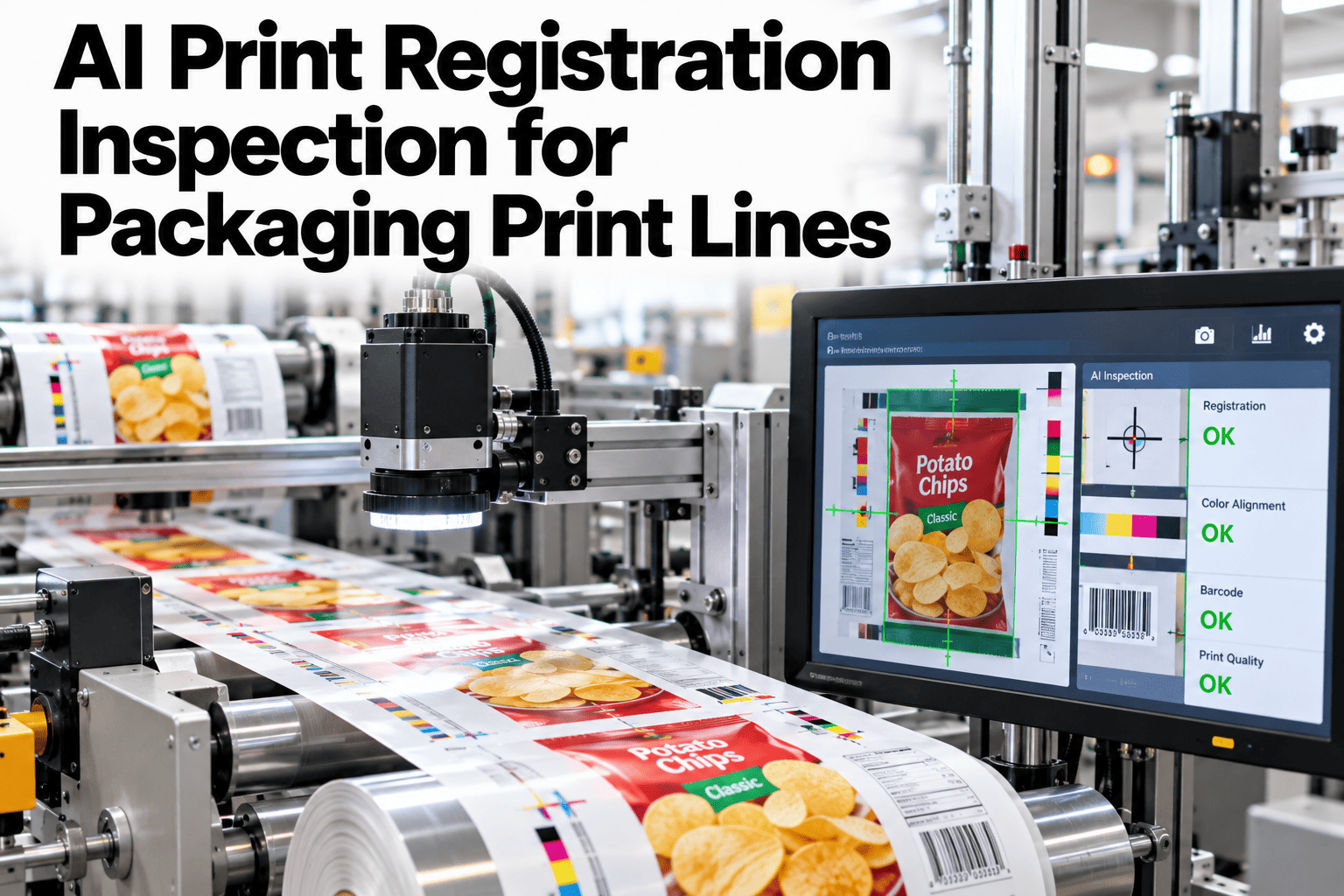
Registration drift on a flexo press rarely announces itself. The color-to-color shift starts small, a fraction of a millimeter, and by the time it has grown enough for an operator walking past the unwind to notice, dozens or hundreds of meters of printed material have already run with visibly misaligned color. Checking registration manually at fixed intervals catches the drift eventually, but eventually is the problem: every meter printed between checks is at risk, and a press running fast can produce a lot of waste in the gap between one manual check and the next. AI-based registration inspection checks color-to-color alignment continuously, catching drift within a few meters instead of a full roll. Print production managers rethinking this gap can see registration drift caught within meters on a live print line before the next roll runs unchecked.
AI Print Registration Inspection for Packaging Print Lines
Color-to-color registration checked continuously, catching drift within a few meters, not a full roll.
Illustrative registration drift: each layer shifting slightly further from the one before it
Why Manual Checks Catch Drift Too Late
A fixed-interval manual check leaves a gap where drift can grow unnoticed.
Every meter printed between manual checks runs at risk of undetected drift.
Drift builds gradually, often invisible to the eye until it has already become significant.
A fast press can produce a large volume of waste in the time it takes to notice a drift visually.
Continuous inspection removes the gap entirely, catching drift at the meter it starts rather than the roll it is discovered.
What Continuous Inspection Actually Checks
Registration inspection tracks more than a single alignment number.
Color-to-Color Alignment
Each color layer is checked against the others for consistent registration.
Print Repeat Accuracy
Repeat length is monitored to catch drift that accumulates over the length of the run.
Drift Direction and Rate
The system tracks whether drift is growing, stable or correcting itself over time.
Press Setup Verification
Initial setup is checked against target before a full production run begins.
Check How Much Drift Your Current Check Interval Misses
Book a 30-minute session and bring your current inspection schedule. iFactory AI will show the gap between checks on a live run.
Manual Checks vs Continuous Inspection
The difference shows up most clearly in how much waste is produced before drift is caught.
| Factor | Manual Interval Checks | Continuous Inspection |
|---|---|---|
| Detection window | Gap between scheduled checks | Within a few meters |
| Waste exposure | Full gap length at risk | Limited to the short detection window |
| Operator dependency | Depends on visual judgment and timing | Consistent, automated check every meter |
What iFactory AI Supports
Registration is checked continuously, with alerts that reach the press operator fast enough to act.
Real-Time Drift Alerts
A drift exceeding tolerance is flagged within meters, not at the next scheduled check.
Waste Reduction Tracking
Waste avoided through early detection is tracked and reported over time.
Multi-Color Monitoring
All color stations are checked against each other continuously, not one at a time.
Setup and Run Comparison
Current run performance is compared against the verified press setup baseline.
iFactory AI integrates camera inspection with existing press control systems. Scope covers camera placement, model calibration, team training and ongoing support.
Expert Review
The waste avoided from early detection usually dwarfs the cost of the inspection system itself, but it is easy to underestimate until a plant actually measures the gap between manual check intervals. A fast press running even twenty minutes with undetected drift can produce a meaningful amount of scrap.
Drift direction and rate matter as much as the current alignment value. A registration that is drifting steadily, even within tolerance today, is a different situation than one holding stable near the same limit, and the two deserve different operator responses.
Frequently Asked Questions
Does this work with our existing press cameras or do we need new ones?
Some presses already have inspection cameras that can be used, while others need cameras added as part of the setup. Either way, the inspection model is calibrated to the specific press and print job. Ask about your current camera setup in a working session.
How does the system handle changing print jobs on the same press?
Each print job has its own target registration and tolerance, set during setup verification, so switching jobs updates the baseline the inspection checks against rather than requiring a manual reconfiguration. Ask support about multi-job configuration.
What happens when a drift alert fires mid-run?
The operator is alerted with the specific color stations and the size of the drift, giving them the chance to adjust the press before more material runs out of tolerance. See a mid-run alert in a live session.
Can this reduce the startup waste at the beginning of a run?
Yes, setup verification against the target registration speeds up getting the press into tolerance before full production starts, which is often a significant source of waste on its own. Contact support about reducing startup waste.
How long before the system is calibrated and trusted for production?
Most presses are calibrated and validated within five to eight weeks, including a period comparing the system's detection against known drift events before relying on it to run unsupervised. Book a session to estimate your own timeline.
Catch Registration Drift Within Meters, Not a Full Roll
iFactory AI checks color-to-color registration continuously on your press. Book a walkthrough on your own print line.