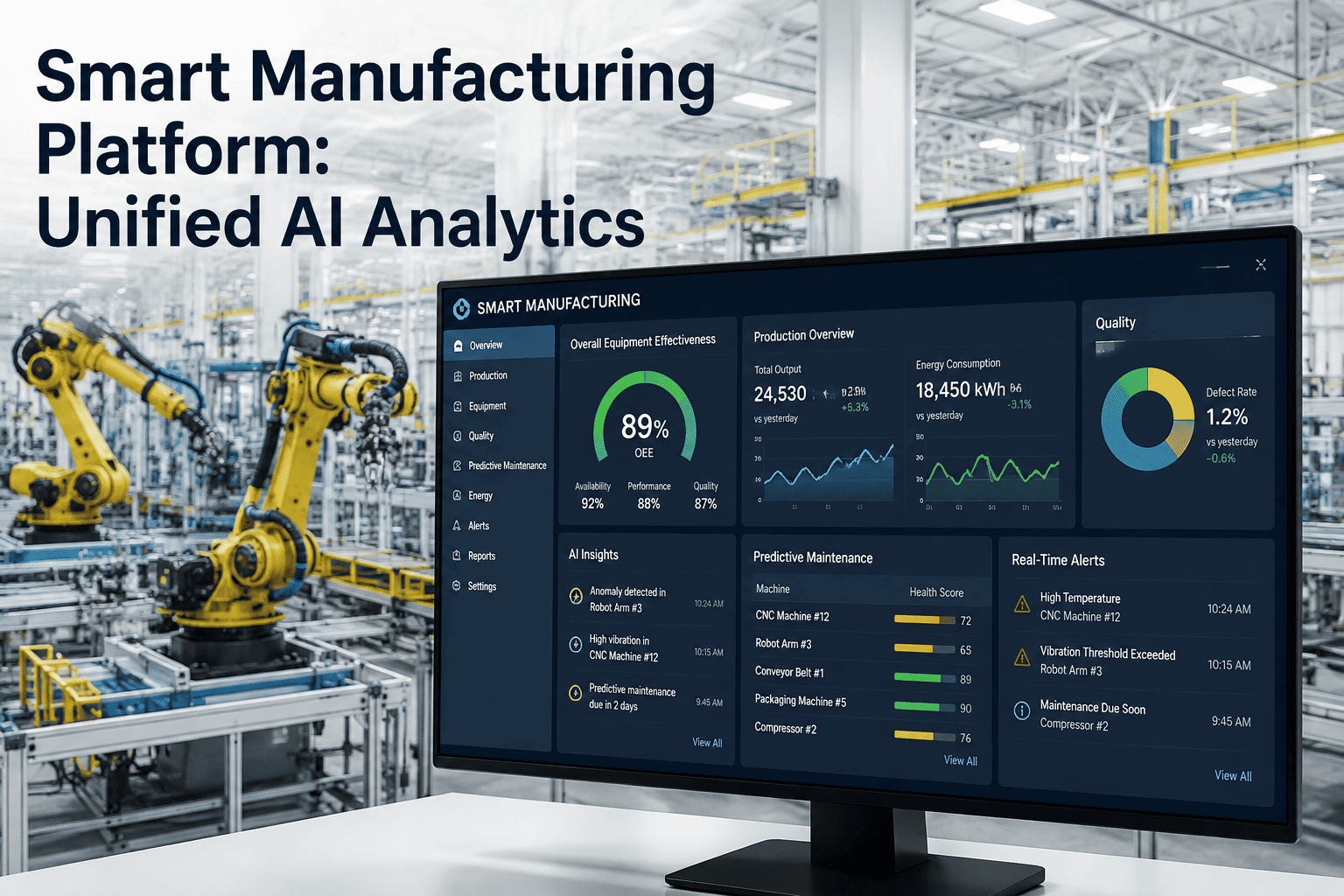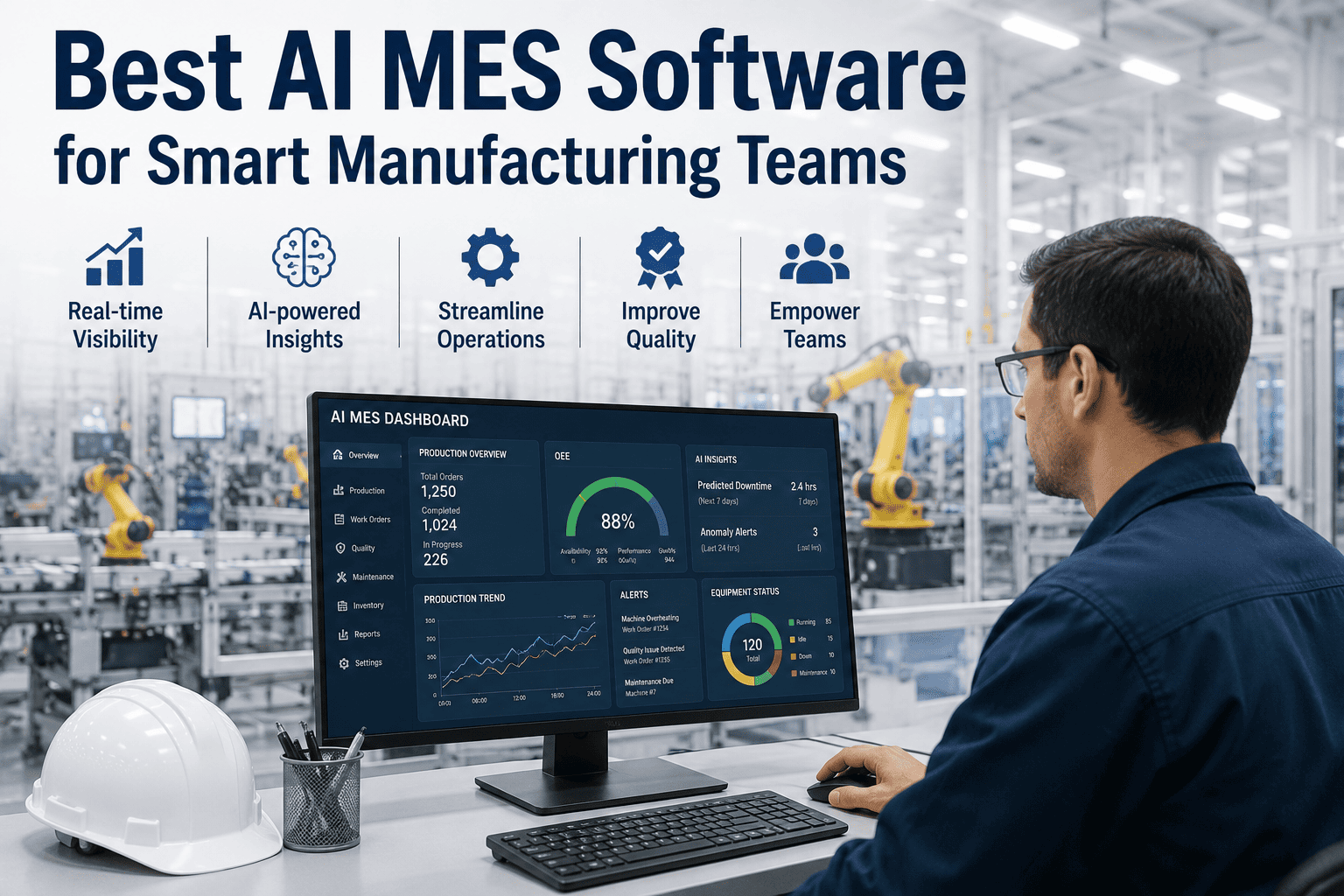
The United States manufacturing sector spans 84 distinct industry groups across NAICS codes 31, 32, and 33 — from food processing and textile mills to semiconductor fabrication and aerospace assembly. Each of these 84 groups faces a shared operational reality in 2026: unplanned downtime averaging $260,000 per hour across all sectors, a skilled-labor gap exceeding 425,000 unfilled positions nationwide, and production complexity that manual monitoring, shift-based walkdowns, and threshold-based SCADA alarms can no longer keep pace with. Yet U.S. Census Bureau survey data shows that 87% of American manufacturers still have not integrated AI into any business function, even as early adopters report 35% to 50% reductions in unplanned stoppages within their first year of deployment. iFactory delivers an AI-native smart factory platform engineered to map directly onto NAICS manufacturing workflows — from raw material intake through finished-goods dispatch — giving plant managers, COOs, and digital transformation leaders a single system that covers vision-based quality inspection, predictive maintenance, production analytics, and real-time OEE tracking across every subsector in the manufacturing economy. Explore how it applies to your specific NAICS group with a Book a Demo.
One AI Platform. 84 NAICS Industry Groups. Zero Blind Spots on the Floor.
iFactory is the AI-native manufacturing platform built to serve every U.S. manufacturing subsector — food, chemicals, metals, electronics, transportation equipment, and 16 more — with computer vision, predictive analytics, and real-time production intelligence that deploys in weeks, not years.
21 Subsectors. 84 Industry Groups. One Platform.
NAICS organizes U.S. manufacturing into three top-level sectors — 31, 32, and 33 — which break down into 21 subsectors and 84 industry groups. iFactory's modular AI architecture maps onto every one of them, because the core operational challenges — quality variance, unplanned stoppages, throughput bottlenecks, and labor-dependent inspection — are structurally identical across the manufacturing economy regardless of whether the plant transforms raw chemicals into pharmaceuticals, stamps sheet metal into automotive components, or assembles electronic circuits onto printed boards. The difference between subsectors is not in the problem structure — it is in the specific failure modes, inspection criteria, and regulatory requirements that the AI models must be trained against, which is exactly what iFactory's industry-specific configuration handles during deployment.
Sector 31
Sector 32
Sector 33
Why 87% of Plants Are Still Running Without AI — and What It Costs Them
AI adoption in U.S. manufacturing climbed from 1.8% in September 2023 to 13.9% by February 2026 — a sevenfold increase that still leaves nearly nine out of ten plants operating without any AI integration. The barriers are not theoretical. They are infrastructure readiness gaps, talent shortages in data engineering and industrial AI, and sequencing problems that cause plants to invest in the wrong capability first and abandon the initiative before value materializes — obstacles that most platform vendors ignore entirely because addressing them requires a deployment model built around the plant's current state, not an idealized digital transformation roadmap.
Have Cloud and Sensors — Not AI
Deloitte's 2025 survey found that 57% of manufacturers have deployed cloud computing and data analytics at the facility level, but only 29% have operationalized AI or ML at the same scale. The prerequisite infrastructure is in place at most mid-to-large plants — the missing piece is a platform that converts sensor data into actionable intelligence without requiring a dedicated data science team.
Unfilled Positions Blocking Scale
The manufacturing labor gap exceeds 425,000 unfilled positions, and 86% of employers now identify AI and machine vision as their primary levers for bridging this shortfall. Plants that cannot hire enough inspectors, reliability engineers, or process analysts are the ones most likely to benefit from AI that automates the pattern-recognition work these roles perform — provided the AI deploys fast enough to matter.
Task Hours Remain Human-Driven
Deloitte's 2026 Manufacturing Outlook found that over 81% of task hours in manufacturing are expected to stay human-driven. The most successful AI implementations position the technology as workforce augmentation — freeing operators from repetitive data-intensive monitoring so they can focus on judgment calls, problem-solving, and process improvement that machines cannot replicate.
Average ROI for Early Adopters
Manufacturers that have deployed AI report an average 200% return on investment according to the Capgemini Smart Factories Report 2025. The ROI comes from converging gains — reduced scrap rates, lower unplanned downtime, compressed changeover times, and better schedule adherence — rather than from any single application, which is why a platform covering multiple use cases outperforms point solutions.
Your NAICS Group Has a Downtime Number. Do You Know Yours?
iFactory benchmarks your plant's unplanned downtime cost by cause, asset, and shift — then shows you the AI prevention strategy that cuts it fastest.
Five AI Capabilities That Work Across All 84 Industry Groups
iFactory is not an AI wrapper on top of a legacy MES or SCADA system. It is a purpose-built AI platform with five core capabilities designed to address the operational problems that every NAICS manufacturing group shares — regardless of whether the plant produces pharmaceuticals, fabricated steel, or consumer electronics.
AI Vision Inspection
Computer vision cameras mounted at critical quality checkpoints detect surface defects, dimensional variance, color deviation, label misplacement, and foreign-object contamination in real time. Models are trained on your specific product line, not generic image libraries, meaning detection accuracy reflects actual production conditions from day one of baseline calibration. The system replaces the most repetitive and fatigue-prone inspection tasks — the ones where human accuracy drops below 80% after the first two hours of a shift — while escalating ambiguous findings to operators for judgment-based review.
Predictive Maintenance
Vibration patterns, thermal profiles, motor current signatures, and historical failure data feed into failure-probability models that flag degradation weeks before it causes a stoppage. Maintenance teams receive prioritized work orders ranked by risk severity and production impact — not just a list of alerts. This converts maintenance from a calendar-driven or breakdown-driven activity into a condition-based discipline, which is the single operational change most consistently associated with 35% to 50% reductions in unplanned downtime across manufacturing sectors.
Production Analytics
Real-time OEE tracking breaks down availability, performance, and quality losses by line, shift, product, and operator — surfacing the specific bottlenecks that account for the largest share of lost throughput. Most plants discover that 60% to 70% of their OEE gap is concentrated in three to five root causes that were previously invisible because the data was scattered across spreadsheets, shift logs, and SCADA historians that nobody had time to cross-reference. iFactory centralizes this analysis and updates it continuously.
Energy and Resource Monitoring
Energy consumption data correlated against production output reveals which machines, processes, and operating patterns are driving cost-per-unit higher than the plant-level average. For energy-intensive subsectors like primary metals (NAICS 331), chemicals (NAICS 325), and nonmetallic mineral products (NAICS 327), even a 5% to 8% reduction in energy-per-ton translates into six-figure annual savings. The system also tracks water, compressed air, and steam usage where those utilities represent significant production inputs.
Safety and Compliance Monitoring
AI vision and sensor analytics extend to safety-critical monitoring — PPE compliance verification, restricted-zone incursion detection, ergonomic risk flagging, and environmental emission tracking. For manufacturers operating under OSHA, EPA, FDA, or sector-specific regulatory frameworks, the system provides audit-ready logs that document compliance status continuously rather than relying on periodic manual inspections that capture a single moment in time and miss everything between rounds.
AI Impact by NAICS Subsector — Downtime Cost, Primary Use Case, and Deployment Priority
The table below maps the highest-impact NAICS subsectors to their estimated hourly downtime cost, the AI capability that delivers the fastest ROI, and the typical deployment priority for plants beginning their smart manufacturing journey. Use it to identify where your operation sits and what iFactory would address first.
| NAICS Subsector | Est. Downtime Cost / Hour | Highest-Impact AI Capability | Deployment Priority |
|---|---|---|---|
| 311 — Food Manufacturing | $30K - $150K | Vision Inspection (contamination, labeling) | Quality first, then predictive maintenance |
| 325 — Chemical Manufacturing | $100K - $500K | Predictive Maintenance (reactor, pump failure) | Maintenance first, then safety monitoring |
| 326 — Plastics and Rubber | $50K - $200K | Production Analytics (cycle time, scrap rate) | OEE analytics first, then vision inspection |
| 331 — Primary Metals | $150K - $1M+ | Energy Monitoring (furnace optimization) | Energy first, then predictive maintenance |
| 332 — Fabricated Metal Products | $40K - $180K | Vision Inspection (weld, surface defect) | Quality first, then production analytics |
| 333 — Machinery Manufacturing | $60K - $250K | Production Analytics (assembly throughput) | OEE analytics first, then maintenance |
| 334 — Computer and Electronics | $200K - $1.8M | Vision Inspection (micro-defect, solder joint) | Quality first, then yield analytics |
| 336 — Transportation Equipment | $500K - $2.3M | Predictive Maintenance (line-stop prevention) | Maintenance first, then safety compliance |
| 327 — Nonmetallic Minerals | $80K - $300K | Energy Monitoring (kiln, crusher efficiency) | Energy first, then production analytics |
| 339 — Miscellaneous Manufacturing | $20K - $100K | Production Analytics (batch tracking, OEE) | Analytics first, then vision inspection |
What Happens When a Plant Delays AI Adoption by 12 Months
The most expensive decision in manufacturing technology is not choosing the wrong platform — it is delaying the decision itself. Every month a plant operates without AI-driven predictive maintenance, vision-based quality inspection, and real-time production analytics, it accumulates costs that compound silently across the P&L. The comparison below quantifies what a mid-sized manufacturing facility — 200 employees, two production lines, running three shifts — typically loses by postponing deployment for one year.
Without AI — Annual Loss Exposure
With iFactory — First-Year Recovery
From Pilot Line to Plant-Wide AI in Four Phases
iFactory deploys with turnkey NVIDIA hardware, pre-configured for your plant's specific NAICS vertical. The typical timeline from contract to first production insight is 6 to 12 weeks — not the 12-to-18-month integration cycle that legacy MES vendors require, and not the multi-year digital transformation projects that consume capital without delivering measurable production improvements in their first year. The roadmap below shows how a single-line pilot expands into full plant coverage through a phased approach designed to generate ROI at every stage rather than requiring full-scale deployment before any value is realized.
Phase 1 — Week 1 to 3
Site Assessment and Hardware Staging
iFactory engineers conduct a remote and on-site assessment of your highest-priority line, identifying camera placement points, sensor integration requirements, network topology, and baseline data sources. NVIDIA edge hardware is pre-configured off-site and shipped ready to mount, eliminating weeks of on-site build time.
Phase 2 — Week 3 to 6
Pilot Line Deployment and Model Training
Hardware installs on the pilot line during a planned maintenance window. AI models begin baseline calibration using your actual production data — product images, vibration signatures, energy profiles — so that detection accuracy reflects your facility's real-world conditions, not generic training sets. Initial dashboards go live within days of installation.
Phase 3 — Week 6 to 12
Validation, Optimization, and ROI Measurement
The pilot line runs under AI monitoring alongside existing processes, generating side-by-side performance comparisons that quantify the value of early defect detection, predictive maintenance alerts, and OEE improvement. This validation period builds the internal business case for expanding coverage to additional lines and capabilities.
Phase 4 — Month 3 to 6
Plant-Wide Rollout and Multi-Site Expansion
Proven configurations replicate across remaining production lines and, for multi-site operations, across facilities. Each expansion reuses the models, dashboards, and alert configurations validated during the pilot, compressing subsequent deployment timelines to days rather than weeks. Enterprise-level analytics aggregate performance data across all sites for executive visibility.
We evaluated three smart manufacturing platforms before selecting iFactory. The other two required 6-month integration timelines and dedicated data engineering teams we did not have. iFactory deployed on our pilot extrusion line in four weeks, identified a recurring bearing degradation pattern the maintenance team had been chasing for months, and paid for the first year of the platform in avoided downtime within 90 days. We are now rolling out across all five lines and planning a second-site deployment.
Frequently Asked Questions
Q: How does iFactory handle the differences between NAICS subsectors — does a food plant use the same AI models as a metals plant?
No. While the underlying platform architecture is shared, the AI models are trained specifically on the product, process, and failure patterns of each facility. A food manufacturing plant (NAICS 311) will have vision models calibrated for contamination detection, label accuracy, and packaging integrity, while a primary metals facility (NAICS 331) will have models focused on surface defects, thermal anomalies, and furnace energy profiles. This industry-specific model training is what separates iFactory from generic analytics dashboards that provide data visualization without actionable intelligence. During your initial assessment, the engineering team maps AI capabilities to your specific NAICS group's operational priorities — Book a Demo to start that conversation.
Q: Our plant already uses a SCADA system and a CMMS — does iFactory replace them or integrate alongside them?
iFactory integrates alongside your existing SCADA and CMMS infrastructure rather than replacing it. The platform ingests data from SCADA historians, PLC outputs, and sensor feeds, adds an AI intelligence layer on top of that raw data, and pushes prioritized alerts and work orders back into your existing CMMS workflow. This means your operators and maintenance teams continue using the tools they already know, but the intelligence behind the alerts, priorities, and recommendations comes from AI models that can detect patterns human monitoring and threshold-based alarms consistently miss. Integration typically requires minimal IT lift during deployment, and specific connectivity questions can be discussed with the engineering team through Support Contact.
Q: What does the turnkey NVIDIA hardware include, and does our plant need any existing AI infrastructure to run it?
The turnkey hardware package includes NVIDIA edge computing units pre-loaded with iFactory's AI software, industrial-grade cameras configured for your specific inspection and monitoring points, and all necessary networking components for on-premises data processing. No existing AI infrastructure is required — the system is designed to deploy into plants that have never run AI workloads before. Edge processing means production data stays on-site and is analyzed in real time without requiring cloud connectivity for critical alerting, which addresses both latency and data-security concerns common in regulated manufacturing environments.
Q: What kind of ROI timeline should we expect, and how is it measured?
Most facilities see measurable ROI within the first 90 days of pilot deployment. iFactory measures return across four dimensions: avoided downtime cost from predictive maintenance alerts that prevented unplanned stoppages, scrap reduction from vision-detected quality defects caught before downstream processing, energy savings from optimized equipment operating parameters, and labor efficiency gains from automated monitoring tasks that previously required dedicated operator attention. The platform's analytics dashboard tracks these savings continuously, giving operations and finance teams a real-time view of the system's financial impact rather than requiring quarterly manual ROI calculations. Reach out via Book a Demo to see the ROI dashboard with sample data from your NAICS vertical.
Q: Is iFactory suitable for small and mid-sized manufacturers, or is it designed only for large enterprise plants?
iFactory's modular architecture is specifically designed to scale from single-line deployments at small and mid-sized manufacturers to multi-site enterprise rollouts. Census data shows that company size is the strongest predictor of AI adoption in manufacturing, not because smaller plants have fewer problems, but because traditional AI solutions require large IT teams and long integration cycles that small manufacturers cannot support. iFactory's turnkey deployment model and pre-configured hardware eliminate both barriers, making the platform accessible to plants with as few as one production line and no existing AI or data science staff. Contact Support Contact to discuss deployment options for your plant size.
Your Industry Group Is Already Mapped. See the AI Strategy for Your NAICS Code.
Tell us your NAICS subsector, and we will show you the exact deployment configuration, ROI model, and timeline that applies to your plant.