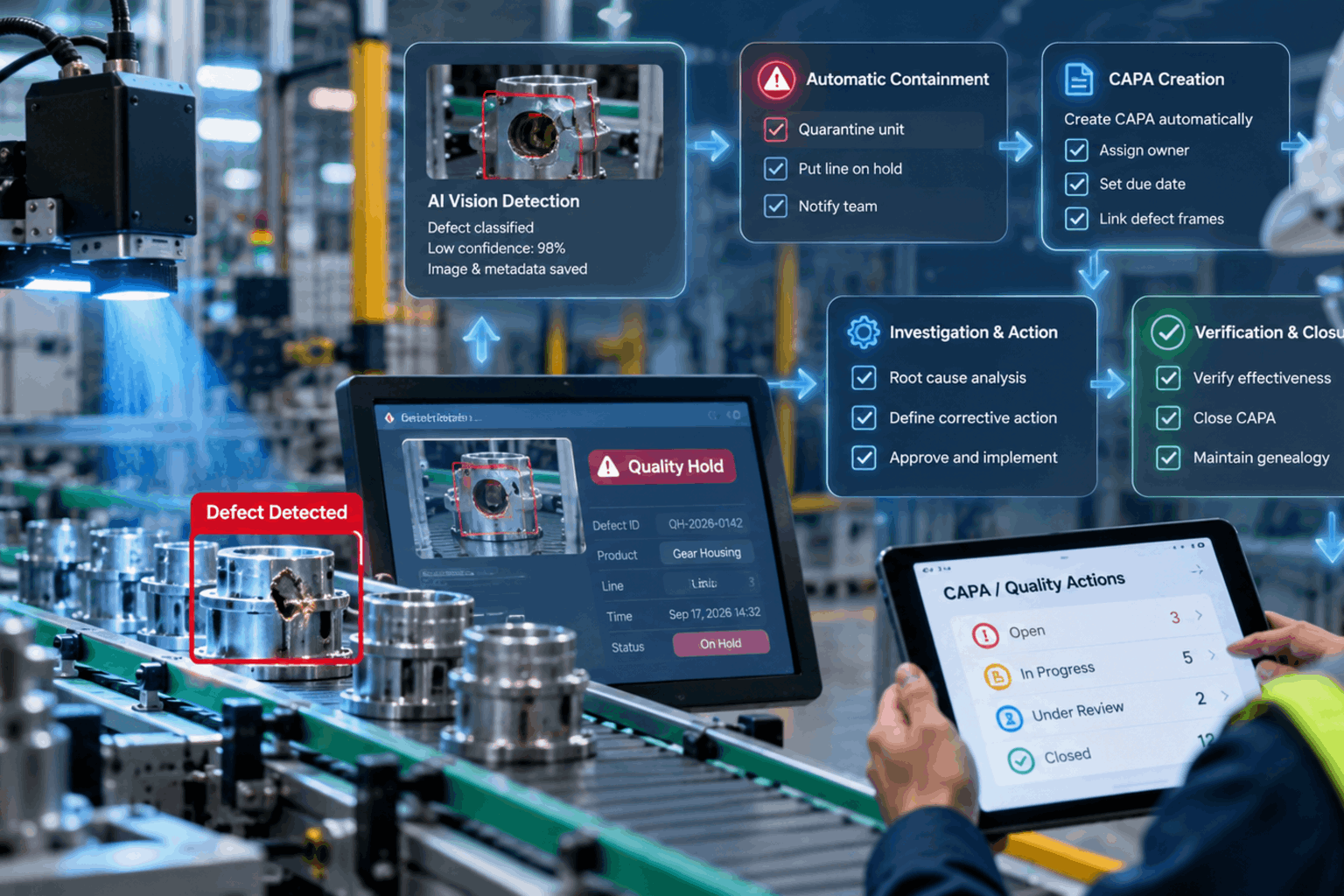
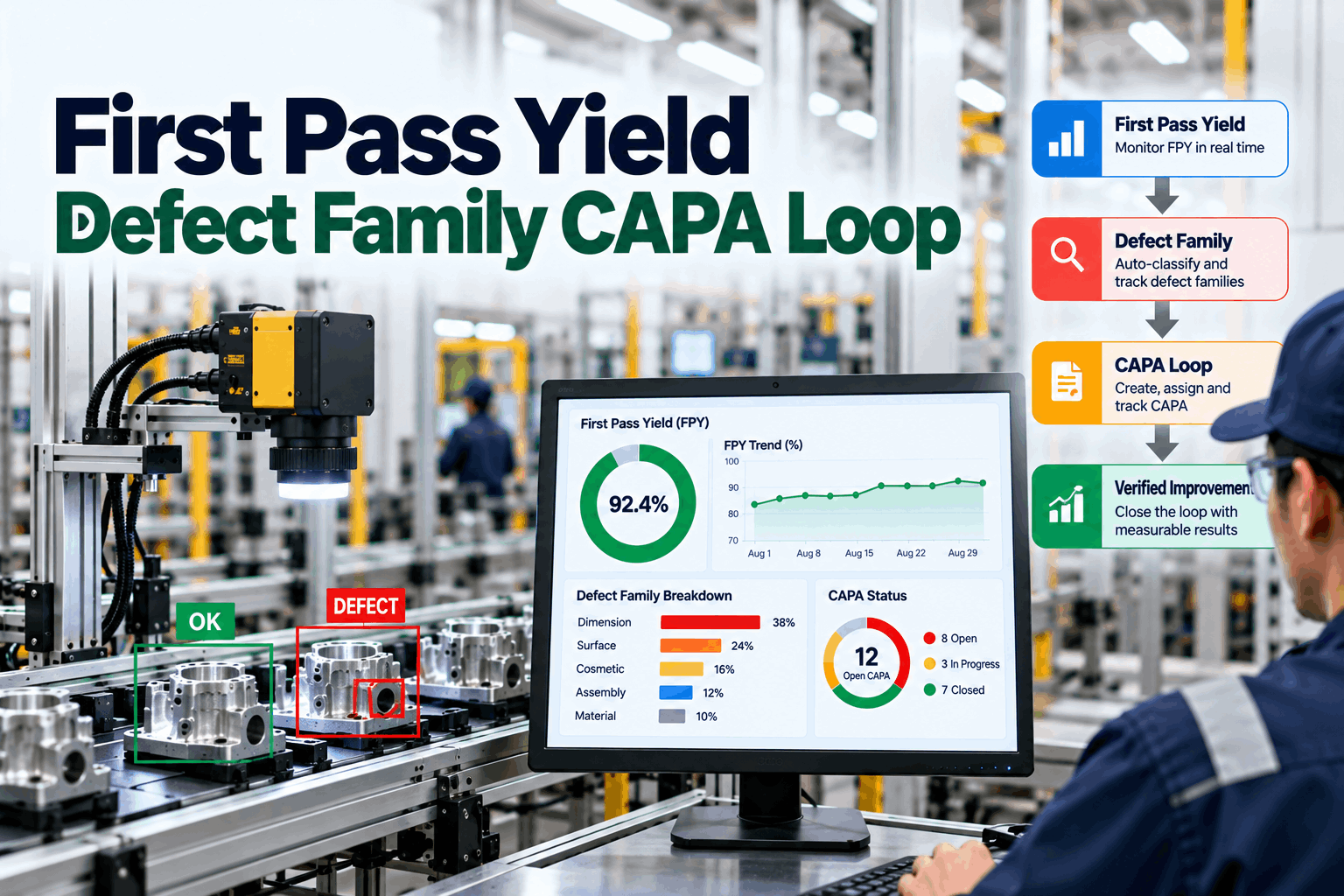
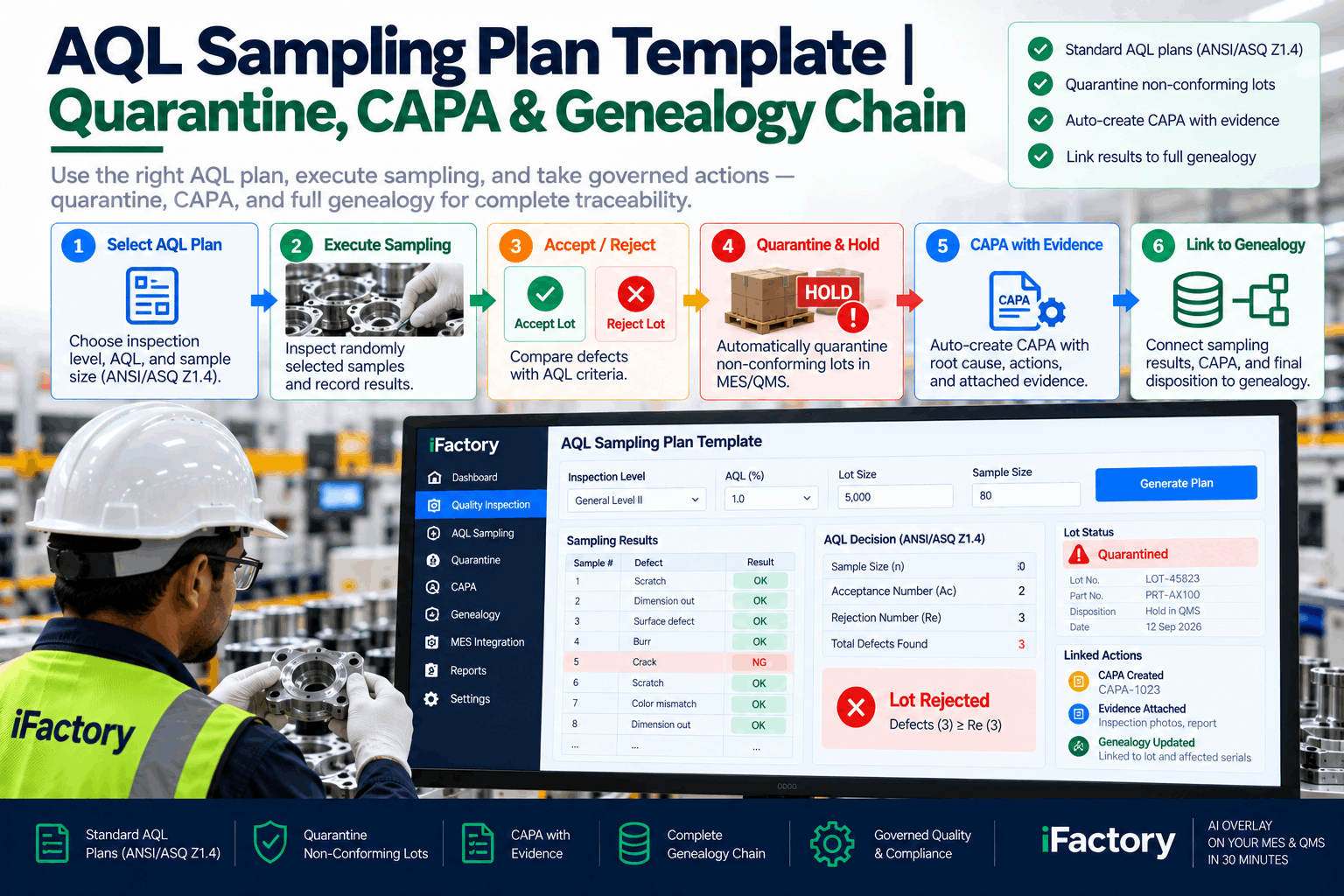
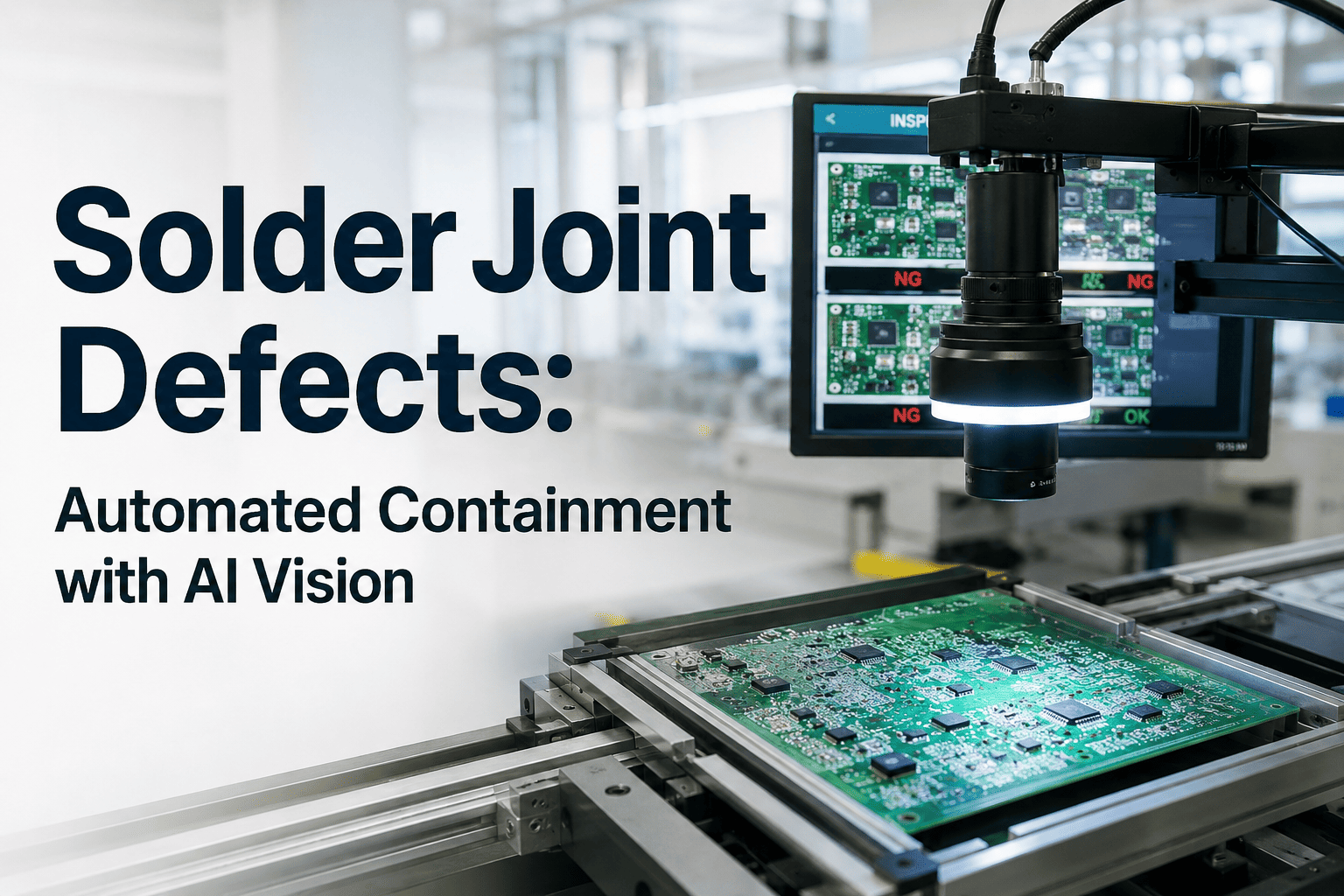
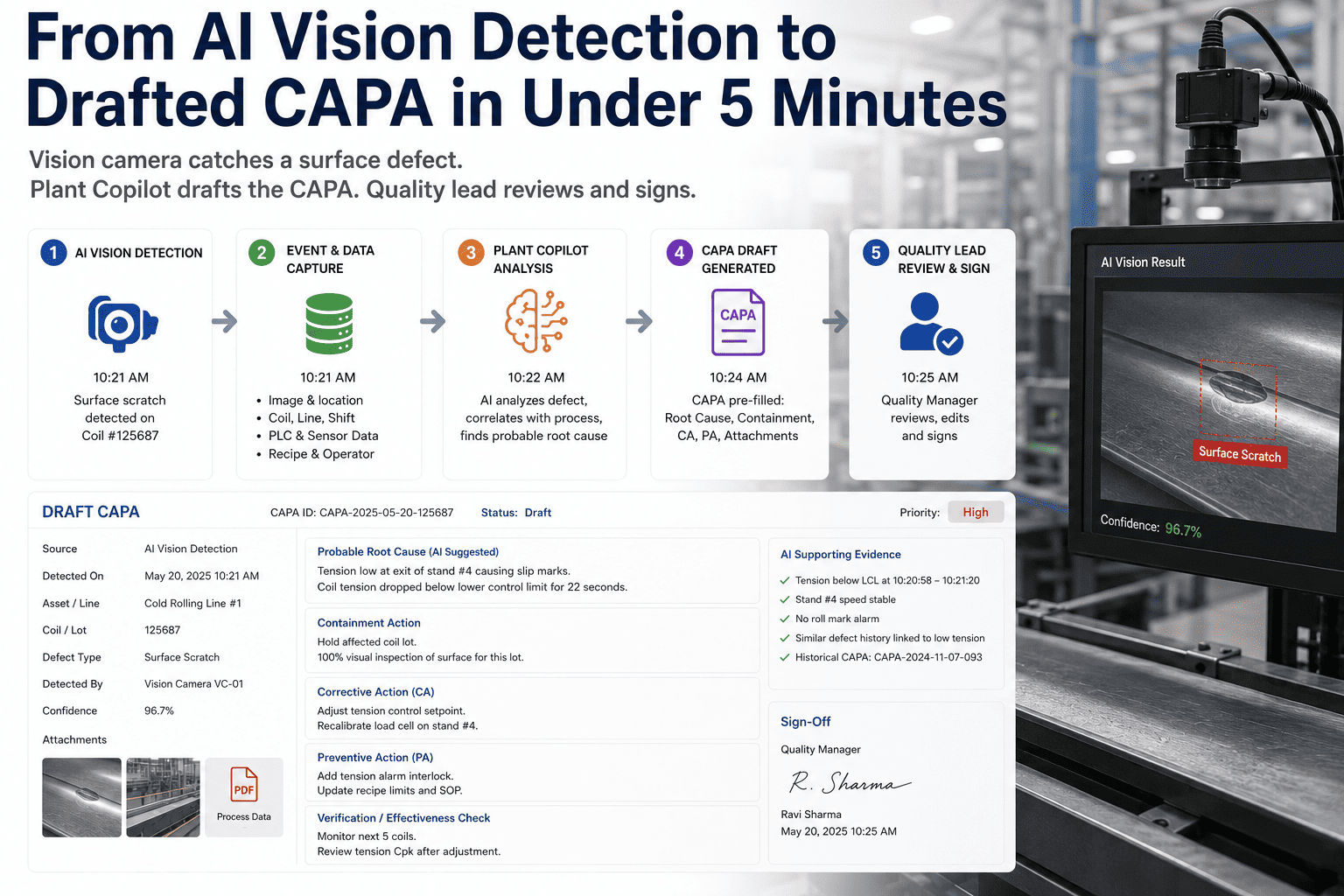
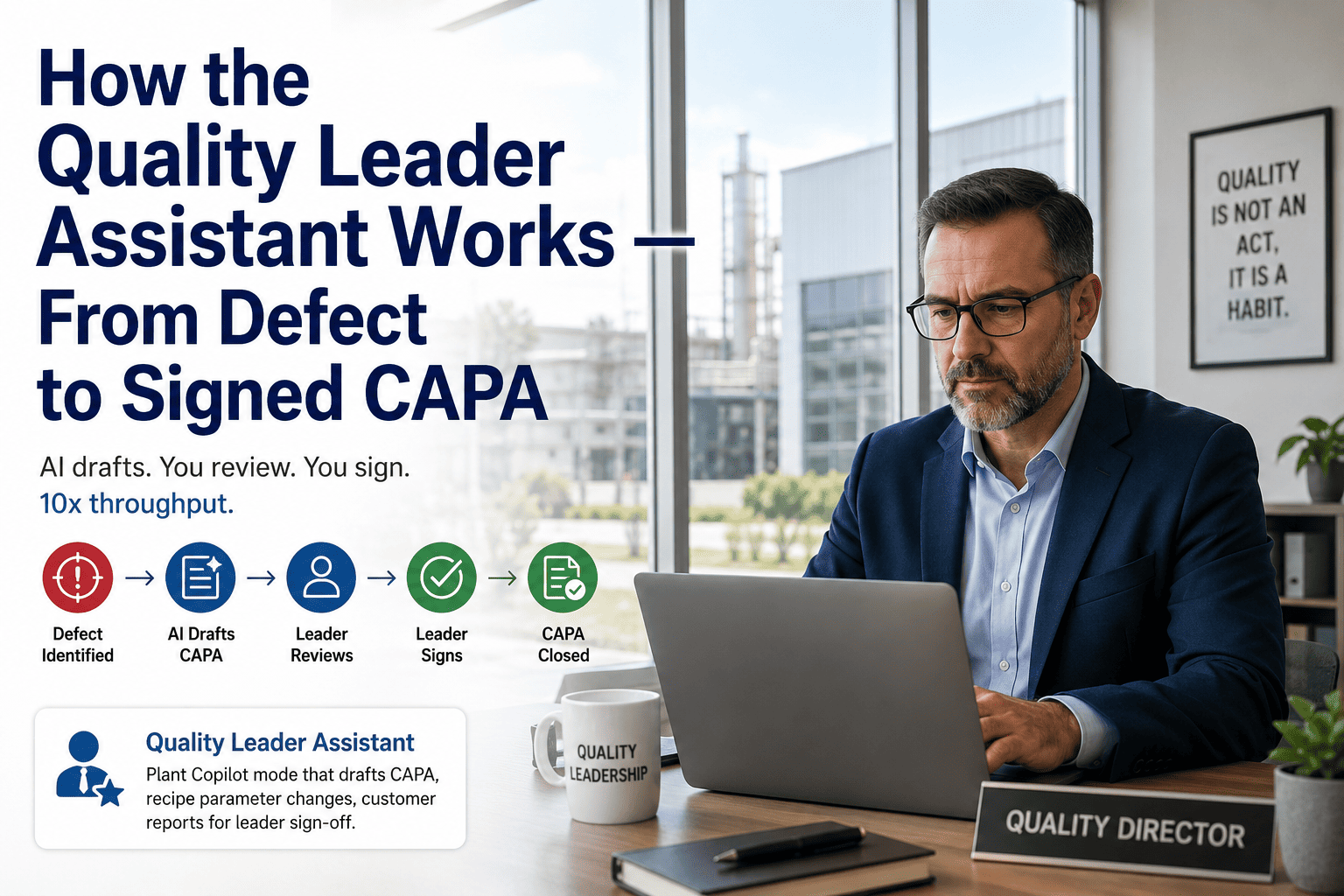
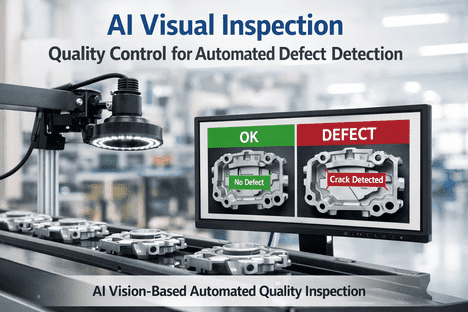
At 2:14 p.m., a live line keeps moving while a defect frame is flagged on the inspection screen and the hold decision is still pending. Every minute that passes adds hold lag, and that lag can let suspect product move farther downstream before the response is fully controlled. That is the pressure point this workflow refresh addresses. If a defect is visible but the lot is not yet quarantined, you do not have a closed-loop quality process — you have a delay between signal and action. iFactory AI converts that signal into quarantine, CAPA, verification, and genealogy without losing governance along the way — the result is not just faster detection, but a more reliable path from defect frame to verified corrective action. See the closed-loop workflow in a 30-minute walkthrough.
Signal → Quarantine → CAPA → Verify → Genealogy
From Defect Frame to Verified Corrective Action — In One Controlled Path
iFactory AI turns every AI vision detection into a governed CAPA response with owner assignment, approval routing, verification evidence, and full genealogy — while MES, QMS, SAP, SPC, and CMMS remain the systems of record.
2:14
The moment hold-lag starts costing you
5
Steps in the closed-loop CAPA path
1
Genealogy record per defect event
0
Email threads chasing hold status
At a Glance
01
Convert AI vision detections into a closed-loop CAPA path
02
Trigger defect frame review, quarantine, and hold actions fast
03
Preserve genealogy from unit, lot, batch, line, and shift
04
Assign owners, approvals, due dates, and reopen logic automatically
05
Support verification with follow-up inspection and recurrence checks
06
Keep quality records aligned with MES, QMS, SAP, SPC, and CMMS
Why Live Detection Must Connect to CAPA
AI vision is most useful when it identifies a defect in real time. But detection alone does not solve the quality problem. If the next steps live in email threads, spreadsheets, or disconnected quality records, the plant still loses time at the exact moment speed matters most. In practice, the workflow often breaks at the handoff points — and each break widens the gap between signal and containment.
→
The defect is seen — but hold is delayed
→
The lot is known — but genealogy is incomplete
→
Containment happens — but the CAPA owner is unclear
→
Corrective action is assigned — but approval is not tracked
→
Verification starts — but closure is not evidence-based
That is why the higher-value use case is not only AI vision. It is AI vision plus CAPA workflow, quarantine, genealogy, and verified corrective action in one controlled path. Book a demo to see the handoff points closed.
The Closed-Loop Path: Five Steps From Signal to Traceable Closure
A strong quality system needs a repeatable sequence. When iFactory AI supports that sequence, teams can move from defect frame to closure without losing control or traceability.
Detect the Defect Frame
The process starts with the image or frame that shows the defect. At this point, the record should capture the details quality teams need later. This is not just a pass/fail image — it is the beginning of a traceable quality event.
Timestamp
Line / Camera
Defect class
Operator / Shift
Work order / Lot
SKU
Quarantine and Hold the Affected Scope
Once the defect is confirmed, the workflow should support immediate containment — a hold recommendation, a quarantine action, or a review queue for the affected lot or batch. iFactory AI is useful as a workflow layer here: it triggers the response while leaving release authority, disposition, and final quality governance with the plant's existing process.
Suspect inventory scope
Affected unit location
Downstream pause
Containment reviewer
Draft the CAPA Automatically
The defect event should translate into a structured CAPA draft with the right fields already populated — reducing administrative burden without lowering standards. The quality team still reviews the record, edits the details, and approves the final path.
Problem statement
Containment action
Cause hypothesis
Corrective action
Preventive action
Owner + due date
Approval chain
Evidence attachments
Verify Corrective Action — And Allow Reopen Logic
Closure should not depend on form completion alone. A CAPA is only strong when the corrective action is verified. Verification can be tied to follow-up inspection evidence, recurrence checks, and reviewer signoff. If the defect returns, the record reopens with a clear reason and a visible history of what changed. Many plants discover the issue after the first "close" — reopen logic preserves the original defect frame, corrective action, verification result, and reopened status so the team can see the full decision trail.
Follow-up inspection
Recurrence check
Reviewer signoff
Reopen history
Preserve Genealogy End to End
Genealogy is the backbone of traceability. Without it, the quality record is incomplete. With it, teams can trace exactly what happened and where — from defect event to controlled audit trail.
Unit / lot / batch
Work order + route
Line + machine + station
Shift + operator
Hold + quarantine action
CAPA owner + approval
Verification evidence
Disposition + closure
Assignment · Approval · Reopen
The Difference Between a Digital Form and a Closed-Loop Quality Process
Owner routing by defect type. Approval logic matched to governance model. Reopen threads that keep genealogy intact instead of creating duplicate issues. Those workflow details are not cosmetic — they are what makes iFactory AI a control layer rather than another dashboard.
Implementation Detail: Assignment, Approval, and Reopen Flow
When plants ask how this works in practice, the answer is usually in the workflow rules. iFactory AI supports the decision logic that makes each handoff automatic.
Rule 01
Owner Assignment by Defect Signature
Owner assignment should be based on defect type, line, product family, or severity. An appearance defect may route to quality engineering, while a recurring equipment-related issue may route to maintenance and quality together. iFactory AI supports that decision logic so the task lands with the right person first, not after multiple manual handoffs.
Rule 02
Approval Logic Matched to Governance
A low-risk containment action may require one quality approval, while a high-severity event may require quality, operations, and engineering signoff before release. The system keeps each approval visible so there is no confusion about who accepted what and when.
Rule 03
Explicit Reopen Logic Preserves History
If verification fails, if recurrence is detected, or if evidence is incomplete, the record reopens to the same CAPA thread instead of creating a duplicate. That keeps the genealogy intact and prevents teams from losing the history of the original defect.
What You Will See in a 30-Minute Demo
A focused demo helps quality, operations, and engineering teams see the workflow without guesswork. In 30 minutes, you can walk through how a defect frame becomes a governed response.
01
Defect Frame Detection
A defect frame detected by AI vision on a live inspection feed.
02
Quarantine / Hold Action
A quarantine or hold action triggered from that event with scope defined.
03
CAPA Drafting with Genealogy
CAPA drafting with genealogy already attached and fields pre-populated.
04
Owner + Approval Routing
Owner assignment, approval, and due date routing based on your rules.
05
Verification + Reopen Logic
Verification evidence capture and reopen logic if the fix does not hold.
06
Enterprise Integration Points
Integration points with MES, QMS, SAP, SPC, or CMMS in your stack.
Book your 30-minute walkthrough.
Why Closed-Loop CAPA Matters More Than Faster Detection
The real benefit of automation is not speed in isolation. It is controlled speed. When the defect frame, quarantine decision, and CAPA record live together, teams spend less time reconstructing the event later.
Better Containment
If a defect event triggers a hold recommendation quickly, the plant reduces the time between discovery and containment.
Better Documentation
When the defect frame, quarantine decision, and CAPA record live together, teams spend less time reconstructing the event later.
Better Accountability
Owner assignment, due dates, and approval steps are visible in one flow, which makes responsibility clearer and follow-up more reliable.
Better Recurrence Control
If the same issue reappears, iFactory AI helps quality teams compare the new event to the original CAPA and decide whether the fix really held.
Better Traceability
Genealogy keeps the record audit-ready. That matters for internal review, customer questions, and recall readiness.
Better Enterprise Fit
The workflow layer respects MES, QMS, SAP, SPC, and CMMS as systems of record instead of replacing them — reducing change management risk.
How iFactory AI Fits Into the Enterprise Stack
Most plants do not want another isolated tool. They want a workflow layer that respects the systems already in place. iFactory AI is designed to connect those steps without replacing your existing control plan.
MES & QMS
Systems of Record Stay in Control
MES and QMS often remain the system of record for production and quality events. iFactory AI sits beside them to orchestrate response when a vision event needs to become a hold, a CAPA, or a verification task.
SAP & Governed Deployment
Enterprise Controls Respected
For plants with stricter deployment and security requirements, integration and architecture matter. SAP integration and on-prem AI context can be important when the quality workflow must fit enterprise controls.
CMMS + Equipment Root Causes
Maintenance Loop Stays Connected
Not every defect comes from material or operator variation. Some issues trace back to maintenance, calibration, or equipment condition. CAPA needs a path into maintenance work management — so quality and CMMS workflows stay connected.
Trust, Governance, and Quality Discipline
This refresh is built for teams that care about compliance and accountability. The goal is not to automate judgment away — it is to make the response more reliable.
✓
Human review still matters
✓
Control plans still govern release and disposition
✓
SPC, FAI, PPAP, and inspection standards still apply
✓
Quality engineering still owns final decisions
✓
Verification still has to prove effectiveness
✓
Every step leaves an auditable record
That is the real advantage of iFactory AI: faster movement from defect detection to corrected process, without weakening the discipline that quality systems require.
Frequently Asked Questions
Q1What does AI vision to CAPA workflow mean?
It means a defect detected by AI vision is automatically turned into a structured quality response, including hold, quarantine, assignment, approval, verification, and closure. Every step leaves an auditable record tied back to the original defect frame.
Walk through the workflow live.
Q2Does iFactory AI replace MES or QMS?
No. iFactory AI works beside MES and QMS as a workflow layer. It helps connect the defect event to the right response without replacing system-of-record controls, so your governance model stays intact.
See the integration points in a demo.
Q3How does quarantine work in the workflow?
The defect event can trigger a hold or quarantine recommendation for the affected lot, batch, or work order so quality teams can contain suspect product quickly. Scope is defined by defect signature so containment stays narrow instead of stopping the whole line.
See scoped quarantine in action.
Q4Why is genealogy important?
Genealogy ties the defect to the exact product, process, and production context. That makes containment, audit readiness, and corrective action verification much stronger — and reduces the time spent reconstructing the event later.
Review a real genealogy trail with our team.
Q5Can the workflow reopen a CAPA if the fix does not hold?
Yes. If verification fails or the defect recurs, the record reopens so the team can preserve the original history and continue the corrective action thread — instead of losing the story to a duplicate ticket.
See reopen logic walked through live.
Close the Loop
Turn Live Defect Detection Into Verified Corrective Action — Not Just Another Alert
The value is in the closed loop: signal, quarantine, assign, approve, verify, and keep genealogy intact. iFactory AI is built for that workflow — sitting beside your MES, QMS, SAP, SPC, and CMMS to strengthen governance instead of replacing it.
5-Step Closed Loop
Auto-Populated CAPA
Reopen History Preserved
Full Genealogy Trail
MES / QMS / SAP Native