AI vs Human Inspector Agreement Study for Quality

By James Smith on August 3, 2026

ai-vs-human-inspector-agreement-study-quality

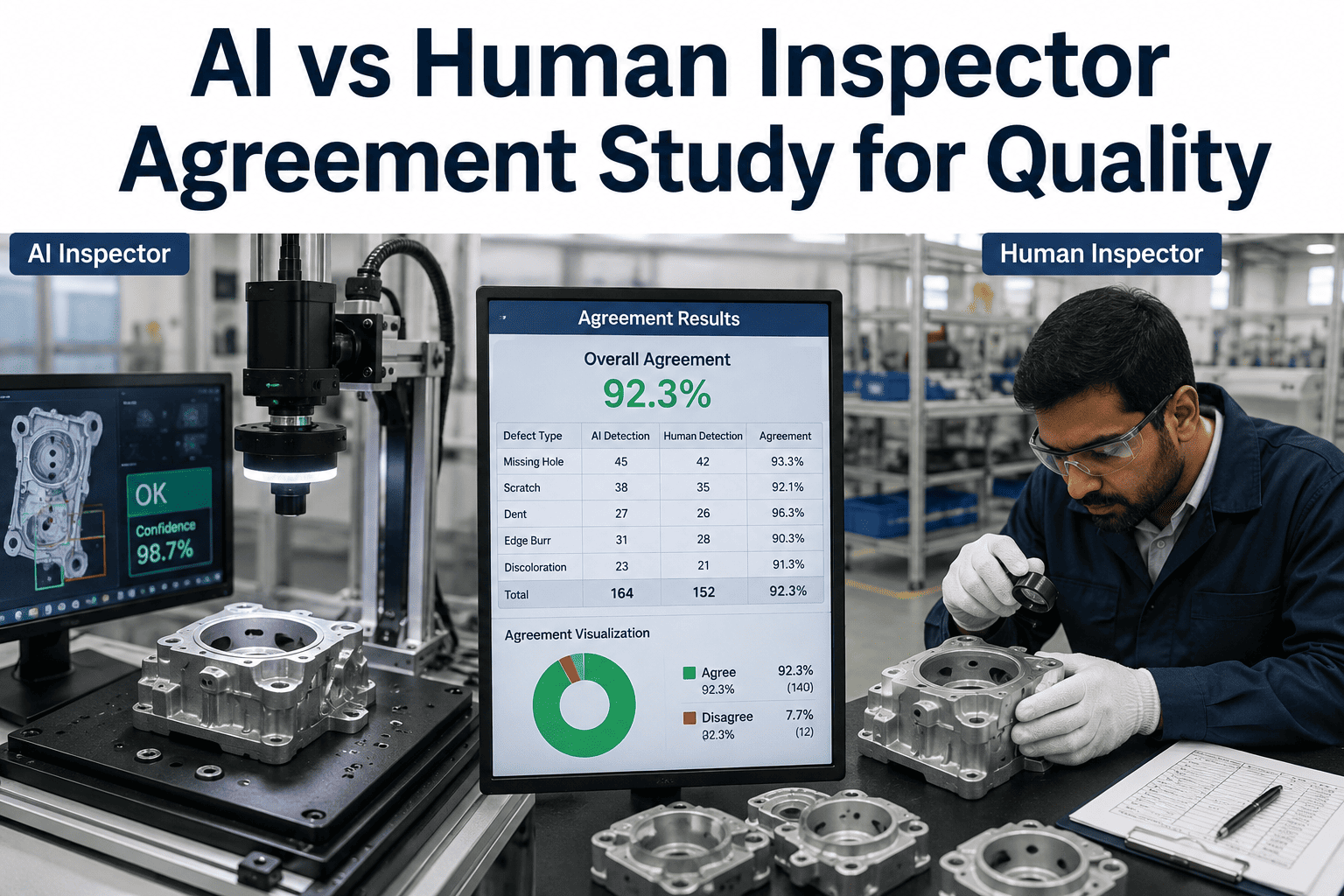
Before any quality team hands inspection authority to a camera, someone reasonably asks whether it actually agrees with the human inspectors it's meant to work alongside. That question deserves a real answer, not a vendor claim, and the honest way to get one is a structured agreement study — running the AI model and the current inspection team against the same set of parts and measuring where they align, where they diverge, and which of the two is actually closer to ground truth when they disagree. A demo can walk through how an agreement study is typically structured before a cutover.

Quality Validation
Quantify Agreement Before You Trust a Camera Over a Person
iFactory helps plants run a structured AI-vs-human inspection agreement study, feeding unit-level results into live SPC with automated root cause on any disagreement.

Why "It Looked Right on the Demo" Isn't Good Enough

A vendor demo is built to show a model performing well on a curated set of parts, and that's a reasonable thing for a demo to do, but it's a poor substitute for evidence that the model will perform consistently on the actual, messy variation your production line produces day to day. Real production parts include lighting variation across shifts, material lot differences, tool wear drift, and the occasional genuinely ambiguous defect that even two experienced human inspectors would disagree about. A model that hasn't been tested against that real variability, side by side with your current inspectors, is an unproven assumption wearing the confidence of a finished product.

The instinct to trust human judgment over a new AI system by default is understandable, but it's worth remembering that human inspectors themselves aren't perfectly consistent, even with each other. Inter-rater reliability studies in visual inspection tasks across many industries have repeatedly found that two trained human inspectors looking at the same part don't always agree, particularly for borderline or subjective defect calls. An agreement study isn't just about proving the AI is good enough — it's about establishing what "good enough" actually means for your specific process, using your own inspectors as the baseline.

Structuring an Agreement Study

01
Assemble a Test Set
Pull a representative sample of real parts, including known good units, known defective units, and genuinely borderline cases from actual production history.
02
Independent Human Review
Multiple experienced inspectors review the same test set independently, without seeing each other's calls or the AI's output, establishing a human baseline.
03
AI Model Scoring
The trained model scores the identical test set under the same conditions, producing a pass/fail or defect classification for every unit.
04
Agreement Analysis
Results are compared across all three data sets — human-to-human, human-to-AI, and AI-to-established ground truth where it exists — to quantify real agreement levels.

What the Comparison Usually Reveals

Human-to-Human Variation
Establishes the baseline disagreement rate that already exists between trained inspectors, which sets realistic expectations for what "perfect" agreement would even look like.
AI Consistency
The same model scores the same part the same way every time, removing the shift-to-shift and fatigue-related variation inherent in human inspection.
Borderline Case Handling
Genuinely ambiguous defects are where the most valuable insight usually comes from, showing whether the model's confidence threshold aligns with how your team actually treats edge cases.
False Reject and False Pass Rates
Quantifies specifically where the AI over-rejects good parts or under-catches genuine defects relative to the established human baseline.

Turning Disagreement Into Root Cause Instead of a Dead End

A disagreement between the AI and a human inspector isn't automatically a model failure — it's a data point that needs investigation, and treating it that way is what separates a useful agreement study from a simple accuracy score. When a unit-level disagreement is fed into a live SPC system alongside machine parameters, material lot, and inspection timestamp, it becomes possible to trace back whether the disagreement traces to a genuine model blind spot, an inconsistent human call, or an edge case neither side was well-calibrated to handle in the first place.

This matters because the goal of an agreement study isn't to declare a winner between AI and human judgment — it's to establish where each is more reliable, so the eventual inspection workflow can lean on whichever is stronger for a given defect type. Some defect categories are visually unambiguous and well suited to full AI automation from day one. Others remain genuinely subjective enough that human review stays in the loop, with the AI handling first-pass screening and flagging only the parts that warrant a closer human look.

3-Way
comparison across human-to-human, human-to-AI, and AI-to-ground-truth agreement
0
shift-to-shift consistency drift in the AI model's scoring once trained and validated
Unit-Level
disagreement data traced automatically back to likely root cause
Prove It Before You Trust It
Run an Agreement Study Against Your Own Inspectors and Parts
See exactly where a trained model agrees with your current team, and where the disagreement is worth a closer look.

A Realistic Cutover Sequence Once Agreement Is Established

1
Run the AI in shadow mode alongside full human inspection for an agreed period, comparing every call without letting the AI make any live reject decisions yet.
2
Review the shadow-mode agreement data against the thresholds established in the initial study, adjusting model confidence thresholds where needed.
3
Move to AI-led inspection with human spot-checks on a defined sampling rate, rather than a full switch on day one.
4
Reduce the human spot-check rate gradually as ongoing agreement data continues to confirm the model's reliability over time.

Frequently Asked Questions

How long does a proper agreement study typically take?
It depends on part volume and defect variety, but a study needs enough parts across enough defect categories to be statistically meaningful, which usually means several hundred to a few thousand units reviewed independently by both the model and multiple human inspectors. Rushing this stage undermines the entire point of the exercise, since a small or unrepresentative test set won't reveal how the model performs on real production variation.
What if our own inspectors don't agree with each other on some parts?
That's a normal and expected finding, not a sign the study failed. Establishing the existing human-to-human disagreement rate is itself valuable, since it sets a realistic ceiling for what "perfect" AI agreement would even mean — a model can't reasonably be expected to agree more consistently with humans than humans agree with each other on genuinely ambiguous parts. Support can help interpret what a given disagreement rate means for your specific process.
Does a lower agreement score always mean the AI is wrong?
No, in some cases the AI is actually catching a genuine defect that a fatigued or rushed human inspector missed, which is precisely why the comparison needs a ground truth reference wherever one is available — such as a destructive test, a lab confirmation, or a downstream field outcome — rather than relying solely on the human call as the assumed correct answer.
Can the study be run without disrupting current production inspection?
Yes, the typical approach runs the AI model in a shadow, non-decision-making mode alongside the existing inspection process, so current production inspection continues unaffected while the comparison data is collected in parallel.
What happens to agreement tracking after the initial cutover is complete?
Ongoing agreement tracking typically continues at a reduced sampling rate even after full cutover, since process changes, new part variants, or material changes over time can shift what the model encounters relative to its original training set. Continuous low-level tracking catches that drift before it becomes a quality gap. A demo can show how ongoing agreement monitoring is typically configured.

Reading an Agreement Study Result the Right Way

A common mistake once study results come back is fixating on a single overall agreement percentage as though it's a pass or fail grade for the whole model. A more useful read breaks the result down by defect category, since a model can show excellent agreement on clearly visible, high-contrast defects while showing weaker agreement on a genuinely subtle or rare defect type that appeared only a handful of times in the test set. Treating those two situations the same, as one blended number, hides exactly the information a quality team needs to decide where the model is ready today and where it needs more training data before it can be trusted unsupervised.

It's also worth reading the disagreement cases individually rather than only looking at the summary statistics. A disagreement on a part that turns out to have a genuinely borderline defect, where reasonable inspectors could differ, carries a very different implication than a disagreement on a part that's unambiguously good or unambiguously bad. The former suggests the model's confidence threshold may need calibration against your team's own tolerance for borderline calls; the latter suggests an actual gap in the model's training data that needs to be closed before the cutover moves forward.

What Ongoing Monitoring Looks Like After Cutover

Monitoring ActivityPurpose
Periodic spot-check samplingConfirms the model's live performance continues to match the validated study results over time
New part variant validationEnsures a newly introduced part number or material change is covered before it goes fully unsupervised
Drift alertingFlags when the model's confidence distribution shifts meaningfully from its original baseline, a sign something in the process changed
Disagreement review cadenceKeeps a standing process for reviewing any flagged disagreement rather than letting exceptions pile up unreviewed
Make the Decision With Data, Not a Guess
Get a Structured Agreement Study Before Your Cutover
See exactly how a trained model compares to your current inspection team on your own parts, before you change anything on the line.

Share This Story, Choose Your Platform!